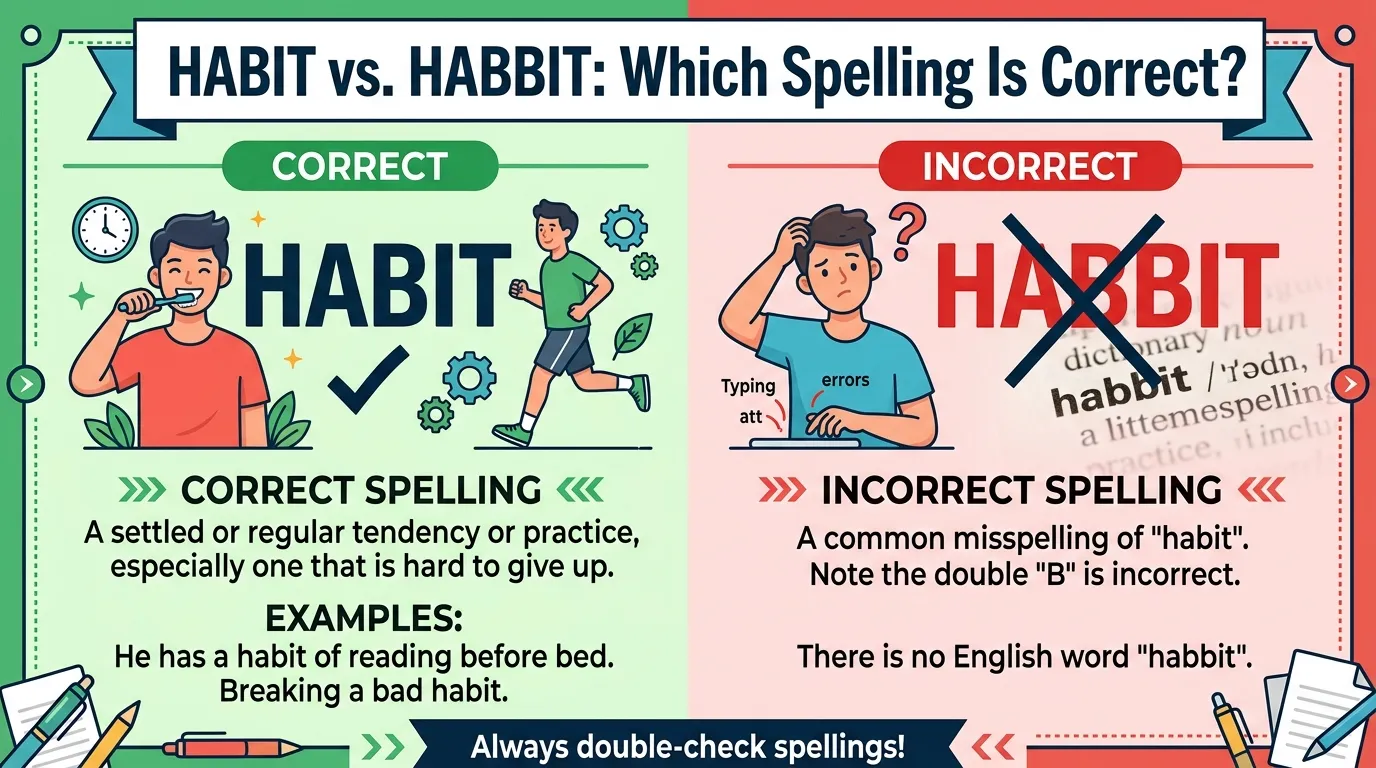
If you have ever typed “habbit” instead of “habit,” you are not alone. The spelling habit vs habbit is a common source of confusion because both versions look plausible at first glance. However, there is an important difference: habit is the correct English spelling, while habbit is a misspelling.
The correct word is habit. It refers to something a person does regularly, often without having to think about it. For example, “Reading before bed is a good habit.” The word can describe everyday routines, repeated behaviors, personal tendencies, and established patterns.
Habbit, on the other hand, is not a standard English spelling of this word. You may occasionally see it in informal messages, social media posts, comments, or user-generated content, but it should not be used in standard American English or formal writing.
In this guide, you will learn the difference between habit and habbit, why people confuse the spellings, how to pronounce habit, where the word came from, how to use it naturally, and which related words and expressions are worth knowing. You will also see common mistakes, memory tricks, examples, and answers to frequently asked questions.
Quick Answer: Habit vs Habbit
Habit is the correct spelling.
Habbit is a misspelling and should generally be avoided.
| Word | Correct? | Meaning | Example |
|---|---|---|---|
| habit | ✅ Yes | A repeated behavior or routine | Exercise is a healthy habit. |
| habbit | ❌ No | Incorrect spelling of habit | I need to break this habbit. |
The safest rule is simple:
Always write “habit,” with only one B.
For example:
- Correct: She has a habit of checking her phone.
- Incorrect: She has a habbit of checking her phone.
What Does Habit Mean?
The noun habit generally means a behavior or action that someone repeats regularly and often automatically.
A habit can be positive, negative, neutral, personal, social, physical, or mental.
Dictionary-Style Definition of Habit
Habit (noun): a regular or repeated behavior, action, or tendency that becomes established through repetition.
Examples include:
- Drinking coffee every morning
- Brushing your teeth before bed
- Checking email after waking up
- Exercising several times a week
- Biting your nails when nervous
- Reading before sleeping
- Saying “thank you” automatically
- Taking the same route to work
The important idea is repetition.
When something happens repeatedly and becomes a regular part of someone’s behavior, it can become a habit.
Habit in a Sentence
Here are some natural examples:
- Waking up early is a habit I developed in college.
- He has a habit of arriving early.
- Reading every night is one of her favorite habits.
- I am trying to break my habit of checking social media.
- Drinking enough water is a healthy habit.
Is “Habbit” a Correct Word?
No. Habbit is not the standard spelling of the English word habit.
If you are writing an email, school assignment, article, business document, resume, report, or professional message, use habit.
The spelling habbit usually occurs because people mistakenly double the b. English contains many words with double consonants, so the incorrect version can look natural.
For example:
- rabbit
- hobby
- cabbage
- rubber
- bubble
Because these words contain double letters, writers may incorrectly assume that habit should also contain bb.
It does not.
Correct
habit
Incorrect
habbit
There is no standard English word spelled habbit that means a repeated behavior.
Why Do People Confuse Habit and Habbit?
The confusion mainly comes from spelling patterns, pronunciation, and visual similarity.
1. The Double-B Pattern
People may associate the sound or appearance of habit with words such as rabbit or hobby.
Compare:
- rabbit
- hobby
- habit
The first two contain bb, but habit contains only one b.
2. Pronunciation Can Be Misleading
In normal speech, the difference between one consonant and a doubled consonant is not obvious in English spelling.
You hear the word habit, but you do not hear the letter count.
Therefore, someone who has learned the word mainly through conversation may accidentally spell it habbit.
3. Fast Typing
Typing quickly can also produce habbit. People often double a letter accidentally, especially when typing on phones or keyboards.
4. Visual Familiarity
If someone has seen words such as rabbit, hobby, and habit together, the incorrect spelling may look familiar even though it is not correct.
Habit: Meaning, Pronunciation, and Grammar
Understanding the grammatical role of habit makes it easier to use correctly.
Pronunciation of Habit
In American English, habit is commonly pronounced approximately like:
HAB-it
The first syllable receives the main stress.
The word has two syllables:
hab-it
The spelling does not require a second b.
Grammatical Role
Habit is primarily a noun.
Examples:
- Exercise is a good habit.
- He has an unusual habit.
- She developed a reading habit.
The plural form is:
habits
Example:
- Healthy habits can improve your daily routine.
Common Forms
| Form | Example |
|---|---|
| habit | This is a bad habit. |
| habits | Healthy habits take time to develop. |
| habitual | His habitual lateness caused problems. |
| habitually | She habitually checks her phone. |
Habit vs Habbit: Key Differences
There is actually no meaning difference between the two spellings because habbit is not the accepted spelling of this word.
The real distinction is correctness.
| Feature | Habit | Habbit |
|---|---|---|
| Standard spelling | Yes | No |
| Standard English | Yes | No |
| Common dictionary word | Yes | No |
| Means repeated behavior | Yes | Intended meaning only |
| Appropriate for formal writing | Yes | No |
| Appropriate for academic writing | Yes | No |
| Used in casual typing as a mistake | Sometimes | Yes |
| Recommended spelling | ✅ | ❌ |
If you are unsure, choose habit.
Examples of Habit in Everyday English
The word habit appears in many ordinary situations.
Personal Habits
- I have a habit of making lists.
- She developed a habit of walking after dinner.
- His habit of interrupting people can be distracting.
Healthy Habits
- Eating vegetables is a healthy habit.
- Regular exercise is an important habit.
- Getting enough sleep is a good habit.
Bad Habits
- I am trying to break my habit of staying up late.
- Smoking is a harmful habit.
- He has a bad habit of procrastinating.
Work Habits
- Good work habits can improve productivity.
- Her habit of checking every detail makes her work reliable.
- The company encourages efficient work habits.
Study Habits
- Good study habits can make learning easier.
- Students often develop different study habits.
- Reading regularly is a useful study habit.
Habit vs Routine: Are They the Same?
Habit and routine are related, but they are not exactly the same.
A routine is a regular sequence or pattern of activities.
A habit is a behavior that has become established through repetition.
For example:
My morning routine includes breakfast, exercise, and reading.
Within that routine, you might have a habit:
Drinking water immediately after waking up is one of my habits.
A routine is often more structured, while a habit can be a single repeated behavior.
Compare These Examples
- My morning routine starts at 6 a.m.
- Checking my phone first thing in the morning is a habit.
Both words describe repetition, but they focus on slightly different ideas.
Habit vs Practice
Practice can mean something done repeatedly to improve a skill or maintain a standard.
For example:
- Daily writing practice improves your skills.
- Backing up files regularly is good practice.
A habit, however, focuses more on repeated behavior.
Compare:
- She practices the piano every day.
- She has a habit of practicing the piano after dinner.
The first sentence emphasizes an activity designed to improve a skill. The second emphasizes the repeated pattern.
Habit vs Custom
Custom usually refers to a traditional or socially established way of behaving.
For example:
- It is a local custom to greet guests warmly.
- The tradition has been part of the community for generations.
A habit is usually more personal or behavioral.
Compare:
- He has a habit of drinking tea in the afternoon.
- Serving tea to guests is a local custom.
Common Collocations With Habit
A collocation is a group of words that naturally occur together.
Knowing common collocations can help you sound more natural in English.
Common Habit Collocations
- good habit
- bad habit
- healthy habit
- unhealthy habit
- daily habit
- regular habit
- personal habit
- old habit
- lifelong habit
- study habit
- eating habit
- sleeping habit
- work habit
- habit of doing something
- develop a habit
- form a habit
- build a habit
- create a habit
- break a habit
- change a habit
- maintain a habit
- get into a habit
- fall into a habit
Examples
- Reading has become a daily habit.
- He is trying to break a bad habit.
- She developed the habit of planning her day the night before.
- It takes time to build a new habit.
- I fell into the habit of working late.
Common Expressions With Habit
Several English expressions use the word habit.
“Creature of Habit”
A creature of habit is someone who strongly prefers familiar routines and patterns.
Example:
My father is a creature of habit; he eats breakfast at exactly the same time every morning.
“Old Habits Die Hard”
This expression means that established behaviors can be difficult to change.
Example:
I stopped staying up late, but old habits die hard.
“Kick the Habit”
To kick the habit means to stop an unwanted or unhealthy behavior.
Example:
He decided to kick the habit of checking his phone constantly.
This expression is informal and often used when discussing a difficult behavior to stop.
“By Habit”
This means doing something because it has become automatic or customary.
Example:
She reached for her phone by habit.
Habit in Formal and Informal Writing
The word habit works well in almost every style of English.
Academic Writing
Use habit when discussing repeated behavior, routines, learning, psychology, or social patterns.
Example:
Regular reading can become a productive study habit.
Business Writing
Example:
Effective time-management habits can improve workplace productivity.
Journalistic Writing
Example:
The report examines changing spending habits among younger consumers.
Technical Writing
The word may be used when describing repeated user behavior or established operational practices.
Example:
The software records common usage habits to improve the user experience.
Blogging
Example:
Five simple habits can make your morning more productive.
Casual Conversation
Example:
I have a bad habit of forgetting where I put my keys.
The word is flexible enough for both casual and formal contexts.
Regional Variations: American vs British English
The spelling habit is standard in both American and British English.
There is no major regional spelling difference between the United States and the United Kingdom.
| Variety | Correct Spelling |
|---|---|
| American English | habit |
| British English | habit |
| Canadian English | habit |
| Australian English | habit |
| International English | habit |
So you do not need to change the spelling based on your audience.
Whether you are writing for an American website, British publication, international audience, or academic reader, habit is the standard choice.
The History and Etymology of Habit
The word habit has a long history in English and ultimately comes from Latin.
It is related to the Latin word habitus, which referred to a condition, appearance, character, or manner of being. This is connected to the Latin verb habere, meaning “to have” or “to hold.”
The word entered English through historical developments involving French and Latin and gradually developed meanings related to a person’s customary behavior.
Interestingly, habit has also been associated historically with clothing or dress, especially a distinctive style of clothing. That older sense still appears in certain contexts, such as religious or institutional dress.
Today, however, the most common meaning is a regular behavior or established tendency.
The important spelling point remains unchanged: modern English spells the behavioral noun habit, not habbit.
Synonyms for Habit
The best synonym depends on context.
Common Synonyms
- routine
- practice
- behavior
- pattern
- tendency
- custom
- practice
- inclination
- mannerism
- ritual
These words are related but are not always interchangeable.
For example:
“Checking email every morning is a habit.”
Possible alternatives include:
- Checking email every morning is a routine.
- Checking email every morning is a regular practice.
- Checking email every morning is a pattern of behavior.
However, each alternative emphasizes a slightly different idea.
Habit vs Tendency
A tendency is something someone is likely to do, but it does not necessarily happen regularly.
Example:
He has a tendency to worry.
A habit suggests repeated behavior.
Example:
He has a habit of checking the door twice.
Antonyms and Opposite Ideas
There is no single perfect antonym for habit in every context.
Depending on what you mean, possible contrasting ideas include:
- spontaneity
- irregularity
- unpredictability
- novelty
- change
- inconsistency
For example:
She prefers routine rather than spontaneity.
Or:
His behavior is unpredictable rather than habitual.
Related Words
Several English words are closely related to habit.
Habitual
Habitual means something done regularly or repeatedly.
Example:
His habitual lateness became a problem.
Habitually
Habitually is an adverb meaning regularly or as a matter of habit.
Example:
She habitually arrives early.
Habituation
Habituation refers to becoming accustomed to something through repeated exposure.
Example:
Repeated exposure can lead to habituation.
Habit-forming
Habit-forming describes something that can lead to repeated use or behavior.
Example:
The activity can become habit-forming.
Common Mistakes With Habit
Mistake 1: Adding a Second B
❌ Reading is a good habbit.
✅ Reading is a good habit.
Mistake 2: Using Habbit in Formal Writing
❌ The study examined students’ study habbits.
✅ The study examined students’ study habits.
Mistake 3: Confusing Habit With Routine
❌ My habit includes breakfast, exercise, and commuting.
This may sound awkward if you mean the complete sequence of activities.
Better:
✅ My morning routine includes breakfast, exercise, and commuting.
But:
✅ I have a habit of exercising every morning.
Mistake 4: Incorrect Plural Spelling
❌ healthy habbits
✅ healthy habits
The plural is created by adding -s to habit:
habit → habits
Awkward vs Natural Examples
| Awkward or Incorrect | Natural Version |
|---|---|
| I have a bad habbit. | I have a bad habit. |
| She has many good habbits. | She has many good habits. |
| This is my daily habbit. | This is my daily habit. |
| He is a creature of habbit. | He is a creature of habit. |
| I want to change this habbit. | I want to change this habit. |
| Good habbits help students. | Good habits help students. |
Memory Tricks: How to Remember “Habit”
If you frequently write habbit, use a simple memory trick.
Trick 1: One B in Habit
Think:
Habit has one B.
Say it to yourself when writing the word.
Trick 2: Compare It With “Habitual”
Look at the related word:
habit → habitual
The spelling makes the single b easier to remember.
Trick 3: Remember the Short Form
Think of:
HAB + IT
There is only one B.
Trick 4: Rabbit Is Not Habit
This is a useful visual comparison:
- rabbit = double B
- habit = single B
They may look similar, but their spelling patterns are different.
How to Use Habit Correctly in a Sentence
The most common structure is:
have a habit of + -ing verb
Examples:
- I have a habit of checking my email early.
- She has a habit of speaking quickly.
- He has a habit of leaving his keys on the table.
Another common structure is:
develop/form/build a habit of + -ing
Examples:
- She developed a habit of exercising after work.
- He formed a habit of reading every night.
- They built a habit of reviewing their goals each morning.
You can also use:
break/change a habit
Examples:
- I want to break this habit.
- She is trying to change her eating habits.
Habit in Different Contexts
Health
Healthy habits can support a balanced lifestyle.
Education
Students benefit from strong study habits.
Work
Good organizational habits can save time.
Finance
Developing good saving habits can make financial planning easier.
Technology
Many people have developed the habit of checking notifications frequently.
Sports
Consistent training habits can help athletes prepare effectively.
Psychology
The word is often used when discussing repeated behavior and learned patterns.
Example:
The discussion focused on how repeated actions can become habitual.
Social Behavior
Example:
Greeting people warmly was a habit she learned from her family.
Is “Habbit” Ever Acceptable?
For standard English writing, no.
You may encounter habbit online because of:
- Typing errors
- Spelling mistakes
- Autocorrect failures
- User-generated content
- Informal social media posts
- Non-native English writing
Seeing the spelling online does not make it standard.
If you are editing someone else’s writing, replace habbit with habit unless there is a specific reason to preserve the original spelling, such as quoting an error exactly.
Best Recommendation for Writers
If your goal is clear, professional English, use habit consistently.
For Students
Use habit in essays, assignments, exams, and presentations.
For Bloggers
Use habit in headlines, articles, introductions, and image captions.
For Businesses
Use habit in reports, emails, presentations, and customer-facing content.
For Journalists
Use habit in news stories and editorial writing.
For Academic Writers
Use habit when discussing repeated behaviors, practices, or patterns.
For Casual Writers
Even in texts and social media posts, habit is the correct spelling.
The only reason to write habbit would be to reproduce an existing spelling error intentionally.
Frequently Asked Questions About Habit vs Habbit
1. Is it habit or habbit?
Habit is the correct spelling. Habbit is a misspelling and should not be used in standard English.
2. What is the meaning of habit?
A habit is a behavior or action that someone repeats regularly, often until it becomes automatic or familiar.
For example, “Reading before bed is a good habit.”
3. Why do people spell habit as habbit?
People commonly add a second b because English has many familiar words with double consonants, such as rabbit and hobby. Fast typing and pronunciation can also contribute to the mistake.
4. Is “habbit” a word?
Habbit is not the standard spelling of the English word meaning a repeated behavior. In ordinary English writing, use habit.
5. How do you spell habit in the plural?
The plural is habits.
Example:
Healthy habits can improve your daily life.
6. What is another word for habit?
Depending on the context, related words include routine, practice, behavior, pattern, tendency, custom, and ritual. They are not always exact synonyms.
7. Is habit spelled the same in American and British English?
Yes. Habit is the standard spelling in both American and British English.
8. What is the difference between a habit and a routine?
A habit is a repeated behavior that becomes established, while a routine is usually a regular sequence of activities. A routine can contain several habits.
9. What is the correct phrase: “bad habit” or “bad habbit”?
The correct phrase is “bad habit.”
Example:
Checking my phone during meetings is a bad habit.
10. How can I remember the correct spelling of habit?
Remember: habit has one B. You can also contrast it with rabbit, which has two B’s: rabbit vs habit.
Conclusion: Habit or Habbit?
When comparing habit vs habbit, the answer is straightforward: habit is correct, and habbit is a misspelling.
The word habit is a common English noun describing a repeated behavior, routine, tendency, or established pattern. It can be used in casual conversation, academic writing, journalism, business communication, technical content, blogging, and professional documents.
The incorrect spelling habbit may appear online, but its presence in informal writing does not make it an accepted spelling. If you are writing for school, work, publication, search engines, or a professional audience, always choose habit.
Remember these key points:
- Habit is the correct spelling.
- Habbit is a spelling mistake.
- Habit has only one b.
- The plural is habits.
- Common phrases include good habit, bad habit, healthy habit, develop a habit, and break a habit.
- Habit is standard in both American and British English.
- Routine, practice, and tendency are related words but do not always mean exactly the same thing.
- The easiest memory rule is: “Habit has one B.”
If you ever hesitate between the two spellings, choose habit. It is the standard, correct, and professional form.