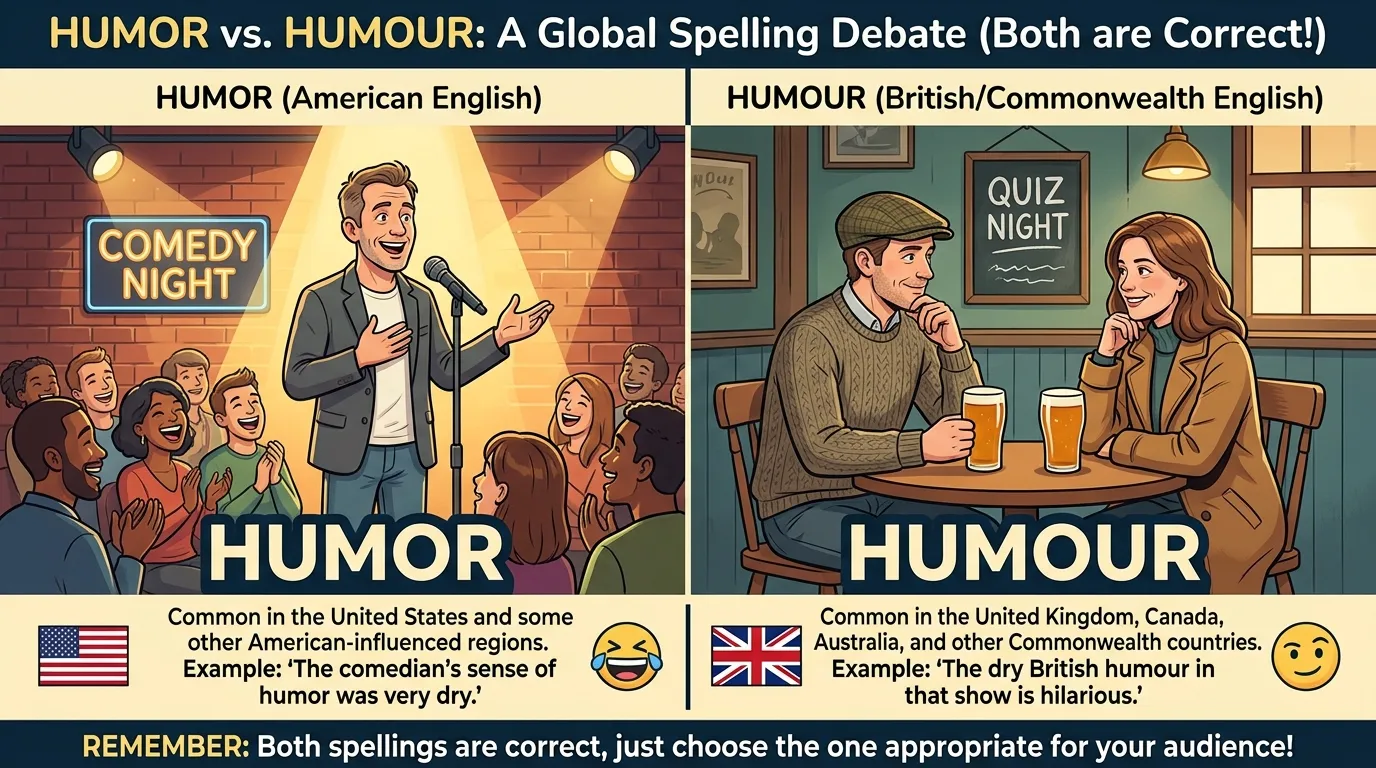
Two posters went up on the same lamppost on the same Friday night. The first, for a touring British comedian, read: “An Evening of Humour.” The second, for a local American comic, read: “Humor Night.” A passerby stopped, read both, and laughed — not at the comedians, but at the posters. The same word, the same street, the same night, spelled two ways. One with a u. One without. The passerby’s question — which one is right? — has the same answer as every other -our/-or question: both are right, and the choice is a matter of place. Humour is the British spelling. Humor is the American spelling. The meaning is identical. The u is a passport, not a correction.
But humour/humor has something the other -our/-or words do not: a secret second life. The word began as a medical term, not a comedy term, and its history runs from the four fluids of the human body to the modern sense of funniness through a journey of two thousand years. The spelling split is the least interesting thing about this word. Its history is the most interesting.
The Two Posters
Look at the posters again. “An Evening of Humour” — the British poster, with the u, in the tradition of colour, favour, labour, honour. “Humor Night” — the American poster, without the u, in the tradition of color, favor, labor, honor. The two posters are not in conflict. They are in two systems, and each is correct in its own. A British comedian touring America might keep the u as a mark of identity — a deliberate Britishness, a signal to the audience that the comedy is imported. An American comic playing London might add the u to the poster as a courtesy, or keep the American spelling as a mark of identity. Either choice is a decision, not an error.
The posters also illustrate a practical point: in comedy, as in all writing, consistency within a document matters more than the choice itself. A poster that says “An Evening of Humour” and then “humor” in the fine print has not made a spelling error. It has made a consistency error, and the audience will notice, because the poster is a designed object and every letter on it was chosen. The same rule applies to books, articles, and websites: pick a system and stay in it. The u is one item in a package, and the package includes colour, favour, theatre, travelled on one side and color, favor, theater, traveled on the other.
The Missing U
The u in humour arrived the same way the u in honour and colour did: through French influence in the seventeenth and eighteenth centuries, when English writers added u to words of French and Latin origin as a mark of elegance. The word came from Old French humor, from Latin humor — meaning moisture, fluid — and for centuries English spelled it without the u. The u was a later addition, a French polish on a Latin word.
Noah Webster removed it. The American lexicographer, compiling his dictionaries in the early nineteenth century, saw the u as an unnecessary French import and deleted it from humor along with the u in colour, favour, labour, and honour. His reforms were deliberate and nationalistic: American spelling should be simpler, more phonetic, and visibly distinct from British spelling. The American public adopted them, and humor without the u became the American standard within a generation. The British kept the u. The split is not an accident of history. It is a decision, made by one man with a dictionary, and it is the reason the two posters on the lamppost disagree.
Humor the Noun
As a noun, humour/humor means the quality of being amusing, the ability to make people laugh, or something that is funny. “She has a great sense of humour.” “His humor makes every meeting enjoyable.” “The play is full of humor.” “Good humor improves teamwork.” In every sentence, the meaning is the same in both spellings, and the only choice is the u.
The noun has a family of compounds and phrases that carry the same spelling choice. Sense of humour (UK) / sense of humor (US): the ability to perceive and enjoy what is funny. Good-humoured (UK) / good-humored (US): cheerful, pleasant-tempered. Ill-humoured (UK) / ill-humored (US): bad-tempered, surly. Humourless (UK) / humorless (US): lacking a sense of humor. Humorous — the adjective meaning funny — is spelled the same in both systems, because the u disappears when the -ous ending is added: humorous, not humourous. This is a useful fact, because it is the one place in the family where the two systems agree. A British writer and an American writer both write humorous. The u vanishes in the adjective, and the systems converge.
The noun also appears in genre labels that carry the spelling of their country of origin. “Black humour” is the British term for comedy about death and suffering; “black humor” is the American term for the same thing. “Dry humour” and “dry humor” describe understated, deadpan comedy. “Slapstick humour” and “slapstick humor” describe physical comedy. The genre is the same. The spelling follows the writer’s system. A British critic writing about an American show will usually keep the British spelling, because the critic writes in British English. An American critic writing about a British show will usually keep the American spelling, for the same reason. The spelling belongs to the writer, not the subject.
Humor the Verb
As a verb, humour/humor means to indulge, to go along with, to accommodate someone’s mood or whim. “Humor me for a moment.” “She humoured his obsession with trains.” “The committee humored the proposal, then rejected it.” The verb is less common than the noun, and it is slightly formal — “humor me” is the phrase most people know, and it is usually said with a hint of impatience: “Humor me. Explain it again.” The verb follows the same spelling rule: humour in British English, humor in American English, with the u staying or going in every form: humours/humors, humoured/humored, humouring/humoring.
The verb has a cousin worth distinguishing: to humor someone is not the same as to amuse someone. Amusing someone makes them laugh. Humoring someone goes along with them, often without sharing their enthusiasm. “She humored his theory” means she listened politely, not that she found it funny. The distinction matters in writing, because the two verbs describe different social acts: one is about laughter, the other is about tolerance. The spelling does not change the distinction. The meaning does.
The Four Humours
Now the secret history. Humour began as a medical word. In ancient Greek and Roman medicine, the body was believed to contain four fluids — the four humours: blood, phlegm, yellow bile, and black bile. Health depended on the balance of these fluids, and illness was an imbalance. A person with too much blood was sanguine — cheerful, optimistic. Too much phlegm made a person phlegmatic — calm, sluggish. Too much yellow bile made a person choleric — irritable, quick-tempered. Too much black bile made a person melancholic — sad, gloomy. The four temperaments — sanguine, phlegmatic, choleric, melancholic — survive in English as personality words, long after the medicine that produced them was abandoned.
The journey from fluids to funniness took centuries. In medieval and Renaissance English, humour meant a mood or a whim produced by the balance of the fluids: “He is in a strange humour today.” From mood, it extended to eccentricity: a person with a peculiar humour was a person with a peculiar temperament, and a play about such people — Ben Jonson’s Every Man in His Humour (1598) — used the word in this sense. From eccentricity, it extended to the ability to perceive and produce the comic: by the seventeenth century, humour meant wit, funniness, the comic spirit. The medical theory died. The word lived on, carrying its history in a meaning that no longer mentions fluids at all.
The four humours also explain two surviving phrases. Good humour originally meant a good balance of the fluids — a healthy temperament — and it survives as “good temper, cheerfulness.” Bad humour originally meant an imbalance, and it survives as “bad temper.” The phrases are fossils: they preserve the medical meaning inside everyday language, the way a shell preserves the shape of a creature long gone. When you write “She is in good humour,” you are, unknowingly, diagnosing her fluids.
Dry, Dark, and Slapstick
The noun’s modern life is in comedy, and its adjectives map the field. Dry humour is understated, deadpan, delivered without a smile — the British specialty, though Americans practice it too. Dark humour is comedy about death, suffering, and taboo subjects — the kind that makes audiences laugh and then feel guilty for laughing. Slapstick humour is physical: falls, pies, collisions, the comedy of the body. Satire is humour with a target: it mocks institutions, politicians, and follies. Irony is humour built on the gap between expectation and reality. Wit is humour built on cleverness and wordplay. Each term names a different mechanism, and each appears in both spelling systems with the u following the writer’s country.
There is one more use worth noting: humour as a tool. Teachers use humour to hold attention. Managers use humour to defuse tension. Writers use humour to make arguments memorable. Doctors use humour — carefully — to comfort patients. The research is consistent: humour improves memory, reduces stress, and builds trust. It is not a frivolity. It is a social tool, and like any tool, it can be used well or badly. The spelling does not affect the tool. The u does not make the joke funnier. But the word’s history — from bodily fluids to the comic spirit — is a reminder that the tools of language carry histories longer than their users know.
Pick Your Poster
Back to the lamppost. The British poster says “Humour.” The American poster says “Humor.” Both are right. Both mean the same thing: the quality of being amusing, the ability to make people laugh, the comic spirit that began as four fluids in an ancient doctor’s theory and ended as a night of stand-up in a club. The choice is the writer’s system, and the only error is mixing systems in the same document.
So pick your poster. If you write in British English, write humour, with the u, and let the u sit alongside colour, favour, and honour. If you write in American English, write humor, without it, and let it sit alongside color, favor, and honor. Either way, remember the adjective: humorous, spelled the same on both sides of the Atlantic, the one place where the two posters agree. And remember the history: the word you are spelling began as medicine, became mood, became eccentricity, and became comedy. The u is the smallest part of that story. The joke is the largest.