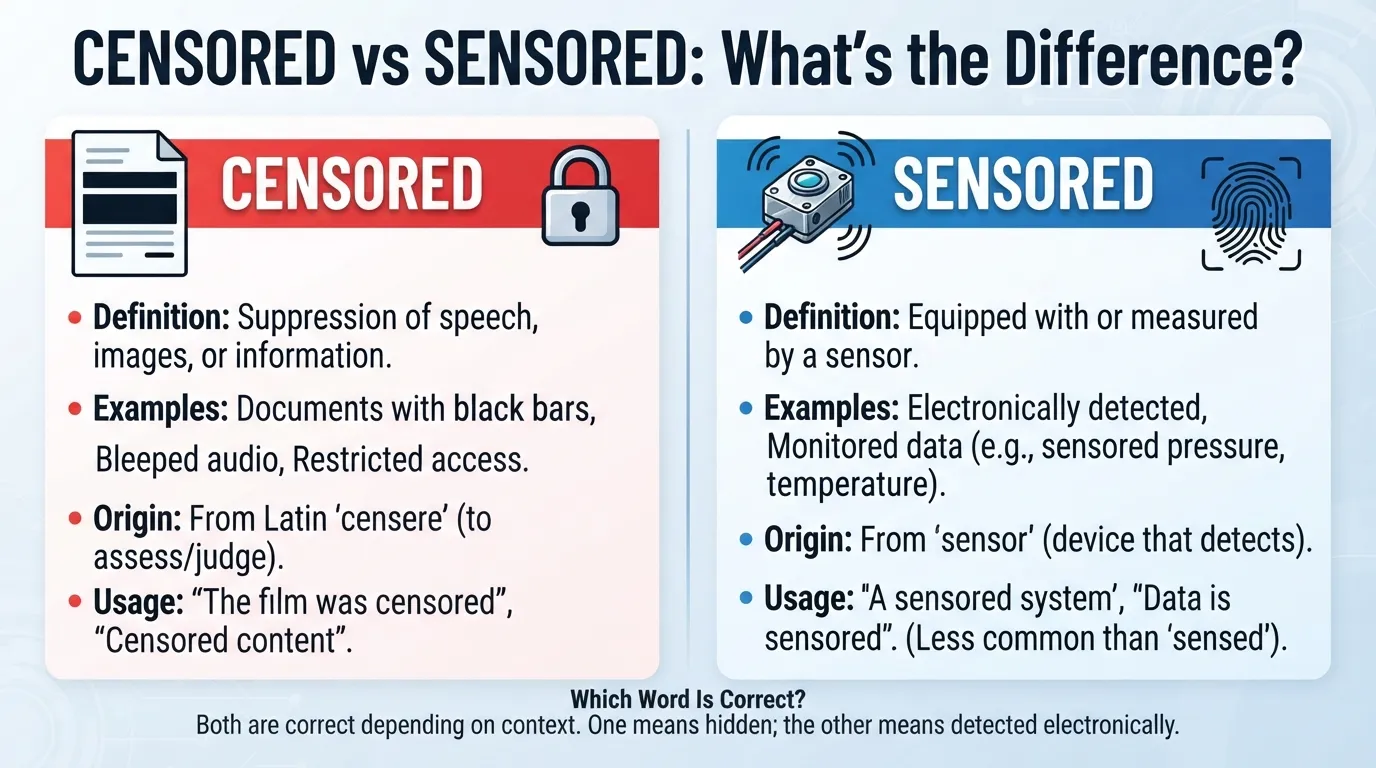
Down a quiet hallway are two offices. In the first, a censor sits at a desk with a red pencil, reading a manuscript and marking the passages that will not be published. In the second, an engineer sits at a bench with a circuit board, testing a motor that reports its own position through built-in sensors. The two workers have never met. Their jobs have nothing in common. But the words for what they do — censored and sensored — differ by a single letter, and that letter changes everything.
Censored means information has been suppressed, removed, blocked, or edited. Sensored means something is equipped with or operated by sensors. One word belongs to the world of information and power. The other belongs to the world of machines and measurement. Confusing them does not produce a small error. It produces a sentence that means something entirely different from what you intended.
The Censor’s Office: A Short History
The censor is one of the oldest jobs in government. In ancient Rome, the censor was a magistrate who took the census — counting citizens and assessing their property — and who also supervised public morals. The word comes from the Latin censere, meaning to judge, to assess, to give an opinion. From the beginning, the censor’s job mixed counting with judging.
The modern sense — the suppression of information — grew with the printing press. When books could be produced by the hundreds, authorities realized they could not control ideas by controlling speakers alone. They had to control texts. The Catholic Church’s Index of Prohibited Books, the licensing of printers in England, the wartime censorship of soldiers’ letters — all of them are chapters in the same story: information examined, and then suppressed, removed, altered, or blocked.
The twentieth century gave censorship its most famous systems. The Hays Code governed what Hollywood films could show from the 1930s to the 1960s. Wartime censors cut news and letters. Authoritarian regimes built entire bureaucracies around the control of newspapers, broadcasts, and books. And the twenty-first century moved the censor’s office online: social media platforms moderate posts, search engines filter results, and governments block websites. The tools changed. The job — deciding what others may see — did not.
That is why censored carries moral weight. To say something was censored is not just to describe an edit. It is to say that someone with power decided that others should not see it. The word implies judgment, authority, and control. It is one of the heaviest words in the language of free speech.

The Sensor’s Workshop
The sensor’s world could not be more different. A sensor is a device that detects a physical property — temperature, light, motion, position, pressure — and reports it to a system. Your phone has a dozen of them. Your car has dozens more. The thermostat on your wall is a sensor with a job: feel the temperature, report it, trigger the heat.
Sensored is a technical adjective meaning equipped with sensors. Its most common use is in engineering, especially in motor control. A sensored brushless motor is a motor with built-in position sensors that tell its controller exactly where the rotor is. Its opposite is a sensorless motor, which estimates position without physical sensors. The distinction matters to engineers because it affects precision, cost, and reliability.
The word is rare outside technical contexts, and that rarity is part of the point. In everyday conversation, nobody says “my phone is sensored.” They say “my phone has sensors.” Sensored belongs in spec sheets, datasheets, robotics manuals, and engineering discussions — places where the presence or absence of sensors is a technical specification, not a casual observation.
Its root is the Latin sentire, meaning to perceive, to feel, to sense. A sensor perceives. A sensored device is one that can perceive. The word is about measurement, not judgment — the opposite of its look-alike.
One Letter, Two Roots
The two words look alike because they share a sound and a spelling pattern, but their roots are entirely different. Censor comes from censere — to judge, to assess. Sensor comes from sentire — to perceive, to feel. One root is about judgment. The other is about perception. The single letter that separates them — C versus S — is the whole difference between judging information and perceiving the physical world.
The pronunciation does not help. In most varieties of English, censor and sensor sound nearly identical. The initial C in censor is pronounced as an S, so both words begin with the same sound. The ear cannot tell them apart. Only the spelling — and the context — can.
That is why the confusion is so persistent. A writer who hears “the report was sensored” in conversation might write it down as censored and be right, or write sensored and be wrong, and the sound gives no clue. The only reliable guide is meaning: was information suppressed, or was a sensor involved?

Censored in the News, Sensored in the Spec Sheet
The two words also live in different registers, and the register is a useful clue. Censored appears in journalism, history, politics, law, publishing, and everyday arguments about free speech. “The article was censored before publication.” “The film was censored for television.” “The letter was heavily censored.” These are sentences about power and information.
Sensored appears in engineering documents, product specifications, robotics papers, and technical forums. “This is a sensored brushless motor.” “The robot uses a sensored system.” These are sentences about hardware and measurement. If you find yourself writing sensored in a sentence about a newspaper, a book, a film, or a post, you almost certainly mean censored. If you find yourself writing censored in a sentence about a motor, a robot, or a circuit, you almost certainly mean sensored.
The collocations — the words each one habitually keeps company with — are a giveaway. Censored travels with heavily, by the government, for television, before publication. Sensored travels with brushless, motor, sensorless, feedback. The company a word keeps reveals its meaning.
Self-Censorship: The Censor Within
The most effective censor does not work in an office. He works inside the writer’s head. Self-censorship is the act of suppressing your own speech — holding back a thought, softening a claim, avoiding a topic — because you fear the consequences of saying it. It is the quietest form of censorship, and often the most powerful, because it leaves no paper trail. No red pencil, no rejection letter, no blocked post. Just silence, chosen in advance.
Self-censorship takes many forms. A journalist avoids a story that might anger an advertiser. An academic softens a conclusion that might offend a funder. An employee bites back a criticism of a boss. A novelist cuts a scene that might draw a lawsuit. In each case, the writer is doing the censor’s job for free, before the censor ever sees the work. The fear of punishment does the censoring, and the writer never has to be told.
The phenomenon has a name in social science: the chilling effect. When people see others punished for speech, they become less willing to speak themselves — even when their own speech would be lawful. The effect spreads like cold through a room. One visible punishment chills a hundred conversations that never happen. That is why free-speech advocates argue that censorship’s real damage is not the books that are banned. It is the books that are never written.
There is a counter-force, and it has a name too: the Streisand effect. When an attempt to suppress information draws attention to the very information being suppressed, the censorship backfires. The effort to hide something makes it famous. The Streisand effect is the censor’s nightmare: the red pencil that underlines what it meant to erase.
The Which-Job Test
When the two words blur, ask one question: what is being done? If information is being blocked, removed, edited, or restricted — the censor’s job — the word is censored. If a device is being equipped with sensors, or is operating through sensors — the engineer’s job — the word is sensored.
Picture the two offices one more time. The censor’s office has a red pencil and a manuscript. The sensor’s workshop has a circuit board and a motor. The two workers will never meet, and their words should never meet either. One letter, two worlds. Keep the censor in the office and the sensor in the workshop, and the words will stay where they belong.

That is the whole difference, and it is worth holding onto. Censored is about information controlled. Sensored is about a sensor involved. One letter apart, two worlds apart — and the letter is the wall between them.










