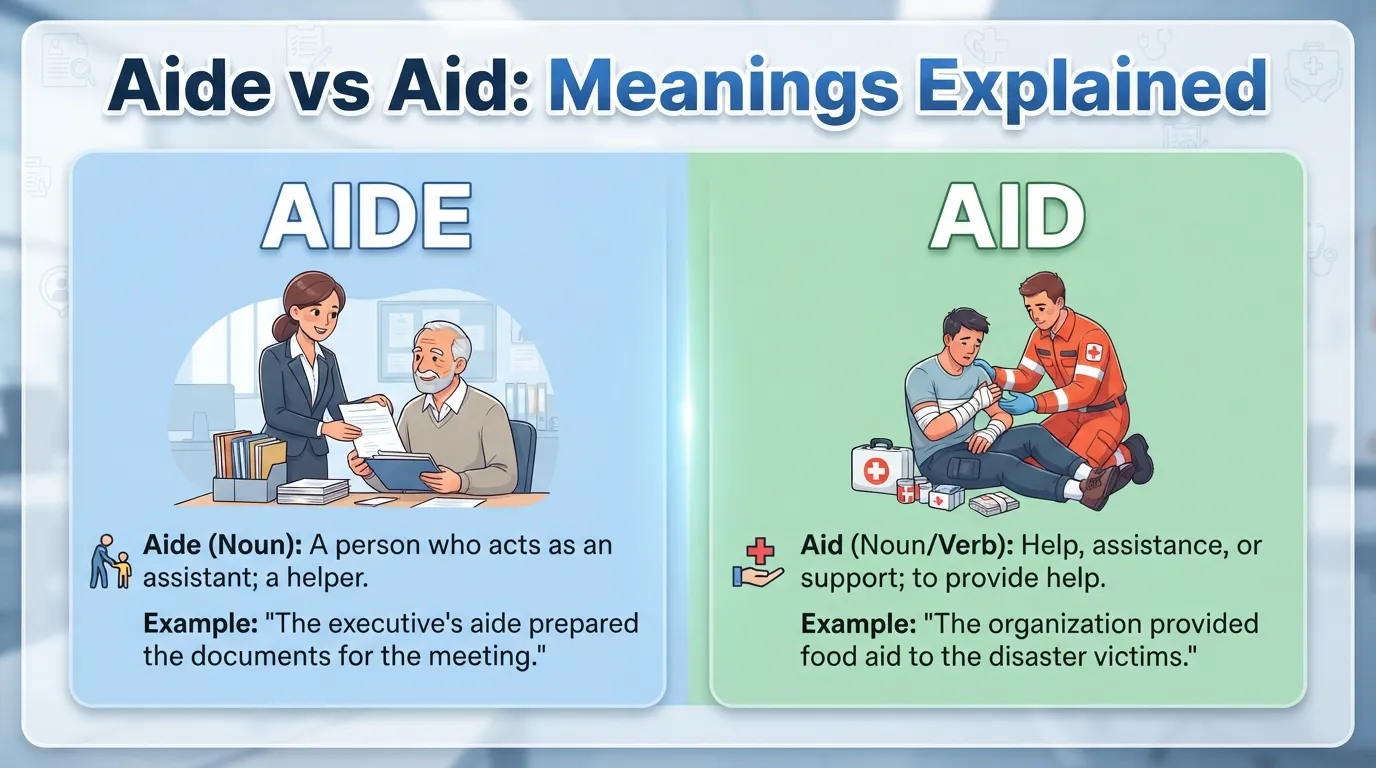
The press briefing is about to start. The podium is ready, the cameras are set, and a young staffer moves through the room handing out fact sheets. A reporter leans to a colleague and asks, “Who is that?” The colleague answers, “The senator’s aide.” The reporter writes it down — and then pauses, because the word on the page looks like it could also be aid, and the two words are not the same. One is a person. The other is help itself. The correct word for the staffer is aide. The correct word for the help is aid. The difference is one letter, and it is the difference between a person and a thing.
Aide and aid are both correct English words. They sound almost identical, they share a history, and they are not interchangeable. Aid means help, assistance, or something that provides help. Aide means a person whose job is to assist another person. If you are talking about the help, use aid. If you are talking about the helper, use aide. That is the whole distinction, and it is worth getting right, because mixing them up turns a person into a thing.
The Briefing Room
Start in the briefing room, because the room contains both words at once. The senator’s aide — the staffer — has prepared the briefing. The briefing contains news about foreign aid — the assistance the country is sending abroad. The aide prepared the aid announcement. Two words, one sentence, two different jobs. The aide is a person. The aid is a policy.
The sentence works because the two words occupy different grammatical slots. Aide is always a noun, and always a person. “The aide answered the question.” “Her aide scheduled the meeting.” “The president’s aides drafted the speech.” You cannot use aide as a verb. Nobody “aides” anyone. The word names a human being with a job.

Aid, by contrast, is flexible. As a noun, it means help or assistance: “financial aid,” “medical aid,” “humanitarian aid.” As a verb, it means to help: “to aid the injured,” “to aid the investigation,” “to aid recovery.” The word moves between noun and verb, and it always names the help, never the helper. “The organization provided aid.” “The volunteers aided the rescue effort.” Help, in both sentences.
The briefing room holds both because government runs on both. Governments send aid, and aides manage the sending. The person and the policy share a room, a sound, and a spelling — minus one letter.
Aid Is the Help
Aid is the older and broader word. It comes from the Latin adiutare, to help, through Old French aide, help. In modern English, it covers every kind of assistance: money, medicine, food, advice, rescue, support. “The Red Cross sent aid to the flood zone.” “She received financial aid for college.” “The hearing aid amplified the sound.” “First aid saved his life.”
The word’s range is wide. Financial aid is money for education or relief. Humanitarian aid is assistance to people in crisis. Foreign aid is assistance from one country to another. Legal aid is free or low-cost legal help. First aid is emergency medical help given before professionals arrive. A hearing aid is a device that helps a person hear. An aid — with the article — can name any device or tool that helps: “a teaching aid,” “a memory aid,” “a visual aid.”
As a verb, aid means to help or support: “The new law aids small businesses.” “The rain aided the firefighters.” “Good sleep aids recovery.” The verb is slightly formal — in casual speech, help is more common — but it is standard in writing, especially in news, law, and policy. “Aid and abet” is the famous legal phrase: to help someone commit a crime. The phrase survives in courtrooms and crime reporting, and it uses aid, the help, not aide, the person.
Notice what aid never does: it never names a person as a job title. You would not write “She is an aid to the senator” when you mean she works for the senator. That sentence says she is a form of help, not a person with a job. The job title is aide.
Aide Is the Helper
Aide is the newer and narrower word. It entered English in the late eighteenth century from French, where aide means helper, and it has always named a person. An aide is someone whose job is to assist another person, especially someone in an official, professional, political, or administrative role.
The most common aides: a congressional aide (works for a member of Congress), a presidential aide (works for the president), a teacher’s aide (assists a teacher in a classroom), a nurse’s aide (assists nurses in a hospital), a campaign aide (works on an election campaign), an aide-de-camp (a military officer who assists a senior officer). In every case, the aide is a person, and the person has a job.

The word is almost always paired with a possessive or a role: “the senator’s aide,” “a White House aide,” “her aide,” “the aide-de-camp.” It rarely stands alone, because an aide is defined by whom they assist. The aide belongs to someone — to a senator, a president, a teacher, a general. The aid belongs to no one. It is help itself, free-floating.
There is a pronunciation note worth hearing. In American English, aide and aid are pronounced identically: both sound like “ayd,” one syllable, rhyming with paid and laid. The spelling difference is invisible in speech. The listener cannot tell which word you mean. Only the writer can, and only by choosing the right letters. The homophone is the trap, and the spelling is the only way out.
Aide-de-camp and the Job Titles
The most formal aide is the aide-de-camp, a military officer assigned to assist a senior officer — a general, an admiral, a head of state. The phrase is French, and it keeps its French spelling: aide-de-camp, with hyphens, and the plural aides-de-camp. The aide-de-camp carries messages, manages schedules, and handles the senior officer’s daily business. The title is centuries old, and it is the purest form of the word: a helper, attached to a leader.
The job titles tell the story of the word’s range. A nurse’s aide does hands-on care work: bathing patients, taking vital signs, changing beds. A teacher’s aide manages classrooms, grades papers, and helps students one on one. A home health aide assists people in their homes. A congressional aide researches policy, drafts speeches, and manages constituents. The jobs are different. The word is the same. All of them are people.
One title deserves a warning: teacher’s aide is sometimes written teacher’s aid, and the error is common enough to appear in school documents. The aide is the person. The aid is the help. A school employs an aide. A school provides aid. The distinction is the same as everywhere else, and it matters more in a job title than anywhere, because a job title is a person’s livelihood.
Aides in Fiction and Film
Aides are everywhere in fiction, and fiction shows why the word matters. The loyal aide who knows the boss’s schedule better than the boss does. The ambitious aide who wants the boss’s job. The exhausted aide who carries the briefing book, the coffee, and the secret. From political dramas to spy thrillers to comedies, the aide is the character who makes the powerful person function — and the character who sees everything.
The most famous fictional aides: the chief of staff in The West Wing, the political aide in House of Cards, the military aide-de-camp in countless war films. In each case, the aide is a person — never a thing — and the spelling follows the person. The writers get it right, because the character is a human being, and the word for a human helper is aide, with the E.
Fiction also shows the aide’s shadow: the aide who becomes the power behind the throne. The aide who knows where the bodies are buried, because the aide scheduled the burials. The aide who leaks, who spins, who covers up. The word carries all of this — loyalty, access, ambition, exhaustion — because the job carries all of it. The E stands for Employee, and the employee, in fiction as in life, is the person in the room who actually knows what is going on.
The E Test
Here is the memory hook, and it is built into the spelling. Aide has an E at the end. E stands for Employee — a person with a job. Aid has no E. It is just help, bare and impersonal. E = Employee = aide, the person. No E = aid, the help.

Run the test on a sentence. “The senator’s aide prepared the notes.” Person with a job — E — aide. “The country sent aid to the disaster zone.” Help, no person — no E — aid. “She works as a teacher’s aide.” Person — E — aide. “First aid saved his life.” Help — no E — aid. The test works every time, because the E and the employee belong together.
And one final check for the briefing room: when the word appears in your draft, ask whether it names a person. If it does, give it an E. If it names help, leave the E off. The aide will thank you. The aid will reach the people who need it. And the sentence will be correct.











