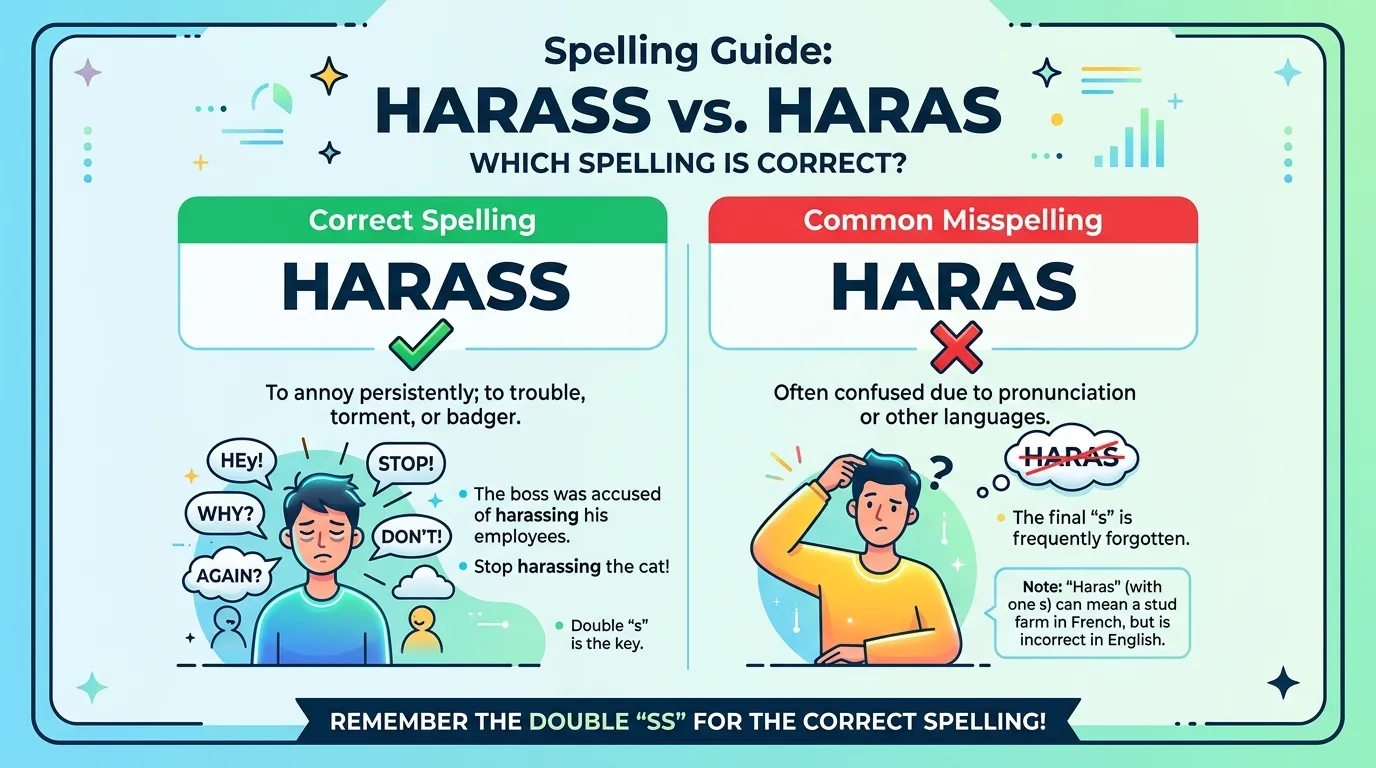
The HR manager stares at a draft policy memo. The document will go to every employee in the company, it will be quoted in training sessions, and it may one day be read aloud in a legal proceeding. One word appears in it a dozen times, and the spelling has to be exactly right — not because the reader will grade the memo, but because a misspelled word in a legal document undermines the document itself. The word is harass. The misspelling is haras. The difference is a single s at the end, and it is the difference between a correct word and a word that does not exist in standard English.
The confusion is understandable. In fast speech, the final sound of harass collapses into a single s, and nothing in the pronunciation tells the writer that there are two. A person spelling by ear writes haras and moves on, unaware that the spelling is wrong. But in writing — especially in formal, legal, and workplace writing, where this word appears most often — the double s matters, and getting it right is part of writing about the subject with the precision it deserves.
The Memo That Has to Be Right
Some words carry more weight than others, and harass is one of them. It appears in workplace policies, in legal complaints, in journalism, in school regulations, and in academic research. In each of these contexts, the word names behavior that has consequences — for the person experiencing it, for the person accused of it, and for the institution handling the complaint. A misspelling in such a document does not change the legal meaning, but it signals carelessness, and carelessness is the last thing a reader wants to see in a document about a serious subject.
The spelling is simple once it is stated: h-a-r-a-s-s. Two ses at the end, always. The forms follow the same pattern: harass, harasses, harassed, harassing, harassment. Every form keeps the double s. The misspellings follow a predictable pattern too: haras, harased, harasing, harasment — each one dropping the second s. If you remember the double s in the base word, the whole family follows.
What Harass Means
Harass is a verb meaning to repeatedly bother, intimidate, pressure, or mistreat someone. The key word in that definition is repeatedly. A single rude comment is unpleasant; a pattern of unwanted, persistent behavior is harassment. The word describes conduct that continues over time and that the target experiences as unwelcome — repeated unwanted messages, repeated intimidation, repeated pressure, repeated interference with someone’s work or life.
The word appears in several distinct contexts. In workplace law, harassment names conduct that creates a hostile work environment or that conditions employment on submitting to unwelcome behavior. In schools, anti-harassment policies cover bullying and intimidation among students. In journalism, reporters describe military forces harassing an opposing force — a figurative extension meaning to wear down through repeated small attacks. In everyday speech, the word covers persistent annoyance: “The telemarketers keep harassing me.” “Stop harassing me about the report.”
The noun form is harassment: “She filed a harassment complaint.” “The policy prohibits harassment of any kind.” The adjective form is harassing: “harassing phone calls,” “harassing behavior.” All three forms keep the double s, and all three carry the sense of repetition — the behavior that happens again and again, not the one-off incident.
Why the Second S Vanishes
Three forces produce haras. The first is pronunciation. In normal speech, the two s sounds in harass blend into one. You do not hear “ha-RASS-SS” with two distinct s sounds — you hear “huh-RASS.” Nothing in the sound tells the writer that there are two ses, so one s feels like enough. The full pronunciation, in American English, is huh-RASS, with the stress on the second syllable. In British English, the stress is also on the second syllable, though some speakers stress the first: HARR-uhs. Either way, the double s is inaudible.
The second is the word’s shape. English has many common words that end in a single s after a vowel: gas, has, this, bias, canvas. The single-s pattern is familiar, so haras looks believable at a glance. The double-s ending is less common, and it appears in a specific family of words — class, pass, glass, grass, boss, loss, across — where the double consonant marks a short vowel before it. Harass belongs to that family, and the double s is doing the same job: marking the short a in the second syllable.
The third is a genuine coincidence from other languages. Haras is a real word in French — it means a stud farm, a place where horses are bred. And harás, with an accent, is a Spanish verb form meaning “you will do.” Neither one has anything to do with the English verb. But their existence means that haras looks like a plausible word to anyone who has seen French or Spanish, and autocorrect systems sometimes accept it. The English verb, however, is always harass, with two ses.
The Family: Harassment, Harassing
The word’s relatives are worth learning together, because they show how the double s survives every suffix:
- Harass (verb) — to repeatedly bother or intimidate. “The manager warned him not to harass his coworkers.”
- Harasses (verb, third-person singular) — “She harasses the new staff with constant demands.”
- Harassed (verb, past tense and past participle) — “He felt harassed by the constant calls.”
- Harassing (verb, present participle; also adjective) — “Stop making harassing calls.”
- Harassment (noun) — the behavior itself. “The company has a zero-tolerance policy on harassment.”
- Harasser (noun) — a person who harasses. Less common, but standard.
Note that harassment adds -ment to the base without changing anything: harass + ment = harassment. No letter is dropped, no letter is doubled beyond the two ses already there. The misspelling harasment comes from dropping the second s in the base word and then adding the suffix to the damaged base. Fix the base, and the whole family follows.
Harassment Law: A Brief, General Note
In many legal systems, harassment is defined by statute or case law, and the definitions share a common shape: unwanted conduct, repeated or severe, that a reasonable person would find hostile, intimidating, or abusive. Workplace harassment law in the United States, for example, distinguishes between conduct that creates a hostile work environment and conduct that conditions employment on submitting to unwelcome advances. Other countries use different frameworks, but the core idea is consistent: the law protects people from patterns of unwanted behavior, not from single rude remarks.
Two practical points follow. First, documentation matters. A complaint that records dates, times, witnesses, and exact words is far stronger than one that records a general feeling. Second, policies matter. Organizations with clear, written anti-harassment policies — spelled correctly, distributed to every employee, and enforced consistently — are better at preventing harassment and better at handling complaints when they arise. The memo on the HR manager’s desk is not paperwork for its own sake. It is the document that tells employees what the organization stands for, and the spelling is part of the message.
Writing About It Carefully
Because harass names serious behavior, the words around it matter as much as the spelling. Precision is a form of fairness. Writing that someone “harassed” a colleague is a factual claim, and in formal contexts it should be supported by specifics — what happened, when, how often, and what evidence exists. Vague accusations help no one, least of all the person making them. The word’s power comes from its precision: it names a pattern, not a single incident, and using it for a single incident dilutes it.
Synonyms exist, but each one shades the meaning differently. Bother and pester suggest mild, repeated annoyance without the element of intimidation. Intimidate suggests frightening someone into compliance. Bully suggests a power imbalance. Stalk suggests following or monitoring someone. Harass sits in the middle of this range — it covers repeated unwanted behavior that is more than mere annoyance and less specific than stalking, and it is the word the law uses, which is why it is the word policies use too.
In reporting and documentation, the passive construction is common: “She was harassed by a coworker.” The passive focuses on the person affected rather than the person acting, and it is appropriate when the focus is the experience. In legal writing, the active construction names the actor: “The supervisor harassed the employee.” Both are correct. The choice between them is a choice about emphasis, not about grammar.
One final usage note: harass is a formal word, and in casual conversation people often reach for softer alternatives — bug, nag, hound, give a hard time. Those are fine in speech. But in writing — in a policy, a complaint, a report, or a news article — harass is the standard term, and it should be spelled with both of its ses.
The Final Line
The memory hook is the meaning itself. Harass names behavior that happens again and again — and the spelling repeats itself, too. Two ses, because the behavior is repeated. Two ses, because one is never enough — in the conduct, or in the spelling. The memo goes out with the word spelled correctly, and the document’s precision matches the seriousness of its subject. That is what careful writing does: it gets the small things right so that the big things can be heard.










