Summary vs Summery: Meaning, Difference, Pronunciation, and Correct Usage

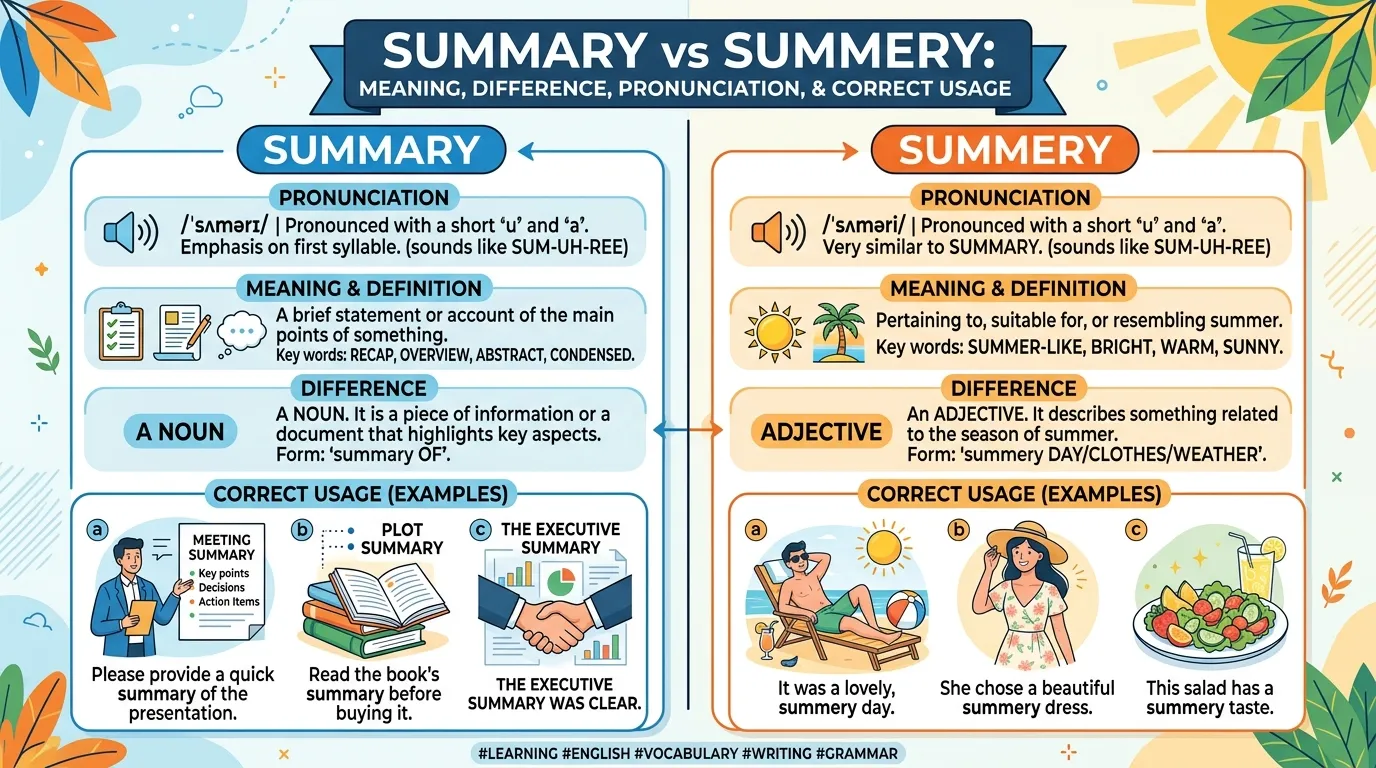
If you are wondering about summary vs summery, the answer is simple: both words are correct, but they have completely different meanings. Summary usually means a short version of something longer, while summery means something that is characteristic of or related to summer.

For example:

  • Please write a summary of the article. → a short version of an article
  • The room has a bright, summery feel. → a feeling associated with summer

These words are easy to confuse because they look and sound very similar. However, they belong to different grammatical categories, serve different purposes, and appear in very different contexts.

In this guide, you will learn the difference between summary and summery, their definitions, pronunciation, parts of speech, word origins, common collocations, examples, mistakes, formal and informal usage, and easy memory tricks.


Quick Answer: Summary vs Summery

Summary is usually a noun meaning a brief statement or shortened version of the main points of something.

Summery is an adjective meaning characteristic of, suitable for, or resembling summer.

WordMain meaningTypical part of speechExample
summaryA short version containing the main pointsNoun; sometimes adjective“I read the summary.”
summeryRelated to or characteristic of summerAdjective“She wore a summery dress.”

The easiest way to remember

Summary = summarize information.
Summery = summer-like.

If you are talking about information, an article, a report, a meeting, or a book, you probably need summary.

If you are describing something as bright, warm, seasonal, relaxed, or characteristic of summer, you probably need summery.


What Does Summary Mean?

Summary is primarily a noun. It refers to a shortened presentation of the most important information from a longer piece of writing, speech, event, report, or discussion.

A summary does not normally include every detail. Instead, it focuses on the main ideas, essential facts, and important conclusions.

Dictionary-style definition of summary

Summary (noun): A brief statement or account that presents the main points of something without including all of its details.

For example:

The teacher asked us to write a summary of the chapter.

The student is not expected to copy the entire chapter. The goal is to explain its most important ideas in a shorter form.

Summary as an adjective

Summary can also function as an adjective, especially in formal, legal, and professional language.

In this use, it can mean brief, concise, or performed without the usual formal process.

Examples include:

  • summary judgment
  • summary report
  • summary procedure
  • summary execution
  • summary dismissal

In everyday writing, however, the noun summary is much more common.


What Does Summery Mean?

Summery is an adjective.

It describes something that feels, looks, smells, sounds, or behaves like summer.

Dictionary-style definition of summery

Summery (adjective): Characteristic of, suitable for, or resembling summer.

Examples:

The garden looked bright and summery.

She chose a light, summery outfit.

The restaurant has a relaxed, summery atmosphere.

The word can describe clothing, colors, weather, food, decorations, music, smells, moods, settings, and experiences.

For example:

  • a summery dress
  • a summery color
  • a summery afternoon
  • a summery scent
  • a summery mood
  • a summery vacation
  • a summery atmosphere

Summary vs Summery: The Key Difference

The most important distinction is the meaning of the two words.

Summary has to do with condensing information.

Summery has to do with summer.

Think of the relationship this way:

summary → summarize → main points

summery → summer → summer-like

Compare these sentences

I prepared a summary of the meeting.

This means you prepared a shortened account of what happened during the meeting.

The meeting room had a summery atmosphere.

This means the room felt like summer, perhaps because of bright colors, flowers, sunlight, or seasonal decorations.

Changing one letter changes the meaning completely.


Summary vs Summery Pronunciation

Another reason these words cause confusion is that their pronunciations are very similar.

How to pronounce summary

Summary is commonly pronounced:

SUM-uh-ree

In American English, the first syllable receives the strongest stress.

Example:

summary → “SUM-uh-ree”

How to pronounce summery

Summery is commonly pronounced:

SUM-er-ee

It is closely connected to the pronunciation of summer.

Example:

summery → “SUM-er-ee”

The difference can be subtle in fast speech, which helps explain why people sometimes confuse the two when writing.

Pronunciation memory trick

If you hear a word connected with summer, think:

summer → summery

If you hear a word connected with summarizing information, think:

summary → summarize


Why Do People Confuse Summary and Summery?

The confusion is understandable because the words share several characteristics.

They look almost identical

Both begin with summ- and contain several of the same letters.

They sound similar

In ordinary conversation, the distinction between summary and summery may not be obvious.

They have different meanings despite their similarity

This is a classic example of words that are easy to confuse because of their spelling and pronunciation but have unrelated meanings.

Their endings can be misleading

The ending -y often forms adjectives, so summery naturally works as an adjective.

Meanwhile, summary is most often used as a noun.


Summary vs Summery Parts of Speech

Understanding grammar makes the difference much easier.

WordPart of speechMeaning
summaryNounA shortened version of information
summaryAdjectiveBrief or carried out through a shortened/formal process
summeryAdjectiveRelated to or characteristic of summer

Summary as a noun

The summary was easy to understand.

I need a summary of the report.

Her summary covered all the major points.

Summary as an adjective

The executive team received a summary report.

The court issued a summary judgment.

Summery as an adjective

The colors are very summery.

We decorated the patio with a summery theme.

Because summery is an adjective, it normally modifies a noun.


Summary vs Summery Examples

The fastest way to understand these words is to see them in context.

Examples with summary

  • Can you give me a summary of the book?
  • The report includes a summary of the findings.
  • I wrote a short summary for my professor.
  • The article begins with a useful summary.
  • She gave us a summary of yesterday’s meeting.
  • The executive summary explains the project’s goals.
  • Read the summary before deciding whether to read the full report.
  • His summary captured the central argument.

Examples with summery

  • The room has a warm, summery feel.
  • She wore a summery yellow dress.
  • The café uses bright colors to create a summery atmosphere.
  • We spent a relaxing, summery afternoon by the lake.
  • The perfume has a fresh and summery scent.
  • These floral decorations look very summery.
  • The song has a cheerful, summery sound.
  • I wanted a light, summery design for the website.

Summary vs Summery in Formal Writing

Use summary in academic writing

Summary is extremely common in academic contexts.

You may write:

The following section provides a summary of the research findings.

In summary, the study suggests that the two approaches produce similar results.

Students often write summaries of:

  • books
  • research papers
  • chapters
  • lectures
  • articles
  • studies
  • arguments
  • historical events

Use summery when describing a seasonal quality

Summery is possible in formal writing, but it is descriptive rather than technical.

For example:

The building’s design creates a bright, summery atmosphere.

However, in highly formal writing, a more precise phrase such as summer-related, associated with summer, or characteristic of summer may sometimes be preferable.


Summary vs Summery in Business Writing

Summary is especially useful in business communication.

Common business expressions include:

  • executive summary
  • project summary
  • meeting summary
  • financial summary
  • sales summary
  • report summary
  • summary of findings
  • summary of recommendations

Examples:

Please review the executive summary before the meeting.

I’ll send a summary of today’s discussion this afternoon.

By contrast, summery is usually relevant only when discussing seasonal design, marketing, products, events, or atmosphere.

The campaign uses bright, summery imagery.

The new collection has a fresh, summery look.


Summary vs Summery in Academic Writing

If you are writing an essay, research paper, book report, or assignment, summary is usually the correct word.

Correct

Write a 300-word summary of the article.

Incorrect

Write a 300-word summery of the article.

Why is the second sentence wrong?

Because you are not asking for something related to summer. You are asking for a shortened explanation of the article.

A useful academic phrase is:

In summary, …

This introduces a brief statement of the main conclusion.

For example:

In summary, the evidence supports the author’s central argument.


Summary vs Summery in Journalism

Journalists frequently use summary because news articles often need concise explanations.

Examples include:

  • news summary
  • story summary
  • article summary
  • event summary
  • daily summary
  • news summary

Example:

Here is a brief summary of today’s major developments.

Summery can appear in lifestyle journalism when describing seasonal subjects:

The resort’s summery atmosphere attracts visitors during the warmer months.


Summary vs Summery in Blogging and Content Writing

For bloggers and content creators, summary is much more common.

You might create:

  • article summaries
  • book summaries
  • product summaries
  • meeting summaries
  • research summaries
  • video summaries
  • podcast summaries

Example:

Here’s a quick summary of everything discussed in the video.

Summery can be useful in lifestyle, fashion, travel, food, and design writing:

These simple decorating ideas will give your home a fresh, summery look.


Common Collocations With Summary

A collocation is a combination of words that commonly appear together.

Here are some common combinations with summary:

Noun collocations

  • brief summary
  • short summary
  • detailed summary
  • concise summary
  • complete summary
  • clear summary
  • accurate summary
  • executive summary
  • book summary
  • article summary
  • meeting summary
  • research summary
  • project summary
  • news summary
  • chapter summary
  • case summary

Verb + summary

  • write a summary
  • provide a summary
  • give a summary
  • prepare a summary
  • read a summary
  • include a summary
  • present a summary
  • create a summary
  • review a summary

Example

The manager asked me to prepare a concise summary of the meeting.


Common Collocations With Summery

Because summery describes summer-like qualities, it commonly appears with descriptive nouns.

  • summery dress
  • summery outfit
  • summery colors
  • summery atmosphere
  • summery mood
  • summery style
  • summery design
  • summery weather
  • summery scent
  • summery fragrance
  • summery drink
  • summery afternoon
  • summery look
  • summery feeling

Examples:

Pastel colors create a soft, summery look.

The restaurant’s outdoor seating has a cheerful, summery atmosphere.


Summary vs Summery: Synonyms

The synonyms are another useful way to distinguish the words.

Synonyms for summary

Depending on context, summary can be replaced with:

  • overview
  • synopsis
  • outline
  • abstract
  • précis
  • digest
  • recap
  • review
  • condensation
  • brief
  • account

These words are not always interchangeable in every situation.

For example, an abstract is especially common in academic and scientific writing, while a synopsis is often used for books, films, or stories.

Synonyms for summery

Possible alternatives include:

  • summer-like
  • seasonal
  • warm
  • sunny
  • bright
  • breezy
  • tropical
  • vacation-like
  • light
  • carefree

These alternatives depend heavily on context.

For example, summery can suggest more than temperature. It can describe an overall feeling or visual style.


Summary vs Summery: Antonyms

The two words do not have direct, universal antonyms, but some useful contrasts exist.

Possible contrasts for summary

Depending on the context:

  • full version
  • detailed account
  • complete explanation
  • expansion
  • elaboration

For example:

The summary is short, but the full report contains extensive details.

Possible contrasts for summery

Depending on context:

  • wintry
  • autumnal
  • seasonal in another way
  • cold
  • winter-like

For example:

The dark colors give the room a more wintry than summery appearance.


Word History and Etymology of Summary

Summary ultimately comes from Latin summarium, meaning an abridged account or summary.

It is related to the Latin summa, meaning something like a total, principal point, or main substance.

The underlying idea is important: a summary brings together the essential or principal points of a larger work.

English adopted summary centuries ago, and the word developed into the familiar modern sense of a concise account.

The word is also related to sum, summarize, and summarization in the broader family of words associated with bringing information together.


Word History and Etymology of Summery

Summery is much more straightforward in its formation.

It comes from summer + -y.

The suffix -y can mean “characterized by” or “having the qualities of.”

For example:

  • cloud → cloudy
  • wind → windy
  • sun → sunny
  • summer → summery

Thus, summery literally means something like characteristic of summer.

This connection makes the word much easier to remember.


Summary vs Summery: Is One a Misspelling?

No.

Summary is correctly spelled.

Summery is also correctly spelled.

Neither is a misspelling of the other.

The problem occurs when writers use the correct spelling in the wrong context.

For example:

I need a summery of the report.

The spelling summery exists, but it is wrong here because the intended meaning is a shortened account.

The correct sentence is:

I need a summary of the report.

Likewise:

The room has a summary atmosphere.

This is incorrect if you mean an atmosphere associated with summer.

The natural sentence is:

The room has a summery atmosphere.


Common Mistakes With Summary and Summery

Mistake 1: “Summery of the book”

I wrote a summery of the book.

I wrote a summary of the book.

A book’s shortened explanation is a summary.


Mistake 2: “Summary dress”

She bought a summary dress for vacation.

If you mean a dress that looks suitable for summer:

She bought a summery dress for vacation.


Mistake 3: “Summer summary”

This phrase can actually be correct, depending on meaning.

I prepared a summer summary of our sales figures.

Here, summer identifies the season, while summary means a concise report.

But:

I prepared a summery of our sales figures.

is incorrect if you mean a report.


Awkward vs Natural Examples

Awkward or incorrectNatural version
I need a summery of the report.I need a summary of the report.
She wore a summary dress.She wore a summery dress.
Give me a summery of the book.Give me a summary of the book.
The room feels summary.The room feels summery.
Please summarize this summery.Please summarize this summary.
The garden has a summary appearance.The garden has a summery appearance.

How to Remember Summary vs Summery

Here are several easy memory tricks.

Trick 1: Look at summer

Summery contains “summer.”

summer + y = summery

So:

summery = summer-like

Trick 2: Think of summarize

Summary is closely connected with summarize.

If you can use summarize, you probably need summary.

Summarize the article.

Write a summary of the article.

Trick 3: Ask yourself one question

Are you talking about information or summer?

If it is information:

summary

If it is summer:

summery


Summary vs Summery in American and British English

There is no major spelling difference between American and British English for these two words.

Both varieties use:

  • summary
  • summery

The meanings are essentially the same.

For example:

American English:

I need a summary of the report.

British English:

I need a summary of the report.

Likewise:

American English:

She chose a summery dress.

British English:

She chose a summery dress.

Pronunciation can vary slightly by speaker and region, but the spelling distinction remains the same.


Summary vs Summery in Casual Conversation

In casual speech, people may not notice which word you mean because the pronunciation is similar.

For example:

Can you give me a summary?

is immediately understood from context.

But in writing, spelling matters.

Text messages, emails, social media posts, school assignments, reports, and professional documents should use the correct word because summary and summery communicate different meanings.


Summary vs Summery in Technical and Professional Writing

Summary has broad professional use.

It appears in:

  • medicine
  • law
  • business
  • education
  • science
  • technology
  • journalism
  • finance
  • government
  • research

Examples:

The report provides a summary of the test results.

The software generates a summary of system activity.

The attorney submitted a summary of the case.

Summery, on the other hand, is mainly descriptive and appears more often in lifestyle, fashion, travel, design, food, and creative contexts.


Legal Meaning of Summary

The word summary has an additional formal meaning in legal language.

As an adjective, it can describe something done through a shortened or expedited procedure.

Examples include:

summary judgment

summary proceeding

summary offense

The precise meaning depends on the legal system and context.

This use has nothing to do with summery or the season of summer.


Sports Usage

In sports writing, summary is common.

You may see:

  • game summary
  • match summary
  • season summary
  • player summary
  • tournament summary
  • statistical summary
  • postgame summary

Example:

The game summary highlighted the team’s strong second-half performance.

Summery may appear in sports lifestyle coverage:

The tournament had a relaxed, summery atmosphere.

But it would not mean a recap of the match.


Political and Public Affairs Usage

Summary is frequently used in political and public affairs writing.

Examples include:

  • policy summary
  • legislative summary
  • election summary
  • proposal summary
  • budget summary
  • committee summary
  • report summary

Example:

The policy summary explains the proposal in plain language.

Summery has no special political meaning. It retains its ordinary meaning of summer-like.


Summary vs Summery: Formal vs Informal Alternatives

If you want a more formal alternative to summary, consider:

  • overview
  • synopsis
  • abstract
  • précis
  • executive summary
  • condensed account

For casual writing, you might say:

  • recap
  • quick rundown
  • brief overview
  • short version

For example:

Formal

The report provides an overview of the findings.

Neutral

The report provides a summary of the findings.

Casual

Here’s a quick recap of what happened.

For summery, alternatives depend on the exact description:

Neutral

The room has a summery feel.

More explicit

The room has a look associated with summer.

Creative

The room feels bright, sunny, and carefree.


Summary vs Summery: Which Word Should You Use?

Use summary when you mean:

  • a shortened version
  • main points
  • a brief account
  • an overview
  • a recap
  • condensed information
  • a report of essential findings

Use summery when you mean:

  • related to summer
  • characteristic of summer
  • summer-like
  • bright and seasonal
  • warm or carefree in a summer context

A simple decision table

If you mean…Use
A shortened articlesummary
Main points of a meetingsummary
A book’s condensed accountsummary
A research overviewsummary
A report’s key findingssummary
A summer-like dresssummery
A summer-like color schemesummery
A summer-like atmospheresummery
A summer-like fragrancesummery
A cheerful summer feelingsummery

Frequently Asked Questions

Is “summary” and “summery” the same?

No. Summary usually means a shortened account of the main points of something. Summery is an adjective meaning characteristic of or related to summer.

Which is correct: “summary of a book” or “summery of a book”?

The correct phrase is “summary of a book.” A summary is a shortened explanation of the book’s main ideas, events, or arguments.

Is “summery” a real word?

Yes. Summery is a standard English adjective. It means characteristic of or resembling summer.

What is the difference between summary and summery?

Summary refers primarily to condensed information, while summery describes something associated with summer.

How do you pronounce summary?

Summary is commonly pronounced approximately SUM-uh-ree, with the first syllable stressed.

How do you pronounce summery?

Summery is commonly pronounced approximately SUM-er-ee. It is closely related to the pronunciation of summer.

Is “summery” a noun?

No. Summery is an adjective. It describes something that has qualities associated with summer.

Can summary be an adjective?

Yes. Although summary is most commonly a noun, it can also function as an adjective in expressions such as summary judgment, summary report, and summary procedure.

Is “summery” used in American English?

Yes. Summery is used in American English and has essentially the same meaning as in British English: characteristic of or related to summer.

How can I remember the difference between summary and summery?

Remember summer + y = summery. If you are describing something as summer-like, use summery. If you are talking about condensed information, use summary.


Conclusion

The difference between summary vs summery becomes easy once you connect each word with its meaning.

Summary is primarily a noun meaning a shortened account of the main points of something. You use it for books, articles, reports, meetings, research, news, presentations, and other forms of information.

Summery is an adjective meaning characteristic of or resembling summer. You use it for things such as clothing, colors, smells, moods, decorations, designs, weather, and atmospheres.

The easiest memory trick is:

Summary → summarize information.
Summery → summer-like.

So, if you are writing “a summary of the report,” choose summary. If you are describing “a summery dress,” choose summery.

Both spellings are correct. The key is using the right word for the right meaning. Once you associate summary with condensed information and summery with summer, this commonly confused word pair becomes much easier to master.

Leave a Comment