If you have ever paused while writing a sentence and wondered whether to use affect or effect, you are not alone. These two words sound similar, look similar, and are closely related in meaning. Yet they usually play different grammatical roles.
The simplest rule is this: affect is usually a verb meaning “to influence,” while effect is usually a noun meaning “a result.”
For example:
The weather affected our travel plans.
The storm had a major effect on traffic.
But English has exceptions. Affect can also be a noun in psychology, while effect can be used as a verb meaning “to bring about” or “to cause.” Understanding these less common uses will help you avoid mistakes in academic writing, business communication, journalism, blogging, and everyday English.
This guide explains affect vs effect in plain American English, including their meanings, pronunciation, grammar, history, common expressions, examples, mistakes, and memory tricks.
Quick Answer: Affect vs Effect
The easiest distinction is:
| Word | Usual Part of Speech | Usual Meaning | Example |
|---|---|---|---|
| Affect | Verb | To influence something | Stress can affect sleep. |
| Effect | Noun | A result or consequence | Stress can have an effect on sleep. |
| Affect | Noun, less common | Observable emotional expression | The patient showed a flat affect. |
| Effect | Verb, formal | To bring about or cause | The new policy may effect major changes. |
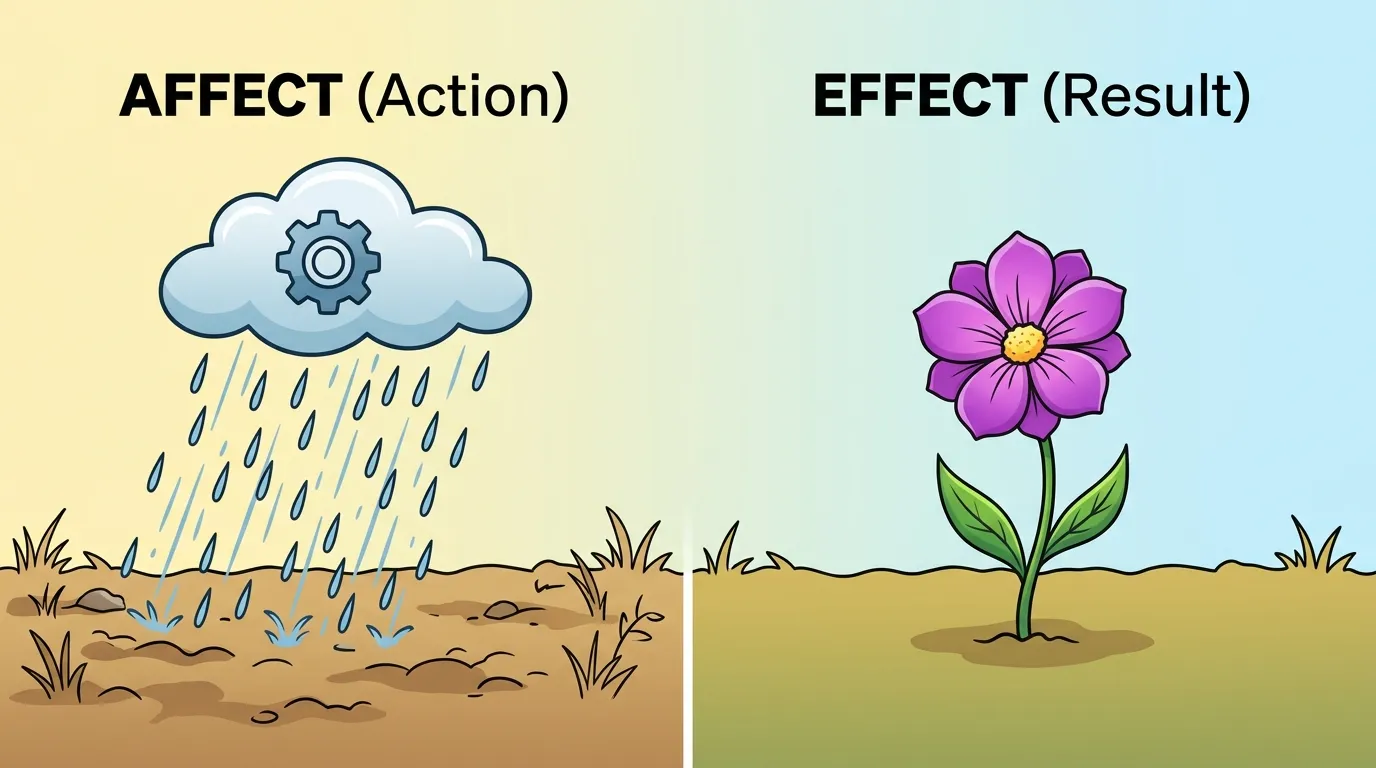
The basic memory trick
Affect = Action
Effect = End result
If something influences something else, you usually need affect.
If you are talking about the result, you usually need effect.
What Does Affect Mean?
Affect is most commonly a verb.
As a verb, affect means to influence, change, or have an impact on something.
Examples
- Lack of sleep can affect your concentration.
- Loud music affected my ability to study.
- The new law could affect small businesses.
- Her decision will affect the entire team.
- Rising prices are affecting consumers.
In each sentence, something is influencing something else.
Dictionary-style definition of affect
Affect (verb): to produce a change in or influence someone or something.
Common synonyms for affect
Depending on the context, synonyms include:
- influence
- change
- alter
- impact
- modify
- shape
- sway
- touch
- move
- transform
For example:
The news affected him deeply.
You could say:
The news moved him deeply.
However, the exact synonym depends on context.
What Does Effect Mean?
Effect is most commonly a noun.
It means a result, consequence, or outcome produced by an action, event, or condition.
Examples
- The medicine had a positive effect.
- The storm caused serious effects on transportation.
- What was the effect of the decision?
- Exercise can have a powerful effect on your mood.
- The new rule had little effect on sales.
Here, effect refers to what happened as a result of something.
Dictionary-style definition of effect
Effect (noun): a result or consequence caused by an action, event, or condition.
Common synonyms for effect
Depending on the sentence, you might use:
- result
- consequence
- outcome
- impact
- influence
- reaction
- impression
- change
- aftermath
- result
For example:
The decision had a major effect on the company.
You could replace effect with impact:
The decision had a major impact on the company.
The Main Difference Between Affect and Effect
The central difference is grammatical as well as semantic.
Affect usually describes the action of influencing something.
Effect usually describes the result of that influence.
Consider this simple example:
Heavy rain affected the game.
The rain influenced the game.
Now:
The rain had an unexpected effect on the game.
The result of the rain was unexpected.
A useful cause-and-result pattern is:
Cause → affects → result
For example:
The heat affected the plants, and the effect was visible within days.
This is not an absolute rule, but it works in most everyday situations.
Affect vs Effect Comparison Table
| Feature | Affect | Effect |
|---|---|---|
| Most common use | Verb | Noun |
| Basic meaning | Influence | Result |
| Common question | What did it influence? | What was the result? |
| Example | Noise can affect sleep. | Noise can have an effect on sleep. |
| Common synonym | Influence | Result |
| Typical pronunciation | uh-FEKT | ih-FEKT |
| Common expressions | affect behavior | cause an effect |
| Less common use | Noun in psychology | Verb meaning bring about |
Why Do People Confuse Affect and Effect?
There are several reasons.
They sound almost identical
In normal conversation, affect and effect can be difficult to distinguish by sound.
Their pronunciation is close enough that spelling becomes important.
They are related in meaning
Both words are connected to change, influence, and results.
For example:
Social media can affect behavior.
and
Social media can have an effect on behavior.
The two sentences communicate nearly the same basic idea.
Their grammatical roles can be reversed
The usual pattern is:
- affect = verb
- effect = noun
But affect can be a noun, and effect can be a verb.
These less common meanings make the distinction more complicated.
Affect as a Verb: How to Use It Correctly
Use affect when one thing influences another.
Everyday examples
Caffeine can affect your sleep.
The traffic affected my arrival time.
Your attitude can affect how people respond to you.
A sudden temperature change may affect the equipment.
Personal experience often affects our opinions.
In business writing
The merger could affect employee benefits.
Changes in demand may affect quarterly revenue.
In academic writing
Environmental conditions can affect plant growth.
Childhood experiences may affect adult behavior.
In journalism
The storm affected thousands of residents.
In sports
Rain affected the quality of the playing surface.
Notice the pattern: affect describes an influence.
Effect as a Noun: How to Use It Correctly
Use effect when referring to the result or consequence.
Everyday examples
The medicine had an immediate effect.
The new schedule had a positive effect on productivity.
The loud noise had a strange effect on the baby.
Business examples
The price increase had little effect on demand.
The decision could have a significant effect on the company.
Academic examples
Researchers examined the effect of stress on memory.
Sports examples
The injury had a major effect on his performance.
Affect vs Effect in the Same Sentence
Sometimes both words naturally appear together.
The heat affected the workers, and the effect was noticeable.
The new policy affected employee morale and had a positive effect on productivity.
Lack of sleep can affect concentration, with serious effects on academic performance.
These examples make the difference easier to see.
Affect = influence something.
Effect = the result of that influence.
The Less Common Meaning of Affect as a Noun
There is an important exception.
In psychology, psychiatry, and clinical writing, affect can be a noun.
Here, affect refers to the observable expression of emotion.
For example:
The patient displayed a flat affect.
The clinician noted a restricted affect.
This is a specialized use. It does not mean simply “emotion.”
A person’s affect refers more specifically to how emotion is outwardly expressed through things such as:
- facial expression
- tone of voice
- body language
- emotional responsiveness
Affect vs emotion
These terms are related but are not always interchangeable in professional contexts.
Emotion generally refers to an internal feeling or emotional state.
Affect can refer to the outward expression of that emotional state.
This distinction is especially relevant in clinical and psychological writing.
The Less Common Meaning of Effect as a Verb
Effect can also function as a verb.
As a verb, effect means to bring about, produce, or cause something to happen.
This use is more formal than the everyday noun use.
Examples
The organization hopes to effect meaningful change.
The new policy was designed to effect improvements in safety.
Leaders must work together to effect lasting reform.
Here, effect does not mean merely “influence.”
It means to bring about a result deliberately.
This distinction matters:
The policy affected change.
This means the policy influenced change.
The policy effected change.
This means the policy brought about change.
The second construction is formal and less common.
Affect vs Effect: Pronunciation
Pronunciation can add to the confusion.
Affect as a verb
Affect is generally pronounced:
uh-FEKT
The stress falls on the second syllable.
Example:
The decision may affect us.
Effect as a noun
Effect is generally pronounced:
ih-FEKT
Again, the second syllable receives the main stress.
Example:
The decision had an effect.
Affect as a noun
The psychological noun affect is commonly pronounced:
AF-ekt
The first syllable receives the stress.
This is one reason specialized vocabulary can sound slightly different from the familiar verb.
Affect vs Effect: Formality and Tone
Both words are standard English and are appropriate in professional writing.
Neither is inherently more formal than the other.
The difference comes from how they are used.
Casual writing
Does this affect you?
What effect did it have?
Business writing
The change may affect operating costs.
We need to evaluate its effect on revenue.
Academic writing
The study investigated how stress affects memory.
The researchers measured the effect of stress on memory.
Journalistic writing
The storm affected travel across the region.
The storm’s effects were felt throughout the region.
Technical writing
Temperature can affect battery performance.
The effect of temperature on battery performance was measured.
The words work naturally across many forms of writing.
Affect vs Effect in American and British English
There is no major American-versus-British spelling difference between affect and effect.
Both forms are standard in:
- American English
- British English
- Canadian English
- Australian English
- international English
The grammatical distinction is also broadly the same.
For example, American and British writers would both normally write:
The weather affected the event.
and:
The weather had an effect on the event.
Regional vocabulary can differ in other areas of English, but affect vs effect is not primarily a regional spelling issue.
Common Collocations With Affect
A collocation is a combination of words that commonly appear together.
Some useful combinations with affect include:
- affect behavior
- affect health
- affect performance
- affect results
- affect quality
- affect people
- affect decisions
- affect the outcome
- affect emotions
- affect relationships
- affect productivity
- affect the environment
- negatively affect
- positively affect
- directly affect
- significantly affect
Examples
Stress can negatively affect productivity.
The decision could significantly affect the outcome.
Poor lighting can affect workplace performance.
Common Collocations With Effect
Common expressions include:
- have an effect
- have a positive effect
- have a negative effect
- have a significant effect
- have a lasting effect
- cause an effect
- produce an effect
- side effect
- desired effect
- intended effect
- immediate effect
- long-term effect
- harmful effect
- beneficial effect
- cumulative effect
- ripple effect
Examples
The treatment had a positive effect.
The decision could have a lasting effect.
The medication caused several side effects.
Common Expressions and Phrases With Effect
Some familiar English expressions use effect.
In effect
Means currently operating or essentially true.
The new rules are now in effect.
Take effect
Means begin to operate or produce a result.
The new schedule will take effect next month.
Side effect
Means an additional consequence, often associated with medicine or treatment.
Drowsiness is a common side effect.
Cause and effect
Describes the relationship between an action or event and its result.
The lesson focused on cause and effect.
For effect
Means doing something primarily to create a particular impression.
He paused dramatically for effect.
Personal effects
Means someone’s belongings or possessions.
Please collect your personal effects before leaving.
Common Mistakes With Affect and Effect
Mistake: “The weather effected our plans.”
Incorrect in normal usage.
Better:
The weather affected our plans.
Why? The weather influenced the plans.
Mistake: “The new rule had a positive affect.”
Usually incorrect.
Better:
The new rule had a positive effect.
Why? You are describing the result.
Mistake: “How did it effect you?”
Usually incorrect.
Better:
How did it affect you?
Why? The question asks how something influenced you.
Mistake: “What affect did it have?”
Usually incorrect.
Better:
What effect did it have?
You are asking about the result.
Awkward vs Natural Examples
| Awkward or Incorrect | Natural Version |
|---|---|
| The noise effected my sleep. | The noise affected my sleep. |
| It had a negative affect. | It had a negative effect. |
| How did the news effect her? | How did the news affect her? |
| What affect did the decision have? | What effect did the decision have? |
| The medicine affected side effects. | The medicine caused side effects. |
| The policy effected consumer behavior. | The policy affected consumer behavior. |
The last example is worth noting. Effected can be grammatically correct in specialized contexts, but it means “brought about,” not simply “influenced.”
Affect vs Effect Memory Tricks
Here are several ways to remember the difference.
Trick 1: A = Action
Think:
Affect = Action
A verb describes an action.
Stress affects sleep.
Trick 2: E = End result
Think:
Effect = End result
Stress has an effect on sleep.
Trick 3: Replace the word
If you can replace the word with influence, use affect.
The weather influenced the game.
The weather affected the game.
If you can replace it with result, use effect.
The result was unexpected.
The effect was unexpected.
Trick 4: Ask a question
Ask:
Is something influencing something?
→ Affect
Are you talking about the result?
→ Effect
A Simple Affect vs Effect Decision Guide
When you’re unsure, follow these steps.
Step 1: Look at the grammatical role
Is the word acting as a verb?
If yes, affect is probably correct.
Is it acting as a noun?
If yes, effect is probably correct.
Step 2: Test “influence”
The problem will affect sales.
Can you say:
The problem will influence sales?
Yes.
Use affect.
Step 3: Test “result”
The problem had an effect on sales.
Can you replace effect with result?
Yes.
Use effect.
Step 4: Check for exceptions
If you are writing about psychology, affect may be a specialized noun.
If you are writing formal language about bringing about change, effect may be a verb.
Affect vs Effect in Different Fields
Business
Rising costs may affect profits.
Rising costs could have a serious effect on profits.
Education
Anxiety can affect test performance.
Anxiety can have a measurable effect on test performance.
Medicine
The drug may affect blood pressure.
The drug may cause several side effects.
Psychology
Childhood experiences can affect adult behavior.
The patient showed a restricted affect.
Science
Temperature can affect chemical reactions.
Researchers studied the effect of temperature.
Sports
Rain affected the match.
The rain had a major effect on the playing surface.
Technology
A software update may affect performance.
The update had an unexpected effect on battery life.
Journalism
The policy could affect thousands of workers.
Its economic effects may last for years.
Affect vs Effect in Blogging and Online Writing
For bloggers and content writers, clarity matters more than complicated vocabulary.
Prefer:
Social media can affect your sleep.
over a more complicated construction such as:
Social media consumption can produce alterations in sleep-related outcomes.
Likewise:
The effect of poor sleep can be serious.
is usually clearer than:
The resulting consequence of inadequate sleep may be substantial.
Using affect and effect correctly helps your writing sound natural without making it unnecessarily formal.
Related Words You Should Know
Understanding related terms can make the distinction easier.
Influence
Influence can be both a noun and a verb.
Parents can influence their children’s choices.
Impact
Impact can also function as both a noun and a verb.
The decision had a major impact.
The decision impacted the company.
Consequence
A consequence is a result that follows from something.
Every decision has consequences.
Outcome
An outcome is the final result of an event or process.
The outcome was better than expected.
Result
A result is something that happens because of another action or event.
The result surprised everyone.
These words overlap with affect and effect, but they do not always fit the same grammatical structure.
Antonyms of Affect and Effect
Because context matters, their antonyms vary.
Possible opposites of affect as “influence” include:
- leave unchanged
- ignore
- disregard
- preserve
- maintain
Possible opposites of effect as “result” might include:
- cause
- source
- origin
- beginning
There is no single perfect antonym for either word in every sentence.
Affect vs Effect: Important Edge Cases
English grammar is not always as simple as “A is verb and E is noun.”
“Affect” as a noun
In psychological contexts:
The patient’s affect appeared calm.
This is a legitimate noun.
“Effect” as a verb
In formal contexts:
The organization hopes to effect reform.
This means the organization hopes to bring about reform.
“Effect” meaning appearance
Effect can also refer to a visual, audio, or artistic result.
The lighting created a dramatic effect.
The film used special effects.
“Affect” meaning emotional influence
As a verb:
The criticism deeply affected her.
Here, affect can mean emotionally move or influence someone.
How to Choose Between Affect and Effect in Professional Writing
For clear professional communication, use the standard forms unless a specialized meaning is intended.
Use affect when you mean:
- influence
- change
- alter
- emotionally influence
Use effect when you mean:
- result
- consequence
- outcome
- impact
- visual or artistic result
Use specialized forms carefully
Use affect as a noun mainly in psychological or clinical contexts.
Use effect as a verb mainly when you mean bring about or cause to happen, especially in formal writing.
20 Everyday Examples of Affect vs Effect
- Lack of sleep can affect your mood.
- Lack of sleep can have a negative effect on your mood.
- The rain affected our plans.
- The rain had little effect on the event.
- Noise can affect your concentration.
- Noise can have a harmful effect on concentration.
- The decision affected everyone.
- The decision had a major effect on everyone.
- Stress can affect your health.
- Stress can have a long-term effect on health.
- The new rule affected employees.
- The new rule had an unexpected effect on employees.
- Exercise can affect your energy level.
- Exercise can have a positive effect on energy.
- The delay affected the schedule.
- The delay had a serious effect on the schedule.
- Social pressure can affect our choices.
- Social pressure can have a strong effect on our choices.
- The announcement affected public opinion.
- The announcement had a noticeable effect on public opinion.
Frequently Asked Questions About Affect vs Effect
Is it affect or effect?
Usually, use affect as a verb meaning influence and effect as a noun meaning result.
The weather affected the trip.
The weather had an effect on the trip.
What is the easiest way to remember affect vs effect?
Remember:
Affect = Action
Effect = End result
If something influences something, use affect.
If you are talking about the result, use effect.
Is affect always a verb?
No. Affect can be a noun in psychology and clinical contexts. In that specialized usage, it refers to the observable expression of emotion.
Is effect ever a verb?
Yes. Effect can be a verb meaning to bring about, cause, or produce something.
For example:
The leaders hoped to effect meaningful change.
This use is more formal than the common noun effect.
What is the difference between “affect” and “impact”?
Affect usually functions as a verb meaning “influence.”
Impact can be either a noun or a verb and often refers to a significant influence or result.
The policy affected sales.
The policy had a major impact on sales.
Is “positive affect” correct?
It can be correct in psychological or clinical writing, where affect is a noun referring to observable emotional expression.
In ordinary writing, however, if you mean a favorable result, you probably want:
a positive effect
Is “effected” correct English?
Yes, but it has a specific meaning.
Effected is the past tense of the verb effect, meaning brought about or caused.
The reforms effected major changes.
Do not use effected simply because you mean “influenced.” For that meaning, use affected.
Which is correct: “affect on” or “effect on”?
In standard everyday usage, effect on is the usual phrase.
The decision had an effect on sales.
You would normally write:
The decision affected sales.
not:
The decision had an affect on sales.
Which is correct: “have an affect” or “have an effect”?
Usually:
have an effect
For example:
Exercise can have a positive effect on your health.
Affect is not normally the noun you want in this construction unless you are using the specialized psychological meaning.
Conclusion: Affect vs Effect Made Simple
The difference between affect vs effect becomes much easier when you focus on their usual grammatical roles.
Affect is usually a verb meaning to influence or change something:
The weather affected our plans.
Effect is usually a noun meaning the result or consequence:
The weather had an unexpected effect on our plans.
The two words do have less common uses. Affect can be a noun in psychology, where it refers to observable emotional expression. Effect can be a formal verb meaning to bring about or cause something.
For everyday American English, business writing, academic work, journalism, blogging, and casual communication, the safest rule is:
Affect = influence
Effect = result
When in doubt, replace the word with influence or result. If “influence” fits, affect is probably right. If “result” fits, effect is probably right.
Once you learn that simple distinction—and remember the two specialized exceptions—you can use affect and effect confidently in almost any writing situation.