It was 8:40 in the morning when the day started interrupting itself. First, a colleague stopped by your desk and said, “Can you cover my shift on Friday?” You started to say yes — and then you remembered the dentist. “Never mind,” you said. “I can’t.” At 10:15, a meeting went sideways, and someone said, “Never mind the budget for now, let’s fix the timeline.” At lunch, you texted a friend, “Never mind what I said earlier, I found the keys.” By dinner, you had used the same two words five times, and each time they meant something slightly different. That is the quiet power of never mind: two small words that do an enormous amount of conversational work — and one small spelling decision that trips up even confident writers.
Five Interruptions, One Phrase
The phrase shows up in so many situations that it is worth seeing them side by side, because each one reveals a different job the phrase does. The first job is cancellation: you withdraw a request. “Can you help me move on Saturday? Actually, never mind, I’ll hire someone.” The second job is dismissal: you tell someone to stop worrying. “Never mind, it’s not important.” The third job is redirection: you tell someone to ignore a detail and focus on the main thing. “Never mind the noise, just keep working.” The fourth job is self-correction: you take back something you just said. “Never mind what I said earlier, I was wrong.” The fifth job is consolation: you tell someone their mistake does not matter. “Never mind, everyone makes that mistake.”
Notice what all five have in common. In every case, the phrase stops something: a request, a worry, a distraction, a statement, a feeling of guilt. Never mind is a conversational brake pedal. It tells the other person: drop that thread, we are moving on. That is why it appears so often in fast, spoken, everyday English. It is the phrase people reach for when plans change mid-sentence, which is to say, constantly.
The grammar is simple once you see it. Never is an adverb meaning “at no time” or “not.” Mind is a verb meaning “to pay attention to” or “to care about.” Together, the phrase is an instruction: do not pay attention to that. Do not care about that. Let it go. The two words work as a unit, but they remain two words, and that fact matters for the spelling question.
The Two-Word Standard
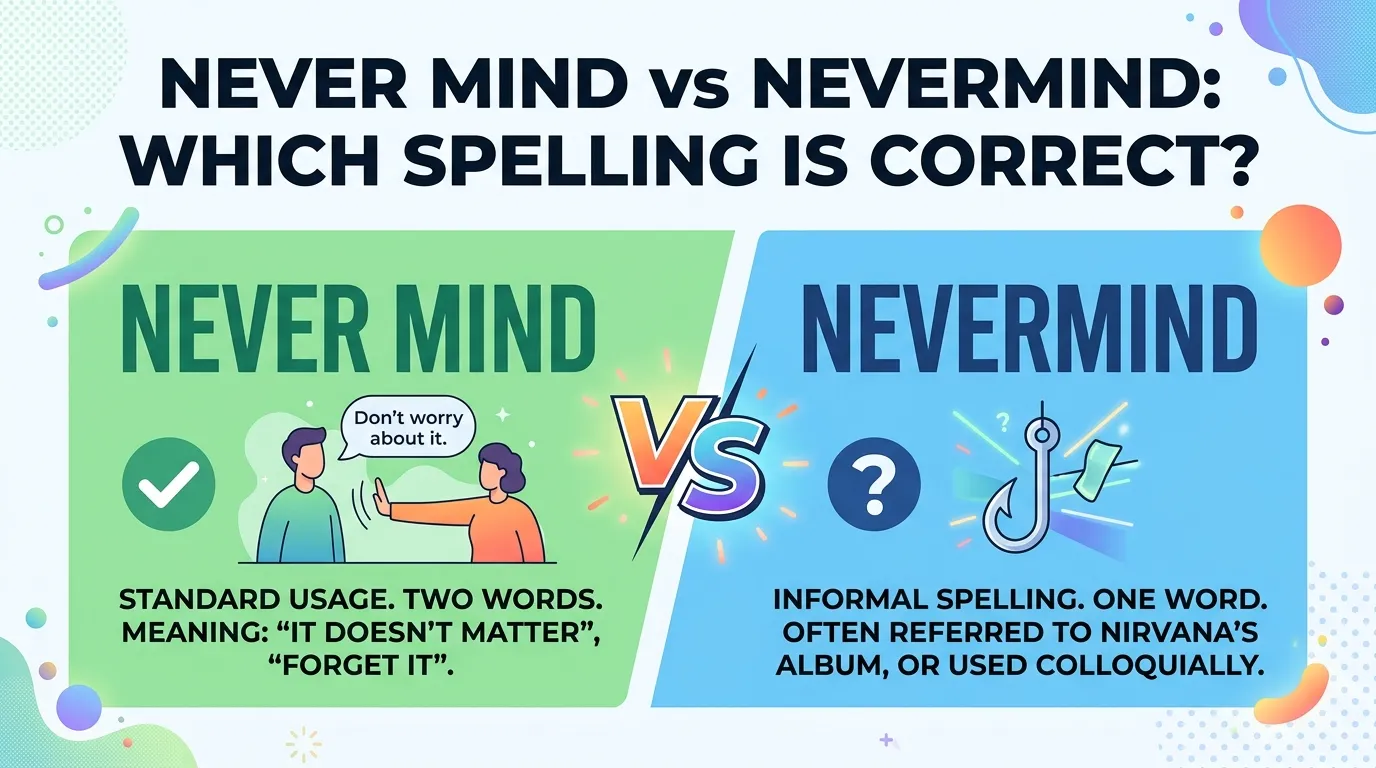
In standard English, the phrase is written as two words: never mind. This is the form used in newspapers, books, business emails, school assignments, and every other context where correctness matters. “Never mind. I found my keys.” “Never mind what I said earlier.” “If you’re busy, never mind.” “Never mind; I’ll handle it myself.” The two-word form is the safe choice in every register, from the most formal to the most casual. If you are ever unsure, write it as two words, and you will be right.
The one-word form, nevermind, is a different story. It appears in informal writing, in text messages, in social media posts, and in some creative contexts. It is not the standard spelling for the everyday phrase, and editors will correct it. But it is not entirely without standing. It shows up in proper names and titles — most famously the Nirvana album Nevermind (1991), which put the one-word form in front of millions of people and is probably the single biggest reason the spelling survives. It also appears in some older usage and in the names of bands, books, and products. In those contexts, the one-word form is correct because it is a name, and names follow their own rules.
There is also a subtle grammatical point. When never mind is used as a verb phrase — telling someone to disregard something — it is two words. When nevermind appears as a noun in very informal usage (“with a nevermind attitude”), it is one word, but this use is rare, nonstandard, and best avoided in careful writing. The practical rule is blunt: if you are using the phrase to tell someone to forget something, write it as two words.
Why the One-Word Form Feels Right
The confusion is understandable, because English is full of phrases that fused into single words over time. Never mind sounds like one word when spoken quickly — the stress falls on never, and mind trails behind it. And English has a long history of merging common phrases: to day became today, to morrow became tomorrow, good bye became goodbye, no body became nobody. A writer who merges never mind into nevermind is following a real historical pattern. The pattern just has not finished its work on this particular phrase yet.
There is also the Nirvana effect. When a word appears on one of the best-selling albums of all time, it gains a familiarity that makes it feel standard. Millions of people have seen Nevermind on a cover, on a poster, on a T-shirt. Familiarity breeds acceptance, and acceptance breeds imitation. But a band name is not a grammar rule. The album title is a deliberate stylistic choice, not evidence that the one-word form has become standard English. Dictionaries still list the phrase as two words, and style guides still prescribe two words.
A third factor is the keyboard. In fast typing — texts, chats, comments — the space bar is the easiest key to skip. Nevermind is what never mind looks like when the space does not register. Autocorrect rarely catches it, because nevermind is a recognized word in the sense that it appears in titles and names. The typo survives because the tools do not flag it.
Never Mind Across the Registers
The phrase behaves differently depending on where it appears, and knowing the register helps you use it well. In casual conversation, it is a softener: “Never mind, forget I asked.” In business writing, it is a redirect: “Never mind the formatting for now; focus on the content.” In formal writing, it appears less often, because formal prose prefers more explicit phrasing: “Disregard my previous message” or “Please ignore the earlier figures.” In literature, it can carry real emotional weight: a character who says “never mind” is often hiding something, or giving up on being understood.
The phrase also has a close cousin worth knowing: never you mind, an older, more commanding form meaning “don’t concern yourself with that.” “Never you mind where I got it.” It is old-fashioned and slightly stern, and it survives mostly in fiction and in regional speech. And there is the related expression pay no mind, meaning “ignore it”: “Pay no mind to the critics.” Both are part of the same family of dismissal phrases, and both remind us that mind in this context means “attention,” not “brain.”
One more distinction matters: never mind as a phrase versus nevermind as a name. If you are writing about the Nirvana album, write Nevermind, one word, capitalized, because that is its title. If you are writing about anything else — an email, an essay, a text, a report — write never mind, two words. The context decides, and the context is almost always the phrase.
Never Mind in Pop Culture
The phrase has had a long career in songs, films, and books, and its appearances reveal how flexible it is. In Leonard Cohen’s “Anthem,” the line “forget your perfect offering” does the work of never mind — a dismissal that becomes an acceptance. In everyday dialogue in films, characters say “never mind” when they decide not to explain themselves, and the audience understands instantly: the character is closing a door. The phrase is a screenwriter’s shortcut for “this does not matter anymore,” and it works because every viewer has said it a hundred times.
The Nirvana connection deserves a closer look, because it is the reason so many people believe the one-word form is standard. The album Nevermind was released in 1991 and became one of the best-selling albums of all time. Its title was a deliberate play on the phrase: the baby on the cover swimming toward a dollar bill is chasing something the band suggests is not worth minding. The title’s spelling was a stylistic choice — a single word that looks like a brand, not a phrase. It worked as a title. It did not change the grammar. Dictionaries did not revise their entries because a band named an album. But millions of people saw the one-word form on a cover, on a poster, on a T-shirt, and absorbed it as normal. Familiarity is a powerful teacher, even when it teaches the wrong lesson.
The Space That Stays
Here is the memory hook, and it is the simplest one in this whole batch of articles: never mind keeps its space because it is an instruction made of two actions. Never is the “don’t.” Mind is the “pay attention.” Two actions, two words. When the words fuse, the instruction blurs. Keep them apart, and the meaning stays sharp.
Another way to remember it: the phrase is a sentence in miniature. “Never mind” is a complete imperative: subject implied (you), verb (mind), modifier (never). You would not fuse the words of any other imperative. You would not write “dontworry” or “forgetit.” Never mind deserves the same respect. It is a small sentence, and small sentences keep their spaces.
So the next time the day interrupts itself — and it will, by 8:40 tomorrow morning at the latest — you will know what to write. The colleague, the meeting, the text, the apology: all of them get the same two words, with the same space between them. Never mind. Two words. One brake pedal. And the space is the whole point.










