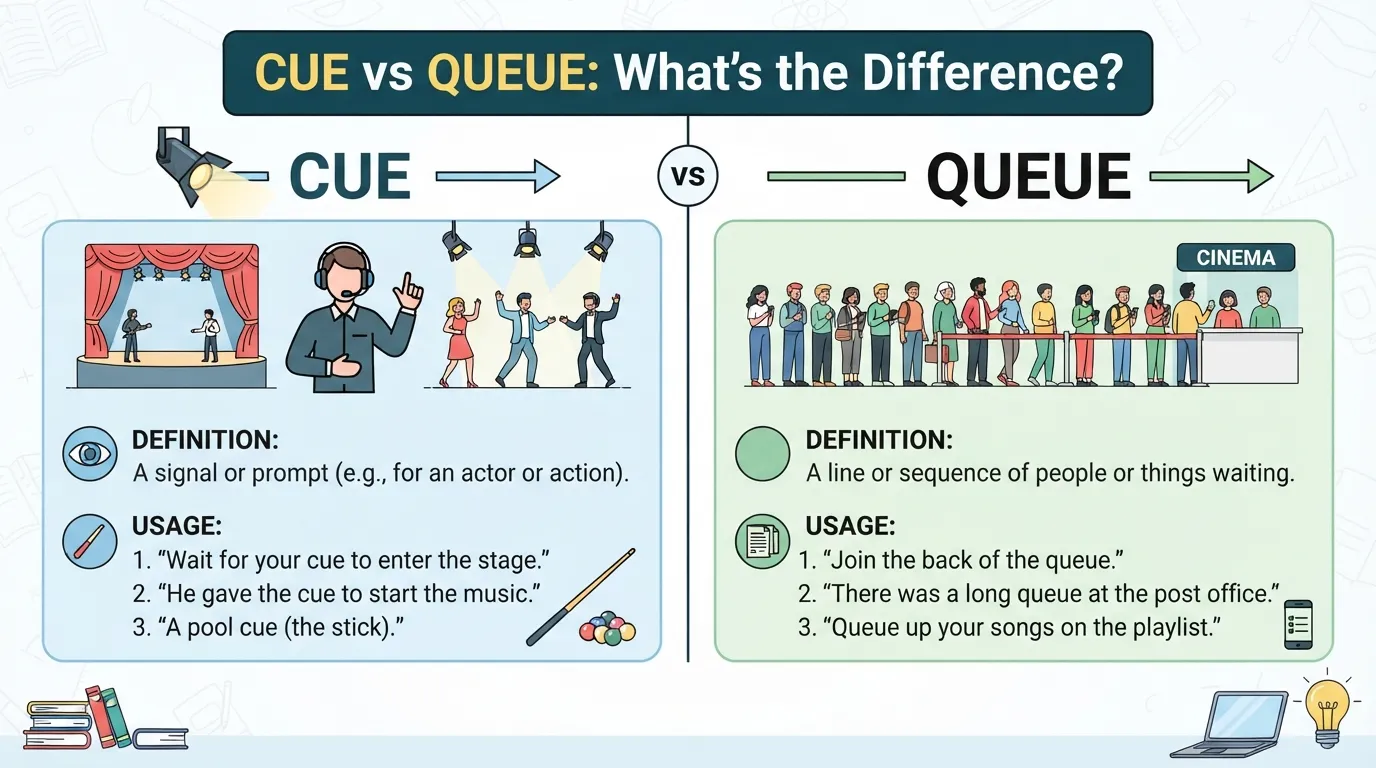
It is 7:58 on opening night. In the wings, the stage manager holds a prompt book and watches the actor playing the messenger. The actor’s entrance depends on a single line from the lead — the moment she says “the letter has arrived,” he walks on. That line is his cue. Out front, in the lobby, a different drama is unfolding: a line of latecomers stretches from the box office to the street, waiting for returned tickets. That line is a queue. The two words sound exactly alike — KYOO — but they have nothing to do with each other. One is a signal. The other is a line. And the theatre, with its backstage and its front-of-house, is the perfect place to keep them straight, because it holds both in a single building.
Cue and queue are homophones: same sound, different spelling, different meaning. The confusion between them is one of the most common in English, and it survives because the words are both short, both frequent, and both plausible in many sentences. “Please cue up” and “please queue up” mean different things, but a listener hears the same sounds. Only the spelling — and the context — tells them apart.
Backstage: The World of the Cue
A cue is a signal, prompt, hint, or indication that tells someone to act, or that something is about to happen. The theatre is its native habitat. Actors wait for cues: a line, a sound, a lighting change, a gesture. The stage manager cues the lights, the sound, the scene change — gives the signal that sets each one in motion. A missed cue is a small disaster: an actor enters late, a spotlight comes up on an empty stage, a sound effect fires in silence.
But the cue’s territory is much larger than the stage. A teacher’s raised eyebrow is a cue for the class to quiet down. A friend’s yawn is a cue that the visit is ending. In music, a conductor’s nod cues the brass section. In conversation, a pause can be a cue — “I waited for a cue that she wanted to talk about it, and when it didn’t come, I changed the subject.” In psychology, a cue is any stimulus that triggers a learned response: the smell of a bakery cues hunger, a phone’s buzz cues a glance at the screen. In every case, the cue is information that prompts action.
As a verb, cue means to give such a signal: “The director cued the actor,” “The host cued the applause,” “The software cued the next video.” The verb is regular — cues, cued, cuing (or cueing; both spellings appear, with cueing more common in American usage). A related noun, cue card, is the card held off-camera with lines or prompts for a speaker — the literal ancestor of the teleprompter. And then there is the other cue, the billiard stick, which is a separate word with a separate history (from the French queue, meaning tail — a story that collides entertainingly with the other queue below). The billiard cue has nothing to do with signals; it is a stick, and context almost always separates it.
Out Front: The World of the Queue
A queue is a line or sequence of people or things waiting — for service, for processing, for movement, for access. The lobby line on opening night is the classic image, and in British English it is the everyday word for it: Britons queue at the bus stop, the post office, the supermarket checkout. In American English, line is the more common everyday word (“stand in line”), while queue survives in technical and formal contexts — and in the fixed phrase “queue up.”
The word’s second life is in computing, where it names a data structure: a first-in, first-out sequence, like a line at a shop. Print jobs sit in a printer queue. Songs sit in a playlist queue. Messages sit in a message queue waiting to be processed. The metaphor is exact: the first job in is the first job out, just as the first person in line is the first served. Computer scientists even use the verb: “The system queued the request.” If you have ever watched a download “queued” behind three others, you have seen the word doing its technical job.
There is also a third, smaller use: queue as a braid or pigtail, from the same French root as the billiard cue. A queue hairstyle — a long braid worn at the back, once common among soldiers and sailors — is now archaic, but it appears in historical novels and costume descriptions. It is the same word as the waiting line, borrowed from French queue (tail), because a line of people, like a braid, trails behind its head. The billiard cue comes from the same French tail-word, via the tapered shape of the stick. Three meanings, one tail.
Two Histories, One Sound
The two words arrived at the same pronunciation from different directions, which is why the pair feels so arbitrary. Cue the signal comes from the Latin letter Q — or so the leading theory goes. In early modern theatre, actors’ scripts marked entrances with a q, short for Latin quando (“when”), indicating when to enter. The letter q, pronounced “cue,” became the word for the signal itself. Other theories point to French queue (tail) — the tail end of a line as the signal — but the quando story is the one most etymologists favor, and it has a pleasing logic: the cue is, literally, the “when” of the performance.
Queue the line comes from Old French coe or queue, meaning tail, from Latin cauda (tail). A line of waiting people was imagined as a tail trailing from a door. The spelling kept its French shape — including the silent ueue — long after the pronunciation simplified to KYOO. That is why queue looks so much longer than it sounds: it carries five letters for one syllable, four of them silent. It is one of English’s great spelling jokes, and every learner of the language has tripped over it.
The shared pronunciation is a coincidence of sound change, not of origin. The two words are homophones by accident, like pair / pear or right / write. English is full of such collisions, and they are the reason context — not spelling rules — is the real tool for telling homophones apart.
British Queues and American Lines
The regional difference between the two words is one of the most useful things to know about them, because it affects which word your reader expects. In Britain, queue is the default word for a waiting line in every context: “There’s a queue at the till,” “Join the queue,” “Queue here.” The British also have a cultural reputation for orderly queuing, celebrated in jokes, documentaries, and at least one Olympic opening ceremony. To queue is, in British English, simply what people do.
In American English, line rules the everyday: “There’s a line at the register,” “Get in line,” “Cut in line.” Queue in American speech sounds technical or slightly formal — at home in computing, aviation (“the plane is queued for takeoff”), and business (“your call is queued”), but less natural at the grocery store. An American who says “queue” at the supermarket will be understood, but may sound faintly British or technical. A Briton who says “line” at the supermarket will also be understood, but may sound faintly American.
Cue, by contrast, is the same on both sides of the Atlantic: a signal everywhere, in theatre, conversation, and psychology. There is no regional split to navigate. If you mean “signal,” cue is the word in London, New York, Sydney, and Toronto alike.
The Test That Settles It in a Second
When you are writing and the two words blur, use this test: replace the word with its meaning. If you can replace it with signal or prompt, write cue. If you can replace it with line or waiting sequence, write queue. “The actor waited for her ___” — signal fits, so cue. “We stood in a ___ for tickets” — line fits, so queue. The test works because the two meanings never overlap: nothing is both a signal and a line.
Watch out for the two most common traps. The first is cue up versus queue up. Cue up means to prepare or prompt: “Cue up the next song” (get it ready to play), “Cue up the slides.” Queue up means to join a line: “We queued up outside the bakery.” In music apps, both appear — a song can be “cued up” (prepared) and sit “in the queue” (in the waiting sequence) — which is why the confusion is worst there. The second trap is the phrase “take a cue from”: “Take a cue from her and arrive early” means “follow her example” — it is a signal word, always cue, never queue. There is no phrase “take a queue from.”
One final image to carry away: the theatre. Backstage, the stage manager gives the cue. Out front, the audience stands in the queue. The cue starts the show; the queue waits for it. If you can picture that building — signals behind the curtain, lines in the lobby — you will never mix the two words again. The spelling of queue may be absurd, five letters for one syllable, but the distinction it marks is perfectly sensible: a signal is not a line, and a line is not a signal, even when they sound exactly the same.










