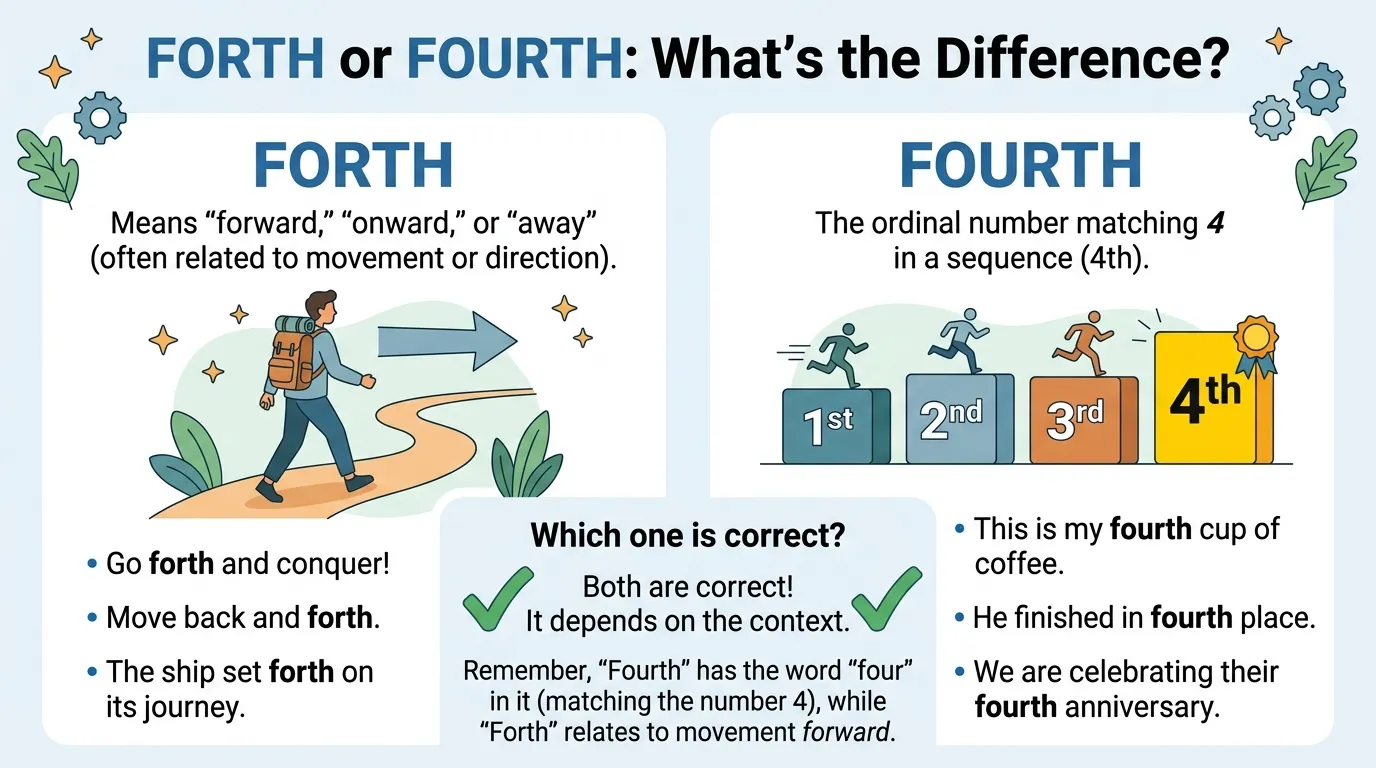
The trail guide’s notebook had two entries on the same page, and they looked like a typo. The first read: “Fourth checkpoint: the spring.” The second read: “From here, the trail goes forth into the pines.” The guide’s apprentice stared at the two words. Fourth and forth sound almost identical, share most of their letters, and mean completely different things. Fourth is the number four in sequence — first, second, third, fourth. Forth is a direction — forward, onward, outward. Confusing them is easy in speech, because the ear cannot tell them apart. In writing, the difference is the whole meaning of the sentence.
Checkpoint Four: Fourth as a Number
Fourth is an ordinal number: the form of four that marks position in a sequence. The fourth checkpoint, the fourth chapter, the fourth floor, the fourth attempt. It answers the question “which one in order?” Like other ordinals, it can act as an adjective (“the fourth page”), a noun (“she finished in fourth”), or part of a fraction (“a fourth of the trail mix” — though quarter is more common for fractions in everyday speech).
The spelling follows the ordinal rule: take the cardinal number and add -th. Four becomes four-th. Six becomes sixth, seven becomes seventh, ten becomes tenth. The exceptions — first, second, third, fifth (which changes ve to f), twelfth — are few, and fourth is not one of them. If you can spell four, you can spell fourth: it is four plus th, with nothing dropped and nothing added. The word also appears in dates and titles: July 4th, the Fourth of July, the fourth movement of a symphony, the fourth quarter of a game.
Into the Pines: Forth as a Direction
Forth is a different creature. It is an adverb meaning forward, onward, outward, or away from a starting point. Hikers go forth. Ideas come forth. Witnesses step forth. The word has an old, slightly formal flavor — it belongs to speeches, scripture, and literature more than to everyday conversation, where forward, out, or on usually do the job. “They went forth” sounds like a line from a novel. “They went forward” sounds like a trail report.
The history explains the flavor. Forth comes from Old English forþ, related to fore and before — the family of words about what lies ahead. It is a cousin of forward and of forthcoming (coming forth, approaching). In older English, forth was an everyday word. Over centuries, forward and out took over most of its jobs, and forth retreated into fixed phrases and formal registers. What remains is a word with a deliberate, almost ceremonial sound.
The Switchbacks: Phrases That Keep Forth Alive
Most modern encounters with forth happen inside fixed expressions, and learning those expressions is the fastest way to master the word. Back and forth is the most common: repeated movement between two places or positions — the switchback trail goes back and forth across the hillside, the committee went back and forth on the route for weeks. And so forth means “and other similar things” — “maps, compasses, water bottles, and so forth” — and is the formal cousin of etc.
Go forth means to set out, especially on a mission: “The hikers went forth at dawn.” Come forth means to emerge: “A spring came forth from the rocks.” Bring forth means to produce: “The valley brought forth wildflowers.” Set forth means to present or explain: “The guide sets forth the trail rules.” Put forth means to propose: “She put forth a new route.” Each phrase uses forth in its directional sense — outward, forward, into the open. None of them has anything to do with the number four. And none of them can swap in fourth: “back and fourth” is a common misspelling, and it is wrong.
The Ear’s Trick: Why the Sound Gives No Help
In most accents, fourth and forth are pronounced almost identically — FORTH — with the only difference being the u sound that some careful speakers preserve in fourth. In rapid speech, even that difference vanishes. The result is a classic homophone trap: the ear gives no reliable signal, and the writer must rely on meaning alone.
The misspellings follow a predictable pattern. Writers who mean fourth but think of forth write “she came in forth place” — wrong, because a place in a ranking needs the ordinal. Writers who mean forth but think of fourth write “they went fourth into the pines” — wrong, because a journey needs the directional adverb. Both errors sound right and look nearly right, which is why they survive proofreading.
Forth in Literature: From Shakespeare to the King James Bible
Forth is at home in the oldest layers of English literature, and meeting it there is the best way to feel its flavor. Shakespeare’s characters go forth, come forth, and set forth constantly: “Friends, Romans, countrymen, lend me your ears” is not a forth line, but “go forth” echoes through the plays as the standard way to say “set out.” The King James Bible uses forth hundreds of times: “And God said, Let there be light,” and the light went forth. “Go ye forth” is the Bible’s standard command for setting out on a mission. The word’s biblical and Shakespearean weight is why it still sounds ceremonial today — it carries four centuries of sermons and soliloquies in its single syllable.
The word also survives in place names and mottos. The Firth of Forth is the estuary of the River Forth in Scotland — the river’s name is a different word, from a Celtic root, but the coincidence has confused visitors for centuries. School mottos and graduation speeches still use “go forth” as the standard farewell, because the old word lends gravity that “go forward” does not. A commencement speaker who says “go forth and make a difference” is borrowing the Bible’s command and Shakespeare’s stage direction in a single phrase.
Forthwith and Henceforth: Forth’s Children
Two more words deserve a mention, because they preserve forth in modern use. Forthwith means immediately, at once — “the payment is due forthwith” — and it is forth plus with, the sense being “forward with it, without delay.” It survives in legal and formal writing, where it adds urgency to a demand. Henceforth means from this time onward — “henceforth, all meetings will be recorded” — and it is hence (from here) plus forth (forward). It survives in proclamations, contracts, and formal announcements. Both words preserve the directional core of forth, and neither has any connection to the number four. If you meet them in a contract or a proclamation, read them as time words built from a direction word: forthwith looks forward to immediate action, henceforth looks forward from this moment.
Fourth in Music and Sport: Movements, Quarters, and Places
Fourth has a busy life in music and sport, and those contexts show the ordinal at its most natural. In music, the fourth movement of a symphony is the finale — Beethoven’s Ninth ends with the fourth movement, the “Ode to Joy.” The fourth string of a violin is the G string, the lowest. A perfect fourth is the musical interval from C to F, a distance of five semitones, and it is the sound of the first two notes of “Here Comes the Bride.” In sport, the fourth quarter is the final period of a basketball or American football game, and the fourth place is the cruellest finish — one place off the podium, the place the trail guide’s apprentice knew from the race that opened this article.
The word also appears in the phrase “fourth estate” — the press, regarded as a fourth power alongside the clergy, the nobility, and the commoners — and in “fourth dimension,” the dimension of time in physics, and in “fourth wall,” the imaginary barrier between actors and audience that gets “broken” when a character addresses the camera. In every one of these, the word is the ordinal, the number four in sequence, and the spelling is fourth, with the u and the th intact. The trail guide’s checkpoint, the symphony’s finale, and the actor’s wall all share the same word, and the same spelling.
The Meaning Test: One Question, Two Answers
The defense is a meaning check, not a spelling rule. Ask: does the sentence involve the number four, a ranking, or an order? If yes, write fourth — the one with four in it. Does the sentence involve moving forward, outward, or onward? If yes, write forth — the one without u, because it has nothing to do with “four” and needs no u to prove it. The mnemonic writes itself: fourth contains four; forth contains fort, as in a fort you march forth from.
Try it on a few sentences. “This is the ___ checkpoint” — counting, so fourth. “The trail goes back and ___” — movement between positions, so forth. “Read the ___ paragraph” — ordering, so fourth. “The committee put ___ a proposal” — proposing, bringing outward, so forth. Each time, the meaning test settles it in a second. The words may sound the same, but they never mean the same — and once the meanings are separate in your mind, the spellings will stay separate on the page.