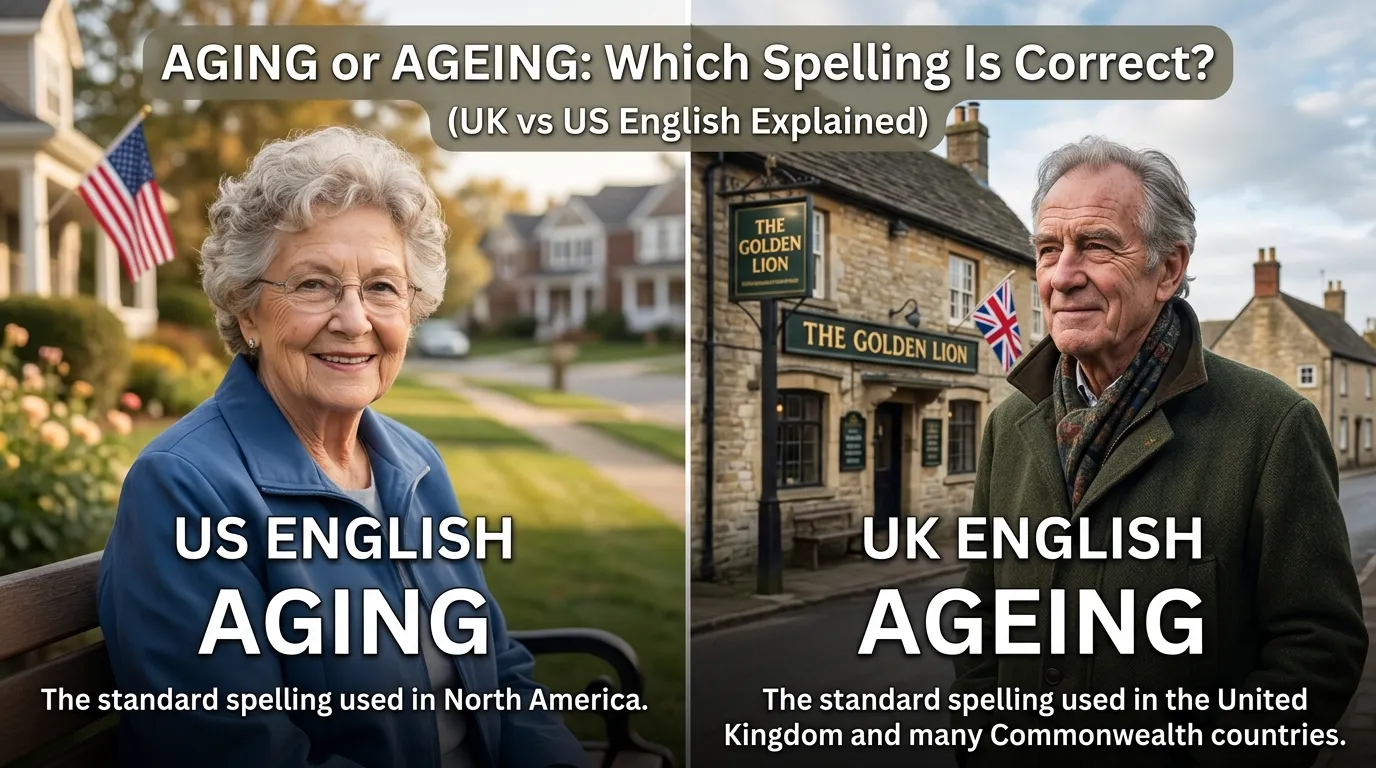
The restoration garage smelled of oil, leather, and old paint. On the lift sat a 1967 roadster, its British racing green paint faded by fifty summers in the sun. The owner, an American who had bought the car from a collector in London, handed the mechanic two documents: the original British service manual, which described “the ageing paintwork,” and the American restoration guide, which described “the aging paintwork.” Same car. Same paint. Two spellings. Both are correct. Aging is the standard American spelling. Ageing is the standard British spelling. The difference is one letter e, kept or dropped, and the rule behind it is one of the most useful spelling rules in English.
The Lift: What Aging Means on a Car — and Everywhere Else
Aging — or ageing — is the present participle and gerund of the verb age, and also an adjective. As a verb form, it describes the process of growing older or maturing: “The paint is aging.” “The wine is ageing in oak barrels.” “The population is aging.” As an adjective, it describes something that is growing older: “an aging car,” “an ageing population,” “aging parents.” As a noun, it names the process itself: “aging is inevitable,” “the ageing of the paint.”
The word travels far beyond the garage. In medicine, aging is the study of growing old — gerontology, the biology of senescence, the search for what time does to cells. In demographics, the aging population is one of the biggest stories of the century, as falling birth rates and longer lives reshape societies. In food and drink, aging is a craft: cheese aged in caves, whiskey aged in barrels, beef dry-aged for weeks. In materials, aging is what the sun, the rain, and time do to paint, leather, and rubber. One word, many workshops, one spelling question.
The E That Stays or Goes: The Drop-E Rule
The general rule for verbs ending in silent e is simple: drop the e before adding -ing. Make becomes making. Write becomes writing. Move becomes moving. Age should become aging — and in American English, it does. The e drops, the -ing attaches, and the word is aging. American spelling follows the rule cleanly.
British English keeps the e: ageing. Why? Because British spelling tradition preserves the e in a small set of words where dropping it would cause confusion or where the e marks a soft sound. The same pattern appears in dyeing (kept, to distinguish from dying), singeing (kept, to distinguish from singing), and tingeing. In ageing, the kept e also preserves the soft g sound — the g in age sounds like j, and the e is part of what signals that softness. British spelling keeps the signal. American spelling trusts the reader to know it.
Two Manuals, One Car: The Regional Map
The regional split is straightforward. In American English, aging is standard in every context: “aging parents,” “the aging process,” “an aging population.” American dictionaries list aging first, and ageing is treated as a British variant. In British English, ageing is standard: “an ageing population,” “the ageing process,” “ageing parents.” British dictionaries list ageing first, and aging is treated as the American form. Australian, Canadian, and New Zealand English generally follow the British pattern, with ageing more common, though aging appears in American-influenced contexts such as medicine and technology.
The practical rule for writers is the same as for every regional spelling pair: pick the spelling that matches your audience, and use it consistently through a single document. A report that writes aging in one paragraph and ageing in the next looks careless, even though both spellings are correct. A publication with a house style — a British newspaper, an American medical journal — will have a settled preference, and following it is part of the job. When no audience is specified, aging is the safer default for international writing, because American spelling dominates global business and science publishing.
The Family: Age, Aged, Ages, Ageing
The word age has a full family of forms, and they all follow the same regional pattern. The base verb is age: “The paint will age.” The past tense is aged: “The wine aged for ten years.” The third-person singular is ages: “Leather ages gracefully.” The present participle is aging or ageing. The adjective aged has two pronunciations: “ayjd” for “having reached a certain age” (“an aged cheese,” “aged parents”) and “AY-jid” for “very old” (“an aged man,” “an aged oak”). The noun age itself is unchanged in every variety: “the age of the car,” “the Age of Exploration,” “coming of age.”
Two derived words deserve a note. Ageism — discrimination based on age — is spelled the same in every variety, with no e question, because it is built from age plus -ism, not from the -ing form. Ageing as a noun in British demographic writing (“the ageing of the population”) is a gerund, and it follows the same regional rule as the participle. The family is consistent: the only member with a spelling question is the -ing form, and the question has only one answer per region.
Aging in the World: Populations, Wine, and Leather
Three contexts show the word at work, and each one favors a different spelling by region. In demographics, the aging population is a global story: Japan, Italy, and Germany have the oldest populations, and every country is watching its median age rise. American reports write aging; British reports write ageing. In wine, aging is a craft term: wine aged in oak, whiskey aged in charred barrels, cheese aged in caves. The same regional split applies, and wine writers on both sides of the Atlantic use their local spelling without a second thought. In materials, aging is what time does to everything: paint fades, leather cracks, rubber hardens, plastic yellows. The roadster in the garage was aging in every sense — its paint, its leather, its rubber seals — and both manuals were describing the same slow process.
Aging Gracefully: The Word as Advice
Aging is not only a process. It is a piece of advice, a genre, and a philosophy. “Aging gracefully” is the phrase for growing old without fighting it — accepting gray hair, wrinkles, slower joints, and the rest of time’s work, while staying active and engaged. “Aging well” is the medical version: exercise, sleep, social connection, purpose. “Anti-aging” is the commercial version: creams, serums, procedures, and promises, a multi-billion-dollar industry built on the idea that aging is a problem to be solved rather than a process to be lived. The three phrases share the word and disagree about the attitude, and the word itself stays neutral through all of it.
The advice literature has its own vocabulary. Healthy aging is the World Health Organization’s term for maintaining functional ability in later life. Successful aging is the psychologists’ term for growing old with physical health, mental sharpness, and social engagement. Active aging is the policy term for keeping older people in the workforce and the community. In all of these, the spelling follows the regional rule — aging in American reports, ageing in British ones — and the meaning is the same. The word is a mirror: it reflects whatever the writer thinks about growing old.
There is also the word’s role in the phrase “aging out” — leaving a program or category because of age. A foster child ages out of the system at eighteen. An athlete ages out of a youth league. A product ages out of a market. The phrasal verb is American in flavor, and it treats aging as a threshold, not a process. The garage’s roadster had aged out of daily driving decades ago, and into a new life as a restoration project. The paint was aging. The car was ageless. The words, as always, did their separate jobs.
The E in Other Words: Dyeing, Singeing, and the Soft-G Family
Ageing is not the only word where British spelling keeps an e that American spelling drops. The pattern appears across the soft-g family. Dyeing keeps its e in every variety, because dropping it would produce dying — a different word with a very different meaning. Singeing keeps its e in every variety, because dropping it would produce singing. Tingeing keeps its e for the same reason. In these words, the e is not a spelling preference. It is a meaning guard, and both varieties keep it.
Ageing is the borderline case: dropping the e does not create a different word, so American spelling drops it and British spelling keeps it. The same borderline logic applies to likeable versus likable — British keeps the e, American drops it — and to liveable versus livable. In each pair, the e is optional, and the region decides. The garage’s two manuals were a perfect illustration: the British manual kept the e in ageing the way it keeps the e in likeable, and the American guide dropped it the way it drops it in likable. The car, indifferent to spelling, sat on the lift and waited for the work to begin.
The Garage Verdict
The mechanic closed both manuals and got to work. The American guide said aging. The British manual said ageing. The car did not care. The paint would be restored the same way either way, and the word on the page would be right either way, as long as it matched its audience. That is the lesson of this pair: the spelling is not a test of correctness. It is a test of consistency and audience awareness. Pick the spelling your readers expect, use it throughout, and the e will take care of itself.