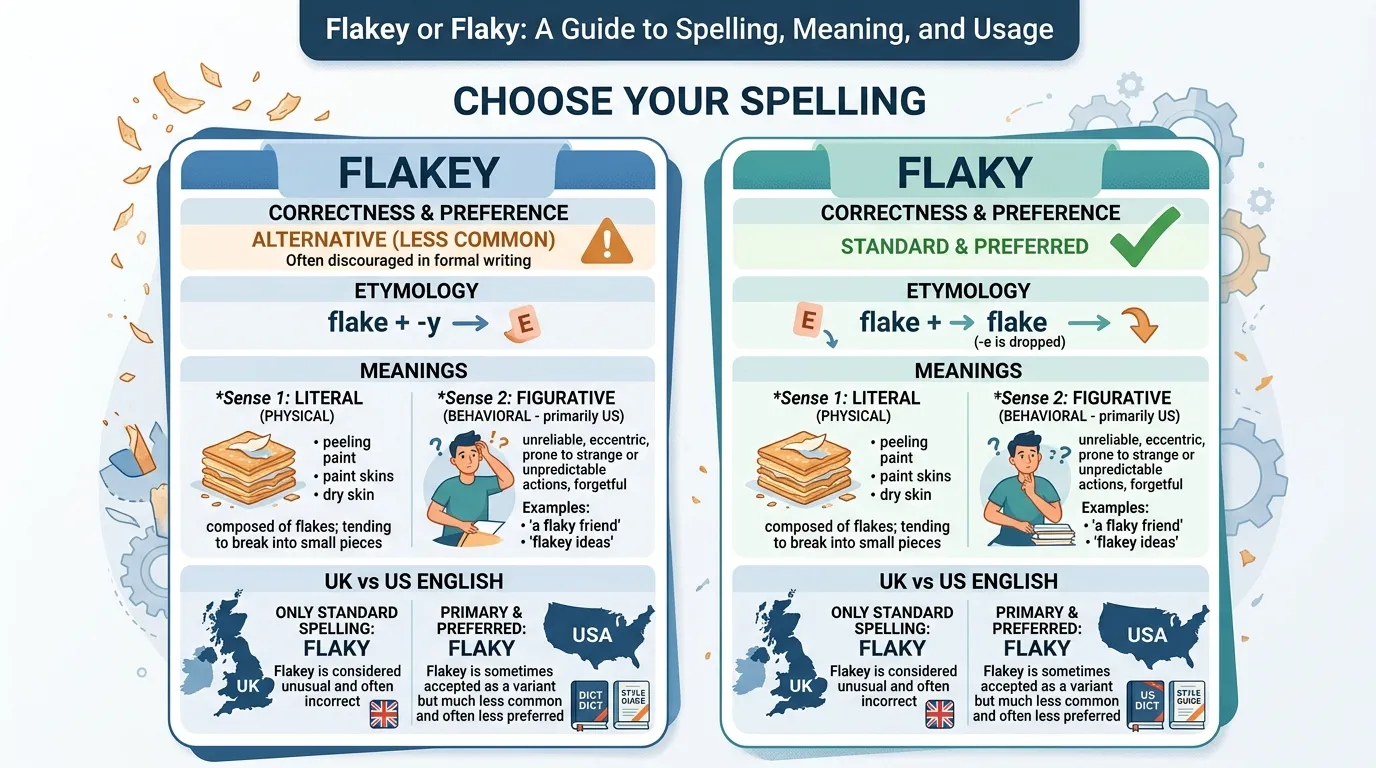
The bakery case held two trays that looked almost identical. The first held croissants, their layers shattering into flakes at the touch of a fork. The second held a sign that read “Flakey Croissants.” The baker, a patient woman who had laminated the dough by hand at five in the morning, looked at the sign and sighed. The croissants were flaky. The sign was wrong. Flaky is the standard spelling in every variety of English. Flakey, with an e, is a nonstandard variant — common enough to appear on signs, menus, and social media, but not accepted in edited writing. The difference is one letter, and the rule behind it is one of the most consistent rules in English spelling.
The Croissant Case: Flaky as Texture
Flaky describes something that breaks into thin, flat layers or flakes. A flaky croissant. Flaky pie crust. Flaky pastry. Flaky paint. Flaky skin. The word comes from flake — a small, thin piece — plus the adjective ending -y. When -y attaches to a word ending in silent e, the e drops: flake becomes flaky. The same rule gives smoky from smoke, shiny from shine, and scary from scare. The rule is mechanical, and it is the reason flakey is wrong: the e in flake has no business surviving the attachment of -y.
The pastry sense is the word’s original home, and it is worth understanding what makes pastry flaky. A croissant gets its layers from lamination: dough folded over cold butter, rolled, folded again, rolled again — dozens of alternating layers of dough and butter. In the oven, the water in the butter turns to steam, pushing the layers apart, and the result is a pastry that shatters into flakes. A flaky pie crust works the same way, with cold fat cut into flour. The word describes the result: thin, crisp, breakable layers. The baker’s sign should have said flaky, because the croissants were doing exactly what flaky pastry does.
The Drummer: Flaky as Character
Flaky has a second life, informal and entirely different: unreliable, inconsistent, eccentric, likely to cancel at the last minute. “The drummer is flaky — he missed the last three rehearsals.” “Don’t rely on him; he’s flaky.” “The Wi-Fi is flaky today.” The figurative sense comes from the texture sense by metaphor: just as flaky pastry crumbles and falls apart, a flaky person crumbles under pressure and falls apart on commitments. The metaphor is vivid, and it has been in American slang since the mid-twentieth century.
The figurative sense has its own vocabulary. A flake (noun) is an unreliable person: “He’s a flake.” To flake out is to fail to show up or to fall asleep: “She flaked out before the encore.” To flake on someone is to cancel on them: “He flaked on us again.” In all of these, the spelling is flake and flaky, with no e in the adjective. The slang is informal, but the spelling rule is the same as in the bakery: flake plus -y drops the e.
The E That Shouldn’t Be There: The Drop-E Rule
The drop-e rule governs this pair completely. When a suffix beginning with a vowel — -y, -ing, -ed, -er, -est — attaches to a word ending in silent e, the e drops. Flake + y = flaky. Flake + ier = flakier. Flake + iest = flakiest. The comparative and superlative follow the same rule: flakier, flakiest — never flakeyer or flakeyest. The rule has a few exceptions, mostly where the e is needed to preserve a soft sound — dyeing (to distinguish from dying), singeing (to distinguish from singing) — but flaky is not one of them. There is no flaky homophone that the e needs to guard against, so the e goes.
Why does flakey persist? Two reasons. First, the e feels protective — writers think keeping it preserves the long a sound of flake, not realizing that the y does that job on its own. Second, flakey appears in surnames and brand names — Flakey is a real family name — and proper nouns keep their own spelling, which makes the e version look legitimate. A person named Flakey keeps the e. A croissant does not.
Flaky in the Wild: Kitchens, Weather, and Group Chats
The word appears in three everyday worlds. In kitchens, it describes pastry, crusts, fish, and paint: “flaky salmon,” “flaky crust,” “flaky paint.” In weather and materials, it describes anything that peels or crumbles: “flaky skin,” “flaky plaster,” “flaky rust.” In social life, it describes people, plans, and technology: “a flaky friend,” “flaky plans,” “a flaky connection.” The three worlds share the same spelling, and the same rule, and the same error: the e that creeps in when the writer is thinking about the sound instead of the rule.
There is also a false friend to watch for: flaky is sometimes confused with flakey in the phrase “flaky pastry,” where the e version appears on unedited menus and food blogs. The error is so common that some readers no longer notice it. But editors notice, and dictionaries are clear: flaky is the standard spelling in American and British English alike. There is no regional split here. The e is wrong on both sides of the Atlantic.
Flaky in Science: Flakes in Geology, Skin, and Paint
The word’s reach extends beyond kitchens and group chats. In geology, flaky describes minerals that split into thin sheets — mica is the classic example, peeling into translucent flakes along its cleavage planes. In dermatology, flaky skin is skin that sheds in small pieces, a symptom of dryness, eczema, psoriasis, or dandruff. In materials science, flaky paint is paint that peels from its surface in thin layers, a sign of poor adhesion or age. In all three sciences, the word describes the same physical process: a material breaking along flat layers into thin pieces.
The science also explains why the spelling rule holds. Flake is the noun, flaky the adjective, and the drop-e rule applies in every register, from the geology textbook to the dermatology pamphlet to the paint manufacturer’s data sheet. There is no scientific exception, no technical variant, no field where flakey is standard. The rule is the same in the lab and in the bakery, and the e is wrong in both.
Flake as a Noun: Snow, Paint, and People
The noun flake has its own life, and it explains the adjective’s two meanings. A snowflake is a crystal of ice, famously unique, famously fragile. A paint flake is a chip of dried paint. A cornflake is a toasted flake of corn. A flake of skin is a shed piece. And a flake as a person is an unreliable character — the noun form of the figurative adjective. The verb to flake means to break into flakes (“the paint flaked off”) or to fall asleep or fail (“she flaked out,” “he flaked on us”). The whole family — noun, verb, adjective — is built on the image of something thin breaking apart, and the spelling is consistent through the family: flake, flakes, flaked, flaking, flaky, flakier, flakiest. The e survives in the noun and the verb, and drops in the adjective. That is the rule, and the rule is the whole story.
Flaky in the Bakery’s Notebook: Lamination, Temperature, and Timing
The baker’s notebook had three rules for flaky pastry, and they explain the word better than any dictionary. First, keep everything cold. The butter must stay solid until the oven, because the flakes are made by steam, and steam needs solid butter to push against. Warm butter melts into the dough, and the pastry comes out dense, not flaky. Second, fold, don’t stir. The layers are made by folding, and stirring destroys them. Third, rest the dough. A rested dough relaxes, and relaxed dough holds its layers. The three rules are about preserving structure, and the structure is what the word flaky describes: thin, separate, breakable layers, held apart by steam and patience.
The same structure appears in the word’s other worlds. Flaky paint is paint whose layers have separated. Flaky skin is skin whose layers are shedding. A flaky friend is a person whose commitments have separated from their actions. The metaphor holds across all three, because the image is the same: something that should hold together, coming apart in thin pieces. The baker, the dermatologist, and the disappointed friend are all describing the same failure of structure, and they all spell it flaky, with no e, because the e dropped when the y attached, and it never came back.
The Sign, Corrected
The baker fixed the sign. It read “Flaky Croissants,” and the croissants beneath it shattered into layers exactly as flaky pastry should. The drummer, who had missed rehearsal again, remained flaky in the other sense — unreliable, crumbling under pressure, falling apart on commitments. One word, two meanings, one spelling, one rule: flake plus -y drops the e. The croissant and the drummer agree on that much, even if they agree on nothing else.