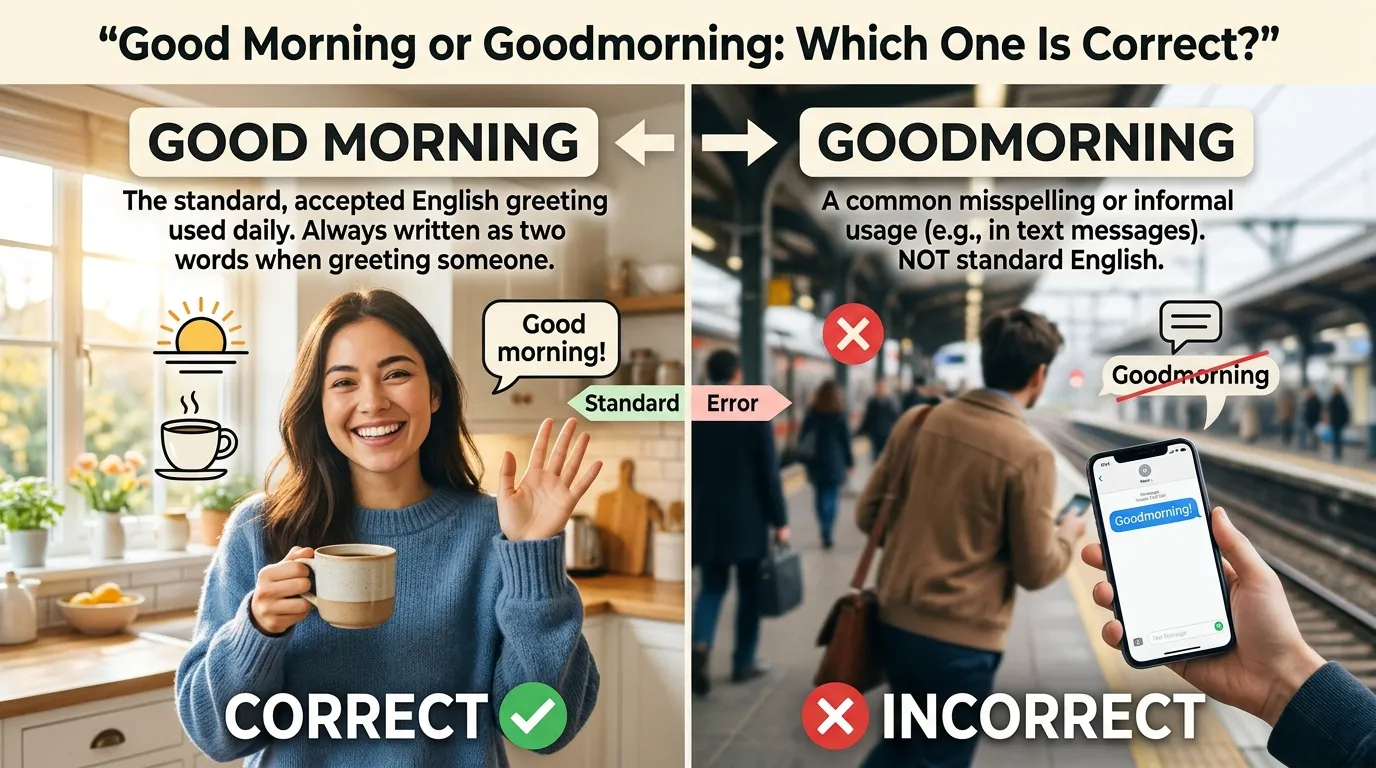
At ten minutes to seven, the postman shoulders his bag and steps onto the first street of his round. The sky is still pale. The milk bottles are still on the steps. At the first door, a woman is already sweeping her path, and he calls out, “Good morning!” She answers, “Good morning!” At the second door, a man in a dressing gown takes his letters and says it back. By the tenth door, the postman has said it ten times, and nobody has said it any other way — because there is no other way to say it. The greeting is good morning, two separate words. Goodmorning, squeezed into one, is not standard English, in any variety of it.
That is the whole answer, and it fits on a postcard. But the postman’s round is worth walking to the end, because every door on it explains a different part of the rule: why the two words stay apart, why people keep pushing them together, when morning ends, and why the greeting behaves differently from its lookalikes. Walk it with him, from the first grey doorstep to the last one before noon.
First Door: The Greeting That Starts the Day
Good morning is the greeting for the first part of the day, roughly from sunrise until around noon. It is a wish, packed into two words: may your morning be good. It is used on doorsteps, in offices, in classrooms, on the telephone, and at the top of emails. “Good morning, everyone.” “Good morning, Mr. Wilson.” “Good morning — thank you for calling.” The speaker does not have to mean anything more complicated than friendliness and respect. The greeting is the handshake of the morning.
Grammatically, it works as an interjection — a greeting phrase rather than a complete sentence. It can stand alone (“Good morning!”), open a sentence (“Good morning, let’s begin”), or sit inside one (“She smiled and said, ‘Good morning.’”). It has no verb form, which is worth knowing, because it stops a common joke-error in its tracks. You would not say, “I goodmorninged him.” You say, “I wished him good morning,” or, “I greeted him by saying, ‘Good morning.’” The greeting is something you say, not something you do to someone.
It is also a greeting with a clock attached to it. It belongs to the morning. That sounds obvious, but it is the first place writers go wrong in practice: a message sent at three in the afternoon that opens “Good morning” has missed its window. The postman knows this better than anyone, because his round ends when the morning does.
The Envelope With One Word
Halfway down the second street, the postman delivers a birthday card. Inside, someone has written, “Goodmorning! Have a wonderful day!” The spelling is wrong, but the postman is not surprised, because he sees it every week — on cards, in texts, in emails, on social media posts. The one-word version is one of the most common spelling slips in English, and it has a clear set of causes.
The first cause is speed. People type fast, especially on phones, and the space bar is the easiest key to skip. A greeting typed in a hurry loses its gap, and the typo survives because the eye reads the shape of the word rather than its letters. The second cause is autocorrect and habit: once a phone has accepted “goodmorning” from you once, it may offer it again. The third is the lookalikes — and this is the real engine of the error. English has two famous greetings that did fuse into one word: goodbye and goodnight. A writer who has seen those two spellings a thousand times assumes, reasonably, that good morning works the same way. It does not. The assumption is the mistake.
Every major dictionary agrees: Oxford, Cambridge, Merriam-Webster, and Collins all list the greeting as two words. There is no American-versus-British split here. American English writes good morning. British English writes good morning. The rule is the same on both sides of the Atlantic, which makes it one of the simplest rules in English — and one of the most often broken, because the broken version looks so plausible.
Two Words on the Doorstep: Good the Adjective, Morning the Noun
Why do the two words stay apart when goodbye and goodnight fused? The answer is in the grammar. Good morning is built from an adjective and a noun: good describes morning. It is the same pattern as good afternoon, good evening, good day, and good luck — an adjective placed before a noun to wish someone well. The two words keep their own jobs, and because each job is visible, the space between them stays visible too.
Goodbye is different. It did not start as adjective-plus-noun at all. It began as a sentence — “God be with ye” — that was squeezed down over centuries until it became a single word. Its fusion was the collapse of a whole phrase, not the joining of two ordinary words. Goodnight fused by a similar route, as a farewell formula repeated so often that the gap wore away. Good morning never went through that process. It stayed a plain adjective-plus-noun greeting, and plain adjective-plus-noun phrases keep their spaces: nobody writes goodday or goodafternoon either.
The pronunciation tells the same story. In American English, good morning is pronounced /ɡʊd ˈmɔːrnɪŋ/; in British English, /ɡʊd ˈmɔːnɪŋ/. Two words, two beats, with the stress on morning. The one-word version has no official pronunciation, because it is not a recognized word — people who write it pronounce it exactly the same way, which is another sign that the fusion is a spelling accident, not a new word.
The Clock on the Church Tower: When Morning Ends
The postman’s round has a natural ending. When the church clock strikes twelve, the morning is over, and the greeting changes with it. From noon onward, the correct greeting is good afternoon; in the evening, good evening. A “good morning” sent at three in the afternoon is not a spelling error, but it is a timing error, and in a business email it reads as careless — the digital equivalent of arriving at lunch still wearing a breakfast menu.
The other half of the clock rule belongs to good night. It is usually a farewell, not a greeting: you say it when someone is going to bed or leaving for the night. Saying “Good night, everyone!” at nine in the morning is wrong in a different way — it sends the room to bed instead of waking it up. The greetings form a small daily cycle: good morning for arrival in the morning, good afternoon for the middle of the day, good evening for the night’s beginning, good night for its end. Each one has its hour, and the postman’s round walks through the first of them.
The Shop Signs: Why Goodbye Fused and Good Morning Didn’t
The history of the two words explains why one greeting stayed in two pieces. Good comes from Old English gōd, meaning beneficial, kind, or desirable, with roots in the Proto-Germanic word gōdaz. Morning comes from Old English morgen, the early part of the day after sunrise, tracing back to Proto-Germanic murgana. For hundreds of years, English speakers greeted each other with the two words side by side, and the pairing never collapsed, because it never needed to: it was already short, already clear, already doing its job.
That is the real lesson of the shop signs. Fusions in English happen when a phrase is repeated so constantly, and in such a fixed form, that speakers stop hearing the seam. “God be with ye” was a farewell formula said at every parting, and it wore down into goodbye. Good morning is repeated just as often, but it is not a formula in the same way — it is a wish, rebuilt fresh each time from an adjective and a noun, and each rebuilding keeps the seam in place. The space is not an accident of history. It is the mark of a phrase that is still alive, still being assembled word by word every time it is spoken.
The Capital Letter on the Letterhead
Further along the round, the postman delivers a stack of business letters. Every one of them opens the same way: “Good Morning, Mr. Smith,” with both words capitalized. Then he delivers a birthday card that reads, “She said good morning to everyone,” all lowercase. Both are correct, and the difference is position, not correctness.
When the greeting opens an email, a letter, or a message, it is usually capitalized: “Good Morning, Sarah.” The capital letters mark the start of the message, the way a capital marks the start of a sentence. Inside a sentence, the lowercase form is equally correct: “She said good morning to everyone.” “We always say good morning at work.” The greeting itself does not demand capitals; the position does.
Two smaller rules ride along with it. The first is the comma. When the greeting is followed by a name, the name takes a comma: “Good morning, John.” “Good morning, class.” The comma is the pause between the greeting and the person being greeted, and dropping it — “Good morning John” — reads as rushed. The second is the space. It is the rule this whole round has been about: good morning keeps its gap in every position, capitalized or not, at the start of an email or in the middle of a sentence.
The Shortened Call Across the Street: “Morning!”
Near the end of the round, the postman passes a builder on a scaffold who calls down, “Morning!” — just the one word, no good attached. The builder is not being rude. He is using the shortened form of the greeting, which is informal but common, especially in British English. “Morning!” is the greeting with its first word dropped, the way a wave is a handshake with its grip dropped. It works on a building site, in a corridor, between neighbours. It does not work in a formal email, where the full two-word greeting is expected.
The greeting has a small family of neighbours, and knowing them helps a writer choose. Hello works at any time of day and in almost any register. Hi is casual. Greetings is formal, slightly old-fashioned, and best kept for letters and announcements. Welcome is for arrivals. Morning on its own is the informal shortcut. Good morning itself sits in the middle: it can be formal or informal depending on the situation, which is why it is the safest opening line in professional writing — for emails, meetings, letters, and customer service alike. When in doubt, it is the greeting that offends nobody and suits everybody.
The Round, Finished: The Space That Stays
The postman finishes his round just before noon, his bag empty, his greeting given away at every door. If you remember one thing from his walk, remember the reason the space stays: good is an adjective, morning is a noun, and the two words are doing two separate jobs. They walk side by side, like the postman’s two feet, and they never merge into one. Goodbye fused because it was a sentence that collapsed. Goodnight fused because it was a farewell worn smooth by repetition. Good morning stayed two words because it is still, every time it is spoken, a fresh wish built from two living words.
Before you send the email, the card, or the message, check the opening line. If it reads goodmorning, with no space, add one. If it is after noon, change the greeting. If a name follows, add the comma. And if the message is formal, capitalize both words. The postman’s round is over for today. Tomorrow it starts again, at the same hour, with the same two words — and the same space between them.