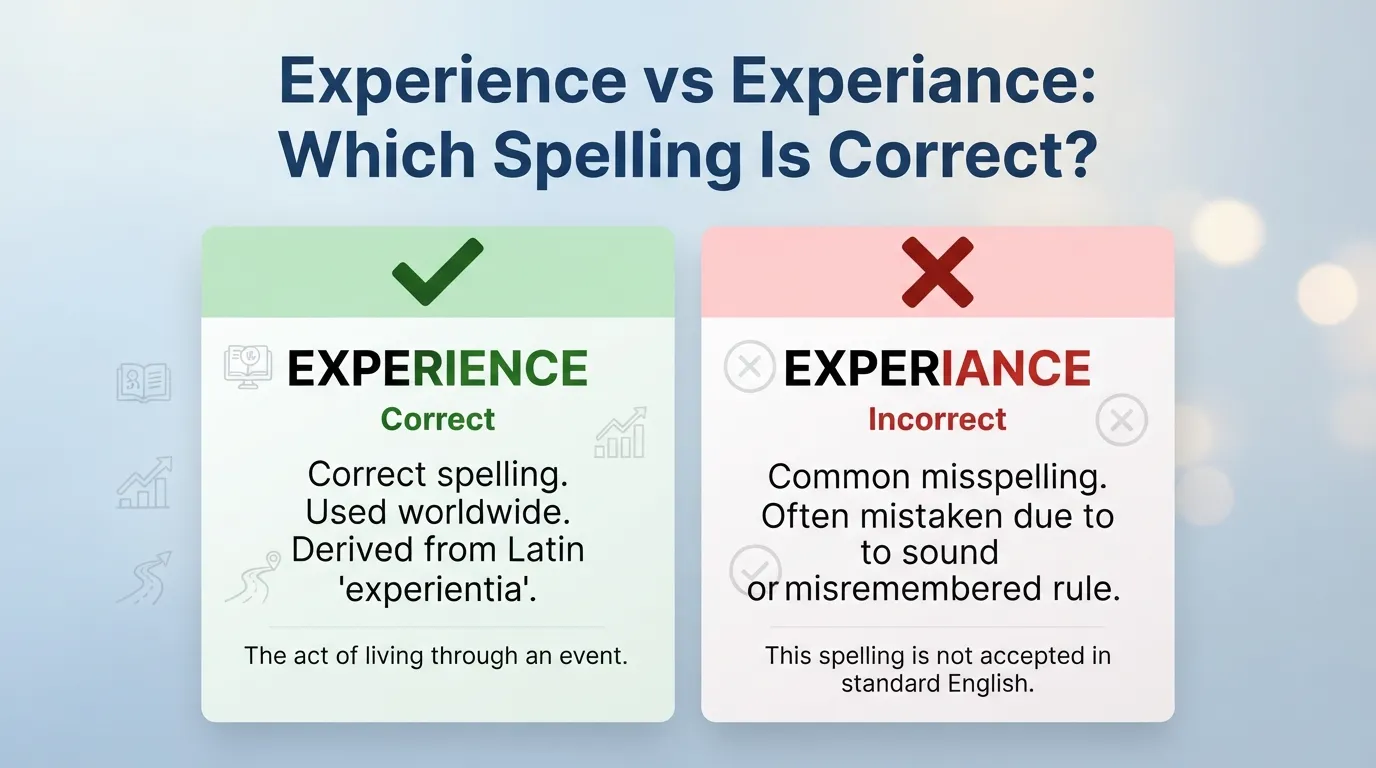
Every life is a collection of stamps in a passport. The first day of school. The first job. The first time you stood in front of a room full of strangers and spoke. The first time you failed and kept going. Each stamp is an experience — a thing you lived through, and the knowledge it left behind. The word is one of the most common in English, and one of the most misspelled. The correct spelling is experience, with -ence at the end. Experiance, with -ance, is a misspelling — and it is a revealing one, because it shows exactly how English spelling traps the ear.
The Passport: Two Kinds of Experience
Experience does two jobs, and keeping them apart is the first step to spelling it correctly. As a noun, it names knowledge or skill gained by doing something or living through an event. “She has five years of experience in marketing.” “Traveling abroad was a wonderful experience.” “He has extensive experience as a teacher.” In these sentences, the word names something you possess: a body of knowledge, a set of skills, a collection of lived moments. It is countable when it names events (“three experiences that changed my life”) and uncountable when it names accumulated knowledge (“years of experience”).
As a verb, experience means to go through, feel, or encounter something. “We experienced heavy rain during the journey.” “She experienced a sudden change in weather.” “The company experienced rapid growth.” Here the word names an action, not a possession. You experience something; you do not “have” the verb in the same way you have the noun. The two jobs share a spelling and a meaning — both are about living through something — but they behave differently in a sentence. The noun follows a, the, years of, much. The verb follows a subject and takes an object.
The word’s range is enormous. In job applications, it means work history. In science, it means empirical observation. In philosophy, it means the raw material of consciousness. In everyday speech, it means anything you have lived through: “It was an experience” can mean it was wonderful, terrible, strange, or simply memorable. The word is a container, and it holds whatever life puts in it.
The -ence/-ance Trap
So why do people write experiance? The reason is the ending. In English, hundreds of nouns end in -ance or -ence, and the two endings sound identical in normal speech. Importance, performance, appearance, assistance — all end in -ance. Difference, existence, dependence, persistence — all end in -ence. The final syllable in all of them is a weak “uns” sound, and the ear cannot tell which spelling it is. Writers who spell by sound have a fifty-fifty chance, and experiance is what happens when the coin lands on the wrong side.
The distribution is not random, but it is not obvious either. The -ence ending tends to follow verbs that end in -ere or -er: differ → difference, exist → existence, persist → persistence, experi (from Latin experiri, to try) → experience. The -ance ending tends to follow verbs that end in -are or -er with a different history: perform → performance, appear → appearance, assist → assistance, import → importance. The pattern is real, but it is subtle, and it is not reliable enough to use as a rule. The safest approach is to memorize the spelling of each word individually — and for this word, the spelling is -ence.
There is also a Latin root worth knowing. Experience comes from the Latin experientia, from experiri, meaning “to try, to test, to prove.” The same root gives us experiment (a test) and expert (someone who has tried many times). All three words share the exper- beginning, and all three keep the e in the middle. The -ence ending is part of the Latin inheritance. Experiance breaks the family pattern — and families, in spelling as in life, are worth keeping together.
The Résumé Sentence
The place where the misspelling matters most is the résumé. “I have three years of experiance in customer service” is the kind of error that costs interviews. Hiring managers read résumés quickly, and a misspelling in the word experience — the very word that claims competence — is read as evidence against the claim. The irony is sharp: the word that says “I know what I’m doing” is the word that, misspelled, says the opposite. The same applies to cover letters, college applications, business proposals, and any document where credibility matters.
The word also appears in a set of fixed phrases that are worth collecting, because they are where writers use it most often. “Work experience.” “Life experience.” “Years of experience.” “Previous experience.” “Hands-on experience.” “First-hand experience.” “In my experience.” “From experience.” “Based on my experience.” “A wealth of experience.” “Lack of experience.” In all of these, the spelling is experience, with -ence. The phrases are so common that they become automatic — and automatic writing is where spelling errors hide. The hand types what the ear hears, and the ear hears “experiance.”
There is a related error worth naming: experiance sometimes appears because writers confuse experience with appearance or importance, both of which genuinely end in -ance. The confusion is understandable — the words are similar in length, in rhythm, and in their weak final syllable. But the endings are different, and the difference is not negotiable. Appearance ends in -ance. Experience ends in -ence. The two words are neighbors, not twins.
The -ence Family
The best defense against the -ance/-ence trap is to learn the -ence family as a group. These words all end in -ence, all sound like they end in -ance, and all are spelled with e:
- Difference — not “differance.”
- Existence — not “existence” with an a.
- Dependence — not “dependance” (though dependant as a noun is a separate word in British English).
- Persistence — not “persistence” with an a.
- Evidence — not “evidance.”
- Confidence — not “confidance.”
- Experience — not “experiance.”
Learning the family is more efficient than memorizing each word separately. When you encounter a word ending in the weak “uns” sound, ask yourself: does it belong to the -ence family? If it is related to differ, exist, depend, persist, evident, confident, or experiri, the answer is yes. The e is the family marker.
There is also a useful cross-check: the adjective form. Many -ence nouns have adjectives ending in -ent: different, existent, dependent, persistent, evident, confident, experienced. If the adjective ends in -ent, the noun almost always ends in -ence. Experienced ends in -ent (well, -enced, but the root is -ent), and so experience ends in -ence. The adjective is the clue to the noun.
Experience vs Experiment: The Cousins
Experience has a close cousin that causes its own confusion: experiment. The two words share the exper- root and the idea of trying something, but they name different things. An experiment is a controlled test, designed to answer a question: a scientist runs an experiment to see whether a drug works. An experience is a lived event, not necessarily controlled or designed: a traveler has an experience in a foreign city. The experiment is planned; the experience is lived. The experiment has a hypothesis; the experience has a memory.
The two words also differ in spelling in a way that reinforces the -ence lesson. Experiment ends in -ment, not -ence or -ance, so it sidesteps the trap entirely. But experimental (the adjective) and experimentation (the noun) keep the exper- beginning, and the family resemblance is a useful anchor: if you can spell experiment, you can spell the first six letters of experience. The rest is -ience, with the e that the whole family carries.
The Stamp That Stays
Here is the memory hook, and it is the simplest one in this article: experience ends in -ence because it comes from experiri, and experiri has an e in every syllable. E-x-p-e-r-i-r-i. The word is built from es. The ending keeps the pattern: -ence, not -ance. The e runs through the whole word, from the first letter to the last syllable, like a thread through a passport’s pages.
Another hook: think of the word science. It also ends in -ence, it also names a kind of knowledge, and it is also misspelled with an a by careless writers. Experience and science are partners: both are about knowing through doing, both end in -ence, both keep their e. If you can spell science, you can spell experience — just change the beginning and keep the ending.
Every life is a collection of stamps. The passport fills up, the pages wear thin, the ink fades. But the word that names the collection stays sharp, if you spell it right. Experience. E-x-p-e-r-i-e-n-c-e. The e at the end is not a detail. It is the stamp that says the word is genuine.










