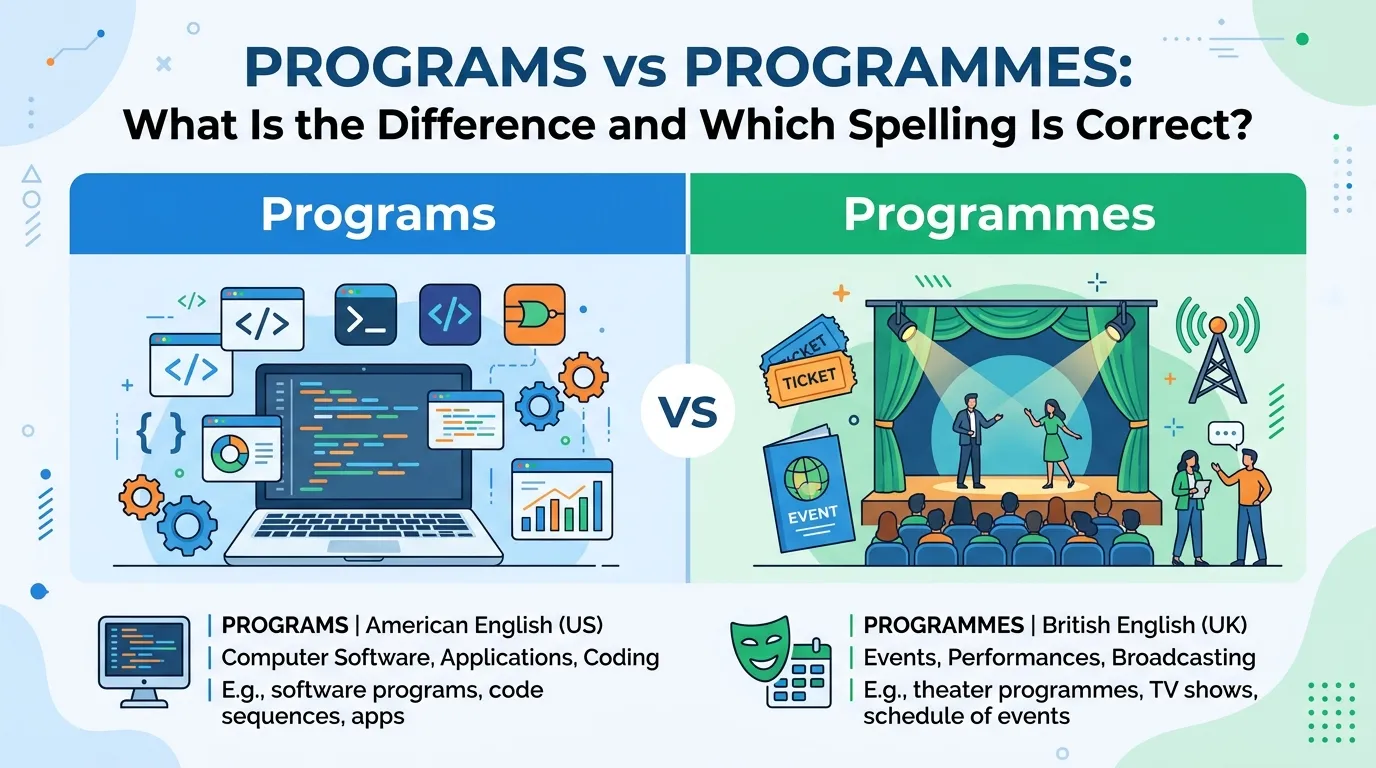
On the coffee table there are two screens. On the left screen, a television listing: “Tonight’s programme: a documentary about the history of the railway.” On the right screen, a code editor: “The program crashed when I clicked save.” Same evening, same room, two spellings of what looks like the same word. One has an extra -me. The other does not. Both are correct — and the reason they differ has nothing to do with the television or the computer. It has to do with which side of the Atlantic the writer is on, and which kind of program they mean.
The Remote Control and the Keyboard
The rule, in its simplest form, fits on two lines. In American English, the spelling is program for everything: television programs, computer programs, exercise programs, government programs. In British English, the spelling splits: programme for organized activities, courses, events, broadcasts, and plans — and program for computer software. “The university offers several academic programmes.” “I installed a new computer program.” A British writer can use both spellings in the same day, in the same office, without contradiction, because the two spellings name different things.
The exception is the key to the whole system. Even in British English, program is used for computer software and computing-related meanings. The computing industry standardized on the American spelling early — in the 1950s and 1960s, when programming was a new field and American companies dominated it — and British English adopted the computing spelling along with the technology. The result is a clean division: if it runs on a computer, it is a program everywhere in the world. If it is a plan, a course, a broadcast, or an event, a British writer calls it a programme and an American writer calls it a program.
Canadian and Australian English largely follow the British split, though American influence — especially in computing and business — has blurred the line. A Canadian university might offer “programs” in its course catalog and “programmes” in its events calendar, following different conventions in different departments. That inconsistency is normal, and it is one reason the word feels so slippery. The word’s spelling depends on the variety, the domain, and sometimes the department.
One Word, Two Passports
The history explains the split. Both spellings come from the same root: the Greek programma, meaning “a public notice” or “a written proclamation,” from pro- (before) + graphein (to write) — literally, something written beforehand. Latin borrowed it as programma. French turned it into programme. English borrowed it from French in the 1600s, initially spelled programme, meaning a planned series of events or a written schedule.
American English simplified the spelling in the early 1800s, as part of Noah Webster’s spelling reforms. Webster believed that English spelling carried unnecessary letters, and he removed them wherever he could: colour became color, centre became center, programme became program. The reform stuck, partly because it made spelling slightly more regular and partly because American dictionaries, schools, and newspapers adopted it together. British English kept the French-derived programme for general uses, and adopted the American program only for computing, where the American spelling arrived with the technology.
The result is a word with two passports. Programme carries the French stamp: the -me ending, the older spelling, the connection to a planned event. Program carries the American stamp: the simplified spelling, the newer form, the connection to computing. A British writer who uses both is not being inconsistent. She is using the right passport for each journey.
Programme in the Wild
The British programme shows up in contexts that are worth collecting, because they reveal how broad the word’s non-computing sense is. In education: “a degree programme,” “a training programme,” “a programme of study.” In broadcasting: “a television programme,” “a radio programme,” “tonight’s programme.” In government: “a housing programme,” “a health programme,” “a programme of reforms.” In events: “a concert programme,” “a theatre programme,” “the festival programme.” In business: “a loyalty programme,” “a development programme.” In all of these, the British spelling is programme, and the American spelling is program. The meaning is the same: a planned series of activities, events, or actions designed to achieve a purpose.
The computing sense, by contrast, is spelled program everywhere. “A computer program.” “A software program.” “To program a computer.” “A programmer.” The verb form is also program in both varieties: “She programs in Python.” “He programmed the thermostat.” There is no British verb programme in computing, and there is no American noun programme in any domain. The computing sense is the one place where the two varieties agree completely.
There is also a small set of related words that follow the same pattern. Programmer is spelled the same everywhere. Programming is spelled the same everywhere. Programmable is spelled the same everywhere. The -me ending appears only in the noun programme in its non-computing sense. Everywhere else, the spelling is program. Learning this boundary is the whole battle: one noun, one sense, one extra syllable.
The -me Ending and Its Cousins
The -me ending in programme belongs to a small family of French-derived words where British English keeps the -me and American English drops it — or where both varieties keep it. Scheme is spelled the same in both varieties. Theme is spelled the same in both. System has no -me variant. Programme is nearly alone in splitting by variety and by sense. That is part of why it confuses people: there is no large family to learn from, no pattern to generalize. The word is its own rule.
One comparison does help: programme is like catalogue/catalog and dialogue/dialog — pairs where British English keeps an extra ending and American English drops it. In those pairs, the American form is now common in British English too, especially in computing (dialog box, catalog). Programme/program follows the same trajectory, but with a twist: the computing sense froze the American spelling, while the general sense kept the British spelling. The word split instead of merging.
Program vs Programme in Job Titles
The split shows up in job titles, and it is a useful place to see the rule working. A programme manager in Britain runs a set of related projects — a programme of work. A program manager in America does the same job under the American spelling. A programmer, everywhere, writes code. A TV programme editor in Britain shapes broadcasts. A computer program editor anywhere shapes software. The titles look similar, but the spelling tells you which world the job belongs to: the world of plans and broadcasts, or the world of code.
The confusion peaks in universities, where both worlds collide. A British university has a programme leader for each degree programme and a computer science programme that teaches students to write programs. The same department, the same building, two spellings, two meanings. Students learn to navigate it quickly: if the document is about the course, it is a programme; if it is about the code, it is a program. The rule is the same as everywhere else — the computer gets program, the plan gets programme — but the university is where the two meanings sit closest together, and where the rule gets tested most often.
The TV Guide Test
Here is a quick test you can run on any British document. Find the word. Ask: “Could this appear in a TV guide?” If yes — a broadcast, a show, a scheduled event — the spelling is programme. If no — if it is code, software, an application — the spelling is program. “Tonight’s programme” passes the TV guide test. “The program crashed” fails it. The test works because the TV guide is the most familiar home of the British programme: the printed schedule of broadcasts, the thing the word originally named. Everything else follows from it.
The test also works in reverse for American writers: if you are writing for an American audience, the answer is always program, and the TV guide test is unnecessary. The American spelling covers every sense, every domain, every document. The British split is the only one that requires a decision, and the TV guide test makes the decision mechanical.
Picking One and Sticking With It
The practical advice is simple. First, decide which variety of English you are writing in. If it is American, use program for everything and stop worrying. If it is British, use programme for plans, courses, broadcasts, and events, and program for computer software. Second, be consistent within a single document. A British report that writes “programme” in one paragraph and “program” in the next — for the same non-computing sense — looks sloppy. Third, when in doubt about a British document, ask yourself: “Does it run on a computer?” If yes, program. If no, programme.
One last trap: the plural. The plural of the British noun is programmes; the American plural is programs. The same rule applies — -me for the British plan, no -me for everything else. And the verb’s forms are always program, programs, programmed, programming in every variety. The verb never takes the -me ending.
So the next time you see two screens on the coffee table — the television listing on the left, the code editor on the right — you will know: neither spelling is wrong. They are just speaking different varieties of the same language, and now you speak both. The remote control gets programme in Britain. The keyboard gets program everywhere. And the evening, with its documentary and its crashed code, goes on.










