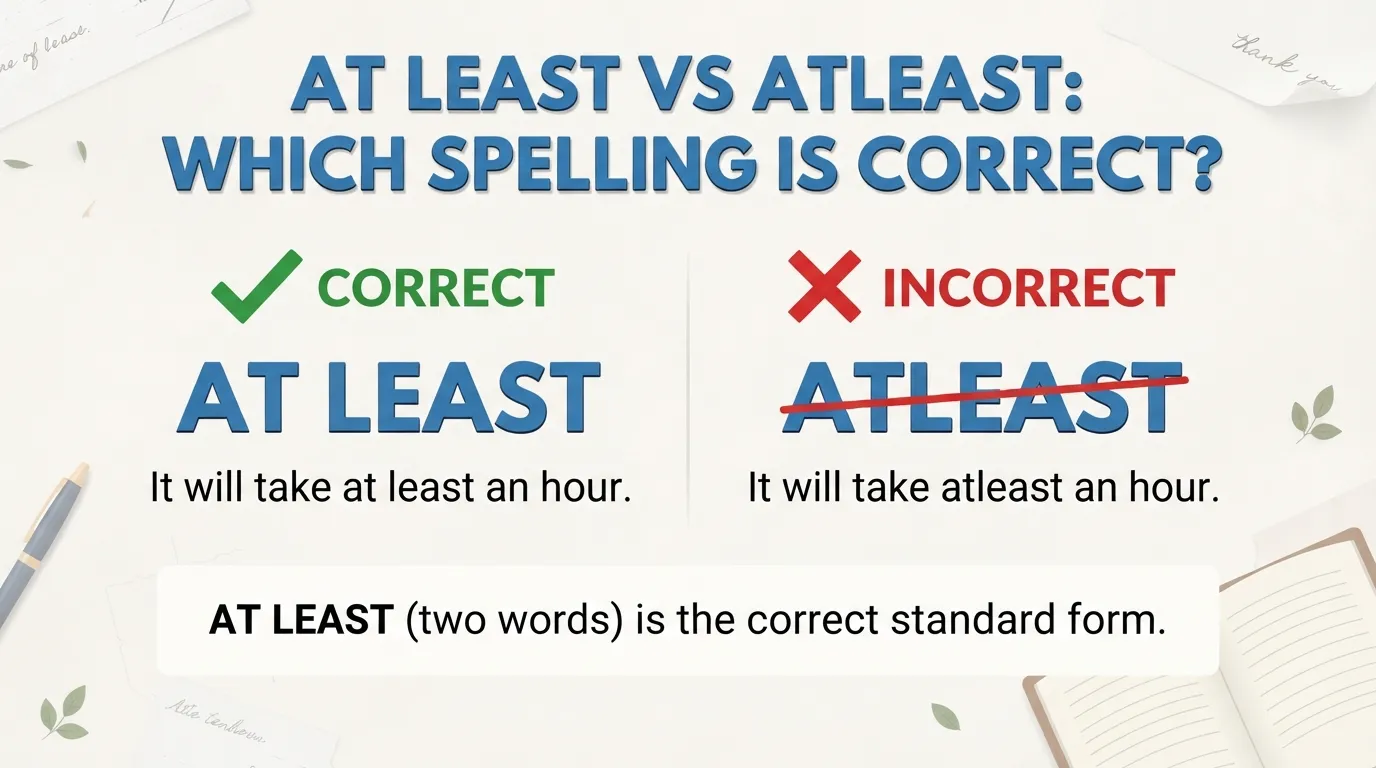
You type the text in a hurry: “We should arrive atleast an hour early.” Before you hit send, a red squiggle appears under atleast. You stare at it. The word looks fine. It sounds fine. It even feels like one word when you say it — at-least, a single beat of meaning: no less than this. But the squiggle is right. In standard English, it is always two words: at least.
This is one of the quietest spelling traps in English. Nothing about atleast looks wrong at a glance, which is exactly why it survives in emails, essays, and group chats everywhere. The fix is simple — keep the space — but the reasons behind it are worth knowing, because they explain a whole family of phrases that refuse to fuse.
The Phrase That Refuses to Fuse
English is full of phrases that started as two words and eventually glued themselves together. Never the less became nevertheless. In as much became inasmuch. Already was once all ready, and altogether was once all together. Given that history, it is perfectly reasonable to assume at least is on its way to becoming atleast. It is not. The phrase has held its two-word shape for centuries, and no dictionary of standard English lists atleast as a word.
Why do some phrases fuse and others not? There is no committee voting on it. Fusion happens when a phrase becomes so fixed, so automatic, that writers stop feeling the seam between its parts. At least never quite got there, partly because each half still does visible work. At points to a position — at a minimum, at the lowest acceptable point. Least names the smallest amount. Readers still feel both halves pulling their weight, so the space stays.
That is the first thing to understand: at least is a phrase, not a word. It is a preposition plus an adjective working together as a single unit of meaning, the way at most, at best, and at worst do. Nobody writes atmost or atbest. At least belongs to the same family, and it keeps the same spacing.
What At Least Actually Does
The phrase does three jobs in English, and they are worth separating because each one shows up in different kinds of writing.
First: the minimum. This is the most common job. At least sets a floor — the smallest acceptable number, amount, or degree. “We need at least five volunteers.” “The repair will cost at least $200.” “Please allow at least an hour for the trip.” In every case, the number given is the lowest bound. More would be fine; less would not. This is the at least of instructions, budgets, requirements, and recipes.
Second: the consolation. Sometimes at least does not name a number at all. It introduces the one good thing in a bad situation. “The weather was terrible, but at least we stayed dry.” “I did not finish the report, but at least I completed the introduction.” Here the phrase means something like if nothing else — a small rescue in an otherwise disappointing sentence. This is the at least of sympathy, of softening bad news, of finding the silver lining.
Third: the hedge. At least can soften a claim, making it less absolute. “He is at least trying to help.” “It will take at least a few days.” In these sentences the phrase admits uncertainty. The speaker is not committing to an exact figure or a full endorsement — only to a minimum. This is the at least of diplomacy, of careful estimates, of sentences where precision would be dishonest.
Notice that all three jobs share one idea: a floor. A minimum number, a minimum consolation, a minimum claim. The phrase always says, “Whatever else is true, this much is true.” That is its core meaning, and it is why the phrase is so useful.
At Least Is Not At Last
The most consequential mix-up involving at least is not a spelling error at all. It is a confusion with a phrase that sounds almost the same: at last.
At last means finally, after a long wait: “At last, the rain stopped.” “At last, she got the job.” It is about time — the end of a long stretch of waiting. At least is about amount or consolation — a minimum, or a small good thing. The two phrases share a rhythm and a first word, and in fast speech they can blur together, but they mean completely different things.
Swapping them produces sentences that sound almost right and mean something else entirely. “At last, we have five volunteers” celebrates that the volunteers finally arrived. “At least, we have five volunteers” says five is the minimum and takes some comfort in it. One is a sigh of relief about timing; the other is a floor about quantity. In writing, the difference is the whole sentence.
There is a second neighbor worth keeping apart: at most. At least sets a floor; at most sets a ceiling. “The job takes at least three hours” means three hours or more. “The job takes at most three hours” means three hours or fewer. Confusing the two reverses the meaning of a schedule, a budget, or a promise.

At Least in the Wild
The phrase shows up at every level of English, and its register shifts with its job. In formal writing — academic papers, legal documents, business reports — the minimum sense dominates. “Participants completed at least three trials.” “The contract requires at least thirty days’ notice.” In these settings the phrase is doing precise, measurable work, and the space between its two words is part of that precision.
In casual writing — texts, social media, conversation — the consolation sense takes over. “At least the pizza was good.” “At least you tried.” Here the phrase is doing emotional work, softening disappointment with a small good thing. The informality of the setting does not change the spelling. Even in the most casual text, atleast is still a misspelling.
One placement note: at least can open a sentence, sit in the middle, or close a clause, and all three positions are correct. “At least ten people attended.” “We need ten people at least.” “At least, we tried.” The comma after a sentence-opening at least in the consolation sense — “At least, we tried” — is a matter of style. Some writers include it, some do not. Either way, the two words stay two words.
At Least, At Most, At Best: The Family
At least belongs to a family of at phrases that all work the same way — two words, a preposition plus a superlative, a fixed job. At most sets a ceiling: “The job takes at most three hours.” At best sets the most favorable reading: “At best, the plan is incomplete.” At worst sets the least favorable: “At worst, we lose a day.” At first marks a beginning: “At first, nobody believed it.” At last marks an ending: “At last, the rain stopped.” Each one is two words. None of them has fused.
The family is useful because it shows that at least is not an oddity. It is a member of a productive pattern — at plus a word that names a limit or a point. The pattern is stable across centuries of English. New members join it occasionally (at minimum, at maximum), but none of them fuse either. The space between at and its partner is part of the pattern’s grammar, not an accident of history.
There is also a practical reason to learn the family together: the members are easy to confuse in pairs. At least versus at most is a floor versus a ceiling. At best versus at worst is optimism versus pessimism. At first versus at last is beginning versus ending. Each pair is a small axis of meaning, and the two-word shape keeps the axis visible. Fuse the words and the axis blurs.
The Two-Word Habit
The cure for atleast is not a clever mnemonic. It is a habit: see the space. Every time you write the phrase, picture the gap between at and least as load-bearing, the way the gap between at most and at best is load-bearing. The phrase is two words because it is built from two words, and no amount of fast typing changes that.
A practical check helps. When you proofread, search your draft for atleast — one word — and split every instance. It is one of the fastest proofreading fixes in English, because the error is always the same and the correction is always the same. And if you ever feel the pull to fuse the phrase, remember its family: at most, at best, at worst, at first. None of them fused. At least did not either. Two words, every time, with a space between them doing quiet, essential work.


That space is the whole lesson. English has phrases that fused and phrases that did not, and at least is firmly in the second group. Keep the gap, and the phrase does everything it is supposed to do: it sets a floor, offers a consolation, softens a claim — all with two words, a space, and no squiggle.










