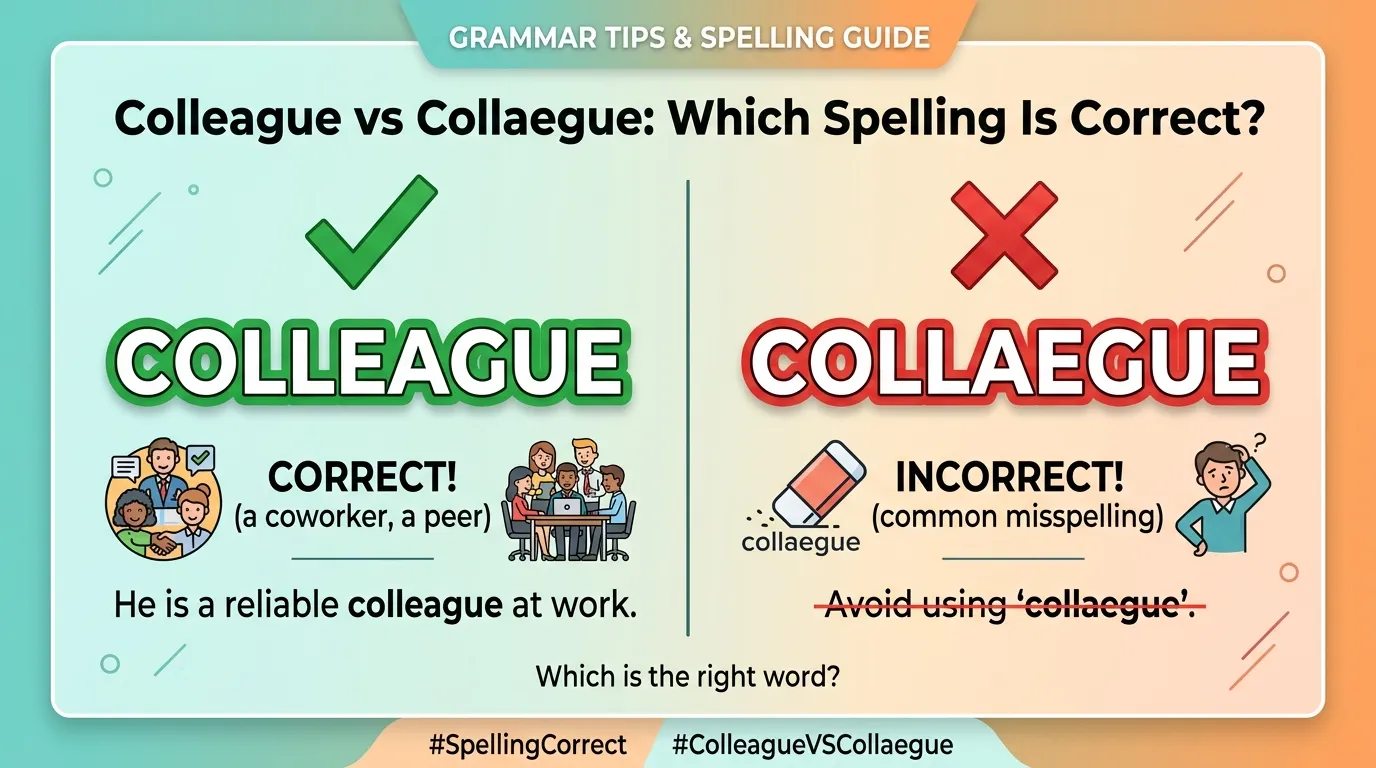
It is Monday morning, first day at a new job. The new hire arrives with a notebook, a laptop, and a seating chart that might as well be a treasure map. The desk by the window belongs to someone named Priya. The desk by the printer belongs to someone named Marcus. The new hire’s job, on day one, is to learn the names — and to learn the word for the people at those desks. They are not friends yet. They are not teammates yet. They are something more specific: colleagues. The new hire writes the word in the notebook, pauses, and spells it collaegue — with an A and an E in the wrong places — because the word sounds like it should be related to league, and league has an EA.
The correct spelling is colleague. The misspelling collaegue is one of the most persistent errors in office English, and it happens because the ear hears a word that sounds like league and the hand follows the sound. The word is not related to league at all. It comes from a different Latin root, and the spelling preserves it.
Monday Morning, New Desk
Start with the office, because the office is where the word earns its keep. A colleague is a person you work with — someone in the same organization, profession, or field. “My colleague in the finance department.” “She is a colleague from my old firm.” “A colleague recommended the book.” The word names a working relationship, not a friendship. Colleagues may become friends, but the word does not require it. It requires only shared work.
The word’s range is wide. In a school, colleagues are fellow teachers. In a hospital, fellow doctors and nurses. In a law firm, fellow lawyers. In academia, fellow scholars — and in academic writing, colleague is the standard word for a peer in the same field, even at a different institution. “A colleague at Oxford” means a fellow academic, not a fellow employee. The word stretches from the office to the profession.
There is a formality to the word that matters. Colleague is slightly formal — more formal than coworker, more formal than workmate. In a company email, “my colleague” sounds professional. In a text to a friend, “my coworker” sounds more natural. The register is part of the meaning: colleague is the word you use when the relationship is professional and the context is professional.
Chosen Together: The Latin Root
Here is the fact that fixes the spelling. Colleague comes from the Latin collega — con- (together) + legare (to choose, to appoint, to send as a deputy). A collega was someone chosen together with you — appointed to the same office, the same mission, the same duty. The word entered English in the sixteenth century, through French collègue, and it kept the Latin spelling: C-O-L-L-E-A-G-U-E.
Look at the pieces: col- (together) + league? No — col- + leag- + -ue. The middle is -leag-, from legare, and the ending is -ue, the French tail that English kept. There is no A anywhere in the ancestry. The A in collaegue is an invention of the ear, with no history behind it.
The root also explains the word’s dignity. A colleague is not just someone who happens to work near you. A colleague is someone chosen together with you — appointed to the same work, the same mission. The Latin root carries a sense of shared purpose that the modern office sometimes forgets. The spelling preserves it: the word is about being chosen together, not about being in a league.
Colleague vs Coworker vs Collaborator
Colleague has close neighbors, and keeping them distinct sharpens a sentence. A coworker is someone who works at the same place — the most general term, slightly informal, American in flavor. A workmate is the British equivalent, slightly warmer. A collaborator is someone you work with on a specific project — the word emphasizes joint action, not shared employment. A peer is someone at the same level, in the same field. A counterpart is someone in the same role at a different organization.
The choice among them is a matter of what you want to say. If the point is shared employment, use colleague or coworker. If the point is joint work on a project, use collaborator. If the point is equal standing, use peer. If the point is the same job elsewhere, use counterpart. The neighbors overlap, but they are not identical, and the sentence improves when the word matches the meaning.
There is one pair worth separating firmly: colleague vs collaborator. A colleague may never collaborate with you — you may work in different departments and never share a project. A collaborator may never be your colleague — you may work at different companies and collaborate on one paper. The words name different relationships: shared workplace vs shared work. The distinction is the whole reason both words exist.
The League Trap
So why does the hand write collaegue? Because of league. The word league — a group of teams, a unit of distance, an alliance — is spelled L-E-A-G-U-E, with an EA, and it sounds almost identical to the middle of colleague: “leeg.” A writer who hears “col-leeg” and knows league can easily reason that colleague must be col- + league. The logic is tidy. The answer is wrong, because the two words come from different Latin roots.
League comes from the Latin liga, a binding or alliance — related to ligament and obligation. Colleague comes from legare, to choose or appoint — related to delegate, legacy, and relegate. The two roots sound alike in modern English and have nothing to do with each other. The spelling preserves the difference: league has EA, colleague has EA too — wait. Both have EA. The difference is not the EA. It is the A before it.
Let that land, because it is the crux. Colleague is spelled C-O-L-L-E-A-G-U-E. The middle is -lea-, not -lae-. The misspelling collaegue adds an A after the double L and drops the E before the A: C-O-L-L-A-E-G-U-E. The error is a transposition — the E and the A swap places, and an extra A appears. The correct order is: double L, then E, then A, then G. The league trap is not about the EA. It is about putting the letters in the wrong order.
There is a second force pushing toward the error: the word college. College and colleague share the col- opening and the double L, and they are related — both come from legare, to choose: a college is a body of people chosen together, a colleague is one of them. But college is spelled C-O-L-L-E-G-E, with a single E in the middle and no A. A writer who knows college can borrow its shape and produce collegue — missing the A entirely. The two neighbors pull in opposite directions: league adds an A in the wrong place, college removes it. The correct spelling sits between them: double L, E, A, G, U, E.
Writing About Colleagues Well
In workplace writing, colleague appears in a set of standard phrases. “A valued colleague.” “My esteemed colleague.” “Dear colleagues” — the standard opening for a group email. “Colleagues and friends” — the standard opening for a farewell speech. The word carries respect: to call someone a colleague is to acknowledge shared work and shared standing.
The word also appears in a set of cautions. “A colleague told me” is the standard attribution for office gossip — the anonymous colleague, the colleague who cannot be named. “My colleague” in a complaint can sound passive-aggressive: “A colleague left the printer jammed again.” The word’s formality makes it a useful shield: it lets the writer sound professional while saying something pointed. The shield works because the word is respectful. It names the relationship without naming the person.
There is also the plural: colleagues, with an S. “My colleagues in the department.” “Colleagues across the industry.” The plural follows the regular rule, and the spelling holds: double L, E, A, G, U, E, S. The A stays in its place, between the E and the G, in every form of the word.
The Double-L, Single-E Rule
Here is the lock-in, and it is the spelling itself doing the work. Colleague is C-O-L-L-E-A-G-U-E. Break it into pieces: col- (together) + leag- (choose) + -ue (the French tail). The middle is -lea-, the same -lea- as in league — but without the extra A that the misspelling adds. The word is col + league minus one letter? No — it is col + leag + ue, and the A belongs after the E, not before it.
And one final check for the keyboard: when the word appears in your draft, look at the middle. If you see -lla- — collaegue — the A has jumped ahead of the E. Swap them back. Col-lea-gue. The new hire, the seating chart, and the notebook all agree: the colleagues at the desks by the window and the printer are spelled with the E first, the A second, and no extra letters anywhere.