The bar menu is printed on a single card, weighted down against the sea breeze by a lime wedge in a small glass. The drinks are listed in a careful hand: Mojito. Cuba Libre. Piña Colada. And then, halfway down, the one that stops the tourist mid-order: Daiquiri. The tourist reads it aloud — “dye-kee-ree?” “dack-werry?” — and the bartender, who has heard every version, smiles and says, “Say it like the town it came from.” The tourist tries again, gets it right, and then writes it in a postcard home as dacquiri. The drink does not mind. The dictionary does.
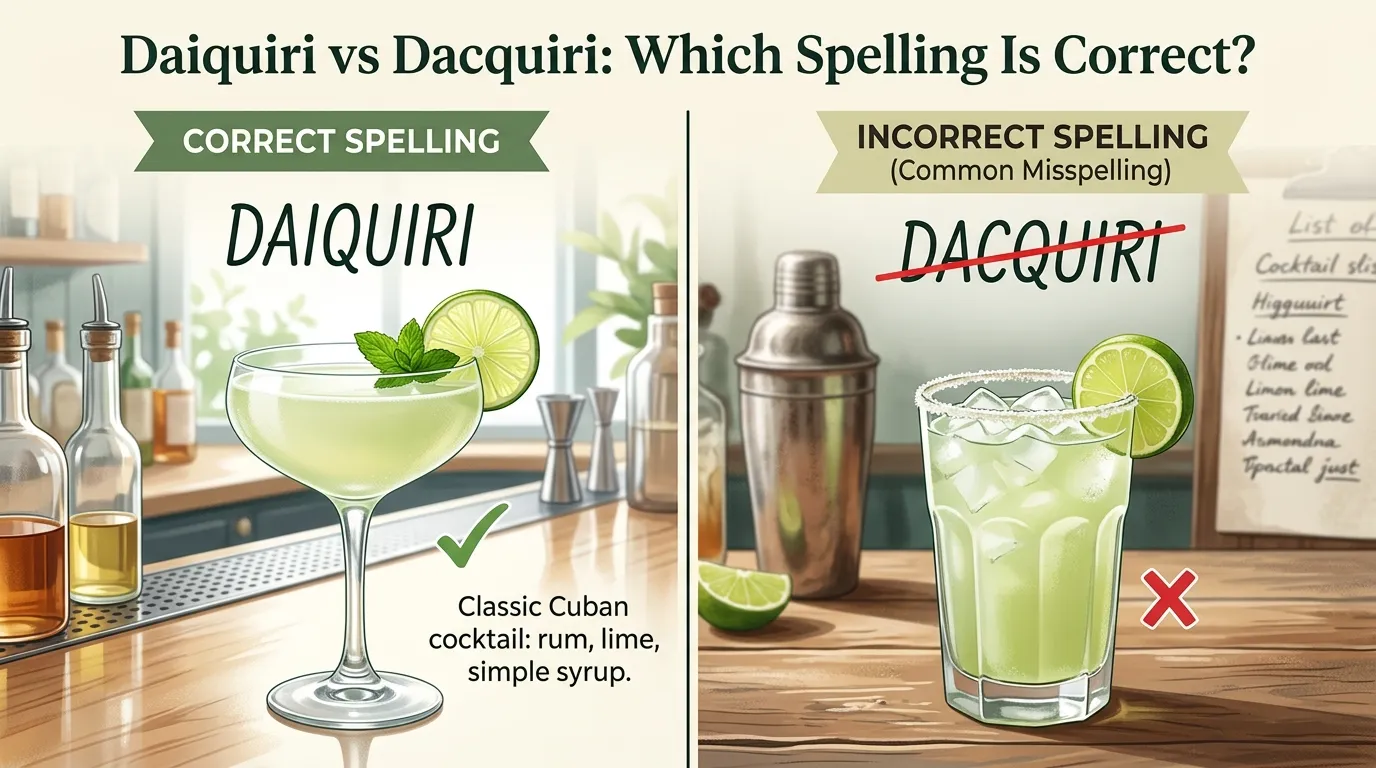
The correct spelling is daiquiri. The misspelling dacquiri — with a C where the I belongs — is the most common error for this word, and it happens because the pronunciation hides the spelling. The word is a place name wearing a cocktail’s clothes, and once you know the place, the spelling explains itself.
The Bar Menu at Sunset
Start with the drink, because the drink is why anyone meets this word. A daiquiri is a cocktail made from rum, lime juice, and sugar — three ingredients, shaken with ice, strained into a chilled glass. That is the classic version, the one bartenders call the “real” daiquiri, and it is a study in balance: the rum’s warmth, the lime’s sharpness, the sugar’s roundness, each holding the others in check. A well-made daiquiri tastes like the place it came from — hot, bright, and clean.
The word also names a family. The frozen daiquiri — blended with ice and fruit, usually strawberry or banana — is the version most tourists meet first, and the version purists complain about. The flavored daiquiri, the daiquiri on the rocks, the Hemingway daiquiri (with grapefruit juice and maraschino liqueur, less sugar, named for the writer who drank them in Havana) — all of them carry the name, and all of them spell it the same way. The family is large. The spelling is one.
There is a third life for the word: as shorthand for a certain kind of vacation. “Daiquiri weather.” “A daiquiri afternoon.” The word has become an adjective for leisure itself — sun, sea, and a cold glass. The drink’s name now sells a mood, and the mood is spelled D-A-I-Q-U-I-R-I.
A Town Called Daiquirí
The word is a place. Daiquirí is a small town on the southeastern coast of Cuba, near Santiago de Cuba, where iron mines drew American engineers in the late 1800s. One of those engineers, Jennings Cox, is credited with inventing the drink around 1898: the story goes that he ran out of gin at a gathering, substituted the local rum, added lime and sugar, and served the result to his guests. Whether the story is exactly true is beside the point. The drink is named for the town, and the town’s name is the spelling.
The town’s name is Spanish, and Spanish spelling explains the vowels. In Spanish, ai is a common diphthong — aire, baile, paisaje — and the town’s name is pronounced “dy-kee-REE,” with the stress on the final syllable. English borrowed the name with its Spanish spelling intact: D-A-I-Q-U-I-R-I. The I after the D is not an English choice. It is a Spanish import, and it kept its passport.
The borrowing also explains the Q. In Spanish, Q is always followed by U, and the combination qu before I or E makes a K sound: queso, quince, Daiquirí. English kept the QU, and the pronunciation followed: the Q is a K, the U is silent, and the I is the vowel. A writer who hears “dack-werry” and writes dacquiri is spelling the English sound, not the Spanish name. The name wins.
The Three-Ingredient Original
The classic daiquiri is worth describing in full, because the simplicity is the point. White rum, fresh lime juice, sugar — in the standard ratio, two parts rum, one part lime, half a part sugar (or a bar spoon of sugar, or simple syrup). Shake with ice until the shaker frosts. Strain into a chilled coupe. No garnish, or a thin wheel of lime. The result is a drink that tastes like nothing else and like its ingredients exactly — the definition of a good cocktail.
The simplicity is also why the drink is a bartender’s test. There is nowhere to hide. Bad rum shows. Bottled lime juice shows. Too much sugar shows. A bartender who can make a great daiquiri can make anything, because the drink tests balance, temperature, and restraint — the three skills that underlie all cocktail-making. The drink is the exam, and the exam is three ingredients long.
The Hemingway version deserves a note, because it is the most famous variation and the most argued-about. Hemingway, who drank at El Floridita in Havana, preferred his daiquiris with less sugar, more rum, grapefruit juice, and maraschino liqueur — the “Papa Doble,” a double. The bar still serves it. The variation is a reminder that the daiquiri is a living recipe, not a museum piece — and that every variation still spells the name the same way.
Frozen, Flavored, and Far From the Original
The frozen daiquiri is the version that conquered the world, and it is a different drink. Blended with crushed ice and fruit — strawberry first, then banana, mango, peach — it is sweet, slushy, and served in a large glass with a straw. It is the drink of beach resorts, cruise ships, and spring break. Purists dismiss it. Tourists love it. Both sides spell it the same way.
The frozen version also explains the word’s modern reputation. A drink that is mostly sugar, fruit, and ice does not taste like the classic, and a generation of drinkers met the frozen version first and concluded that the daiquiri was a sweet, unserious drink. The cocktail revival of the 2000s pushed back, putting the classic back on menus and teaching a new generation that the name belongs to a sharp, balanced, three-ingredient drink. The revival is a spelling lesson in disguise: the real daiquiri is not the slushy one, and the real spelling is not the one that sounds like it.
There is also the bottled and canned daiquiri — the pre-mixed version sold in liquor stores, usually sweet, artificial, and pink. It is the furthest from the original, and it is the version most likely to misspell the name on its own label, because the label is designed for the sound, not the town. The bottle is a warning: if the label says dacquiri, the contents will not be better than the spelling.
Why Fingers Write Dacquiri
So why does the hand write dacquiri? Three forces. The first is sound. In English, the word is pronounced “DACK-uh-ree” or “dy-kee-ree,” depending on the speaker, and the “dack” version invites a C — the letter English uses for the hard K sound before A. The hand hears “dack” and writes dac-. The ear is reporting the English pronunciation. The spelling records the Spanish name.
The second force is the double-C family. English has a large group of words with -cc- in the middle: accident, accommodate, success, tobacco, broccoli. A writer who hears a hard K sound in the middle of a long word reaches for the familiar pattern and doubles the C. The guess is natural. It is also wrong, because daiquiri has a single Q, not a double C — the QU is the Spanish spelling, and it does the work alone.
The third force is the I/U confusion. The word’s middle — -quiri — contains a U that is silent and an I that carries the vowel. The hand, unsure which letters are doing the work, rearranges them: -cquiri, -querry, -querie. Every rearrangement is a guess about a spelling that follows Spanish rules, not English ones. The guesses fail because the word is not playing by English rules.
Daiquiri Culture: The Drink Beyond the Glass
The daiquiri has a cultural life that outgrew the bar. In Havana, El Floridita — the bar where Hemingway drank his Papa Dobles — keeps a bronze statue of the writer at the end of the counter, and tourists line up to photograph it with a daiquiri in hand. The bar’s motto, “La cuna del daiquiri” — the cradle of the daiquiri — is painted on the wall, and the claim is defended with the ferocity of a sports rivalry. In Santiago, the rival claim is quieter: the drink was born in Daiquirí, and Havana merely adopted it. The two cities share the name the way two parents share a child.
The drink also has a literary afterlife. Hemingway’s daiquiris appear in his letters and in the memoirs of his Havana years, usually in the plural and usually after the second round. The association gave the drink a glamour no advertising could buy: the daiquiri became the drink of writers, of expatriates, of people who lived interestingly. The glamour survives in the classic version’s reputation — the sharp, balanced, three-ingredient drink that serious bartenders respect — and it is one reason the cocktail revival treated the daiquiri as a cause worth fighting for.
The Q-U-I-R-I Lock-In
Here is the memory hook, and it is the town doing its work. Daiquiri is a place in Cuba. The place is spelled D-A-I-Q-U-I-R-I. The drink is named for the place, and the spelling traveled with it. When the word appears in your draft, ask where it came from. If it came from the town, it is spelled like the town: DAI, then QUIRI — the AI of dai, the QUIRI of the Spanish ending.
And one final check for the keyboard: if you see dacquiri in your draft, you have written the English sound, not the Spanish name. Delete the C, restore the I: dai-, not dac-. The bartender will approve. The town will approve. And the postcard home will be spelled the way the place it names has been spelled all along.










