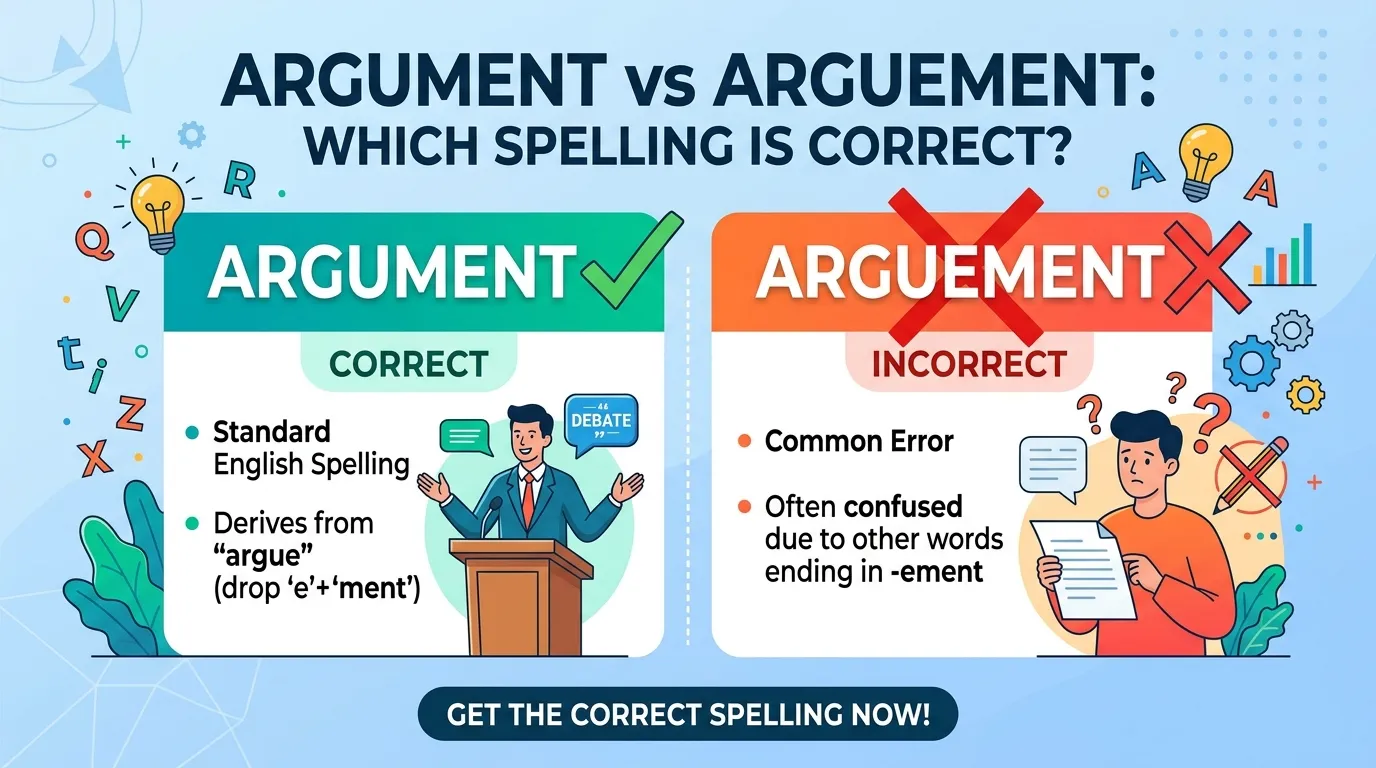
Argument vs Arguement: Which Spelling Is Correct?

If you are wondering whether “argument” or “arguement” is the correct spelling, the answer is simple: argument is correct, while arguement is a misspelling.

The confusion is understandable because the word comes from argue, and many people naturally expect the spelling to be arguement. However, standard English drops the e from argue before adding -ment, producing argument, not arguement.

This guide explains the difference between argument vs arguement, why the mistake happens, how to pronounce argument, what the word means in different contexts, and how to remember the correct spelling. You will also see examples from everyday conversation, academic writing, business, journalism, law, sports, technology, and casual communication.


Quick Answer: Argument or Arguement?

Argument is the correct spelling.

Arguement is an incorrect spelling and should not be used in standard English.

SpellingCorrect?Meaning
argument✅ YesA reason, position, debate, disagreement, or set of reasons
arguement❌ NoCommon misspelling of argument

Correct examples

  • She presented a strong argument for changing the policy.
  • We had an argument about where to eat.
  • His main argument was supported by evidence.
  • The lawyer made a convincing argument in court.

Incorrect examples

  • She presented a strong arguement. ❌
  • His arguement was difficult to understand. ❌
  • We had an arguement yesterday. ❌

The correct form is always argument.


Why Is “Argument” Correct and “Arguement” Wrong?

The main reason people write arguement is that they connect the spelling directly to the verb argue.

The verb is:

argue

But the noun is:

argument

Notice what happens:

argue → argument

The final e in argue does not remain in the noun.

This is similar to other English word-building patterns in which the spelling changes when a suffix is added. English spelling is not always perfectly predictable, so relying only on the base word can lead to mistakes.

Think of it this way

  • argue → argument
  • develop → development
  • govern → government
  • excite → excitement

You should memorize argument as a complete word rather than trying to construct its spelling from argue.


What Does “Argument” Mean?

The word argument has several meanings depending on context.

1. A reason supporting an idea

An argument can be a reason or group of reasons used to support a particular position.

Example:

Her strongest argument was that the plan would save money.

Here, argument does not mean a fight. It means a reason or case supporting an idea.

2. A disagreement or quarrel

In everyday conversation, an argument can mean a disagreement between people.

Example:

My brother and I had an argument about the car.

Here, argument means a verbal disagreement or quarrel.

3. A formal case or position

In academic, legal, political, or professional writing, an argument is often a carefully developed position supported by evidence and reasoning.

Example:

The researcher builds an argument around three major findings.

4. A technical or mathematical term

Argument also has specialized meanings.

In mathematics, an argument can refer to an independent variable on which the value of a function depends.

In grammar and linguistics, an argument can refer to a word or phrase that is required by a particular verb or predicate.

So the word is much broader than simply “a fight.”


Argument vs Arguement: The Key Difference

There is actually no difference in meaning between the two spellings because arguement is not the standard spelling of the noun.

The important distinction is:

  • argument = correct English word
  • arguement = misspelling

This means you should not treat them as two alternative spellings, such as color and colour.

Comparison

FeatureArgumentArguement
Standard EnglishYesNo
Dictionary spellingYesNo
American EnglishYesNo
British EnglishYesNo
Academic writingYesNo
Business writingYesNo
Casual writingYesNo
MeaningReason, debate, disagreement, etc.No standard meaning
Recommended useAlwaysNever

Why Do People Spell “Argument” as “Arguement”?

The mistake usually comes from the word argue.

When people see:

argue

they may naturally form:

argue + ment = arguement

That looks logical at first glance.

Unfortunately, English does not always work that way.

The accepted spelling is:

argument

not:

arguement

The pronunciation can also contribute to confusion

The word argument is pronounced roughly like:

AR-gyuh-mənt

The ending sounds like “ment,” which can make people imagine the spelling arguement.

The correct spelling, however, is:

argument

not arguement.


How Do You Pronounce “Argument”?

In American English, argument is commonly pronounced approximately:

AR-gyuh-mənt

The stress falls on the first syllable.

It can be broken down as:

ar + gu + ment

The spelling does not contain the extra “e” found in the incorrect form arguement.

Pronunciation example

“They had an argument.”

You can think of the ending as:

-ment

rather than:

-uement

Pronunciation and spelling are not identical, but remembering the sound can help reinforce the correct spelling.


Is “Arguement” Ever Correct?

No. Arguement is not the standard spelling of the English noun.

If you see arguement in a text, it is normally a spelling error for argument.

This applies across common varieties of English, including:

  • American English
  • British English
  • Canadian English
  • Australian English
  • International English

There is no standard regional version in which arguement replaces argument.


American vs British English: Is There Any Difference?

Not in this case.

Both American and British English use:

argument

The spelling arguement is not a standard American or British alternative.

This is important because English does have genuine regional spelling differences.

For example:

  • color / colour
  • favorite / favourite
  • center / centre

But argument vs arguement is not one of those cases.

Correct for both varieties

American English: argument
British English: argument


Argument as a Noun

The most common grammatical role of argument is a noun.

Examples

  • That is a convincing argument.
  • We heard both sides of the argument.
  • Her argument was based on facts.
  • The two neighbors had an argument.
  • The professor challenged my argument.

The plural form is:

arguments

Singular

The argument was convincing.

Plural

The arguments were convincing.


Related Words: Argue, Argument, Argumentative

Several words come from the same word family.

WordPart of SpeechMeaning
argueVerbTo give reasons or disagree verbally
argumentNounA reason, case, disagreement, or debate
arguerNounSomeone who argues
argumentativeAdjectiveInclined to argue or marked by argument
argumentationNounThe process or practice of developing arguments

Examples

Argue:

They often argue about politics.

Argument:

They had an argument about politics.

Argumentative:

He became argumentative during the meeting.

Argumentation:

The course focuses on formal argumentation.


Argument: Dictionary-Style Definition

A simple dictionary-style definition would be:

Argument (noun): a reason or set of reasons given to support or oppose an idea; a discussion involving different views; or an angry disagreement.

The exact meaning depends on the context.

In simple English

An argument can be:

  1. A reason
  2. A case supporting an opinion
  3. A disagreement
  4. A formal debate
  5. A technical term in mathematics or grammar

Different Meanings of “Argument” in Context

The word changes slightly depending on where you encounter it.

In everyday conversation

It often means a disagreement.

We had an argument over the weekend.

In school

It usually means a position supported with reasons and evidence.

Your essay needs a clear central argument.

In academic writing

It refers to the main claim or line of reasoning developed throughout a paper.

The author’s argument becomes clearer in the final section.

In law

A lawyer may present an argument supporting a legal position.

The attorney presented a detailed argument before the court.

In politics

Politicians and commentators frequently use argument to describe a case for or against a policy.

The senator’s main argument was that the bill would reduce costs.

In journalism

A writer may describe an argument made by a public figure, organization, or political group.

The article examines both arguments surrounding the proposal.

In business

An argument can be a reason supporting a strategy or decision.

The strongest argument for expansion is increased customer demand.

In sports

An argument may simply mean a disagreement between players, coaches, officials, or fans.

The referee stepped in after an argument between the players.


Formal vs Informal Meanings of “Argument”

The tone of argument depends heavily on context.

Informal

In casual conversation, it often means a fight or disagreement.

We had a little argument last night.

Formal

In academic or professional writing, it often refers to reasoning.

The report presents a strong argument for reform.

This distinction matters because argument does not always mean conflict.

Someone can have a strong argument without being angry.

For example:

Her argument was logical and well supported.

That sentence describes reasoning, not a quarrel.


Argument vs Debate vs Discussion vs Disagreement

These words are related but not identical.

WordBasic Meaning
ArgumentReasons supporting a position, or a disagreement
DebateA structured exchange of opposing views
DiscussionA conversation about a subject
DisagreementA difference in opinion
DisputeA serious disagreement or conflict
QuarrelAn angry disagreement
ReasonA cause or explanation supporting a position

Example

A group can have a discussion without disagreement.

Two people can have a disagreement without becoming angry.

A formal debate can contain several carefully developed arguments.

An angry argument can turn into a quarrel.


Synonyms for “Argument”

The best synonym depends on the intended meaning.

When “argument” means a reason

Possible alternatives include:

  • reason
  • case
  • rationale
  • justification
  • point
  • position
  • contention
  • claim

Example:

Her argument was persuasive.

Possible alternatives:

Her case was persuasive.

Her reasoning was persuasive.

When “argument” means a disagreement

Possible alternatives include:

  • disagreement
  • dispute
  • quarrel
  • conflict
  • confrontation
  • altercation
  • row
  • squabble

The tone of these words varies.

For example, squabble sounds relatively minor, while altercation can suggest a more serious confrontation.


Antonyms of “Argument”

There is no single perfect antonym because argument has multiple meanings.

Depending on context, possible opposites include:

  • agreement
  • harmony
  • consensus
  • accord
  • cooperation
  • understanding

Example

They had an argument about the decision.

Opposite:

They reached an agreement about the decision.

But when argument means a reason supporting an idea, an exact opposite is harder to identify.


Common Collocations With “Argument”

Collocations are words that commonly appear together.

Learning them can make your English sound more natural.

Common combinations

  • strong argument
  • weak argument
  • convincing argument
  • compelling argument
  • persuasive argument
  • logical argument
  • reasonable argument
  • valid argument
  • powerful argument
  • compelling argument
  • central argument
  • main argument
  • final argument
  • counterargument
  • supporting argument
  • opposing argument

Examples

She made a strong argument for reform.

His main argument was easy to understand.

The evidence supports her central argument.

The writer presents a convincing argument.


Common Phrases With “Argument”

Here are some natural expressions you will frequently encounter.

“Make an argument”

The author makes a strong argument for renewable energy.

“Make an argument for”

She made an argument for expanding the program.

“Make an argument against”

They made an argument against the proposal.

“Win an argument”

He thinks he can win any argument.

“Lose an argument”

She admitted that she had lost the argument.

“Get into an argument”

I don’t want to get into an argument.

“Have an argument”

They had an argument yesterday.

“Settle an argument”

Let’s look at the facts and settle the argument.

“A heated argument”

The meeting ended with a heated argument.


Common Expressions and Idioms Related to Arguments

English contains many expressions involving disagreement and reasoning.

“Argue the point”

To continue discussing or defending a particular position.

There’s no need to argue the point any further.

“Play devil’s advocate”

To deliberately argue an opposing position in order to test an idea.

I’ll play devil’s advocate and challenge your proposal.

“Agree to disagree”

To accept that two people have different opinions.

We don’t see the issue the same way, so we’ll have to agree to disagree.

“Make a case”

To present reasons supporting an idea.

She made a strong case for hiring another employee.

“Counterargument”

An argument that challenges another argument.

The essay includes a strong counterargument.


Common Mistakes With “Argument”

Mistake 1: Writing “arguement”

Incorrect:

He presented a convincing arguement.

Correct:

He presented a convincing argument.


Mistake 2: Adding the extra “e”

The incorrect spelling usually appears because writers think:

argue + ment = arguement

Instead, remember:

argue → argument


Mistake 3: Assuming “argument” always means a fight

Consider:

The essay presents a strong argument.

This does not mean the essay contains a fight.

Here, argument means a reasoned position or case.


Mistake 4: Confusing “argument” with “argue”

These words have different grammatical roles.

Argue is usually a verb:

They argue about money.

Argument is a noun:

They had an argument about money.


Mistake 5: Using “argument” when “reason” is clearer

Sometimes reason is more natural.

Awkward:

My argument for being late was that the bus was slow.

More natural:

My reason for being late was that the bus was slow.

However, argument can be appropriate when discussing a formal position or persuasive case.


Awkward vs Natural Examples

Example 1

Awkward:

His arguement was very strong.

Natural:

His argument was very strong.

Example 2

Awkward:

She gave me an arguement about the price.

Natural:

She gave me a reason for the price.

Or:

She made a strong argument about the price.

Example 3

Incorrect:

We had an arguement yesterday.

Correct:

We had an argument yesterday.

Example 4

Incorrect:

The student developed an interesting arguement.

Correct:

The student developed an interesting argument.


How to Use “Argument” in Academic Writing

Academic writing often uses argument to describe the central position of a paper, essay, thesis, or study.

Common academic phrases

  • central argument
  • main argument
  • primary argument
  • supporting argument
  • counterargument
  • logical argument
  • evidence-based argument
  • persuasive argument
  • develop an argument
  • present an argument
  • support an argument
  • challenge an argument
  • strengthen an argument
  • weaken an argument

Example

The central argument of the essay is that early education improves long-term learning outcomes.

Another example:

The author supports this argument with historical evidence.

Practical tip

In academic writing, an argument is not simply an opinion.

A strong academic argument normally includes:

  1. A clear claim
  2. Supporting reasons
  3. Relevant evidence
  4. Explanation
  5. Logical connections

Argument in Business Writing

Business communication often uses argument in a formal sense.

For example:

The strongest argument for the new software is its lower operating cost.

Other natural examples include:

The report presents several arguments in favor of expansion.

Management rejected the argument that the change would improve productivity.

We need a stronger argument before presenting the proposal to the board.

For business writing, use argument when discussing a reasoned case. Use disagreement, conflict, or dispute when you specifically mean interpersonal tension.


Argument in Legal Writing

The word is also common in legal language.

Examples include:

The lawyer presented a strong argument.

The court considered the defendant’s argument.

The attorney’s closing argument focused on the lack of evidence.

In legal contexts, argument generally refers to reasoning presented to persuade a court or decision-maker.


Argument in Journalism and Political Writing

Journalists often use argument when describing competing positions.

For example:

The article examines the argument for and against the proposed law.

Critics rejected the government’s argument.

Supporters have a strong argument for expanding the program.

Political writing frequently uses phrases such as:

  • political argument
  • policy argument
  • economic argument
  • moral argument
  • constitutional argument
  • public argument
  • argument for reform
  • argument against reform

Argument in Sports

In sports, argument commonly refers to a disagreement.

Examples:

The players got into an argument after the final whistle.

The coach had an argument with the referee.

Security intervened when the argument became heated.

You may also see argument in sports analysis when it means a case or reason:

His record makes a strong argument for including him in the starting lineup.


Argument in Technical and Mathematical English

The word has specialized meanings outside everyday conversation.

Mathematics

In mathematics, an argument can refer to a variable or input associated with a function.

For example:

The function takes two arguments.

This usage is common in mathematics and computer programming.

Programming

In software development, an argument is commonly a value supplied to a function or method.

For example:

The function accepts two arguments.

This is completely different from an argument between two people.

Grammar

In linguistics, an argument can be a grammatical element required or selected by a verb or predicate.

These technical meanings demonstrate why context matters.


Argument in Technology and Programming

If you work with software, you may see argument frequently.

For example:

Pass the filename as the first argument.

Or:

The function requires three arguments.

Here, argument means an input or value supplied to a function, not a disagreement.

Important distinction

We had an argument about the software.

means a disagreement.

But:

The function requires one argument.

means a required input.

The spelling remains argument in both cases.


Word History and Etymology of “Argument”

The word has a long history.

Argument entered English through Middle English and Anglo-French from Latin argumentum. It is related to the Latin verb arguere, associated with ideas such as showing, demonstrating, or making something clear.

The word has been used in English since the medieval period.

Over time, its meanings developed in several directions. It became associated not only with a reason or proof but also with debate, disagreement, literary subject matter, and specialized technical concepts.

This historical development helps explain why argument has so many meanings today.

It is also related to the verb argue, which has similarly deep roots.


Memory Tricks for Spelling “Argument”

If you often write arguement, try one of these memory tricks.

Memory trick 1: “Argue loses E”

Remember:

argue loses the e → argument

So:

argue → argument

Memory trick 2: Think “ARG + U + MENT”

Break the spelling into:

argu + ment

not:

argu + e + ment

Memory trick 3: Compare the word family

Remember:

argue
argument
argumentative
argumentation

The noun is argument.

Memory trick 4: Say “argument” while spelling it

Think:

AR-GU-MENT

That can help prevent the extra e from appearing.


Argument vs Arguement: A Simple Rule to Remember

If you remember only one thing from this article, remember this:

There is no standard English word spelled “arguement.” The correct spelling is “argument.”

Whenever you are unsure, choose:

argument

Never:

arguement


Recommendations by Writing Type

American English

Use argument.

British English

Use argument.

International English

Use argument.

Academic writing

Use argument, especially when discussing claims, reasoning, evidence, and counterarguments.

Business writing

Use argument when referring to a reasoned case or position.

Legal writing

Use argument for a lawyer’s or party’s reasoning.

Journalism

Use argument for competing claims, positions, or reasoning.

Technical writing

Use argument when referring to a function input or formal reasoning.

Sports writing

Use argument for a disagreement or a persuasive case.

Blogging

Use argument. Avoid arguement because spelling errors can reduce credibility.

Casual writing

Even in texts and social media, argument remains the correct spelling.


Is “Argument” a Formal Word?

Argument can be formal or informal depending on how it is used.

In:

We had an argument last night.

it sounds ordinary and conversational.

In:

The researcher develops a compelling argument.

it sounds academic.

In:

The attorney presented her final argument.

it sounds formal and professional.

So the word itself is not limited to one level of formality.


Natural Alternatives to “Argument”

Sometimes another word will communicate your meaning more precisely.

If you mean a reason

Use:

  • reason
  • rationale
  • explanation
  • case
  • justification
  • point

If you mean a disagreement

Use:

  • disagreement
  • dispute
  • quarrel
  • conflict
  • confrontation
  • disagreement

If you mean formal reasoning

Use:

  • case
  • position
  • claim
  • reasoning
  • analysis
  • contention

Choose the word that matches your exact meaning.


Quick Editing Checklist

Before publishing or submitting your writing, check for these common errors.

Spelling

  • Did I write argument, not arguement?
  • Did I use the correct plural arguments?

Grammar

  • Am I using argue as a verb?
  • Am I using argument as a noun?

Meaning

  • Does argument mean a reason in this sentence?
  • Does it mean a disagreement?
  • Would reason, case, or disagreement be clearer?

Style

  • Is the word appropriate for my audience?
  • Have I avoided unnecessary repetition?
  • Does the surrounding sentence make the intended meaning clear?

Argument vs Arguement: Final Comparison

QuestionAnswer
Which spelling is correct?Argument
Is “arguement” correct?No
Is “argument” used in American English?Yes
Is “argument” used in British English?Yes
Can argument mean a disagreement?Yes
Can argument mean a reason?Yes
Can argument be used in academic writing?Yes
Can argument be a technical term?Yes
Does argument come from argue?Yes
Should you write “arguement”?No

Frequently Asked Questions About Argument vs Arguement

1. Is it “argument” or “arguement”?

The correct spelling is argument. Arguement is a common misspelling.

Correct:

We had an argument.

Incorrect:

We had an arguement.


2. Why is “arguement” spelled incorrectly?

People often add -ment directly to argue in their minds, producing arguement. However, the standard noun spelling is argument, with no extra e before -ment.


3. Is “arguement” a word?

Arguement is not the standard spelling of the English noun. In normal English writing, it should be corrected to argument.


4. What is the meaning of “argument”?

Argument can mean a reason supporting a position, a set of reasons used to persuade someone, a disagreement between people, or a specialized concept in fields such as mathematics, grammar, and programming.


5. Is “argument” American or British English?

Argument is standard in both American and British English. There is no American/British spelling difference between argument and arguement.


6. How do you pronounce “argument”?

In American English, argument is commonly pronounced approximately AR-gyuh-mənt, with the main stress on the first syllable.


7. Is “argument” a noun or a verb?

Argument is a noun.

The related verb is argue.

For example:

They argue about politics.

They had an argument about politics.


8. What is the plural of “argument”?

The plural is arguments.

Singular:

The argument was convincing.

Plural:

Both arguments were convincing.


9. What is the difference between an argument and a disagreement?

A disagreement simply means that people have different opinions. An argument can mean a disagreement, but it can also mean a reasoned case supporting a particular position.

For example:

We have a disagreement about the plan.

means the people do not agree.

But:

She presented an argument for the plan.

means she gave reasons supporting it.


10. How can I remember the correct spelling of argument?

Use this simple rule:

Argue loses the e: argue → argument.

When writing the noun, remember argument, not arguement.


Conclusion

When comparing argument vs arguement, there is a clear winner: argument is the correct spelling.

Arguement is a common spelling mistake caused by the natural temptation to keep the final e from argue when adding *-ment. However, standard English uses argument.

The word itself has several meanings. It can describe a reason supporting an idea, a carefully developed position, a debate or disagreement, or a specialized concept in areas such as mathematics, grammar, and programming.

The safest rule is simple:

argue → argument

Use argument in American, British, academic, business, legal, journalistic, technical, sports, blogging, and casual writing.

If you are proofreading a sentence and see arguement, change it to argument. Once you remember that the noun drops the extra e, this spelling mistake becomes easy to avoid.

Leave a Comment