The archive box is labeled in pencil: “Hargreaves Family, 1841–1903.” Inside are parish registers, a bundle of letters tied with string, and a hand-drawn family tree that runs out of room at the edges. The genealogist tracing the family has hit the same puzzle three times in one afternoon: the same burial ground appears in the records as “the cemetery,” “the cemetary,” and once, in a hurried clerk’s hand, “the semetary.” Two of those spellings are wrong. One is right. The family’s dead, it turns out, are less confusing than the word for where they lie.
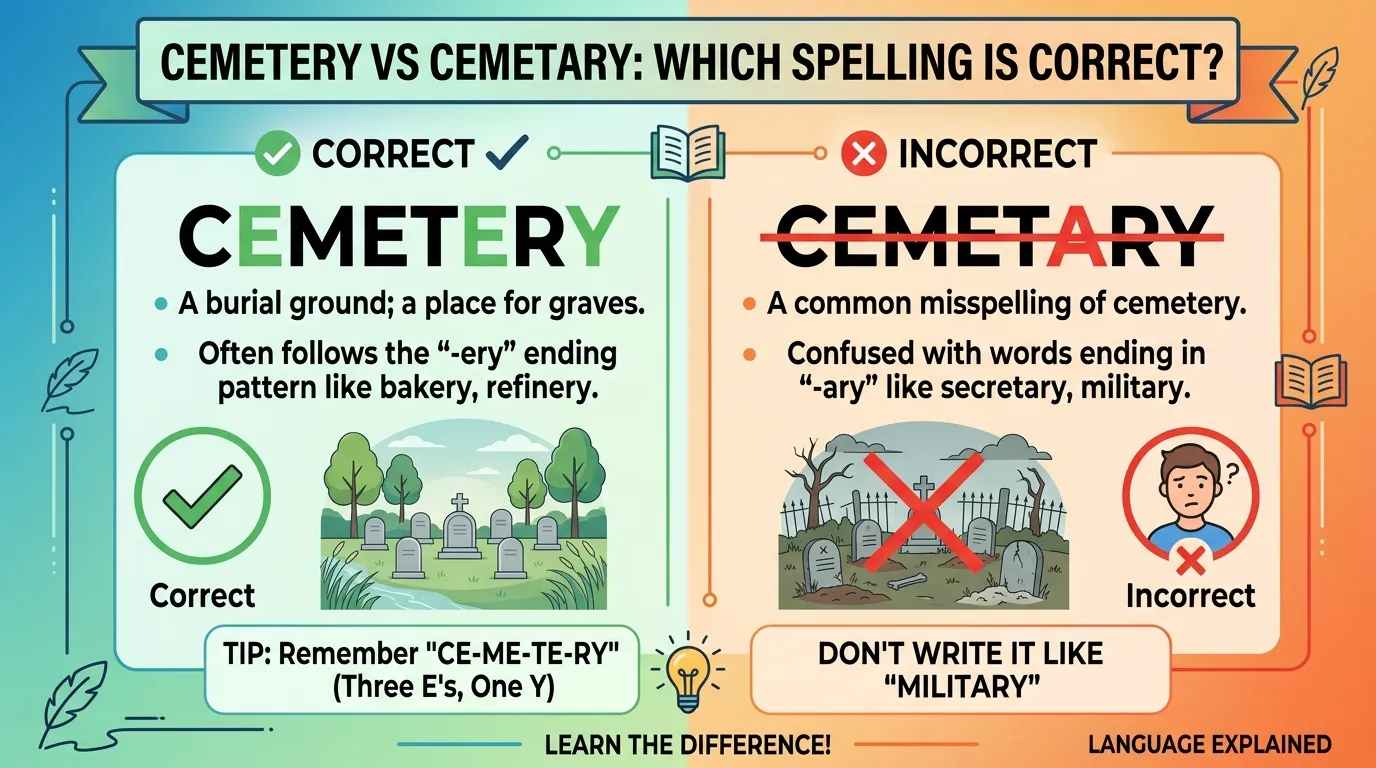
The correct spelling is cemetery. The misspelling cemetary — with an A in the third syllable — is one of the most common spelling errors in English, and it survives because the ear genuinely cannot hear the difference. In unstressed syllables, the vowels blur, and the hand guesses. The guess, in this case, lands on the wrong letter almost every time.
The Archive Box
Start with the place itself, because the word’s meaning explains its spelling. A cemetery is a large burial ground, usually one not attached to a church, where the dead are buried in marked graves. The word is the general term: a city cemetery, a national cemetery, a military cemetery. It is the word on the sign at the gate, the word in the legal documents, the word on the map.
The word entered English from the Greek koimeterion, meaning “a sleeping place” — from koiman, to put to sleep. The Greeks called burial grounds sleeping places because they thought of the dead as sleeping, and the word carried that gentleness across two thousand years and three languages: Greek koimeterion to Latin coemeterium to Old French cimetiere to English cemetery. Every step of that journey kept the E in the middle. The A in cemetary has no ancestor anywhere in the family tree.
The archive box shows why the spelling matters in practice. A genealogist searching a database for “Hargreaves cemetery” will miss every record indexed under “cemetary” — and a clerk who indexed the records under the misspelling has buried the family’s history a second time. Spelling, in the archive, is not pedantry. It is retrieval.
Sleeping Place: The Greek Root
The Greek root gives you the memory hook that actually holds. Cemetery is a sleeping place. The middle of the word is -meter- — the same -meter- that appears in meter, geometry, symmetry, and barometer. All of those words spell the syllable with an E. If you can spell geometry, you can spell cemetery, because the middle is the same.
The root also explains the word’s tone. A cemetery is not a morbid word. It is a euphemistic one — a word chosen, two thousand years ago, to make death sound like sleep. That is why cemetery language is full of sleep metaphors: “rest in peace,” “eternal rest,” “laid to rest,” “the sleeping.” The word itself is the first euphemism, and the spelling preserves it.
There is a second Greek gift in the word: the ce- opening. English words borrowed from Greek through Latin often begin with ce- where the C is soft: center, century, ceremony, cemetery. The soft C is another fingerprint of the borrowing, and it is worth hearing: the word begins with an S sound, not a K sound, because it came through Latin and French, not straight from Greek.
Cemetery, Graveyard, Churchyard, Burial Ground
Cemetery has close neighbors, and keeping them distinct sharpens a sentence. A graveyard is a burial ground attached to a church — the word is older, more Anglo-Saxon, and more associated with village churches and horror stories. A churchyard is the same thing said more plainly: the yard around a church. A burial ground is the general, slightly formal term, often used for ancient or Indigenous sites. A cemetery is the large, usually municipal or commercial ground that may have no church at all.
The distinctions matter in writing. “The village graveyard” conjures a church, a yew tree, tilted headstones. “The city cemetery” conjures gates, avenues, sections, a superintendent’s office. “The burial ground” conjures archaeology, antiquity, something found rather than founded. The words are not interchangeable, and a writer who swaps them casually is moving the reader’s mental picture without noticing.
There is also necropolis — “city of the dead,” from Greek nekros (dead) + polis (city) — the grand, ancient term for vast burial cities like those of Egypt and Etruria. And columbarium, the wall of niches for urns, from Latin columba, dove — because the niches reminded Romans of dovecotes. The vocabulary of burial is a small museum of euphemism, and cemetery is its most everyday exhibit.
Why the Ear Writes Cemetary
So why does the hand write cemetary? Two forces, both powerful. The first is the schwa — the neutral “uh” sound that lives in unstressed syllables. Cemetery is pronounced “SEM-uh-tair-ee”: the second syllable is unstressed, and its E comes out as a murmur. The ear hears “uh” and the hand, guessing, writes A — the letter that most often stands for that murmur in words like separate, desert, and secretary. The guess is reasonable and wrong.
The second force is analogy. English has a large family of words ending in -tary: military, voluntary, momentary, commentary, documentary, sanitary. A writer who knows those words can reason that cemetery must belong to the same family. It does not. Cemetery belongs to the -tery family — monastery, mystery, mastery — and the two families spell their middle syllables differently. The brain files the word with the wrong relatives, and borrows the A across the filing cabinet.
There is also the pull of secretary and cemetery as sound-alikes: both four syllables, both ending in -tery/-tary, both with a murmur in the middle. The brain pairs them, and secretary — which really does have an A — lends its vowel to its neighbor. The borrowing is natural. It is also the entire error.
Cemeteries in Law, Literature, and Everyday Speech
In law, cemeteries are regulated spaces: perpetual-care funds, plot deeds, burial rights, disinterment permits. The legal language is precise, and the spelling matters, because a deed that names the wrong cemetery — or misspells the right one — can cloud a title. Lawyers write cemetery carefully, because a cemetery is, legally, a piece of real estate with unusual tenants.
In literature, cemeteries are among the most productive settings in English. Gray’s “Elegy Written in a Country Churchyard” made the village burial ground a place of meditation. Dickens, Hardy, and Faulkner all used cemeteries as places where the past speaks. The word carries the genre with it: a sentence that mentions a cemetery primes the reader for reflection, mystery, or horror, depending on what follows. The spelling is part of the atmosphere — a misspelled cemetery breaks the spell the way a misspelled name does.
In everyday speech, the word appears in fixed phrases: “the cemetery gates,” “cemetery hill,” “a cemetery plot,” “the old cemetery.” It also appears in the idiom “whistling past the graveyard” — pretending not to be afraid — where graveyard, not cemetery, is the standard word, because the idiom is older and more colloquial than the municipal term. The idiom is a reminder that the neighbors are not interchangeable: the graveyard gets the idiom, the cemetery gets the deed.
Walking the Ground: What a Cemetery Contains
A modern cemetery is a small city, and its vocabulary repays attention. The plots are the individual burial spaces, sold by deed. The sections are the neighborhoods — often named for trees, saints, or virtues. The avenues are the roads between them. A mausoleum is an above-ground building for the dead, from King Mausolus of Halicarnassus, whose tomb was one of the Seven Wonders. A crypt is an underground chamber. A cenotaph is a monument to someone buried elsewhere — from Greek kenos (empty) + taphos (tomb). The words are a walking tour of Greek and Latin, and every one of them keeps the spelling its root gave it.
The cemetery’s records are a second vocabulary: the interment register, the plot map, the perpetual care fund, the disinterment permit. Genealogists live in these records, and they learn quickly that the spelling of the place name is the key to the whole archive. A database search for “cemetary” returns nothing, because the records were indexed under the correct spelling — and a search for the correct spelling returns everything, including the families the researcher did not know were there. The archive rewards the careful speller and punishes the careless one, silently, by omission.
There is also the cemetery as a habitat. Old cemeteries are among the most biodiverse urban spaces: ancient trees, undisturbed grassland, stone walls that shelter lichen and bats. Ecologists call them “accidental nature reserves,” and cemetery managers increasingly manage them as such — mowing less, planting native species, recording wildlife. The sleeping place has become, paradoxically, one of the liveliest places in the city.
The Etery Check
Here is the lock-in, and it is the Greek root doing its work. Cemetery is a sleeping place. The middle is -meter-, with an E, like geometry and symmetry. When the word appears in your draft, look at the third syllable. If you see -tar-, you have written cemetary, and the A is an intruder — borrowed from military, secretary, and the whole -tary family that the word does not belong to. Swap it for E. Cem-e-ter-y. The dead are sleeping, the spelling is settled, and the archive box can close.










