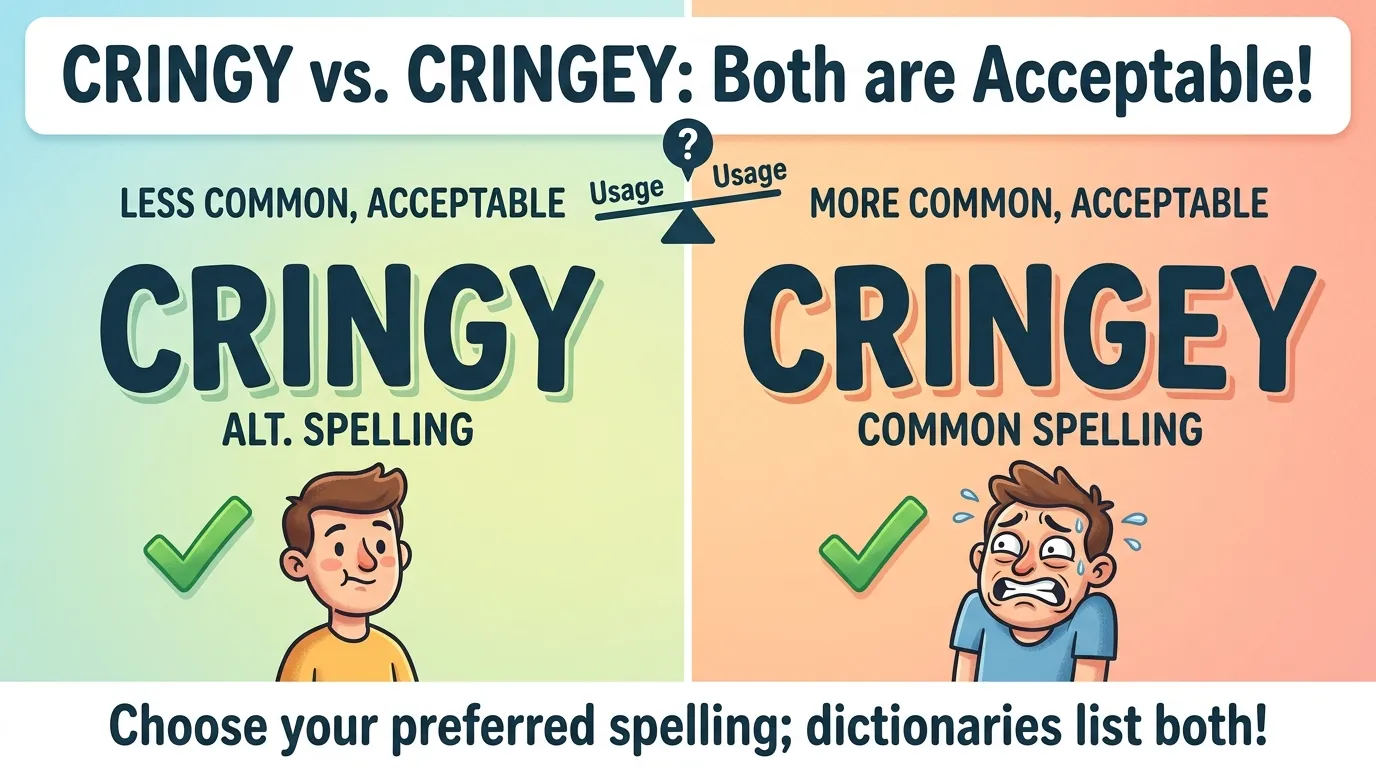
The screenshot spread across the group chat in minutes. It showed a comment someone had left under a video — earnest, overlong, full of emojis, trying far too hard to be funny — and underneath it, a single-word reply: “Cringey.” Then someone else replied: “Cringy.” Then a third person: “Which one is it?” The chat spent the next twenty minutes arguing about the spelling of a word that describes exactly the feeling the argument itself was producing.
Here is the answer the chat never reached: both spellings are correct. Cringy and cringey are accepted spellings of the same informal adjective, meaning embarrassing, awkward, or uncomfortable to watch. They are pronounced the same. They mean the same. The difference is spelling, and the story of why there are two spellings is a small history of how the internet changes English.
The Screenshot That Started the Argument
The word cringy or cringey describes a specific modern feeling: secondhand embarrassment. It is the feeling you get watching someone embarrass themselves without realizing it — a bad audition, a forced joke, a romantic message sent too soon, a corporate social media post trying to sound young. “That video was so cringey.” “His pickup line was incredibly cringy.” “I found my old school photos so cringey.” In each case, the word names the wince, the urge to look away, the discomfort of watching someone else’s awkwardness.
The word is informal. It belongs to texting, social media, casual conversation, and group chats. It does not belong in a formal report, an academic essay, or a job application — not because it is wrong, but because it is slang, and slang carries a register. Using cringey in a board meeting would be like wearing a hoodie to a wedding: technically possible, socially off-key. In casual writing, though, it is one of the most useful words of the last decade, because it names a feeling that older vocabulary — embarrassing, awkward — describes only approximately.
Part of the word’s power is its precision. Embarrassing can mean many things. Cringey means one thing: the kind of embarrassment that makes you physically react, that makes you curl inward, that makes you want to cover your eyes. The word itself imitates the feeling. Say it: cringe. The mouth tightens. The sound curls. The word performs what it describes.
Cringe, the Parent Verb
Both spellings come from the verb cringe, which is much older than the adjective. Cringe has been in English since the Middle Ages, from an Old English word meaning to bend or crouch. To cringe is to shrink back in fear or embarrassment: a dog cringes at a raised voice, a person cringes at a memory of something foolish they said. The physical image is central: cringing is what the body does when it wants to be smaller.
The adjective is formed by adding -y to cringe, following the same pattern as spice → spicy, noise → noisy, shine → shiny. The standard rule for this pattern is to drop the silent e before adding -y: spice becomes spicy, not spicey. By that rule, cringe should become cringy, and indeed cringy is a correct spelling.
So why does cringey exist at all? Because English spelling is not always rule-bound, and because the e in cringe does real work. The ge at the end of cringe is pronounced with a soft g — a j sound — and dropping the e to make cringy leaves a spelling, cringy, that some readers initially pronounce with a hard g, like cring-gy. Keeping the e in cringey preserves the soft g and makes the pronunciation obvious. The extra letter is not a mistake. It is a pronunciation guide.
Two Spellings, One Internet
The two spellings coexist because they grew up in different corners of the internet. Cringy is the shorter, more compact form, favored by fast typists and by people who follow the drop-the-e rule instinctively. Cringey is the fuller form, favored by people who want the pronunciation to be unmistakable and by the dictionaries that first recorded the word. Both appear in social media posts, memes, comments, and captions, often in the same thread — as the group chat discovered.
Dictionaries have weighed in, and their verdict is that both are acceptable. Most major dictionaries list cringey as the headword, with cringy as a variant. A few list them as equal alternatives. The practical difference is negligible: no reader will misunderstand either spelling, and no editor will flag one as an error. The choice is a matter of house style and personal habit, not of correctness.
If you want a tiebreaker, cringey is the slightly safer choice in writing that will be read by a broad audience, because it is the form most dictionaries list first and the form that makes the pronunciation clearest. Cringy is the slightly faster choice in texting and casual posts, where brevity wins. Either way, pick one and use it consistently within a single document. A post that writes cringey in one sentence and cringy in the next looks careless, even though both spellings are right.
Cringe Comedy and the Culture of the Wince
The word’s rise tracks a cultural shift. In the 2000s and 2010s, a genre of comedy built on secondhand embarrassment became mainstream: shows and films where the humor comes from watching characters humiliate themselves. Critics called it cringe comedy. The term gave the feeling a name and a genre, and the adjective followed. A scene could be cringey. A character could be cringy. A whole show could be described as “so cringe.”
Social media accelerated the word. Platforms built on short videos made awkwardness visible at scale: failed stunts, tone-deaf ads, earnest confessions, public meltdowns, all served to millions of strangers. The comment sections needed a word for the feeling, and cringey was ready. The word’s informality was part of its appeal: it sounded like the internet, not like a textbook, and it named a feeling that the internet produces more efficiently than any medium before it.
The word has also produced a small family. Cringe itself is now used as a noun (“That video is pure cringe”) and as an adjective (“a cringe post”). Cringeworthy is the formal cousin, acceptable in journalism and professional writing where cringey would be too casual: “a cringeworthy interview.” And cringe factor names the degree of embarrassment: “The ad had a high cringe factor.” Each of these is built from the same root, and each carries the same wince.
Formal Alternatives and the Register Ladder
When the situation calls for formal language, cringey has several respectable replacements. Embarrassing is the closest general term. Awkward covers the social discomfort. Cringeworthy works in journalism and professional writing. Uncomfortable to watch is a plain, clear paraphrase. Secondhand embarrassment names the feeling precisely. The choice depends on the register: a film review can call a scene cringeworthy; a text message can call it cringey; a psychology paper would call it secondhand embarrassment.
The word’s synonyms shade the meaning differently. Awkward suggests social clumsiness. Embarrassing suggests shame. Uncomfortable suggests unease. Cringey suggests all three at once, plus the physical reaction — the wince, the curl, the urge to look away. That is why it survived: it says something the other words do not quite say.
One last point about usage: cringey and cringy are adjectives, and they behave like adjectives. They take comparative and superlative forms — cringier, cringiest, or more cringey, most cringey — though these forms are rare in practice, because the word is usually used at full strength. “That was the cringiest thing I have ever seen” is grammatically fine and conversationally perfect. It is also, like the word itself, a sentence that belongs in a group chat, not a boardroom.
Cringe in Other Languages
Secondhand embarrassment is universal, and other languages have their own words for it. German has Fremdschämen — literally, “to be ashamed for a stranger” — a word that names exactly the feeling cringey describes. The German word is a compound: fremd (strange, foreign) + schämen (to be ashamed). English borrowed the idea but not the word, and cringey grew up to fill the gap.
Spanish has vergüenza ajena, “someone else’s shame,” a phrase used for the same feeling. French has malaise, a general word for unease, and gêne, for embarrassment. Japanese has hazukashii, which covers shame and embarrassment, and a rich vocabulary for social discomfort. The existence of so many near-equivalents suggests that the feeling is a basic human experience — watching another person’s awkwardness and feeling it as your own — and that every language needs a word for it.
The German word has entered English-language discussion of the feeling, and it appears in articles about cringe culture alongside cringey. Some writers prefer Fremdschämen because it is precise and has no slang associations. Others prefer cringey because it is shorter and sounds like the feeling. The two words coexist, like cringy and cringey themselves — different spellings, different registers, same wince.
The Verdict the Group Chat Missed
So the argument in the group chat had no loser. The person who wrote “Cringey” was right. The person who wrote “Cringy” was also right. The third person, who asked which one it was, asked the best question of all — and the answer is that English sometimes allows two spellings for one word, and the internet is very good at producing exactly that situation.
If you want a rule to carry away: in casual writing, either spelling works; in writing for a broad audience, cringey is the slightly safer choice, because it keeps the e that tells the reader how to say it. And if you ever find yourself arguing about it in a group chat, remember that the argument itself is cringey — spelled either way.










