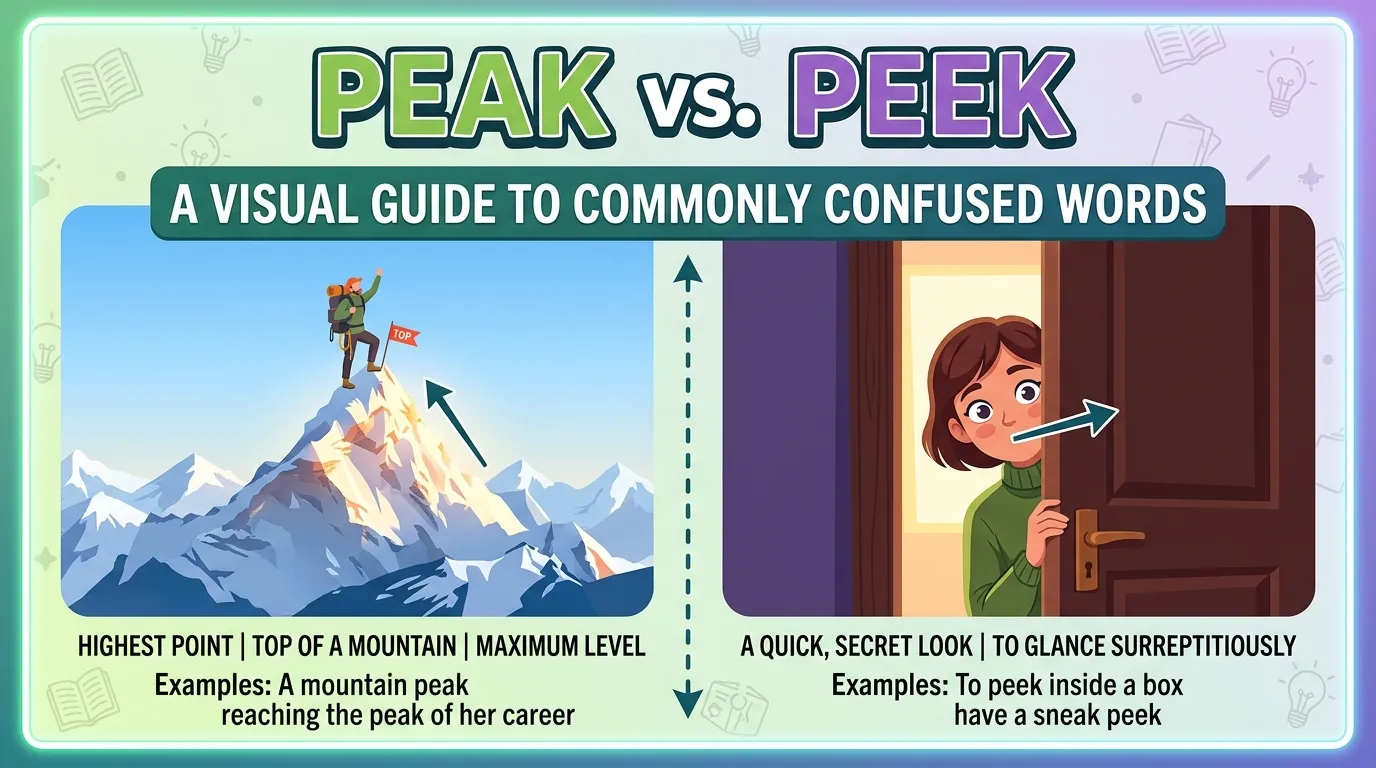
Field guides describe animals by their markings, their habitat, and the sounds they make, so that a reader in the wild can tell two similar species apart. This article is a field guide to two words that look alike, sound alike, and live in entirely different habitats. One lives on mountaintops. The other lives behind keyholes. Confuse them, and your sentence will do something you never intended.
The two species are peak and peek. Peak means the highest point, the greatest level, or the top of something. Peek means a quick or secret look. They are pronounced identically in standard American English. They are spelled differently, and the spelling is the only thing that tells the reader which one you mean.
Species One: Peak, the Mountaintop Word
Peak is the word of high places and high points. As a noun, it names the top of a mountain (“The mountain’s peak was covered in snow”), the highest level of anything (“Sales reached their peak in July”), or the most successful stage of a career (“She was at the peak of her powers”). As a verb, it means to reach that highest point: “Temperatures peaked in the afternoon.” “The band’s popularity peaked last summer.” As an adjective, it describes the period when something is at its highest: “peak hours,” “peak demand,” “peak season.”
The word’s habitat is broad. It lives in geography (mountain peaks, the Peak District in England), in business (peak sales, peak performance), in sports (peak fitness, peak form), in traffic (rush hour is “peak hour”), and in statistics (a peak on a graph). In every habitat, the meaning is the same: the top, the maximum, the highest point. The word carries a sense of achievement and of limit — a peak is the place beyond which there is no higher to go, and the moment after which things decline.
Its etymology fits the meaning. Peak probably comes from the word pike, a pointed tool or weapon, by way of the pointed shape of a mountain top. A peak is a point. The spelling preserves the image: the ea vowel and the hard k ending give the word a sharp, pointed feel, the way a mountaintop looks on a map.
Species Two: Peek, the Keyhole Word
Peek is the word of quick, secret looks. As a verb, it means to look briefly, often through a narrow opening or without being noticed: “She peeked through the keyhole.” “He peeked at the answers.” “The children peeked around the corner.” As a noun, it names the look itself: “She took a quick peek inside the box.” “The trailer gave us a peek at the new film.”
The word’s habitat is smaller and more intimate than peak‘s. It lives in childhood (peeking at presents, peekaboo), in secrecy (peeking at a neighbor’s letter, peeking at the exam), and in marketing (a “sneak peek” of a new product, a “peek behind the scenes”). In every habitat, the meaning involves brevity and stealth: a peek is short, and it is often hidden. You do not peek for an hour. You peek for a second, and then you look away.
Its etymology is less certain than peak‘s, but it probably comes from a Middle English word meaning to peer or look quickly. The spelling, with its double e, gives the word a narrow, slit-like feel — the way a keyhole looks, the way half-closed eyes look when they are trying to see without being seen. The word looks like what it means.
The Third Cousin: Pique
Any field guide to peak and peek must mention the third homophone that shares their sound: pique. Pique is a French borrowing with two main meanings. As a verb, it means to arouse interest or curiosity: “The story piqued her interest.” As a noun, it means a feeling of irritation or resentment: “He left in a fit of pique.” The phrase “pique one’s interest” is one of the most commonly misspelled expressions in English, because writers reach for peak (“peaked my interest”) or peek (“peeked my interest”) instead. The correct word is pique.
The three words form a complete set of homophones: peak, peek, pique — same sound, three spellings, three meanings. The set is a favorite of spelling tests and a trap for fast typists, because autocorrect will accept all three. The only defense is meaning: if the sentence is about a high point, it is peak; if it is about a quick look, it is peek; if it is about arousing interest or feeling offended, it is pique.
Habitat Notes: Where Each Word Lives
The best way to tell the species apart in the wild is to look at their companions — the words they habitually appear with. Peak travels with words of height and quantity: peak performance, peak season, peak demand, peak hour, peak oil, peak fitness. If the sentence contains numbers, graphs, mountains, or records, the word is almost certainly peak.
Peek travels with words of secrecy and brevity: sneak peek, quick peek, peekaboo, peek behind the curtain, peek inside. If the sentence contains eyes, keyholes, curtains, or presents, the word is almost certainly peek. The companions are so reliable that a careful reader can often identify the word from its neighbors alone, without even looking at the spelling.
The two words also differ in grammar. Peak does three jobs: noun, verb, and adjective. Peek does two: verb and noun. Peak can describe a time (“peak hours”); peek cannot. Peek can describe a glance; peak cannot. The grammatical difference is a useful secondary check when the meaning is unclear.
Common Misidentifications
The most frequent error is writing peek where peak belongs, usually in business and sports writing: “Sales reached their peek” or “He is at the peek of his career.” The error happens because peek is the more vivid word — it conjures an image — and the writer reaches for it without thinking. The reverse error, peak for peek, is less common but appears in phrases like “Take a peak inside” or “a sneak peak.” The phrase “sneak peek” is so common in marketing that its misspelling, “sneak peak,” has become one of the most visible errors on the internet.
A second class of error involves pique. “The article peaked my interest” is wrong; the article piqued it. “The article peeked my interest” is also wrong, and more confusing, because it suggests the article was looking at something. The three-way confusion is a reminder that homophones are hardest when there are three of them, not two.
There is also a subtle error with peak as a verb. “Interest peaked” is correct when interest reached its highest point. “Interest was piqued” is correct when interest was aroused. The two sentences describe different events, and choosing the wrong one changes the meaning entirely. A careful writer checks which event they mean before choosing the word.
Peak in Science: Peaks on Graphs
Scientists use peak in a specialized sense that is worth knowing, because it appears in news reporting about research. A peak on a graph is a local maximum — a point where a curve rises, reaches its highest value, and falls again. A spectrum has peaks where light is absorbed or emitted. A disease curve has a peak where infections are highest. A seismograph has peaks where the ground shook hardest. In each case, the peak is the high point, and the word carries its ordinary meaning into a technical setting.
The scientific sense produces phrases that show up in everyday news. Peak oil is the hypothetical point at which global oil production reaches its maximum and begins to decline. Peak demand is the highest level of electricity use on a grid, usually on a hot afternoon. Peak flow is the fastest rate at which a person can breathe out, measured by asthma patients. Peak performance in sports science is the maximum output an athlete can sustain. In all of these, the peak is a measurable maximum, not a metaphor.
The graph sense also explains a common error. Headlines sometimes say a number “peaked” when they mean it rose sharply but is still rising. A peak, by definition, is followed by a decline. If infections are still climbing, they have not peaked; they are approaching a peak. The distinction matters in public health reporting, where “cases have peaked” is a claim about the future, not just the present. A careful reader checks whether the decline has actually started before accepting the word.
The One-Second Identification Test
When you are unsure, substitute. If you can replace the word with top or highest point, the word is peak. “Sales reached their top” works, so “Sales reached their peak” is correct. If you can replace the word with quick look, the word is peek. “She took a quick look inside” works, so “She took a peek inside” is correct. If you can replace the word with aroused or offended, the word is pique.
The substitution test takes a second, and it works because the three words have no overlap in meaning. They share a sound and nothing else. The mountain, the keyhole, and the French import live in different habitats, eat different companions, and do different jobs. Learn the habitats, and you will never mistake one species for another.










