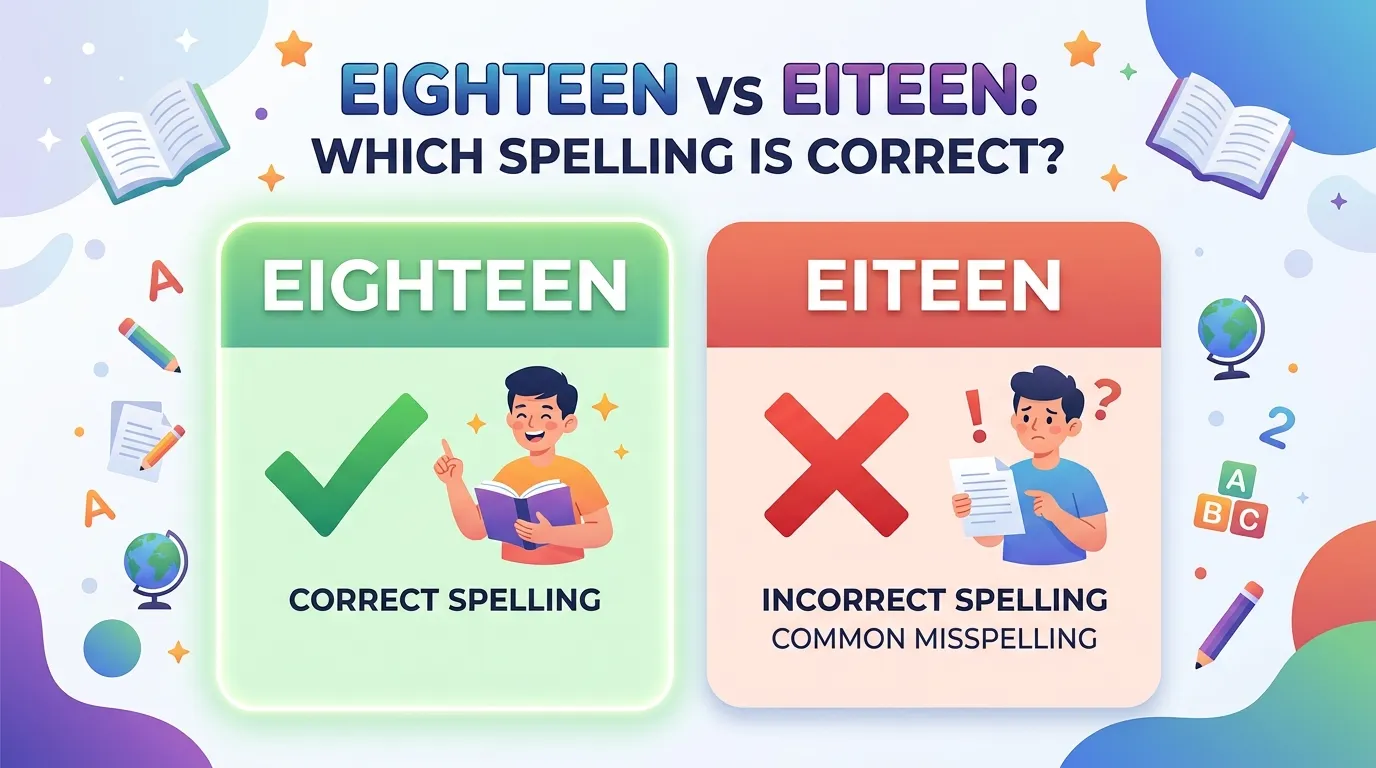
Eighteen is the number that unlocks adulthood. At eighteen, a person can vote in most democracies, sign a contract, open a bank account, join the military, and be tried as an adult. It is the age of graduation speeches, first jobs, first apartments, and the first time a form asks you to confirm that you are legally an adult. It is also a word that a surprising number of people misspell. The correct spelling is eighteen. Eiteen, with the gh missing, is a misspelling. And the reason the gh is there at all is a story about how English counts — a story that starts with the number eight.
The Birthday That Changes Everything
Think about what eighteen means in real life, because the meaning is what makes the spelling worth getting right. Eighteen is the age of majority in most of the English-speaking world. At eighteen, a person becomes a legal adult in the United States, the United Kingdom, Canada, Australia, and New Zealand. The age appears on ballots, driving licenses, university applications, rental agreements, and military enlistment forms — documents where a spelling error looks careless.
The number also marks a cultural threshold. Eighteen is the age of the school-leaving exam in many countries, the age of the prom, the age of the gap year. Songs are written about it. Novels are set there. The birthday itself is treated as a ceremony: the eighteenth birthday is the one with the biggest party, the longest speeches, and the most photographs. The word carries all of that weight, and it deserves its full spelling.
Grammatically, eighteen is a cardinal number — a counting number, like one, two, and seventeen. It answers the question “how many?”: “She has eighteen books.” “There are eighteen students in the class.” It can also describe age: “He turned eighteen last month.” Its ordinal form, used for order and position, is eighteenth: “the eighteenth century,” “her eighteenth birthday,” “the eighteenth floor.” The ordinal keeps the full spelling and adds -th.
Eight, Eighty, Eighteen: The gh Family
Now the spelling. Eighteen is built from two parts: eight + teen. The teen ending is the same one that appears in thirteen, fourteen, fifteen, sixteen, seventeen, and nineteen — it means “ten more than,” so eighteen is literally “eight more than ten.” The gh in the middle of the word comes from eight. It is not decorative. It is inherited.
That inheritance is the key to the whole word. Eight is spelled e-i-g-h-t, and the gh is silent in modern English — a leftover from Old English, when the letters represented a throaty sound that English later lost. When eight combines with teen to make eighteen, it brings its silent letters with it. The same thing happens with eighty (“eight tens”) and eighth (“the eighth floor”). The gh family sticks together: eight, eighteen, eighty, eighth — all four keep the gh.
This is why eiteen looks believable. The gh makes no sound in modern pronunciation — eighteen is pronounced “ay-TEEN,” two syllables, stress on the second — so a writer spelling by ear can easily drop the silent letters. The ear says the gh is not there. The history says it is. In English spelling, history wins.
The -teen Family and Its Traps
Eighteen belongs to the -teen family, and the family has its own set of traps. The numbers from thirteen to nineteen all end in -teen, and all of them are pronounced with the stress on the second syllable: thir-TEEN, four-TEEN, fif-TEEN, six-TEEN, seven-TEEN, eigh-TEEN, nine-TEEN. The tens — thirty, forty, fifty, eighty — stress the first syllable: THIR-ty, FOR-ty, EIGH-ty. The stress difference is the only thing separating eighteen from eighty in speech, which is why phone conversations about numbers are a minefield.
Two members of the family cause special trouble. Fourteen is often misspelled as forteen, by analogy with forty, which drops the u from four. But fourteen keeps the u: f-o-u-r-t-e-e-n. And fifteen is often misspelled as fiveteen, by analogy with five. But fifteen changes the v to an f: f-i-f-t-e-e-n. Eighteen has the opposite problem: it keeps letters that the ear cannot hear. Each -teen word has its own quirk, and the quirks have to be memorized one by one.
The ordinal forms add another layer. Eighteenth adds -th to eighteen, and the th at the end creates a consonant cluster — n-th — that many writers stumble over. “The eighteenth century” is a phrase that appears constantly in history writing, and it is worth practicing: e-i-g-h-t-e-e-n-t-h. Ten letters, one silent pair, one ordinal ending.
Writing Numbers: Words or Numerals?
Knowing how to spell eighteen is only half the question. The other half is when to spell it out at all. Style guides differ, but the most common rule in general writing is to spell out numbers from one to ten and use numerals for eleven and above — which would make 18 the usual form in most documents. Other guides spell out numbers up to one hundred. Newspapers, academic journals, and legal documents each have their own conventions, and the conventions matter: a contract that says “eighteen (18) years” uses both forms, the words and the numerals, to prevent tampering.
A few practical points apply everywhere. Never start a sentence with a numeral: write “Eighteen students attended” rather than “18 students attended.” Use a hyphen for compound numbers between twenty-one and ninety-nine (“twenty-one”), though eighteen itself needs no hyphen. And in ages, both forms are accepted: “She is eighteen” and “She is 18” are both correct, but pick one style per document and keep it.
The age sense produces its own vocabulary. An eighteen-year-old is a person of that age, hyphenated when used before a noun: “an eighteen-year-old student.” Without hyphens, the phrase splits: “She is eighteen years old.” The hyphen rule is a common source of errors in school and university writing, and it is worth learning alongside the spelling itself.
Eighteen Around the World
Eighteen is the most common age of majority, but it is not universal. In some places, adulthood arrives earlier or later. In Scotland, the age of legal capacity is sixteen. In Japan, the age of adulthood was lowered from twenty to eighteen in 2022. In the United States, the drinking age is twenty-one, even though the voting age is eighteen — a split that produces the famous complaint that a person can vote and enlist at eighteen but cannot legally buy a beer. In Germany, beer and wine are legal at sixteen, spirits at eighteen. The number eighteen is a landmark, but the map of what it unlocks varies by country.
The voting age tells its own story. Most democracies set it at eighteen, but Austria, Brazil, and Scotland allow voting at sixteen in some elections. The debate over lowering the voting age to sixteen has run for decades, and it always centers on the same question: at what age is a person mature enough to decide? Eighteen became the standard in the 1970s, when the United States lowered its voting age from twenty-one to eighteen with the 26th Amendment, arguing that people old enough to be drafted were old enough to vote. The slogan was “Old enough to fight, old enough to vote,” and it carried the day.
Other thresholds cluster around eighteen as well. The age of criminal responsibility is eighteen in most systems, meaning that a person under eighteen is tried in a juvenile court. The age for marriage without parental consent is eighteen in most countries. The age for signing a contract is eighteen. The number is so consistent across legal systems that it feels natural, but it is a human invention — a line drawn on the calendar, agreed by law, and enforced by spelling on every form that asks for it.
The Silent Letters That Stay
English is full of silent letters that refuse to leave, and eighteen‘s gh is one of the most stubborn. The same silent gh appears in night, light, right, thought, through, weight, and height — words where the gh once represented a sound that modern English no longer makes. The letters stayed because spelling changes more slowly than speech, and because the written form carries history that the spoken form has discarded.
There is a memory trick that works for eighteen specifically, and it uses the family. If you can spell eight, you can spell eighteen: take eight, drop the t, add een. Eight minus t plus een equals eighteen. Or think of it as eight + teen with the t of eight absorbed into the teen. Either way, the rule is the same: the gh belongs to eight, and eight belongs inside eighteen.
So the next time you write the number that unlocks adulthood — on a form, in a birthday card, in an essay about voting age — write all ten letters: e-i-g-h-t-e-e-n. The gh is silent, but it is not absent. It is the sound of eight centuries of English history, sitting quietly in the middle of the word, waiting for you to remember it.










