The letters arrived every morning in a canvas sack, sorted by the intern into three piles: praise, complaint, and the pile that made the editor sigh. The third pile was the biggest. A new bypass was to be built through the old orchard, and the town had opinions. The editor read the letters, chose one for the op-ed page, and wrote a headline: “The Bypass Stirs a Contraversy.” The headline was perfect. The spelling was not. The correct spelling is controversy — c-o-n-t-r-o-v-e-r-s-y — with an O in the second syllable, not an A. Contraversy is a misspelling. The error is a single vowel swapped by the ear, and the op-ed page is exactly the kind of place where it cannot survive.
Controversy is the noun for public disagreement — the argument that will not settle, the debate that fills the letters page, the dispute that splits the town meeting. It is a word that appears in every newsroom, every parliament, every school board, and it is misspelled more often than it should be, because the way most people say it hides the vowel that the spelling needs.
The Letters Page
Start with the letters page, because the letters page is where controversy lives. A controversy is not a private argument. It is a disagreement that has gone public — that has been argued in print, in meetings, on air, in the street. Two neighbours disagreeing over a fence is a dispute. Two thousand neighbours disagreeing over a bypass, in letters to the paper, is a controversy.
The word’s anatomy is worth learning. A controversy has three ingredients. First, opposing opinions: two sides that genuinely disagree, not a misunderstanding that a fact could settle. Second, publicity: the disagreement is conducted in the open, where others can watch and join. Third, duration: a controversy lasts. A quarrel flares and dies. A controversy simmers, returns, and generates new rounds. The bypass controversy had been running for three years when the editor wrote the headline, and it would run for three more.
The letters page also shows the word’s grammar. Controversy is a noun, usually uncountable when it names the state of disagreement — “The plan caused controversy” — and countable when it names a specific dispute — “The bypass controversy,” “a controversy over the budget.” The adjective is controversial: “a controversial decision,” “a controversial figure.” The adverb is controversially. The whole family keeps the O, because the O belongs to the root.
There is a tone note worth hearing. Controversy is neutral. It does not say who is right. It says that people disagree, publicly, and at length. A writer who calls something a controversy is reporting a fact about the debate, not taking a side in it. The neutrality is the word’s value in journalism, and it is why the word appears in headlines more than its louder cousins — scandal, outrage, row — which all take sides.
Why the Ear Writes Contraversy
Say controversy aloud the way most people say it in conversation. There are two common pronunciations, and both of them hide the O.
In American English, the stress usually falls on the first syllable: CON-tro-ver-see. The second syllable — tro — is unstressed, and unstressed vowels in English collapse toward the schwa, the neutral uh. The O in tro comes out sounding like uh, and the ear, hearing uh, guesses A — because A is the letter that most often stands for uh in words like about, along, and against.
In British English, the stress often falls on the second syllable: con-TRO-ver-see. The O is clearer in this pronunciation, but the word is still spoken fast, and the second syllable still gets compressed. Either way, the O is a quiet letter in a loud word, and quiet letters are the ones the ear drops.
There is a second force: the contra- prefix. English has a large, visible family of words beginning with contra-, meaning “against”: contradict, contrast, contrary, contraband, contraception. A writer who knows those words can easily reason that controversy must belong to the same family, spelled with the same prefix. The reasoning is natural. It is also wrong, because controversy comes from a different Latin root, and the resemblance is a coincidence.
There is a third force: speed. Controversy is a word that appears in fast writing — news copy, social media, meeting notes, essays written against a deadline. The hand is moving fast, the word is familiar, and the second syllable is the first casualty. The misspelling is a hurry error wearing an ear error’s clothing.
Contro- + Vertere: Turning Against
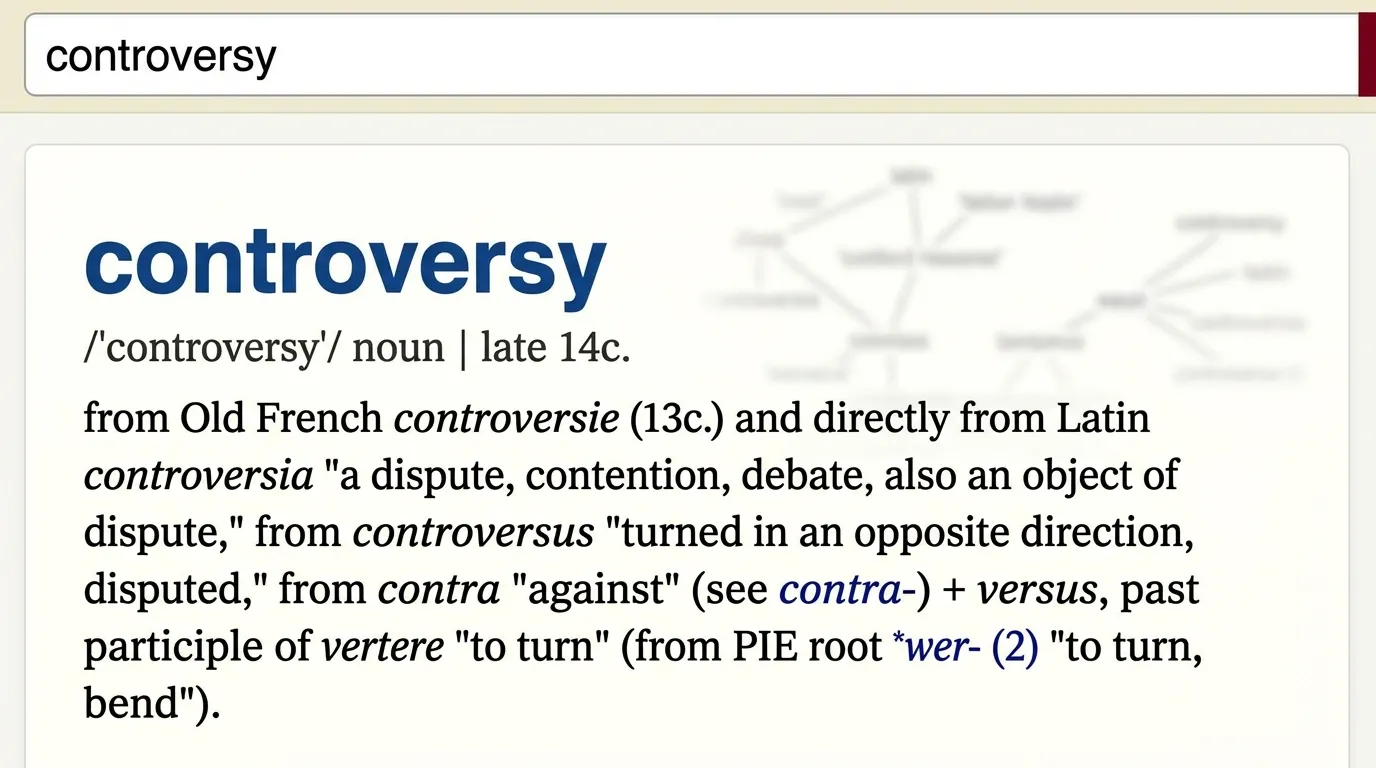
Here is the fact that fixes the spelling for good. Controversy comes from the Latin controversia, built from contro-, a form of contra meaning “against,” and versus, the past participle of vertere, meaning “to turn.” A controversy is, literally, a turning-against — a dispute in which one side turns against the other. The O belongs to contro-, the “against” root, and it is the same O that appears in control, contour, and contort — words that also begin with contro- and also keep the O.
The root also explains the word’s relationship with its neighbours. Controvert — to dispute or argue against — is built on the same root. Controvertible — capable of being disputed — the same. Incontrovertible — incapable of being disputed, undeniable — the same root with a negative prefix. The whole family keeps the O, because the O belongs to the root, and the root belongs to Latin.
There is a useful contrast with the contra- family. Contradict means to speak against. Contrast means to stand against. Contrary means opposite. All of them are spelled with A, and all of them mean “against.” Controversy also means “against,” but it is spelled with O. The two families mean the same thing and spell it differently, because they came into English through different routes. The contra- family came through the direct prefix. The contro- family came through the combined word controversia, in which the A of contra had already softened to O before English ever saw it. The difference is history, not logic, and history is the whole answer.
The root also explains the -versy ending. Vertere, to turn, is one of the most productive roots in English. It gives us reverse (turn back), adverse (turned against), diverse (turned apart), perverse (turned wrong), converse (turned together), and controversy (turned against). The -vers- in the middle of the word is the turning. The O before it is the against. The word is a small diagram of its own meaning.
Controversy, Scandal, Debate, Dispute: Four Arguments
Controversy has close neighbours, and keeping them distinct sharpens a sentence.
Debate is the most orderly neighbour. A debate is a structured argument with rules, sides, and often a moderator. “The candidates debated the policy.” A debate can be calm. A controversy rarely is.
Dispute is the most general neighbour. A dispute is any disagreement, public or private, large or small. “A dispute over the fence.” “A border dispute.” The word is cooler than controversy, and it does not imply publicity.
Scandal is the most moral neighbour. A scandal is a controversy about wrongdoing — about behaviour that shocks or offends. “A financial scandal.” “A scandal in the church.” Every scandal is a controversy, but not every controversy is a scandal. A controversy over a bypass is not a scandal. A controversy over embezzlement is.
Controversy sits between them: more public than a dispute, less orderly than a debate, less moral than a scandal. It names the state of public, prolonged disagreement. When you want the neutral word for a public argument, pick controversy. When you want the orderly word, pick debate. When you want the general word, pick dispute. When you want the moral word, pick scandal. The choice is a matter of register, and the register is the message.
There is also the adjective family. Controversial means arousing controversy: “a controversial film.” Uncontroversial means arousing none: “an uncontroversial appointment.” Noncontroversial is a near-synonym, slightly more formal. All of them keep the O, because the O belongs to the root.
The Life of a Controversy
Controversies have a lifecycle, and it is worth knowing because it explains why the word appears in the news so often.
First comes the trigger: a decision, a statement, a discovery, a plan. The bypass is announced. The book is published. The statue is proposed. The trigger is a fact, and the fact alone is not a controversy.
Then comes the reaction: someone objects, publicly. A letter is written. A meeting is called. A post goes viral. The objection is the spark, and the spark needs fuel — other people who share the objection and are willing to say so.
Then comes the escalation: the two sides form, the arguments sharpen, the media pick up the story. The controversy grows, not because the facts change, but because more people join the argument. A controversy is a disagreement with an audience, and the audience makes it larger.
Then comes the plateau: the arguments are exhausted, the positions are fixed, and the controversy settles into a standoff. The letters slow. The meetings continue. The bypass is neither built nor abandoned. The controversy is a permanent feature of the town’s life, like the orchard it is about.
Finally comes the resolution — or the fading. Some controversies end with a decision: the bypass is built, the book is withdrawn, the statue is removed. Others end by fading: people move on, the issue is forgotten, the controversy dissolves without ever being settled. The bypass controversy in the editor’s town was heading for the fading kind. The orchard was still there. The letters had slowed. The editor’s headline, misspelling and all, was one of the last the controversy would get.
The Lock-In
The memory hook is the root. Controversy comes from controversia — contro- + versia. The O is the vowel of “against,” and it is the same O that opens control, contour, and contort. Think of a controversy as a loss of control — a disagreement that has spun out of anyone’s hands — and the O in control will remind you of the O in controversy.
There is a second hook, and it is built for the eye. The word controversy contains the word contro-, which is also the beginning of control. If you can spell control — and almost everyone can, because it is one of the commonest words in English — you can spell controversy, because the first six letters are the same: C-O-N-T-R-O. The A that the ear wants to insert has no place in control, and it has no place in controversy either.
And one final check for the keyboard: when the word appears in your draft, look at the second syllable. If you see -tro-, with an O, the spelling is right. If you see -tra-, with an A, the contra- family has smuggled its vowel across the border, and the word is wrong. The editor’s headline deserved the right spelling. The controversy deserved it too. Spell it with the O, and the letters page will read correctly.