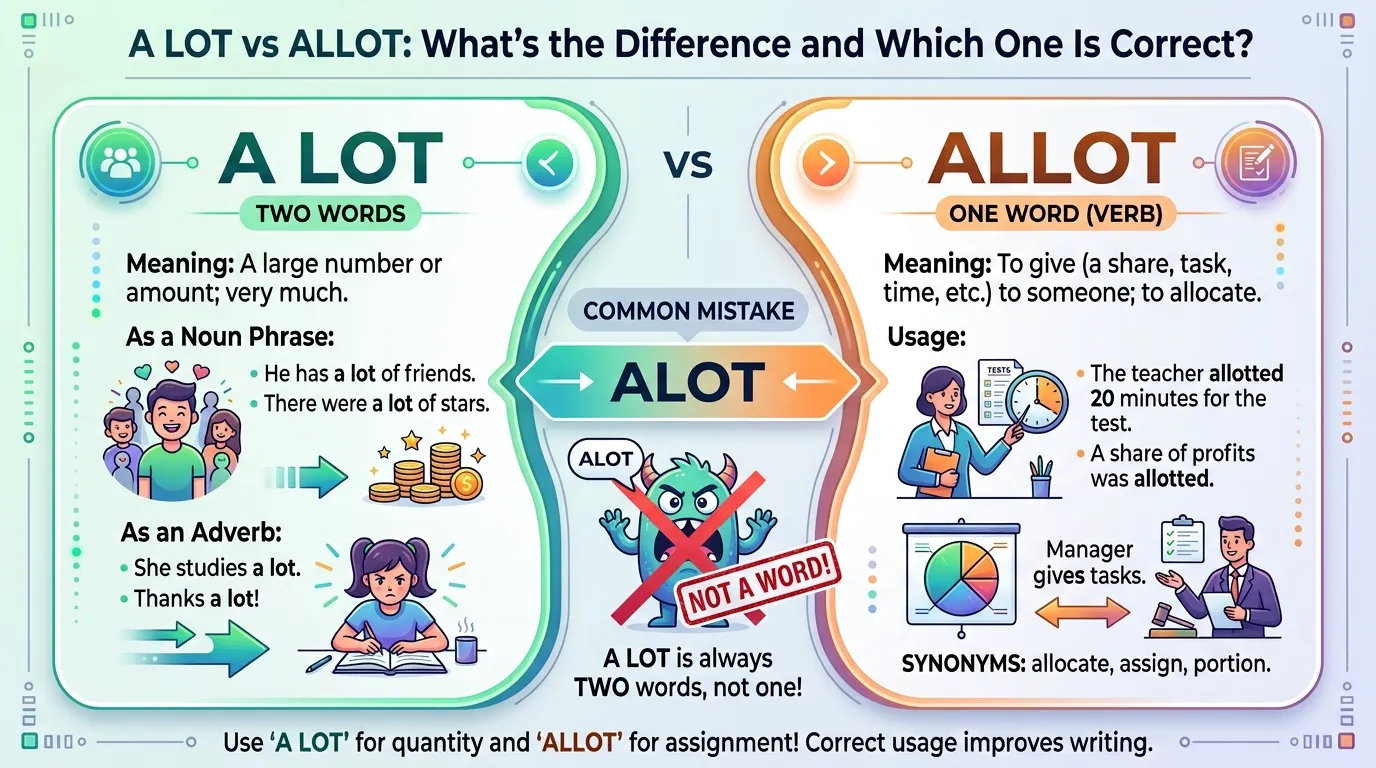
A Lot vs Allot: What’s the Difference and Which One Is Correct?

If you are unsure whether to write “a lot” or “allot,” the answer is simple: both are correct English words, but they have completely different meanings and grammatical roles.

A lot means a large amount, a large number, or frequently, depending on how it is used. Allot is a verb meaning to distribute, assign, or give someone a particular share of something.

For example:

  • I have a lot of work today.
  • The manager will allot each employee a desk.

The two expressions sound almost identical when spoken, which is why they are often confused. But in writing, the difference matters. Writing “I have allot of work” is incorrect when you mean “a large amount of work.”

This guide explains a lot vs allot in detail, including their meanings, pronunciation, grammar, spelling, formality, common mistakes, synonyms, word history, examples, and usage in American, British, academic, business, technical, sports, and everyday English.


Quick Answer: A Lot vs Allot

WordMeaningPart of SpeechExample
a lota large amount or number; frequentlyPhrase/adverbial expressionI have a lot of homework.
allotto distribute or assign somethingVerbWe will allot each student 20 minutes.

The easiest way to remember the difference

A lot = a large amount.

She has a lot of books.

Allot = assign or distribute.

The teacher will allot ten minutes to each group.

If you can replace the word with “give,” “assign,” or “distribute,” you probably need allot.

If you can replace it with “many,” “much,” “a large amount,” or “frequently,” you probably need a lot.


What Does “A Lot” Mean?

A lot generally means a large amount, a large number, or a great deal.

It can be used with both countable and uncountable nouns.

With countable nouns

Use a lot of before plural countable nouns.

We have a lot of customers today.

She owns a lot of books.

There were a lot of people at the event.

With uncountable nouns

Use a lot of before uncountable nouns.

He needs a lot of time.

We spent a lot of money.

The project requires a lot of patience.

She gave me a lot of information.

The expression is common in everyday English and is generally considered informal or conversational. Lots of is another common version and is even more informal.


What Does “Allot” Mean?

Allot is a verb meaning to give, assign, or distribute a particular amount or share of something for a specific purpose.

For example:

The committee allotted $10,000 to the project.

Each student was allotted 30 minutes.

The manager allotted two hours for the meeting.

The thing being allotted is usually a resource such as:

  • time
  • money
  • space
  • land
  • seats
  • resources
  • responsibilities
  • funding
  • equipment
  • opportunities

The word often appears in formal, administrative, academic, business, government, and professional contexts.


A Lot vs Allot: The Main Difference

The most important distinction is meaning.

A lot describes quantity or frequency.

I have a lot of work.

Here, a lot of tells us that the amount of work is large.

Allot describes an action.

The supervisor will allot work to each employee.

Here, allot means the supervisor will assign or distribute the work.

Think of the difference this way:

A lot = quantity

Allot = distribution

That single distinction solves most a lot vs allot questions.


A Lot vs Allot Comparison Table

FeatureA lotAllot
MeaningA large amount, number, or frequencyGive or distribute a share
GrammarPhrase/adverbial expressionVerb
Common patterna lot of + nounallot + something + to someone
ExampleI have a lot of work.They allotted work to us.
FormalityUsually informal/conversationalMore formal
Can describe quantity?YesNo
Can mean “assign”?NoYes
Can be replaced by “many/much”?OftenNo
Can be replaced by “assign/distribute”?NoOften

Why Do People Confuse “A Lot” and “Allot”?

There are several reasons.

1. They sound similar

When spoken quickly, “a lot” can sound very similar to “allot.”

Compare:

a lot

allot

The pronunciation is close enough that learners sometimes treat them as alternative spellings of the same word.

They are not.


2. “A lot” looks like it could be one word

Many English expressions eventually become confusing because spoken language does not always show word boundaries clearly.

However, the standard spelling when you mean “a large amount” is:

a lot

Not:

alot

The spelling “alot” is not the standard form for this meaning.


3. Their meanings can appear near each other

Consider:

The company has a lot of money.

and:

The company will allot money to different departments.

Both sentences involve money, but the grammar is different.

The first describes how much money exists.

The second describes what someone does with that money.


Is “A Lot” One Word or Two Words?

When you mean “a large amount” or “frequently,” write it as two words:

a lot

Correct:

I learned a lot today.

She has a lot of experience.

Incorrect:

I learned alot today.

Incorrect:

She has alot of experience.

What about “alot”?

Alot is generally considered a misspelling when intended to mean a lot.

In standard American English, professional writing, academic writing, journalism, business communication, and most edited content, use:

a lot


Is “Allot” One Word?

Yes.

Allot is correctly written as one word:

The school will allot each student a locker.

Its forms include:

  • allot
  • allots
  • allotted
  • allotting
  • allotment

Notice the spelling changes when endings are added.

Examples

The committee allots funds every year.

The committee allotted funds last year.

The committee is allotting additional resources.

The allotment was smaller than expected.


A Lot: Grammar and Usage

A lot has several common grammatical uses.

“A Lot of” Before a Noun

The most common pattern is:

a lot of + noun

Examples:

We have a lot of time.

She has a lot of friends.

They received a lot of support.

There are a lot of reasons to wait.

It works with both singular uncountable nouns and plural countable nouns.


“A Lot” Without a Noun

You can also use a lot by itself when the meaning is already clear.

“Did you enjoy the movie?”

“Yes, a lot.”

Here, a lot means something like very much.

Another example:

“Do you travel?”

“Yes, I travel a lot.”

In this sentence, a lot refers to frequency.


“A Lot” as an Adverb

A lot can describe how frequently or strongly something happens.

I exercise a lot.

She travels a lot for work.

We talk a lot.

He worries a lot.

In natural English, a lot generally comes after the verb or after the object rather than being inserted awkwardly between a verb and its object.

Natural

I enjoy this movie a lot.

Awkward

I enjoy a lot this movie.

Natural

She visits her parents a lot.

Awkward

She visits a lot her parents.


“Allot” as a Verb

Allot is a transitive verb. That means it normally takes an object.

The basic structure is:

allot + something + to someone/something

Examples:

The company allotted $50,000 to the department.

The teacher allotted ten minutes to each group.

The government allotted funds to the program.

Another common structure is:

allot + someone + something

The teacher allotted each student ten minutes.

Both structures are correct.


Allot vs Assign vs Allocate vs Distribute

These words are related, but they are not always interchangeable.

WordGeneral MeaningExample
allotGive a particular share for a purposeThe manager allotted two hours to the task.
assignGive someone a task, duty, or responsibilityThe manager assigned me a task.
allocateOfficially distribute resourcesThe board allocated more funding.
distributeGive things out among people or placesVolunteers distributed food.
divideSeparate something into partsDivide the cake into eight pieces.

When should you use “allot”?

Use allot when you want to emphasize that a specific amount or share has been set aside or given for a particular purpose.

The committee allotted $5,000 for training.

Allocate is often more common in modern business and administrative writing:

The committee allocated $5,000 for training.

Assign is especially natural when talking about tasks or responsibilities:

The manager assigned me three tasks.


A Lot vs Lots

Both a lot and lots can express a large quantity.

A lot of

We have a lot of work.

Lots of

We have lots of work.

Both are common, but lots of tends to sound more informal.

For casual conversation:

I have lots of ideas.

For neutral everyday writing:

I have a lot of ideas.

For highly formal writing, consider alternatives such as:

  • many
  • numerous
  • considerable
  • substantial
  • a significant amount of
  • a large number of

A Lot vs Many vs Much

This is another useful distinction.

A lot of

Works with countable and uncountable nouns:

a lot of books

a lot of information

Many

Usually goes with plural countable nouns:

many books

many students

Much

Usually goes with singular uncountable nouns:

much information

much time

In affirmative everyday English, a lot of is often more natural than much or many.

Compare:

I have a lot of work.

Natural conversational English.

I have much work.

Grammatical in certain formal contexts, but unusual in ordinary American conversation.


Pronunciation: A Lot vs Allot

The two expressions are pronounced similarly, which contributes to the confusion.

A lot

Common pronunciation:

/ə lɑt/

Allot

Common American pronunciation:

/əˈlɑt/

The stress pattern can help distinguish them.

With allot, the second syllable receives the main stress:

uh-LOT

With a lot, the phrase consists of two separate words, although the phrase can sound compressed in normal speech.

Because pronunciation can vary in connected speech and across accents, spelling and context are more reliable than sound alone.


Tone and Formality

A Lot

A lot is very common and natural in:

  • conversations
  • emails
  • text messages
  • blogs
  • casual articles
  • social media
  • everyday writing

Example:

I learned a lot from that experience.

For formal academic or professional writing, you may sometimes prefer:

  • considerably
  • substantially
  • significantly
  • numerous
  • many
  • a considerable amount
  • a significant number

Allot

Allot sounds more formal and deliberate.

It is common in:

  • business
  • administration
  • government
  • education
  • project management
  • legal or institutional contexts
  • formal reports

Example:

The committee allotted additional funds to the program.

In casual conversation, give, set aside, or assign may sound more natural.


Formal vs Informal Examples

Informal/NaturalMore Formal
We spent a lot of money.We spent a considerable amount of money.
Many people attended.A large number of people attended.
Give each speaker ten minutes.Allot ten minutes to each speaker.
We have a lot of information.We have substantial information.
They gave the project more money.They allocated additional funding to the project.

The best choice depends on context. Formal writing does not mean replacing every simple phrase with a complicated one.


Common Mistakes With “A Lot” and “Allot”

Mistake 1: Writing “alot”

Incorrect:

I have alot of work.

Correct:

I have a lot of work.


Mistake 2: Using “allot” to mean “a lot”

Incorrect:

There were allot of people at the concert.

Correct:

There were a lot of people at the concert.


Mistake 3: Using “a lot” when you mean “assign”

Incorrect:

The teacher will a lot ten minutes to each student.

Correct:

The teacher will allot ten minutes to each student.


Mistake 4: Confusing “allot” with “allocate”

These words are close in meaning, but they are not always exact substitutes.

The company allocated its annual budget.

The company allotted funds to each department.

Both can work, but allocate often emphasizes planned distribution of resources, while allot emphasizes giving a particular share.


A Lot vs Allot: Correct and Incorrect Examples

IncorrectCorrectWhy
I have alot of homework.I have a lot of homework.“A lot” means a large amount.
There were allot of cars.There were a lot of cars.“Allot” cannot mean many.
We will a lot ten minutes.We will allot ten minutes.“Allot” means assign.
She travels alot.She travels a lot.The phrase remains two words.
They allotted of money.They allotted money.“Allot” is a verb, not “a lot of.”

Natural Everyday Examples of “A Lot”

Here are examples you might hear in everyday American English:

I drink a lot of coffee.

She has a lot of experience.

We have a lot of things to finish.

He talks a lot.

They travel a lot.

That means a lot to me.

I learned a lot from my mistake.

There were a lot of people at the game.

We don’t have a lot of time.

She doesn’t know a lot about cars.


Natural Examples of “Allot”

Examples of allot in professional or formal contexts include:

The school allotted each class two hours for the examination.

The committee allotted funds for equipment.

The government allotted land for the new facility.

The manager allotted responsibilities among the team members.

Each participant was allotted a specific amount of time.

The budget allotted $25,000 for maintenance.

The organization allotted additional resources to the project.

The tournament allotted each player a limited practice period.


“Allot” in Business Writing

Allot can be useful when discussing budgets, resources, schedules, and organizational planning.

Examples:

The department was allotted a larger budget this year.

We have allotted additional time for testing.

Each branch was allotted a specific number of employees.

However, allocate is often more common in contemporary business writing:

The company allocated additional resources to research.

Use the word that best reflects your meaning rather than choosing a word simply because it sounds more formal.


“Allot” in Academic Writing

In academic and educational contexts, allot commonly describes time, resources, space, or opportunities.

Examples:

Students were allotted 60 minutes to complete the examination.

The researchers allotted equal time to each participant.

The course allotted two weeks to the final research project.

However, don’t force the word into every academic sentence. Sometimes give, assign, or allow is clearer.


“A Lot” in Academic Writing

Although a lot is perfectly grammatical, it can sometimes sound informal in academic prose.

Casual:

A lot of researchers have examined this issue.

More academic:

Many researchers have examined this issue.

Or:

Numerous researchers have examined this issue.

Likewise:

Casual:

This requires a lot of time.

More formal:

This requires considerable time.

The goal is not to avoid a lot completely. The goal is to match your language to the audience.


A Lot vs Allot in Journalism

Journalistic writing often favors concise, familiar language.

For example:

A lot of residents opposed the proposal.

Depending on the publication’s style, a journalist might instead write:

Many residents opposed the proposal.

Allot is appropriate when reporting an actual allocation:

The council allotted $2 million to the project.


A Lot vs Allot in Technical Writing

Technical writing should prioritize precision.

Use a lot when referring generally to a large amount:

The process generates a lot of heat.

But when a specific amount is assigned:

The system allots 512 MB of memory to each process.

In technical documentation, allocate may be even more common:

The system allocates 512 MB of memory to each process.

This is especially true in computing, where memory allocation is an established technical concept.


A Lot vs Allot in Sports

Sports writing may use both words naturally.

A lot

The team has a lot of talented players.

He has improved a lot this season.

Allot

Each player was allotted 20 minutes of practice time.

The tournament allotted each team a limited number of substitutions.

In casual sports discussion, give or allow may be more natural than allot:

Each player was given 20 minutes.


A Lot vs Allot in Blogging and Content Writing

For blogs, a lot is usually the more natural choice when discussing quantity.

A lot of beginners make this mistake.

But don’t overuse it.

Instead of repeating:

a lot of people

a lot of reasons

a lot of examples

a lot of information

vary your language with:

  • many people
  • several reasons
  • numerous examples
  • extensive information
  • considerable evidence
  • a large number of readers

This improves readability without making the writing unnatural.


Synonyms for “A Lot”

Depending on context, possible alternatives include:

Meaning “a large amount”

  • much
  • a great deal
  • a considerable amount
  • a substantial amount
  • plenty
  • a large quantity

Meaning “a large number”

  • many
  • numerous
  • countless
  • a large number
  • scores of
  • dozens of

Meaning “frequently”

  • often
  • frequently
  • regularly
  • repeatedly
  • many times

Meaning “very much”

  • greatly
  • considerably
  • significantly
  • tremendously
  • very much

The best synonym depends on the sentence.


Synonyms for “Allot”

Possible alternatives include:

  • allocate
  • assign
  • distribute
  • apportion
  • designate
  • give
  • set aside
  • earmark
  • grant

These words are related but can differ in tone and precise meaning.

For example:

The manager assigned me a task.

sounds more natural than:

The manager allotted me a task.

But:

The committee allotted $10,000 to the project.

sounds completely natural.


Antonyms and Opposites

Opposites of “A Lot”

Depending on the meaning:

  • little
  • few
  • not much
  • not many
  • rarely
  • seldom
  • hardly

Examples:

I have a lot of time.

I have little time.


Opposites of “Allot”

Depending on context, possible opposites include:

  • withhold
  • retain
  • take back
  • reclaim
  • remove
  • withdraw
  • deny

For example:

The organization allotted funds to the project.

Opposite:

The organization withheld funds from the project.


Common Collocations With “A Lot”

Some natural combinations include:

  • a lot of time
  • a lot of money
  • a lot of work
  • a lot of people
  • a lot of information
  • a lot of experience
  • a lot of effort
  • a lot of pressure
  • a lot of attention
  • a lot of interest
  • a lot of support
  • a lot of problems
  • a lot of questions
  • a lot of opportunities
  • a lot of fun

Examples:

This job requires a lot of patience.

The story received a lot of attention.

We still have a lot of questions.


Common Collocations With “Allot”

Common combinations include:

  • allot time
  • allot money
  • allot funds
  • allot resources
  • allot space
  • allot land
  • allot seats
  • allot responsibilities
  • allot a share
  • allot a portion
  • allot a budget
  • allot a certain amount
  • allotted time
  • allotted resources

Examples:

We need to allot enough time for testing.

Each department was allotted a budget.

The participants were given their allotted time.


Related Words: Allotment and Allotted

Allotment is the noun form related to allot.

It means an amount or share that has been assigned or distributed.

Each employee received an allotment of vacation days.

Allotted can function as the past tense or past participle of allot, and it can also work adjectivally.

We used the allotted time.

The funds were allotted to the program.


Is “A Lot” Always Informal?

Not necessarily.

A lot is common in everyday English and may appear in perfectly acceptable professional writing. However, it can sound less formal than alternatives such as many, numerous, considerable, or substantial.

For example:

The study received a lot of attention.

This is understandable and natural.

More formal:

The study received considerable attention.

Neither is automatically “wrong.” The second simply fits a more formal register.


Is “Allot” More Formal Than “Give”?

Usually, yes.

Compare:

The teacher gave each student ten minutes.

The teacher allotted each student ten minutes.

The first is simpler and more conversational.

The second sounds more formal and emphasizes the planned distribution of time.

Good writing does not always require the more formal word. Choose allot when the meaning and context call for it.


Memory Trick: How to Remember A Lot vs Allot

Here is an easy trick:

A LOT = A LARGE AMOUNT

Both contain the idea of amount.

A lot of money = a large amount of money.

ALLOT = ASSIGN

Think:

Allot = Assign

Both begin with an A, and both relate to giving something to someone for a purpose.

So remember:

A lot = how much?

Allot = who gets what?


A Simple Test You Can Use

When you’re unsure, ask yourself:

Question 1: Am I talking about quantity?

If yes, use a lot.

She has a lot of friends.

Question 2: Am I talking about assigning or distributing something?

If yes, use allot.

The manager will allot tasks to the team.

Question 3: Can I replace it with “many,” “much,” or “frequently”?

If yes, you probably need a lot.

Question 4: Can I replace it with “assign,” “allocate,” or “distribute”?

If yes, you probably need allot.


Regional Variations: American vs British English

The distinction between a lot and allot is essentially the same in American and British English.

Both varieties use:

a lot

for a large amount or frequency.

And both use:

allot

for assigning or distributing a share.

Differences may appear in the surrounding vocabulary and preferred level of formality, but there is no major American-versus-British spelling difference between these two words.

One useful point is that a lot is common across English varieties, while formal alternatives such as a great deal, many, or considerable may vary in frequency depending on context.


Does “A Lot” Have a Literal and Figurative Meaning?

Yes.

Its literal quantity meaning is straightforward:

There is a lot of water in the tank.

But it can also be used idiomatically to express strong emotional or personal significance:

Your support means a lot to me.

Here, a lot does not describe a measurable quantity of something. It means greatly or very much.

Another example:

I miss you a lot.

This means:

I miss you very much.


Common Expressions With “A Lot”

Some familiar expressions include:

“A lot of”

She has a lot of confidence.

“A whole lot”

That makes a whole lot of sense.

This is informal and emphatic.

“A lot better”

I feel a lot better now.

“A lot more”

This version is a lot more efficient.

“A lot less”

We spent a lot less money this month.

“Mean a lot”

Your help means a lot to me.

“Talk a lot”

He talks a lot.

“Travel a lot”

She travels a lot for work.


Common Expressions With “Allot”

Because allot is a formal verb, it appears more often in straightforward institutional phrases than in idioms.

Examples include:

  • allotted time
  • allotted amount
  • allotted share
  • allotted space
  • allotted resources
  • allotted budget
  • allotted funds
  • allotted seats
  • allotted portion

Examples:

Please complete the test within the allotted time.

The team exceeded its allotted budget.

Each participant received an allotted share.


“A Lot” vs “Allot” in Passive Voice

Allot is frequently used in passive constructions.

Each student was allotted 30 minutes.

The department was allotted additional funding.

The players were allotted equal practice time.

This is one reason you may encounter allotted frequently in formal documents.

You cannot use a lot in the same grammatical way.

Incorrect:

Each student was a lot 30 minutes.

Correct:

Each student was allotted 30 minutes.


Can “Allot” Mean “Allow”?

Sometimes the meanings may seem similar, but they are not identical.

Allow usually means permit.

The teacher allowed us to leave early.

Allot means assign a share or amount.

The teacher allotted us 20 minutes.

Compare:

The manager allowed me to work from home.

versus:

The manager allotted me two hours for the project.

One concerns permission; the other concerns distribution of time.


Can “Allot” Mean “Give”?

Yes, but with an important qualification.

Allot can mean give someone a particular share of something available, especially for a particular purpose.

The organization allotted funds to the program.

But ordinary give is much broader:

She gave me a gift.

You would not normally replace gave with allotted in that sentence.

So:

He gave me a book.

Natural.

He allotted me a book.

Very unnatural unless a particular distribution or allocation is involved.


A Lot vs Allot: 20 Quick Examples

  1. I have a lot of homework.
  2. The teacher allotted one hour for the exam.
  3. She spends a lot of time reading.
  4. The committee allotted funds to the project.
  5. We met a lot during college.
  6. Each team was allotted five minutes.
  7. There are a lot of reasons to stay.
  8. The manager allotted each employee a workstation.
  9. He knows a lot about computers.
  10. The school allotted additional classroom space.
  11. I learned a lot from the experience.
  12. The government allotted money for repairs.
  13. She has a lot of patience.
  14. Each participant was allotted equal time.
  15. They travel a lot.
  16. The budget allotted more money to education.
  17. We received a lot of useful feedback.
  18. The organizers allotted seats to each group.
  19. That means a lot to me.
  20. The company allotted resources for training.

A Lot vs Allot vs Alot

This three-way comparison is especially useful.

FormCorrect?Meaning
a lotYesA large amount/number; frequently
allotYesAssign or distribute
alotNo, in standard usageUsually a misspelling of “a lot”

Remember:

a lot = quantity

allot = distribute

alot = avoid


How to Choose the Right Word in Professional Writing

Before submitting an email, report, article, essay, or business document, check the sentence.

If you wrote:

We have alot of information.

Change it to:

We have a lot of information.

If you wrote:

We will a lot time to testing.

Change it to:

We will allot time to testing.

If you want a more formal alternative to a lot of, consider:

many

numerous

substantial

considerable

a significant number of

a significant amount of

But don’t make your writing unnecessarily complicated. Clear English is usually better than overly formal English.


Final A Lot vs Allot Cheat Sheet

If you mean…Use…
a large amounta lot
a large numbera lot of
frequentlya lot
very mucha lot
assign somethingallot
distribute a shareallot
set aside resourcesallot
“alot”Don’t use it

The fastest rule is:

A lot tells you how much. Allot tells you how something is assigned.


Frequently Asked Questions About A Lot vs Allot

1. Is “a lot” or “allot” correct?

Both are correct, but they have different meanings. A lot means a large amount, a large number, or frequently. Allot is a verb meaning to assign or distribute something.

I have a lot of work.

The manager will allot work to each employee.


2. Is “alot” a correct word?

In standard English, alot is not the correct spelling when you mean “a large amount” or “frequently.” Write a lot as two words.

Correct:

She has a lot of experience.

Incorrect:

She has alot of experience.


3. What is the difference between a lot and allot?

A lot expresses quantity or frequency, while allot means to distribute or assign something.

There are a lot of students.

The teacher allotted ten minutes to each student.


4. Does allot mean a lot?

No. Allot does not mean “a lot.”

A lot means a large amount or number.

Allot means to assign or distribute a share.

The words sound similar but have different meanings.


5. Is “I have allot of work” correct?

No. The correct sentence is:

I have a lot of work.

Here, you are describing the quantity of work, so a lot of is required.


6. Is “I allot of work” correct?

No, not if you mean “I have a large amount of work.”

You could say:

I allot work to my team.

Here, allot is a verb meaning assign or distribute.


7. Is “a lot” formal or informal?

A lot is common and natural in everyday English and is generally associated with informal or conversational language. In formal writing, alternatives such as many, numerous, considerable, or substantial may sometimes be better.

However, a lot is not inherently incorrect in professional writing.


8. What is the past tense of allot?

The past tense and past participle are allotted.

The committee allotted $5,000 to the project.

Notice the spelling:

allot → allotted

The final t is doubled before -ed.


9. What is the noun form of allot?

The noun is allotment.

An allotment is an amount or share assigned to someone or something.

Each department received an allotment of funds.


10. What is an easy way to remember a lot vs allot?

Use this rule:

A lot = a large amount.

Allot = assign.

If you are describing how much, use a lot.

If you are describing who gets a share, use allot.


Conclusion: A Lot vs Allot

The difference between a lot and allot is simple once you focus on meaning rather than pronunciation.

A lot is used to express a large amount, a large number, frequency, or degree:

We have a lot of work.

She travels a lot.

Allot is a verb meaning to assign, distribute, or give a particular share of something:

The manager allotted each employee two hours.

The most important spelling rule is equally simple: when you mean “a large amount,” write a lot as two words, never alot.

For everyday American English, a lot is natural and widely used. In formal writing, you can sometimes replace it with many, numerous, considerable, substantial, or a significant amount/number, depending on context. Allot, meanwhile, is useful when discussing the planned distribution of time, money, space, resources, responsibilities, or other limited quantities.

If you remember only one distinction, remember this:

A lot = a large amount or number.
Allot = assign or distribute.

Once you connect a lot with quantity and allot with assignment, choosing the correct word becomes much easier.

Leave a Comment