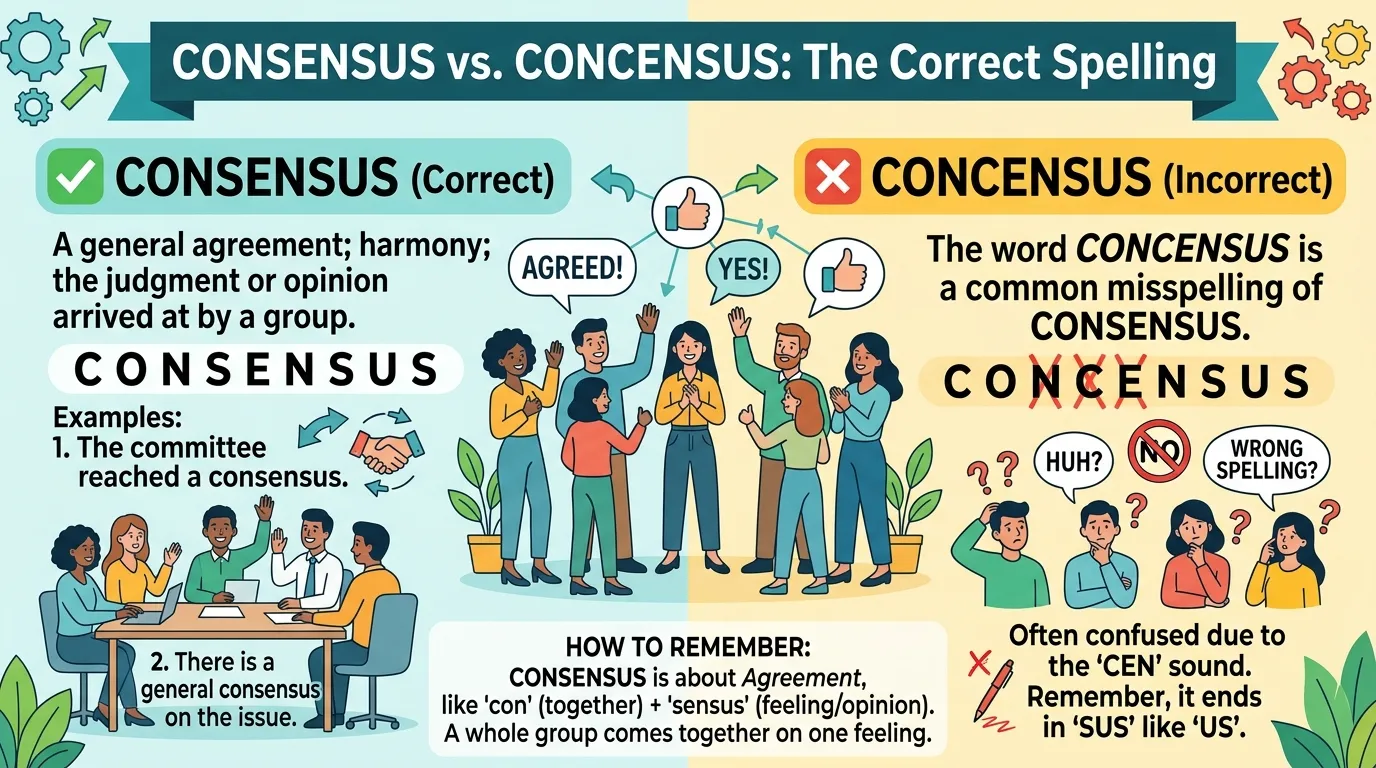
If you are unsure whether the correct spelling is consensus or concensus, the answer is simple: consensus is the correct spelling.
Concensus is a common misspelling of consensus. It is not the standard spelling in American English or British English.
The word consensus means a general agreement or shared opinion among a group of people. You may see it in business writing, academic papers, news reports, politics, sports discussions, workplace conversations, and everyday English.
In this guide, you will learn the difference between consensus and concensus, how to pronounce and use consensus, where the spelling comes from, why people add the extra c, common mistakes, useful synonyms, natural example sentences, and how to remember the correct spelling.
Quick Answer: Consensus vs Concensus
| Word | Correct? | Meaning |
|---|---|---|
| consensus | ✅ Yes | General agreement or shared opinion |
| concensus | ❌ No | Common misspelling of consensus |
Correct example
The committee reached a consensus after several hours of discussion.
Incorrect example
The committee reached a concensus after several hours of discussion.
The correct spelling is always consensus.
A useful memory trick is:
Consensus has one C after the N: con-sen-sus.
Do not write con-census.
What Does Consensus Mean?
Consensus is a noun meaning general agreement among members of a group.
It does not necessarily mean that every person completely agrees. Instead, it usually means that the group has reached a position that most or all members can accept.
Simple definition
Consensus: A general agreement or shared understanding reached by a group.
For example:
The team reached a consensus about the best way to solve the problem.
This means the members discussed the problem and eventually agreed on a solution.
More examples
- There is a growing consensus that the policy should change.
- The board reached a consensus on the proposal.
- After a long debate, the group finally achieved consensus.
- Scientists have reached a broad consensus on the subject.
- The players were in consensus about the strategy.
The word is especially common when several people need to make a decision together.
Is Consensus or Concensus Correct?
Consensus is correct. Concensus is incorrect.
The spelling concensus may look logical because of other words beginning with con-, but standard English spells the word:
C-O-N-S-E-N-S-U-S
There is no second C after the N.
Remember this spelling
con + sensus = consensus
Not:
con + census = concensus
This distinction matters because census is a real English word, but concensus is not the correct spelling of consensus.
Why Do People Confuse Consensus and Concensus?
The spelling mistake is understandable because English contains many words beginning with con-.
People may unconsciously divide the word into:
con + census
This can produce the incorrect spelling concensus.
Another reason is pronunciation. When people hear consensus, the middle sounds may not make the spelling obvious.
There is also a real word called census, meaning an official count of a population. Because census is familiar, people may accidentally insert its spelling into consensus.
Compare:
- consensus = general agreement
- census = official population count
- concensus = incorrect spelling
The words consensus and census are related historically, but they do not have the same meaning.
Consensus vs Census: Do Not Confuse These Words
A particularly useful distinction is between consensus and census.
| Word | Meaning | Example |
|---|---|---|
| consensus | General agreement | The team reached a consensus. |
| census | An official count of a population | The government conducted a census. |
| concensus | Incorrect spelling | Avoid this spelling. |
Consensus
There was a consensus among the doctors.
This means the doctors generally agreed.
Census
The country conducts a census to count its population.
This refers to collecting population information.
Easy memory trick
Think:
consensus = consent + agreement
census = count
If you are talking about agreement, use consensus.
If you are talking about counting people, use census.
Consensus: Dictionary-Style Definition
Consensus
Part of speech: Noun
Definition: A general agreement, shared opinion, or common understanding among members of a group.
Example
The committee reached a consensus on the new policy.
Plural
The plural form is:
consensuses
Although consensuses is grammatically possible, it is relatively uncommon. Writers often restructure the sentence to avoid it.
For example:
Several consensuses emerged during the negotiations.
This is grammatical, but a more natural alternative may be:
Several areas of agreement emerged during the negotiations.
What Is the Part of Speech of Consensus?
Consensus is primarily a noun.
It names an idea or state of agreement.
Examples
The consensus was clear.
We need to reach a consensus.
There is broad consensus among experts.
You generally should not use consensus as an adjective or verb in ordinary standard English.
For example, this is awkward:
The committee consensused on the issue.
A more natural version is:
The committee reached a consensus on the issue.
Common Collocations With Consensus
A collocation is a combination of words that commonly appear together.
Learning common collocations makes your English sound more natural.
Here are some of the most useful expressions with consensus.
Reach a consensus
The committee reached a consensus after several meetings.
Build consensus
The leaders worked together to build consensus.
Achieve consensus
The negotiators eventually achieved consensus.
Find consensus
The two groups are trying to find consensus.
Seek consensus
The organization is seeking consensus before making a decision.
Broad consensus
There is broad consensus on the need for reform.
General consensus
The general consensus was that the plan needed more work.
Growing consensus
There is a growing consensus that the system should be updated.
Widespread consensus
There is widespread consensus among researchers.
Strong consensus
The members reached a strong consensus.
Lack of consensus
The debate ended with a lack of consensus.
Reach a consensus on
The team reached a consensus on the final design.
Consensus among
There is consensus among the experts.
These expressions are useful in academic, professional, journalistic, and business writing.
Should You Say “Reach Consensus” or “Reach a Consensus”?
Both forms can be found in standard English.
Reach a consensus
This is extremely common and natural:
The committee reached a consensus.
Reach consensus
This is also used, particularly in formal, academic, institutional, and professional writing:
The parties worked together to reach consensus.
For everyday American English, reach a consensus is a very safe and natural choice.
Consensus vs Agreement
Consensus and agreement are closely related, but they are not always interchangeable.
Agreement
Agreement can refer to a situation where people have the same opinion or where two parties accept the same terms.
We reached an agreement about the price.
Consensus
Consensus emphasizes a shared position within a group.
The committee reached a consensus about the proposal.
The difference can be subtle.
Agreement can describe a specific decision between two people or organizations.
Consensus often suggests a broader shared view developed through discussion.
Compare
Sarah and John reached an agreement.
This may involve only two people.
The committee reached a consensus.
This suggests a group developed a generally shared position.
Consensus vs Unanimous Agreement
These terms are also different.
Consensus does not necessarily mean unanimous agreement.
If a group reaches a consensus, everyone may not have exactly the same opinion. Instead, members may accept a common decision.
Unanimous means everyone agrees.
Example of consensus
The committee reached a consensus, although two members still had reservations.
This is possible because consensus does not always require complete agreement.
Example of unanimous agreement
The decision was unanimous.
This means every member agreed.
Therefore, avoid assuming that consensus = 100% agreement.
Consensus vs Majority Rule
Consensus is also different from majority rule.
Under majority rule, a decision may be made because more than half of the group supports it.
Under consensus, the group tries to develop a decision that the members can broadly accept.
Majority rule
Sixty percent of the members voted for the proposal, so it passed.
Consensus
The members discussed the proposal until they found a solution everyone could accept.
This distinction is important in politics, management, community organizations, meetings, and collaborative decision-making.
How to Pronounce Consensus
Consensus is commonly pronounced approximately:
kuhn-SEN-sus
The stress falls on the middle syllable:
con-SEN-sus
The final syllable sounds like “sus.”
Pronunciation tip
Do not try to pronounce the incorrect spelling concensus.
The word has three main syllables:
con – sen – sus
This can also help you remember the spelling.
Is Consensus Formal or Informal?
Consensus is neutral to formal.
It works well in everyday conversations, but it is especially common in professional, academic, political, scientific, and journalistic contexts.
Casual
Everyone agreed on the plan.
Neutral
We reached a consensus about the plan.
Formal
The panel reached a broad consensus regarding the proposed reforms.
All three are grammatical, but the level of formality changes.
Consensus in American English
In American English, the standard spelling is:
consensus
The misspelling concensus should be avoided in professional and academic writing.
American examples
The committee reached a consensus.
There is no consensus on the issue.
The scientific community has reached broad consensus on the findings.
The board is trying to build consensus among its members.
For American writers, there is no special regional spelling difference here.
Consensus in British English
British English also uses:
consensus
There is no standard British spelling concensus.
Therefore:
- American English: consensus
- British English: consensus
- International English: consensus
This is one of those spelling questions where the answer is consistent across major English varieties.
Consensus in Academic Writing
Consensus is common in academic and scholarly writing because researchers often discuss areas where experts broadly agree.
Examples
There is broad academic consensus on the importance of early education.
The researchers found little consensus among participants.
The literature does not yet provide a clear consensus.
In academic writing, avoid repeatedly using phrases such as general consensus when the word consensus already communicates the idea.
However, general consensus is established and commonly used, so it is not automatically wrong.
Is “General Consensus” Redundant?
Technically, consensus already implies general agreement, so some editors consider general consensus somewhat redundant.
However, the expression is extremely common in modern English.
Example
The general consensus was that the proposal should be revised.
This is natural and widely understood.
If you want tighter writing, you can simply say:
The consensus was that the proposal should be revised.
Both versions work.
Consensus in Business Writing
Business teams frequently use consensus when discussing decisions, strategy, negotiations, and management.
Examples
The leadership team reached a consensus on the new strategy.
We need to build consensus before moving forward.
There was no consensus about the proposed budget.
The managers sought consensus from the regional offices.
More direct business alternatives
Depending on context, you could use:
- agreement
- shared decision
- common understanding
- alignment
- common position
- mutual agreement
For example:
We need consensus before launching the project.
could become:
We need agreement before launching the project.
Or:
We need alignment before launching the project.
The best choice depends on the exact meaning.
Consensus in Politics
The word is very common in political writing.
Examples
The parties failed to reach a consensus.
Lawmakers are searching for consensus on the proposed legislation.
There is little political consensus on the issue.
The leaders called for greater consensus.
In political contexts, consensus often describes a shared position across different parties or groups.
Consensus in Science and Medicine
Scientific and technical writing frequently uses consensus to describe broad agreement among specialists.
Examples
There is a scientific consensus on the basic findings.
Researchers have not reached a consensus on the cause.
The panel developed a consensus statement.
The term does not mean that every scientist agrees.
It generally refers to a broad level of agreement supported by evidence and professional discussion.
Consensus in Sports
The word also appears in sports writing.
Examples
The consensus among analysts was that the team needed a stronger defense.
There was a consensus that the player deserved the award.
The preseason consensus favored the defending champions.
In sports journalism, consensus pick is a useful expression.
Consensus pick
A consensus pick is a choice widely shared by analysts, experts, voters, or commentators.
He was the consensus pick for MVP.
This means most relevant people agreed that he was the likely or preferred choice.
Consensus in Journalism
Journalists often use consensus to describe a broad public, political, expert, or institutional view.
Examples
The political consensus has shifted in recent years.
Experts have yet to reach a consensus.
The consensus among analysts is that the market will remain uncertain.
Good journalism should make clear whose consensus is being discussed.
Instead of:
The consensus is that the policy will succeed.
A clearer sentence may be:
The consensus among industry analysts is that the policy will succeed.
This avoids making a broad claim without identifying the group.
Consensus in Technical and Professional Writing
In technical fields, consensus often appears in phrases such as:
- consensus standard
- consensus process
- consensus model
- consensus statement
- consensus decision
- consensus approach
- consensus method
- consensus building
Examples
The organization developed a consensus standard.
The panel published a consensus statement.
The project uses a consensus-based decision-making process.
These expressions are especially common in organizational, scientific, engineering, and policy contexts.
Synonyms for Consensus
The best synonym depends on context.
Common synonyms
- agreement
- accord
- harmony
- unity
- understanding
- common ground
- common view
- shared opinion
- shared understanding
- general agreement
- mutual agreement
Example
Original:
The group reached a consensus.
Possible alternatives:
The group reached an agreement.
The group found common ground.
The group developed a shared understanding.
The group reached an accord.
These alternatives are not always exact substitutes.
Antonyms of Consensus
Words that express the opposite of consensus include:
- disagreement
- conflict
- division
- dispute
- dissent
- opposition
- disagreement
- controversy
- discord
- disagreement
Examples
There was a lack of consensus among the members.
The proposal created significant disagreement.
The group remained divided.
Several members expressed dissent.
Related Words and Expressions
Understanding related vocabulary can make the word easier to remember.
Consensus
General agreement.
Consent
Permission or approval.
She gave her consent to the proposal.
Consensus-based
Based on general agreement.
The organization uses a consensus-based approach.
Consensus-building
The process of helping people reach agreement.
The workshop focused on consensus-building.
Consensus-driven
Guided by the goal of achieving broad agreement.
The organization uses a consensus-driven decision process.
Consensus statement
A formal statement representing a broadly shared expert position.
Consensus and Consent: What Is the Difference?
The words consensus and consent look and sound somewhat similar, but their meanings differ.
Consent means permission or approval.
The participant gave consent before the procedure.
Consensus means general agreement among a group.
The committee reached consensus.
A simple way to remember them:
Consent = permission.
Consensus = agreement.
Word History and Etymology of Consensus
The word consensus comes from Latin consensus, meaning agreement, harmony, or accord.
It is related to the Latin verb consentire, meaning roughly “to agree” or “to feel together.”
The word entered English through historical use in scholarly and formal language and gradually became a standard term for general agreement.
Its connection with words such as consent helps explain why the meaning centers on agreement.
However, the spelling is consensus, not concensus.
Common Mistakes With Consensus
Here are some of the most frequent mistakes.
Mistake 1: Writing “concensus”
❌ The group reached a concensus.
✅ The group reached a consensus.
Mistake 2: Using consensus as a verb
❌ The members consensused on the proposal.
✅ The members reached a consensus on the proposal.
Mistake 3: Assuming consensus means unanimous agreement
❌ Consensus always means every person completely agrees.
✅ Consensus usually means broad or general agreement.
Mistake 4: Confusing consensus with census
❌ The government reached a consensus of the population.
If you mean an official population count:
✅ The government conducted a census.
If you mean agreement:
✅ The government reached a consensus with the participating organizations.
Mistake 5: Using “consensus” when “decision” is more precise
Sometimes writers use consensus simply because it sounds formal.
For example:
The manager made a consensus.
This is incorrect and unnatural.
Better:
The manager made a decision.
Or, if a group agreed:
The team reached a consensus.
Awkward vs Natural Examples
| Awkward or Incorrect | Natural Version |
|---|---|
| We made a consensus. | We reached a consensus. |
| They consensused on the issue. | They reached consensus on the issue. |
| There was a concensus. | There was a consensus. |
| The census was that everyone agreed. | The consensus was that everyone agreed. |
| Everyone reached consensus individually. | The group reached a consensus. |
The key is to use consensus as a noun and pair it with natural verbs such as reach, build, achieve, seek, find, and develop.
Natural Everyday Examples of Consensus
Here are practical examples you might encounter in real life.
At work
After the meeting, we reached a consensus about the deadline.
At school
The students reached a consensus about their presentation topic.
In a family
We came to a consensus about where to spend the holiday.
In a community
Residents reached a consensus on the neighborhood project.
In politics
The parties could not reach a consensus.
In science
Researchers have not reached a consensus about the cause.
In sports
The consensus among commentators was that the team needed a new strategy.
Online
The consensus in the discussion was that the product was overpriced.
Formal vs Informal Alternatives to Consensus
The word consensus is useful, but sometimes a simpler expression is better.
| Formal/Professional | More Conversational |
|---|---|
| reach a consensus | agree |
| build consensus | get people to agree |
| seek consensus | try to agree |
| lack of consensus | disagreement |
| common consensus | shared view |
| consensus among members | what the members agree on |
Formal
The committee sought consensus before issuing its recommendation.
Conversational
The committee tried to get everyone to agree.
Choose based on your audience.
How to Remember the Correct Spelling
If you frequently write concensus, use one of these memory tricks.
Memory Trick 1: Think “consent”
consent and consensus both relate to agreement.
Start with:
CON-SEN-
Then finish:
-SUS
So:
CON-SEN-SUS
Memory Trick 2: Avoid “census”
Remember that census is a different word.
census = population count
consensus = agreement
Memory Trick 3: Say the syllables
Break it into:
con – sen – sus
Not:
con – cen – sus
Memory Trick 4: One C in the middle
The spelling contains:
conSENsus
There is no extra C after the N.
Consensus vs Concensus: Comparison Table
| Feature | Consensus | Concensus |
|---|---|---|
| Standard spelling | ✅ Yes | ❌ No |
| Standard American English | ✅ Yes | ❌ No |
| Standard British English | ✅ Yes | ❌ No |
| Part of speech | Noun | — |
| Meaning | General agreement | — |
| Pronunciation | kuhn-SEN-sus | Not standard |
| Academic use | Common | Incorrect |
| Business use | Common | Incorrect |
| Political use | Common | Incorrect |
| Journalistic use | Common | Incorrect |
The choice is straightforward: use consensus.
Which Spelling Should You Use in SEO Content?
If you are writing a blog post, website page, article, product description, business document, or other online content, always use consensus when you mean general agreement.
You may naturally encounter searches such as:
- consensus vs concensus
- is concensus a word
- consensus meaning
- concensus meaning
- consensus spelling
- correct spelling of consensus
- consensus definition
- consensus pronunciation
- how to spell consensus
- consensus or concensus
- consensus meaning in English
- consensus example sentence
You can address the misspelling concensus when explaining the difference, but you should not repeatedly use the incorrect spelling simply to target search traffic.
Good SEO prioritizes usefulness and natural language.
When Should You Use Consensus?
Use consensus when you are describing a general agreement or shared position among a group.
It works especially well when:
- Several people are involved.
- The group has discussed an issue.
- A broadly shared position has developed.
- You want to describe agreement rather than a simple vote.
- The context is professional, academic, political, scientific, or organizational.
Example
After several rounds of negotiation, the countries reached a consensus.
This clearly describes a shared position developed through discussion.
When Should You Use Agreement Instead?
Use agreement when you want a simpler, broader term.
For example:
We have an agreement.
This is perfectly natural.
But:
We have a consensus.
suggests a broader shared opinion or position.
If you are writing for a general audience, agreement may sometimes be clearer than consensus.
Is Concensus Ever Correct?
No, not as the standard spelling of the English noun meaning general agreement.
If you see concensus, it is almost certainly a spelling error for consensus.
The correct word is:
consensus
Do not use concensus in formal, academic, professional, journalistic, or everyday standard English.
Quick Editing Checklist
Before publishing or submitting your writing, check these points:
- ✅ Spell it consensus.
- ❌ Do not spell it concensus.
- ✅ Use it as a noun.
- ✅ Say reach a consensus.
- ✅ Say build consensus.
- ✅ Say seek consensus.
- ✅ Distinguish consensus from census.
- ✅ Do not assume consensus means unanimous agreement.
- ✅ Identify whose consensus you mean when clarity matters.
- ✅ Use simpler words such as agreement when they communicate the idea better.
Consensus vs Concensus: Frequently Asked Questions
1. Is “consensus” or “concensus” correct?
Consensus is correct. Concensus is a common misspelling. The standard spelling is c-o-n-s-e-n-s-u-s.
2. Is “concensus” a real word?
No. Concensus is not the standard English spelling of the word meaning general agreement. Use consensus instead.
3. What does consensus mean?
Consensus means general agreement among a group of people. For example, “The committee reached a consensus” means the committee developed a broadly shared position.
4. How do you spell consensus?
The correct spelling is:
C-O-N-S-E-N-S-U-S
A helpful pronunciation and spelling pattern is con-sen-sus.
5. What is the difference between consensus and agreement?
Both refer to agreement, but consensus often suggests a broadly shared position within a group, while agreement has a wider meaning and can describe agreement between individuals or organizations.
6. What is the difference between consensus and census?
Consensus means general agreement. Census means an official count or survey of a population.
For example:
The group reached a consensus.
The government conducted a census.
7. Does consensus mean everyone agrees?
Not necessarily. Consensus generally means broad or general agreement, but it does not always require every person to have exactly the same opinion.
8. Is “reach a consensus” correct English?
Yes. Reach a consensus is a common and natural expression.
Example:
The team reached a consensus after a long discussion.
9. Is consensus formal or informal?
Consensus is neutral to formal. It is common in everyday English but especially frequent in business, academic, political, scientific, and professional writing.
10. What is an easy way to remember consensus?
Remember:
Consensus = agreement.
Census = counting.
And remember that consensus has no extra C after the N.
Final Verdict
When choosing between consensus and concensus, there is only one correct standard spelling:
CONSENSUS ✅
Concensus ❌ is a misspelling.
Consensus is a noun meaning general or broad agreement among members of a group. It is widely used in American and British English and works naturally in business, academic, political, scientific, journalistic, sports, technical, and everyday contexts.
The most useful expressions to remember are:
- reach a consensus
- build consensus
- achieve consensus
- seek consensus
- find consensus
- broad consensus
- general consensus
- lack of consensus
- consensus among experts
- consensus on an issue
Also keep these three words separate:
consensus = general agreement
consent = permission or approval
census = an official population count
If you are writing in American English—or virtually any standard form of English—use consensus, never concensus, when you mean general agreement.
When in doubt, remember the simple spelling:
con-sen-sus
That one small spelling habit will prevent one of the most common errors associated with this word.