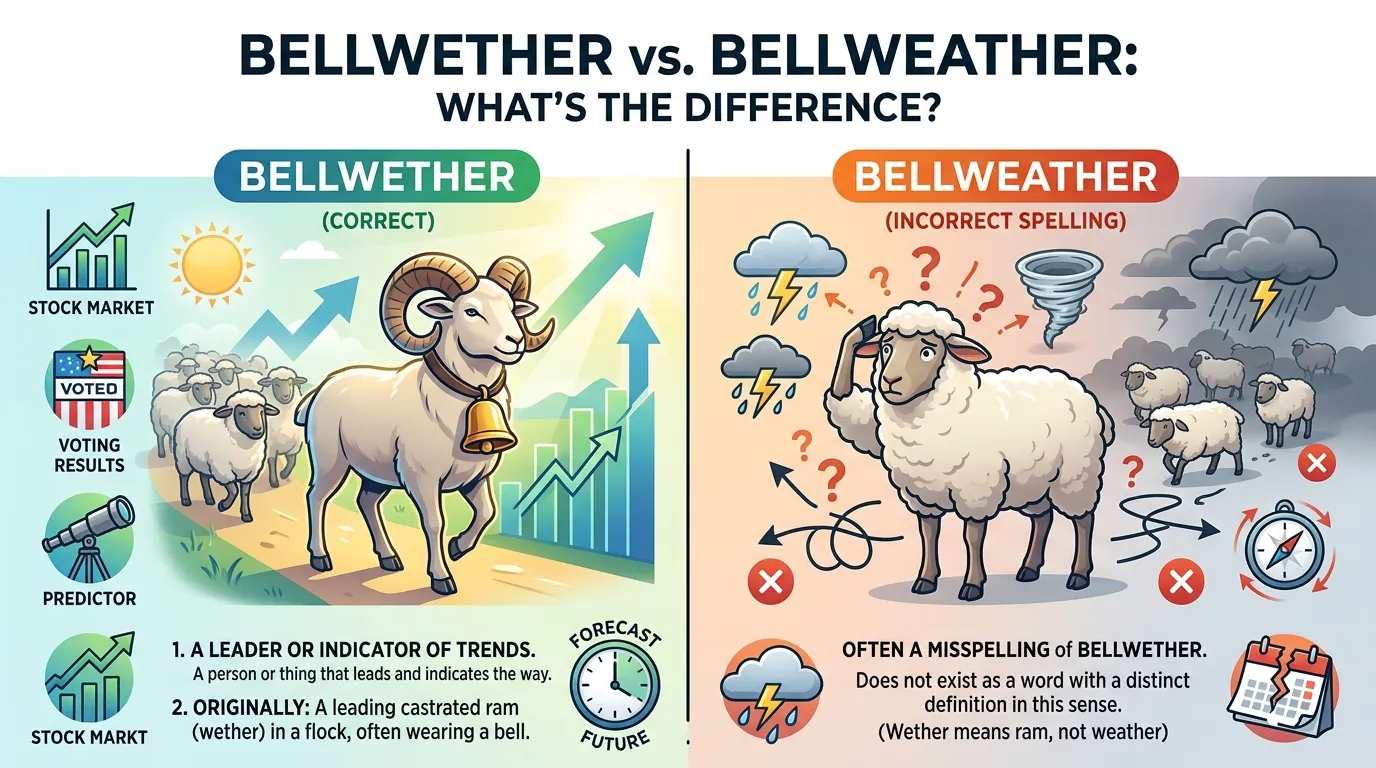
The shepherd’s flock moves across the hillside in a slow, woolly river — two hundred sheep, one dog, and one animal at the front that is not like the others. Around its neck hangs a bell, and the bell rings with every step, telling the flock where to go. The animal is a bellwether: a castrated ram, chosen to lead, wearing the bell that the flock follows. The word is spelled bellwether, not bellweather. The difference is one letter — wether, not weather — and the difference is the whole story, because a wether is a sheep, and weather is the sky, and the two have nothing to do with each other except that they sound alike.
Bellwether is a word with two lives: one in the pasture, where it names a sheep, and one in the world of business, politics, and investing, where it names a leader, a trendsetter, a predictor of what comes next. In both lives, the spelling is the same, and the spelling is the sheep.
The Sheep With the Bell
Start with the hillside, because the hillside is the word’s origin. A wether is a castrated male sheep — a ram that has been altered so that it is calmer, less aggressive, and easier to manage. Shepherds have used wethers as flock leaders for thousands of years, because a wether is big enough to lead, calm enough to follow, and steady enough to keep the flock together. The bell around its neck lets the shepherd find the flock in fog, in darkness, in rough country. The bell rings, the flock follows, the shepherd listens.
The bellwether is the wether with the bell. It is the lead sheep, the one the flock follows, the one whose bell the shepherd tracks. The word is built from two parts: bell + wether. The bell is the instrument. The wether is the animal. The combination is the leader.
The word’s literal sense is still alive in farming and in sheepdog trials, where the bellwether’s job is to lead the flock through gates, across fields, and into pens. A good bellwether is worth its weight in wool, because a flock without a leader scatters, and a scattered flock is a lost flock. The bell is the flock’s compass. The wether is the compass needle.
There is also the phrase bellwether sheep, used in farming to describe any sheep that leads the flock, whether or not it wears a bell. The phrase has traveled from the pasture into general English, where it means a leader, a trendsetter, a person or thing that shows the way for others.
Wether Is Not Weather
Here is the fact that fixes the spelling. Bellwether is built from bell + wether. The second part is wether, spelled w-e-t-h-e-r, a noun meaning a castrated ram. It is not weather, spelled w-e-a-t-h-e-r, the noun meaning the state of the atmosphere — rain, sun, wind, snow. The two words sound alike. They are spelled differently. The difference is one letter: wether has no A after the W. Weather has an A.
The misspelling bellweather inserts the A, as if the word were bell + weather — a bell that tells the weather, or a bell in the weather. The image is appealing. It is also wrong. The bellwether does not tell the weather. It leads the flock. The bell is not a weather instrument. It is a sheep’s necklace.
So why does the hand write bellweather? Because of the ear and the mind, working together against the writer. The ear hears “bell-wether” and the mind, which knows the common word weather far better than the rare word wether, substitutes the familiar word for the unfamiliar one. Weather is a word everyone writes every day. Wether is a word most people have never written. The familiar word wins, and the A sneaks in.
There is also the fact that wether is a rare word outside of farming. Most English speakers have never met a wether, have never seen one, have never needed the word. The word lives in shepherds’ vocabulary, in livestock manuals, in the history of farming. A writer who meets bellwether for the first time has no reason to know that the second half is a sheep. The mind fills the gap with the word it knows: weather. The gap is filled wrong.
The fix is to meet the sheep. Once you know that the second half of the word is a castrated ram, the spelling is obvious: wether, no A, because a wether is not the weather. The sheep is the spelling.
From Pasture to Stock Market
The word’s second life began in the 1300s, when bellwether started to be used figuratively to mean a leader, a trendsetter, a person or thing that leads the way for others. The metaphor is the flock: just as the sheep follow the bellwether, so the crowd follows the leader. The bellwether is the one who goes first, and the rest follow.
In business, a bellwether is a company whose performance predicts the performance of its industry or the economy. “General Electric was once a bellwether of American industry.” “The housing market is a bellwether for the economy.” The company is the wether. The industry is the flock. The bell is the company’s earnings report, and the flock — the investors, the analysts, the competitors — follows where it leads.
In politics, a bellwether is a district, a state, or a demographic group whose voting predicts the outcome of an election. “Ohio is a bellwether state.” “The suburbs are a bellwether for the national mood.” The district is the wether. The nation is the flock. The bell is the election result, and the flock follows.
In investing, a bellwether stock is a stock whose movement predicts the movement of the market. In technology, a bellwether product is a product that signals a trend. In journalism, a bellwether is a story or a poll that signals a shift in public opinion. In every case, the word means the same thing: the leader, the predictor, the one the flock follows.
There is also the phrase bellwether indicator, used in economics and in medicine, to describe a measure that predicts a larger trend. A bellwether indicator is the canary in the coal mine, the first sign of what is coming. The phrase is formal, and it appears in reports, papers, and policy documents. The spelling is the same: bellwether, no A.
Bellwether vs Trendsetter, Leader, Indicator
Bellwether has close neighbors, and keeping them distinct sharpens a sentence. A trendsetter is a person or thing that starts a trend — a fashion designer, a musician, a company that launches a new style. A bellwether is a person or thing that predicts a trend — the company whose sales predict the industry’s sales, the district whose vote predicts the nation’s vote. The difference is the difference between starting and predicting: the trendsetter starts the trend, and the bellwether shows where the trend is going.
A leader is a person who guides or directs a group — a CEO, a general, a president. A bellwether is a specific kind of leader: the one the flock follows because of where it goes, not because of authority. A CEO leads by authority. A bellwether leads by example. The flock follows the bellwether because the bellwether is going the right way, not because the bellwether is in charge.
An indicator is a measure that shows the state of something — an economic indicator, a health indicator. A bellwether is a specific kind of indicator: one that predicts the future, not just describes the present. An unemployment rate is an indicator. A bellwether stock is a predictor. The difference is the direction of time: the indicator looks at now, and the bellwether looks at next.
There is also the word’s opposite: laggard, straggler, latecomer. A laggard follows the trend after it has started. A straggler trails behind the flock. A latecomer arrives after the bell has rung. The opposites name the failure that bellwether-ness prevents: the sheep that does not lead, the company that does not predict, the district that does not signal.
The Hillside Test
Back on the hillside, the shepherd has a test. He looks at the flock, and he looks for the bell. The bell is on the wether. The wether is the sheep. The spelling is bellwether.
The memory hook is the sheep. Wether is a castrated ram. Weather is rain and sun. The bellwether is a sheep, not a forecast. If you see an A after the W — bellweather — the A is an intruder, and the intruder has brought the sky into the pasture. Delete the A. The sheep is back.
And one final check for the keyboard: when the word appears in your draft, look at the second half. If you see -weather, you have written the sky. Swap it for -wether. The flock follows the bell, the bell hangs on the wether, and the wether has no A.