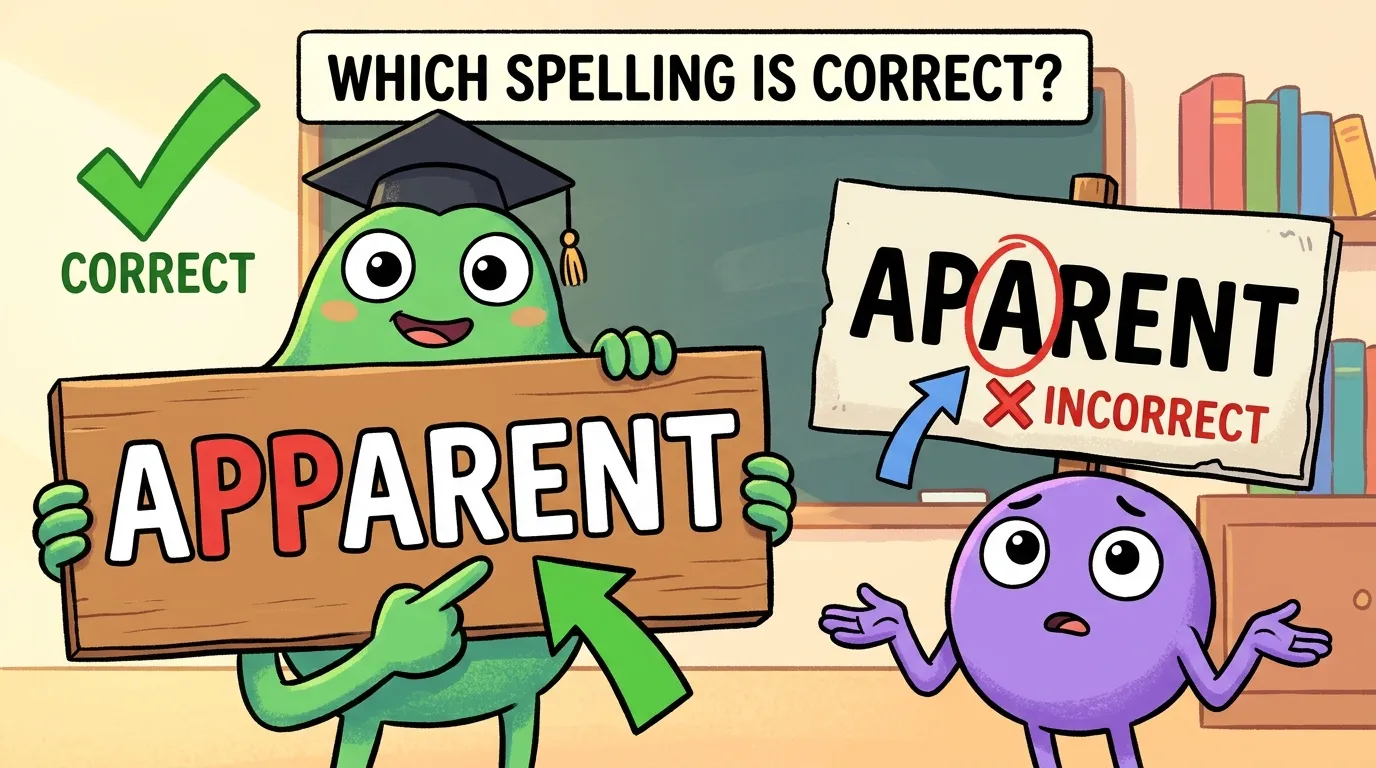
The darkroom is lit by a single red bulb, and the photographer is standing over a tray of developer, watching nothing happen. Then, slowly, the image begins to appear — first a smudge, then a shape, then a face, rising out of the blank paper like a memory. The photograph is becoming apparent: visible, clear, obvious, emerging into sight. The word is spelled apparent, with two P’s. The misspelling is aparent, with one P. The correct spelling is apparent. The missing P is the whole error, and the reason it disappears is a story about a Latin prefix, a silent doubling, and a word that looks simpler than it is.
Apparent is a word with two faces: one that means “visible, clear, obvious,” and one that means “seeming, appearing to be true but possibly not.” The two faces are opposites in a way — the first says “this is clear,” the second says “this only looks clear” — and the spelling is the same in both. The two P’s hold both faces together.
The Tray in the Darkroom
Start with the tray, because the tray is the word’s first meaning. Apparent means clearly visible, obvious, easy to see. “The damage was apparent.” “It was apparent that she was upset.” “The pattern became apparent as the data accumulated.” In each sentence, the word means that something has come into view — the way the photograph comes into view in the developer tray, from nothing to something, from blank to clear.
The word describes a process as much as a state. A thing becomes apparent. It emerges. It was hidden, and now it is seen. The photographer watches the image become apparent. The scientist watches the pattern become apparent. The reader watches the motive become apparent. In every case, the word marks the moment when the invisible becomes visible.
There is a second sense, the one that makes the word tricky: apparent as “seeming, appearing to be true, but possibly not.” “His apparent wealth turned out to be borrowed.” “The apparent cause of the fire was a faulty wire — but the investigation is ongoing.” “She spoke with apparent confidence.” In this sense, the word carries a warning: what appears to be true may not be true. The photograph in the tray may be a trick of the light. The confidence may be a performance. The wealth may be a loan.
The two senses live side by side, and the context tells the reader which one is meant. “It was apparent that he was lying” — the first sense, clear and obvious. “His apparent honesty” — the second sense, seeming honest, possibly not. The difference is the difference between “clearly” and “seemingly,” and the word carries both, which is why it is one of the most useful — and most misused — adjectives in English.
There is also the fixed phrase apparent heir — in law, the person who is next in line to inherit, whose right is clear unless something changes. And apparent magnitude — in astronomy, how bright a star appears from Earth, as opposed to its absolute magnitude, how bright it actually is. In both phrases, the word is doing its double job: the heir appears to be next, and the star appears to be bright. The appearance may or may not match the reality.
Appearing, With Two P’s
Here is the fact that fixes the spelling. Apparent is built from three parts: ap- + par- + -ent. The prefix is ad-, meaning “toward,” which becomes ap- before a P — a process called assimilation, in which the prefix’s final consonant changes to match the root’s first consonant. The root is parere, Latin for “to appear, to come into view, to be visible.” The suffix is -ent, which forms adjectives. Ad- + parere = apparere, “to appear.” Apparere + -ent = apparent, “appearing, coming into view.”
The doubling is the key. When ad- meets parere, the D becomes a P, and the result is two P’s: ap- + par- = appar-. The two P’s are not a decoration. They are the fossil of the prefix and the root meeting. Delete one P, and you delete the prefix. Aparent, with one P, is a word with no prefix — a root without a beginning.
The pattern is consistent across the family. Appear — ad- + parere, two P’s. Apparition — a ghost, an appearance, two P’s. Apparatus — equipment, things that appear ready for use, two P’s. Apparent — two P’s. Apparently — the adverb, two P’s. The whole family keeps the doubling, because the doubling is the family mark.
There is a useful contrast with words where the prefix does not double. Admit — ad- + mittere, the D stays D, because M is not D. Adapt — ad- + aptare, the D stays D, because A is not D. The prefix doubles only when the root starts with the same consonant the prefix ends with — or when the prefix’s consonant assimilates to the root’s. Apparent is the assimilation case: D becomes P before P, and the result is PP.
So why does the hand write aparent? Because of the ear. Say the word aloud: uh-PAIR-ent. The first syllable is unstressed, and the double P is pronounced as a single P — English does not pronounce double consonants as two sounds. The ear hears one P, and the hand writes one P. The guess is reasonable. It is also wrong, because English spelling records the word’s construction, not its pronunciation. The two P’s are silent as a pair, but they are both there, and the spelling knows it.
Apparently, the Adverb
The adverb apparently deserves a section of its own, because it is one of the most used — and most misused — words in English. Apparently means “as far as one can tell, judging by appearances, seemingly.” “Apparently, the meeting has been cancelled.” “She was apparently unaware of the change.” “Apparently, he left early.” In each sentence, the word hedges: the speaker is reporting what appears to be true, not what is certainly true.
The hedge is the point. Apparently is the word a careful writer uses when the evidence is incomplete. A journalist who writes “Apparently, the company is planning layoffs” is saying: this is what the evidence suggests, but it is not confirmed. A scientist who writes “Apparently, the reaction is complete” is saying: the signs point to completion, but the test is not finished. The word is a shield against overclaiming, and it is one of the most honest words in the language.
But the hedge can also be a weapon. “Apparently, you didn’t get the memo” is not a hedge. It is a sarcastic accusation — the speaker means “you obviously did not get the memo, and I am pretending to be surprised.” “Apparently, someone forgot to lock the door” is not a report. It is a complaint. The word’s tone depends on the context, and the context is everything.
There is also the phrase apparently not: “Apparently not.” The two-word sentence is a complete thought — a wry admission that what appeared to be true was not. It is the word’s most conversational form, and it appears in dialogue, in texts, in every register where a person admits to being wrong gracefully.
Apparent vs Obvious, Evident, Clear
Apparent has close neighbors, and keeping them distinct sharpens a sentence. Obvious means so clear that it cannot be missed — “an obvious mistake,” “an obvious lie.” Apparent, in its first sense, means clear and visible, but it carries the sense of becoming clear — the photograph emerging in the tray. An obvious mistake is one you see immediately. An apparent pattern is one that emerges over time.
Evident means supported by evidence — “It is evident from the data that sales are rising.” Apparent means visible to the eye or mind — “The pattern is apparent in the data.” The difference is the difference between evidence and appearance: evident points to the proof, and apparent points to the seeing. A fact can be evident without being apparent — proven by data, but not yet visible — and apparent without being evident — visible, but not yet proven.
Clear is the general word for easy to understand or perceive — “a clear explanation,” “a clear day.” Apparent is more specific: it describes something that has become clear, that has emerged into view. A clear explanation is one that is easy to follow. An apparent motive is one that has revealed itself. The words overlap, but apparent carries the emergence, and clear does not.
There is also the word’s opposite: hidden, obscure, unclear. “A hidden motive.” “An obscure pattern.” “An unclear result.” The opposites name the state before the photograph develops: the image not yet visible, the pattern not yet apparent, the tray still blank.
The Darkroom Test
Back in the darkroom, the photograph is fully developed — the face is clear, the image is apparent, and the photographer lifts it from the tray. The test is the same one that works for every ad- + p word: find the seam. Ap- + par- + -ent. The prefix and the root meet at the double P. The spelling is apparent.
The memory hook is the family. Appear — two P’s. Apparition — two P’s. Apparatus — two P’s. Apparent — two P’s. Four words, one doubling, and the doubling is the family mark. If you can spell appear — and almost everyone can — you can spell apparent, because it follows the same rule.
And one final check for the keyboard: when the word appears in your draft, look at the start. If you see apa-, with one P, the second P is missing. Put it back. Appa-. Two P’s, one appearance, and the photograph is fully developed.