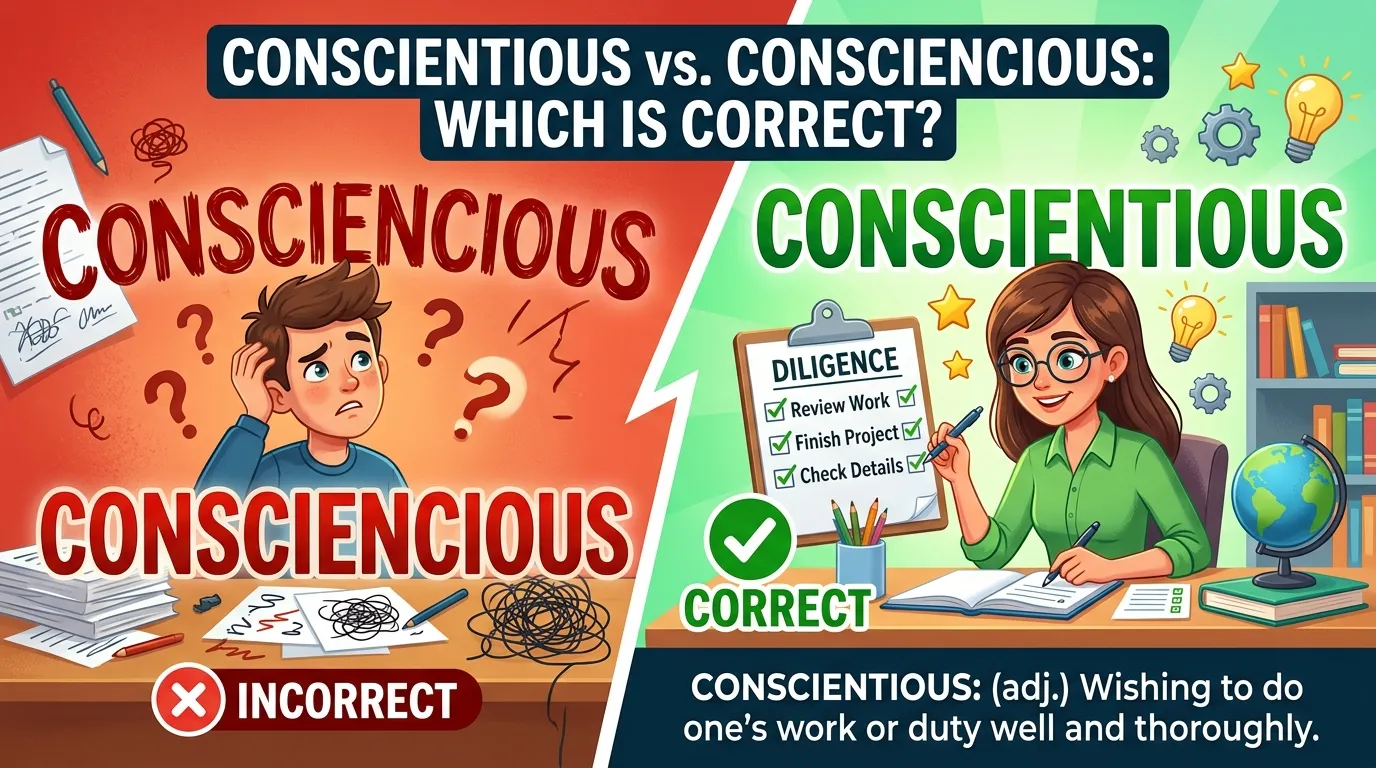
The watchmaker’s bench is lit by a single lamp, and the movement on it is smaller than a coin — a hundred parts, each one placed by hand, each one checked twice. The watchmaker works the way the word conscientious works: carefully, thoroughly, with attention to every detail, as if someone’s life depended on the tiny gear in his tweezers. Which, in a sense, it does — the watch will keep time for its owner for decades, and a careless gear will betray that trust. The word is long, and it is misspelled more often than almost any other long word in English, usually as consciencious. The correct spelling is conscientious. The extra C is an intruder, and the reason it sneaks in is a confusion between two words that look like twins and are not.
Conscientious is the adjective for a person who does their work carefully, thoroughly, and honestly — a person who takes care. It is a word of praise, and it is also a word of precision. The spelling is precise too, and the precision starts with understanding which root the word actually has.
The Watchmaker’s Bench
Start with the bench, because the bench is the word’s definition in physical form. A conscientious watchmaker checks every gear. A conscientious surgeon counts every sponge. A conscientious accountant reconciles every line. A conscientious student reads every footnote. In every case, the person is doing the same thing: taking the care the job deserves, whether or not anyone is watching.
The word describes a character trait, not a single action. A person who double-checks one email is careful. A person who double-checks everything, as a matter of habit, is conscientious. The difference is the pattern. Conscientiousness is carefulness as a way of life — the watchmaker’s bench as a personality.
The word also has a second, narrower sense, used mostly in ethics and law: conscientious as guided by conscience. A conscientious objector is a person who refuses military service because their conscience forbids it. A conscientious decision is one made after careful moral thought. In this sense, the word connects to conscience directly — and that connection is the trap, because the trap is thinking the two words are spelled the same way. They are not.
And there is a third use, the everyday one, where conscientious simply means thorough: “a conscientious worker,” “conscientious research,” “a conscientious effort.” In this use, the word is a compliment with weight. A manager who calls an employee “conscientious” is saying something stronger than “hardworking.” Hardworking is about effort. Conscientious is about care — the quality of the effort, not just the quantity.
The word’s opposite is worth knowing: careless, sloppy, negligent. “A careless watchmaker” is a watchmaker whose watches stop. “A negligent surgeon” is a surgeon who faces a lawsuit. The opposites name the failure that conscientiousness prevents: the gear left unchecked, the sponge left uncounted, the line left unreconciled.
Conscience Is Not the Parent You Think
Here is the fact that fixes the spelling, and it is subtle. Conscientious looks as if it comes from conscience — and in meaning, it does. But in spelling, it follows a different branch of the family. The Latin root is conscientia, from con- (together) + scientia (knowledge): “knowing together,” or shared knowledge. The English adjective formed from this root is conscientious, spelled c-o-n-s-c-i-e-n-t-i-o-u-s. The key letters are -tious at the end — T-I-O-U-S — not -cious.
The confusion comes from conscience, the noun, which is spelled c-o-n-s-c-i-e-n-c-e. The noun ends in -science, with a C. A writer who knows the noun can easily reason that the adjective must keep the C: conscience → consciencious. The reasoning is logical. It is also wrong, because English adjectives formed from Latin nouns ending in -ntia take the -tious ending, not the -cious ending. The noun conscience ends in -ence, but the adjective conscientious is built on the Latin conscientia, which ends in -tia — and -tia becomes -tious.
The pattern is consistent across the family. Prudence → prudential is a different suffix, but look at the -tious family: ambitious (from ambition), cautious (from caution), fictitious (from fiction), nutritious (from nutrition), repetitious (from repetition). In every case, the noun’s -tion becomes the adjective’s -tious. Conscientious follows the same rule: the -tia of conscientia becomes -tious. The T is not a mistake. It is the rule.
There is a useful contrast with the genuine -cious family: gracious (from grace), spacious (from space), malicious (from malice), precious (from price). These adjectives are built on nouns ending in -ce, and they keep the C. Conscience ends in -ce, which is why the hand wants to give the adjective a C. But conscientious is not built on the English noun conscience. It is built on the Latin conscientia. The C belongs to the noun. The T belongs to the adjective.
The -tious Family
The -tious family is large, and knowing it makes conscientious feel less lonely. Ambitious — full of ambition. Cautious — full of caution. Fictitious — invented, not real. Nutritious — providing nourishment. Repetitious — repeating too much. Expeditious — fast and efficient. Seditious — inciting rebellion. Surreptitious — secret, stealthy. Every one of them ends in -tious, and every one of them is built on a Latin noun ending in -tion or -tia.
The -cious family is a different crowd. Gracious, spacious, malicious, precious, ferocious, atrocious. These are built on nouns ending in -ce or -city. The two families sound alike — both end in the -shus sound — and they are spelled differently. The sound is the trap. The spelling is the family.
There is a test for which family a word belongs to. Look at the noun it comes from. If the noun ends in -tion or -tia, the adjective is -tious. If the noun ends in -ce, the adjective is -cious. Conscientia ends in -tia. Therefore: conscientious, with a T. The test works every time, because the families are regular.
One more member of the -tious family deserves a note, because it is the word most often confused with conscientious: conscious. Conscious means aware, awake, perceiving. Conscientious means careful, thorough, guided by conscience. The two words share the con-sci- opening, and they share the Latin root scientia, knowledge. But they are different words with different endings: conscious ends in -scious, conscientious ends in -tious. A writer who confuses the two has confused the words, not just the spelling.
Conscientious in the Wild
The word does its most important work in job descriptions and recommendations. “She is a conscientious worker.” “He did a conscientious job.” “Conscientious attention to detail required.” In these contexts, the word is a specific claim: this person does not cut corners. A hiring manager who reads “conscientious” in a reference letter hears something different from “hardworking” or “reliable.” Hardworking is about hours. Reliable is about showing up. Conscientious is about the work itself — the care inside the hours.
The word also appears in ethics. A conscientious objector is a person who refuses military service on moral or religious grounds. The phrase is a legal category in many countries, and it has a history: Quakers in the 1600s, objectors in both World Wars, draft resisters in Vietnam. The phrase uses the second sense of the word — guided by conscience — and it is the most famous fixed phrase in the word’s family.
There is also the noun: conscientiousness. It is one of the five major personality traits in psychology — the Big Five — alongside openness, extraversion, agreeableness, and neuroticism. Psychologists measure conscientiousness with questionnaires, and they find that it predicts job performance, academic success, and even health. The trait is the watchmaker’s bench as a personality: organized, diligent, careful, thorough. The noun is spelled with the same -tious- as the adjective: c-o-n-s-c-i-e-n-t-i-o-u-s-n-e-s-s. The T survives into the noun.
One caution: conscientious is a formal word, and in casual speech it can sound stiff. “He’s a conscientious guy” is natural. “He’s, like, super conscientious” is less so. In texts and casual conversation, careful or thorough is usually the more natural choice. Save conscientious for the recommendation, the evaluation, the performance review — the documents where the word’s weight is the point.
The Watchmaker’s Test
Back at the bench, the watchmaker has a test. He looks at the word the way he looks at a movement: part by part. Con- (together) + sci- (know) + -ent- + -ious. The middle is -tious, with a T. The C belongs to the noun conscience. The T belongs to the adjective.
The memory hook is the family. Ambition → ambitious. Caution → cautious. Conscientia → conscientious. Three nouns, one suffix, and the suffix is -tious in all three. If you can spell ambitious — and almost everyone can — you can spell conscientious, because it follows the same rule.
And one final check for the keyboard: when the word appears in your draft, look at the ending. If you see -cious, the C is an intruder. Swap it for T. Conscientious. The watchmaker would approve — every part in place, every gear checked, and the movement running true.










