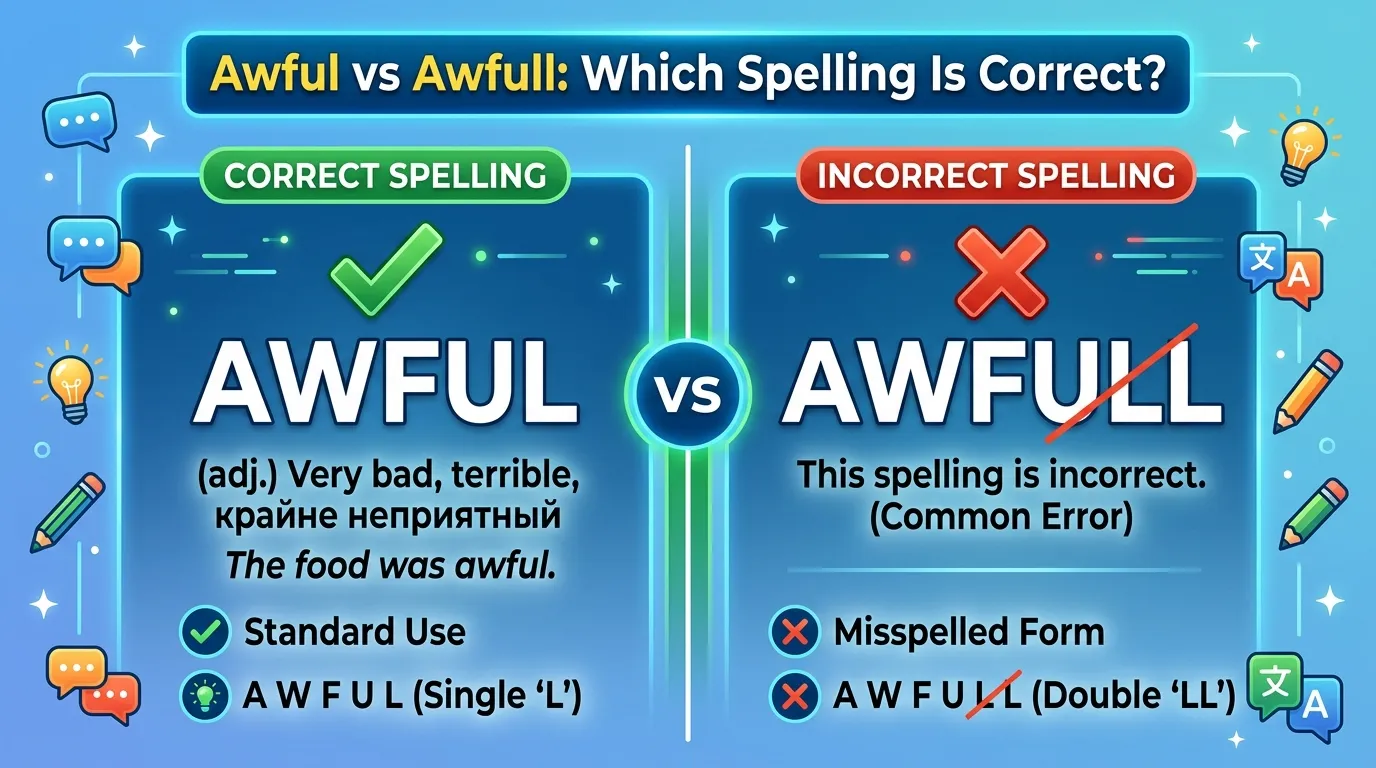
The planetarium dome goes dark, and a comet appears overhead — a smear of light with a tail like torn silk, sliding across a field of stars. The audience gasps. A child in the third row whispers, “Awesome.” The narrator, who has given this show a hundred times, smiles in the dark, because the child has just used a word with a secret twin. The twin is awful. Once, the two words meant nearly the same thing. Today they mean opposites. And the spelling of awful carries the whole history: it is awful, with one L, not awfull with two. The second L is an intruder, and the reason it sneaks in is a rule about what happens to full when it stops being a word and becomes a suffix.
Awful is a word with a double life. It describes something terrible — “an awful mistake,” “awful weather,” “an awful smell.” And it carries, buried in its spelling, the memory of a time when it described something magnificent. The spelling is the fossil. The single L is the proof.
The Night the Dome Went Dark
Start with the show, because the show is the word’s original meaning. The narrator’s script uses awe a dozen times: “awe-inspiring,” “awesome,” “awestruck.” The audience is meant to feel awe — the feeling of being small before something vast. A comet, a canyon, a cathedral, a newborn child: all of them inspire awe, and all of them are, in the old sense, awful.
Awe is the root. It names the feeling: wonder mixed with fear, reverence mixed with dread. A person who stands at the edge of the Grand Canyon feels awe. A person who watches a thunderstorm roll across the plains feels awe. A person who holds a newborn feels awe. The feeling is big, and it has two edges — the beautiful edge and the terrible edge — and English has two words for the two edges. Awesome took the beautiful edge. Awful took the terrible edge. Both words are awe + -ful, “full of awe.” The split is in the feeling, not the spelling.
The modern senses are clear. Awful means very bad, unpleasant, or terrible: “an awful headache,” “awful news,” “the food was awful.” It is one of the strongest negative adjectives in everyday English, stronger than bad, softer than horrific. It is also an intensifier in casual speech: “awfully good,” “awfully nice” — where awfully means “very,” and the negative sense has drained out entirely. “She is awfully kind” is a compliment. The word has traveled far from the comet.
There is also the older sense, still alive in literature and in phrases like “an awful majesty” or “the awful power of the sea.” In these phrases, awful means what it meant in the 1600s: inspiring awe, overwhelming, commanding reverence. A reader who meets awful in Shakespeare or in the King James Bible is meeting the old word, the one that had not yet split from awesome. The modern reader has to read with the old meaning in mind, or the sentence makes no sense.
Full Becomes -ful
Here is the fact that fixes the spelling. Awful is built from two parts: awe + -ful. The suffix -ful means “full of,” and it comes from the word full — but when full becomes a suffix, it loses one of its L’s. This is one of the most consistent rules in English spelling: the standalone word is full, with two L’s, but the suffix is -ful, with one L. Care + full = careful, not carefull. Hope + full = hopeful, not hopefull. Wonder + full = wonderful, not wonderfull. Awe + full = awful, not awfull.
The rule holds across the whole family. Beautiful, grateful, faithful, useful, powerful, successful, thoughtful, peaceful — every one of them ends in a single L. There is no English adjective ending in -full with two L’s. The double L belongs to the standalone word full and to a handful of compounds where full keeps its independence, like full-length or full-time. The moment full becomes a suffix, it sheds a letter.
Why? Because English suffixes are economical. When a word is glued onto another word, it compresses. The -ful suffix lost its second L centuries ago, and the loss stuck. The misspelling awfull undoes the compression: it writes the suffix as if it were still a standalone word. The instinct is understandable — the writer is thinking of full — but the spelling of the suffix is -ful, and it has been for a very long time.
There is a useful contrast with the opposite suffix, -less, which keeps both of its consonants: careless, hopeless, useless. And with -ness, which keeps its double S: kindness, darkness. Each suffix has its own shape, and the shape of -ful is one L. The family is unanimous.
When Awe Split in Two
The history of awful is the history of a word that changed its feelings. In the 1300s, awful meant “worthy of awe” — deserving reverence. A king’s awful majesty was a compliment. A cathedral’s awful beauty was praise. The word described things that were grand, overwhelming, and a little frightening, all at once, because awe itself contains both wonder and fear.
Over the centuries, the two edges of awe drifted apart. Awesome, which once also meant “inspiring awe,” drifted toward the positive: magnificent, impressive, wonderful. In the 1980s, it drifted further, into slang: “awesome” as a general word for “great.” Awful drifted toward the negative: terrible, dreadful, very bad. By the 1800s, the split was complete. The two words, born as twins, had become opposites.
The split left fossils. Awfully, the adverb, kept a foot in both worlds: “awfully good” means “very good,” and “awfully bad” means “very bad.” The adverb became a pure intensifier, a volume knob, and the volume knob works in both directions. Awful the adjective kept the negative meaning in everyday speech, but the old meaning survives in fixed phrases: “the awful majesty of the law,” “an awful silence” — a silence so complete it inspires awe, not just discomfort.
There is also the cousin awe-inspiring, which stayed neutral: a thing that inspires awe, whether beautiful or terrible. And awestruck, which names the state of being struck by awe. The family is a small map of the feeling: awe the noun, awesome the positive adjective, awful the negative adjective, awestruck the state. Four words, one root, and the single-L suffix in all of them.
Awful in the Wild
The word does different work in different rooms. In conversation, awful is the everyday word for “very bad”: “I feel awful.” “The traffic was awful.” “That’s awful news.” It is stronger than bad and more natural than terrible in casual speech. It is also the word people reach for when they want sympathy: “I feel awful” asks for more care than “I feel bad.”
In writing, awful carries more weight. A journalist who writes “an awful disaster” is saying something stronger than “a bad disaster.” A novelist who writes “an awful silence” is describing a silence with presence, a silence that fills a room. The word’s history — the awe inside it — gives it a gravity that bad does not have. Bad is a judgment. Awful is a feeling.
The word also appears in fixed phrases worth knowing. Awful lot — a large amount: “an awful lot of work.” Awfully sorry — very sorry. God-awful — extremely bad, informal and emphatic. Awfulize — a rare verb, used in psychology, meaning to exaggerate the badness of something. In every phrase, the spelling holds: one L, no exceptions.
One caution: awful is a strong word, and overusing it drains it. A writer who calls every inconvenience “awful” ends up sounding dramatic about nothing. The word is at its best when the badness is real — the headache, the news, the weather, the silence. Save it for the comet’s dark side, not the cloudy afternoon.
The Planetarium Test
Back in the dome, the narrator has a test. She points at the comet and asks the audience: is it awesome or awful? The audience laughs, because the answer is both. The comet is awesome — magnificent, wonder-inspiring. The comet is awful — terrible, overwhelming, a little frightening. The two words are the comet’s two edges, and the spelling is the same in both: awe + -ful, one L.
The memory hook is the family. Care → careful. Hope → hopeful. Wonder → wonderful. Awe → awful. Four base words, one suffix, and the suffix has one L in all four. If you can spell careful — and almost everyone can — you can spell awful, because it follows the same rule.
And one final check for the keyboard: when the word appears in your draft, look at the end. If you see -ll, the second L is an intruder. Delete it. Awful. One L, full of awe, and the show goes on.