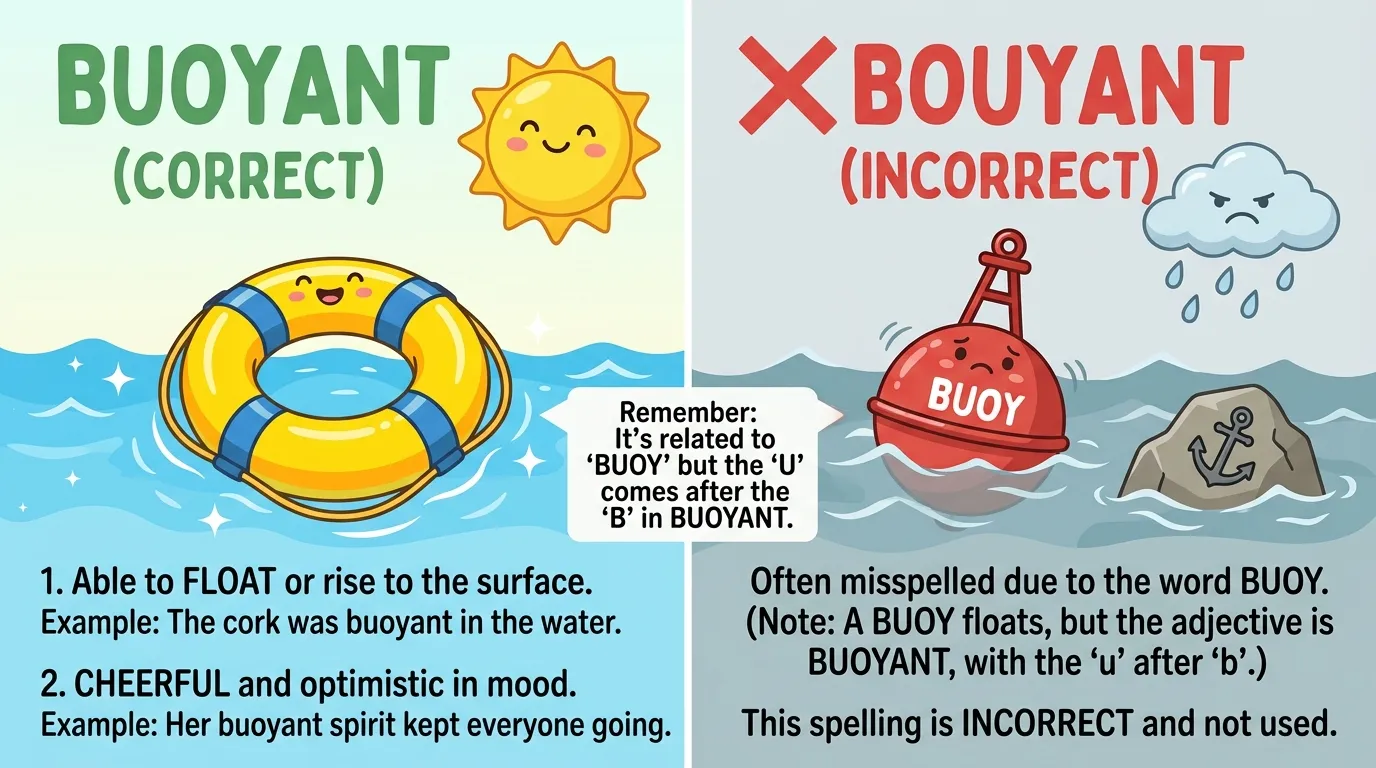
The balloon field wakes up before dawn. Fifty envelopes lie flat on the grass like sleeping whales, and fifty crews work in the cold, filling them with hot air. Then, one by one, the balloons stand up, lift, and rise — slowly, gracefully, impossibly — into a sky the color of bruised peach. A child on the fence watches the first balloon leave the ground and says the word without knowing she is using it: “It’s so buoyant.” She is right. The correct spelling is buoyant. The misspelling is bouyant, with the U and O swapped. The swap is the whole error, and the reason it happens is that the word’s spelling is a small puzzle left behind by the Dutch sailors who invented it.
Buoyant is a word with three lives: one in physics, one in economics, and one in mood. In all three, it means the same thing — rising, floating, refusing to sink. And in all three, the spelling is the same: b-u-o-y-a-n-t.
The Dawn Launch
Start with the field, because the field shows the word’s first meaning. A hot-air balloon is buoyant because the air inside its envelope is hotter — and therefore lighter — than the air outside. The balloon rises because it is less dense than the air it displaces. This is buoyancy, the same force that holds a boat on water and a beach ball on the surface of a pool. The balloon, the boat, and the beach ball are all buoyant: they float because the fluid around them pushes them up.
The physics has a name and a story. Archimedes, the Greek mathematician, discovered the principle in the third century BCE — the famous story says he noticed it in his bath, when the water rose as he stepped in, and ran naked through Syracuse shouting “Eureka!” The principle: a body immersed in a fluid is buoyed up by a force equal to the weight of the fluid it displaces. A balloon displaces a volume of cool air. If the balloon and its load weigh less than that volume of air, it rises. If they weigh more, it sinks. The line between rising and sinking is the line the balloon crews walk every morning.
The word also describes the feeling of buoyancy in water. A swimmer who floats easily is buoyant. A life jacket makes a person buoyant. Salt water is more buoyant than fresh water — which is why floating in the Dead Sea is famously effortless, and why the same swimmer who sinks in a lake floats in the ocean. The word describes a property of the fluid and a property of the floater, both at once.
And there is the technical sense, used by engineers and sailors: buoyant force, buoyancy, buoyant as an adjective for anything that floats or rises. “The hull’s buoyancy keeps it afloat.” “The balloon’s buoyant lift is 500 pounds.” The vocabulary is precise, and the spelling matters in it, because a technical document with a misspelling loses credibility faster than a text message does.
The Sailor’s Puzzle
Here is the fact that fixes the spelling. Buoyant comes from the noun buoy, the floating marker that sailors anchor in harbors to mark channels, hazards, and safe water. Buoy came into English from Dutch boei, or from Middle Dutch boye, and it kept a spelling that looks strange to English eyes: b-u-o-y. The U comes before the O. The Y at the end is doing the work of a vowel.
The adjective buoyant is built by adding -ant to buoy: buoy + ant = buoyant. The base word keeps its spelling whole. The U stays before the O. The Y stays at the end of the base. The suffix attaches cleanly. There is no rearrangement, no dropped letter, no surprise. The spelling of the adjective is the spelling of the noun, plus -ant.
So why does the hand write bouyant? Because of the ear and the eye, working together against the writer. Say the word aloud: BOY-ant. The first syllable sounds like boy or bouy — the ear hears “bou” and the hand writes bou-, with the O before the U, because ou is one of the most common vowel pairs in English: about, house, sound, found. The hand reaches for the familiar pattern and swaps the letters. The guess is reasonable. It is also wrong, because buoy is not an ou word. It is a uo word, and the uo is the whole puzzle.
There is also the pronunciation trap. In American English, buoy is pronounced “BOY” — the U is silent, and the O and Y do the work. A writer who hears “BOY-ant” can easily spell it boyant or bouyant, because the spelling does not match the sound. The U is a silent letter, and silent letters are the first things the ear forgets. But the U is there, and it comes first: b-u-o-y.
Three Lives of Buoyant
The word’s second life is in economics, and it is the life most readers meet first. A buoyant market is a market that is rising, active, and confident. A buoyant economy is one that is growing. Buoyant sales are sales that are strong and rising. The metaphor is the balloon: the market is floating, rising, refusing to sink, the way a balloon rises into the dawn sky. The word carries optimism. A journalist who writes “buoyant housing market” is saying the market is healthy, and the health is visible in the numbers.
The economics sense has a technical cousin: buoyancy in tax policy. A tax system has buoyancy if tax revenues rise automatically as the economy grows, without any change in tax rates. The word is borrowed from physics, and the borrowing is exact: the revenues float up with the economy, the way a boat floats up with the tide. The metaphor has traveled from the harbor to the treasury, and it still carries the harbor with it.
The word’s third life is in mood. A buoyant spirit is a cheerful, optimistic, resilient spirit — a person who bounces back from setbacks the way a balloon bounces back from a gust. “She remained buoyant despite the bad news.” “His buoyant mood lifted the whole team.” In this sense, the word describes emotional resilience: the ability to float when the water is rough. The metaphor is the same in all three lives: rising, floating, refusing to sink.
The three lives share a family. Buoy the noun — the floating marker. Buoy the verb — to keep afloat, to lift, to encourage: “buoyed by good news,” “buoyed up by the crowd’s applause.” Buoyant the adjective — having the quality of floating. Buoyancy the noun — the quality itself. Four words, one root, and the root is spelled b-u-o-y in all four. The U comes first in the whole family.
Buoyant vs Floating, Optimistic, Resilient
Buoyant has close neighbors, and keeping them distinct sharpens a sentence. Floating describes the state of being held up by a fluid — a boat floating, a balloon floating. Buoyant describes the tendency or ability to float — a buoyant boat, a buoyant balloon. The difference is the difference between a fact and a property: the boat is floating now, and it is buoyant always.
Optimistic describes a mental attitude — expecting good outcomes. Buoyant, in its mood sense, describes something more specific: the ability to recover, to bounce back, to rise after being pushed down. An optimistic person expects good news. A buoyant person survives bad news. The words overlap, but they are not the same, and choosing between them is a matter of precision.
Resilient is the closest synonym in the mood sense: able to recover from setbacks. Buoyant adds a specific image to resilience — the image of floating, of rising, of refusing to sink. A resilient person bends and returns. A buoyant person floats and rises. The image is the difference, and the image is why writers choose buoyant when they want the reader to feel the lift.
There is also the opposite: sinking, heavy, leaden. “A sinking market.” “A leaden mood.” “A heavy heart.” The opposites name the failure that buoyancy prevents: the balloon that does not rise, the boat that takes on water, the spirit that goes under.
The Balloon Test
Back on the field, the last balloon is rising, and the child on the fence has a test. She looks at the word the way she looks at the balloon: from the ground up. Buoy + ant. The base word is whole. The U comes first. The spelling is buoyant.
The memory hook is the base word. If you can spell buoy — b-u-o-y, U before O — you can spell buoyant, because the adjective is the noun plus -ant. And if buoy gives you trouble, remember the harbor: the buoy is the floating marker, and the U floats before the O, the way the buoy floats on the water. The letter order is the picture.
And one final check for the keyboard: when the word appears in your draft, look at the first three letters. If you see bou-, the O and U are swapped. Swap them back. Buo-. U first, O second, and the balloon rises.