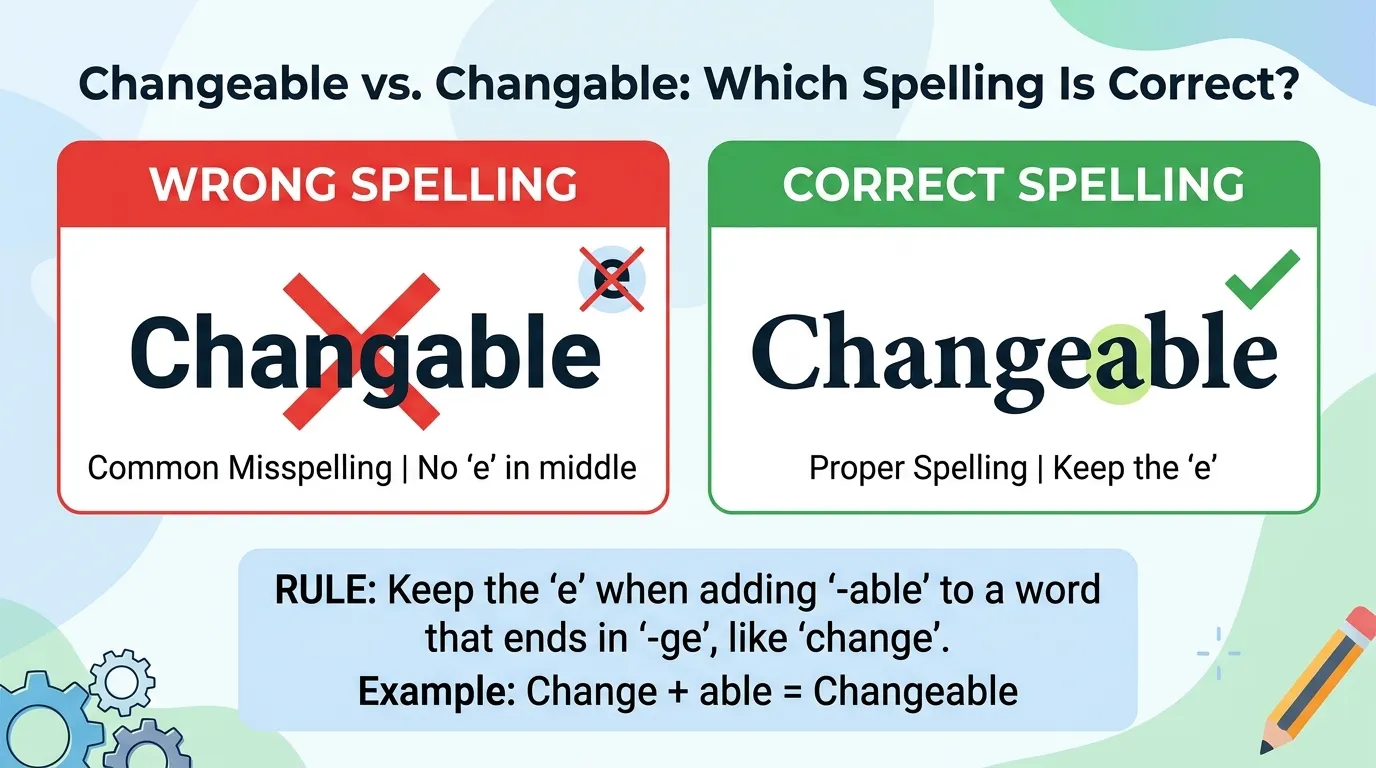
The couple sat across from the mortgage broker with a folder of payslips, a budget spreadsheet, and one question that mattered more than all the others: “Is the rate fixed or changeable?” The broker slid a comparison sheet across the desk. On one side, a fixed-rate mortgage: the same payment every month for five years, no surprises. On the other, a variable-rate mortgage: payments that could rise or fall with the market. The broker’s sheet spelled the word correctly: changeable. The couple’s notes, written in a hurry, spelled it changable — the E dropped, the way the E is dropped in so many English words. The correct spelling is changeable — with the E kept, because the E is doing a job. Changable is a misspelling. The error is a single dropped letter, and the mortgage document is exactly the kind of place where it cannot survive.
Changeable is an adjective that means capable of changing, or likely to change. It appears in finance, in weather, in personality, in plans, and in every document where something might not stay the same. It is also a word whose spelling breaks the rule that most writers expect it to follow — and the break is deliberate.
The Broker’s Desk
Start with the broker’s desk, because the desk is where the word’s financial meaning lives. A fixed-rate mortgage has a rate that does not change for the agreed period. A changeable-rate mortgage — more commonly called a variable-rate or adjustable-rate mortgage — has a rate that moves with a benchmark, usually a central bank rate. When the benchmark rises, the payment rises. When it falls, the payment falls. The borrower trades certainty for the chance of a lower rate, and the trade is described in one word: changeable.
The word appears throughout the mortgage documents. The interest rate is changeable. The monthly payment is changeable. The terms are changeable after the fixed period ends. The documents also contain a warning, in small print, that the borrower must read: “Your payments may go up as well as down.” The warning is the meaning of changeable, spelled out in plain language.
The broker’s job is to explain the trade-off. A fixed rate is predictable. A changeable rate is a bet on the market. The couple must decide which risk they prefer: the risk of paying more than they need to, or the risk of paying more than they can afford. The decision is financial. The word that names it is grammatical, and the grammar is the spelling.
There is also a second financial use worth knowing. In economics, changeable describes anything whose value or state is not fixed: changeable prices, changeable demand, changeable regulations. The word is the adjective of uncertainty, and finance is the industry of uncertainty. The two belong together.
The Dropped E That Isn’t Dropped
Here is why the misspelling happens. English has a well-known rule: when a word ends in a silent E and you add a suffix beginning with a vowel, the E drops. Make + -ing = making. Love + -able = lovable. Admire + -able = admirable. Value + -able = valuable. A writer who has learned this rule — and it is one of the most useful rules in English spelling — will apply it to change + -able and produce changable. The logic is flawless. The spelling is wrong.
The reason is a second rule, less famous but equally real: when a word ends in -ge or -ce, the E is kept before a suffix beginning with a or o, in order to preserve the soft sound of the G or C. Change ends in -ge, pronounced with a soft G — the j sound. If the E were dropped, the G would sit directly before the A of -able, and in English spelling, a G before an A is usually pronounced hard — the g in gap, game, garden. The word would look as though it should be pronounced CHAN-guh-bul, with a hard G. The E stays to keep the G soft.
The pattern is consistent across the -ge family. Manage + -able = manageable, not managable. Knowledge + -able = knowledgeable, not knowledgable. Charge + -able = chargeable, not chargable. Marriage + -able = marriageable. In every case, the E is kept, and the keeping is the rule, not the exception.
The -ce family follows the same rule. Notice + -able = noticeable, not noticable. Peace + -able = peaceable. Service + -able = serviceable. The E is kept to keep the C soft — the s sound — before the A. The rule is the same on both sides: the E is a guard, and it stays at its post.
Change + able: The Guard at the Gate
Think of the E as a guard. Its job is to stand between the G and the A and keep the G soft. Without the guard, the G hardens. With the guard, the G stays soft. The guard is silent — it makes no sound itself — but its presence changes the sound of the letter next to it. That is the whole function of the silent E in this family of words.
The guard is needed only before A and O. Before E, I, and U, the G is already soft by the standard rule — G before E, I, or Y is soft, as in gem, giant, gym — so the E can safely drop. That is why change + -ing = changing, with the E dropped: the I of -ing keeps the G soft on its own. And change + -ed = changed, with the E dropped: the E of -ed does the guarding. The E is kept only when the suffix begins with a letter that would harden the G — A or O.
The same logic governs the -ce family. Notice + -ing = noticing, E dropped, because the I keeps the C soft. Notice + -able = noticeable, E kept, because the A would harden the C. The rule is mechanical, and once it is understood, it predicts the spelling of every word in the family.
There is a useful contrast with a word that looks similar and behaves differently: blame + -able = blamable, E dropped. Blame ends in -me, not -ge or -ce, so there is no soft consonant to protect, and the E drops by the general rule. The difference between blamable and changeable is the difference between a consonant that needs a guard and one that does not. The G needs the guard. The M does not.
Changeable in the World
Beyond the broker’s desk, changeable does work in every register, and its uses are worth collecting.
In weather, changeable is the forecaster’s word for skies that will not settle: “Changeable weather this week, with sunshine and showers.” The phrase is the language of the forecast that cannot commit, because the atmosphere will not commit either. Changeable weather is the weather of spring and autumn, the seasons of transition.
In personality, changeable describes a mood or temperament that shifts quickly: “a changeable disposition,” “changeable moods.” The word is gentler than unstable and more neutral than moody. It says that the person changes, without saying that the changing is a flaw.
In plans, changeable describes arrangements that may be revised: “changeable plans,” “a changeable schedule.” The word is the language of the provisional — the plan that exists but might not survive the week.
In fashion, changeable describes trends that move fast: “changeable fashions,” “the changeable tastes of the market.” The fashion industry is built on changeability, and the word is its quiet engine.
In law, changeable describes terms that may be amended: “changeable terms,” “a changeable agreement.” The legal use is precise: a changeable term is one that the parties may alter by mutual consent. The word appears in contracts, and the contracts are where the spelling matters most, because a contract is a document that must mean exactly what it says.
There is also a noun form: changeability — the quality of being changeable. “The changeability of the weather.” “The changeability of the market.” The noun keeps the E, because the E belongs to the root, and the root belongs to change.
Changeable, Changing, Variable: Three Words for Motion
Changeable has close neighbours, and keeping them distinct sharpens a sentence.
Changing is the present participle of change. It describes something in the act of changing: “a changing climate,” “changing attitudes.” The word names a process in progress. A changing thing is already moving.
Variable is the scientific and mathematical neighbour. A variable is a quantity that can take different values: “a variable rate,” “a variable star,” “a variable in the equation.” The word is more technical than changeable, and it carries a sense of measurement. A variable rate is measured. A changeable rate is described.
Changeable sits between them: it describes the capacity or likelihood of changing, not the act and not the measurement. A changeable rate may change. A changing rate is changing. A variable rate is defined by its variation. The three words overlap, but they are not identical, and the sentence improves when the word matches the meaning.
There is also the negative: unchangeable — incapable of changing, fixed, permanent. “An unchangeable fact.” “An unchangeable decision.” The negative keeps the E, because the E belongs to the root, and the prefix un- does not touch it. The family is consistent: change, changeable, unchangeable, changeability — all of them keep the E before A and O, and all of them drop it before E, I, and U.
The Lock-In
The memory hook is the guard. The E in changeable is a guard standing between the G and the A, keeping the G soft. Without the guard, the G hardens into the g of gap. With the guard, the G stays soft, the j of change. Think of the E as a bodyguard for the G, and the spelling becomes obvious: you would not send a bodyguard home in the middle of the job.
There is a second hook, and it is the family. Manageable, knowledgeable, chargeable, noticeable, peaceable — all of them keep the E before -able, all for the same reason. If you can spell manageable — and almost everyone can, because it is one of the commonest words in business English — you can spell changeable, because the rule is the same. The E stays. The G stays soft. The word stays correct.
And one final check for the keyboard: when the word appears in your draft, look at the letters before -able. If you see -geable, with the E, the guard is at its post and the spelling is right. If you see -gable, with no E, the guard has left, the G has hardened, and the word is wrong. The broker’s comparison sheet will read correctly. The mortgage documents will read correctly. The couple will know whether their rate is fixed or changeable — and the word will say so, spelled the way it has been spelled for centuries.