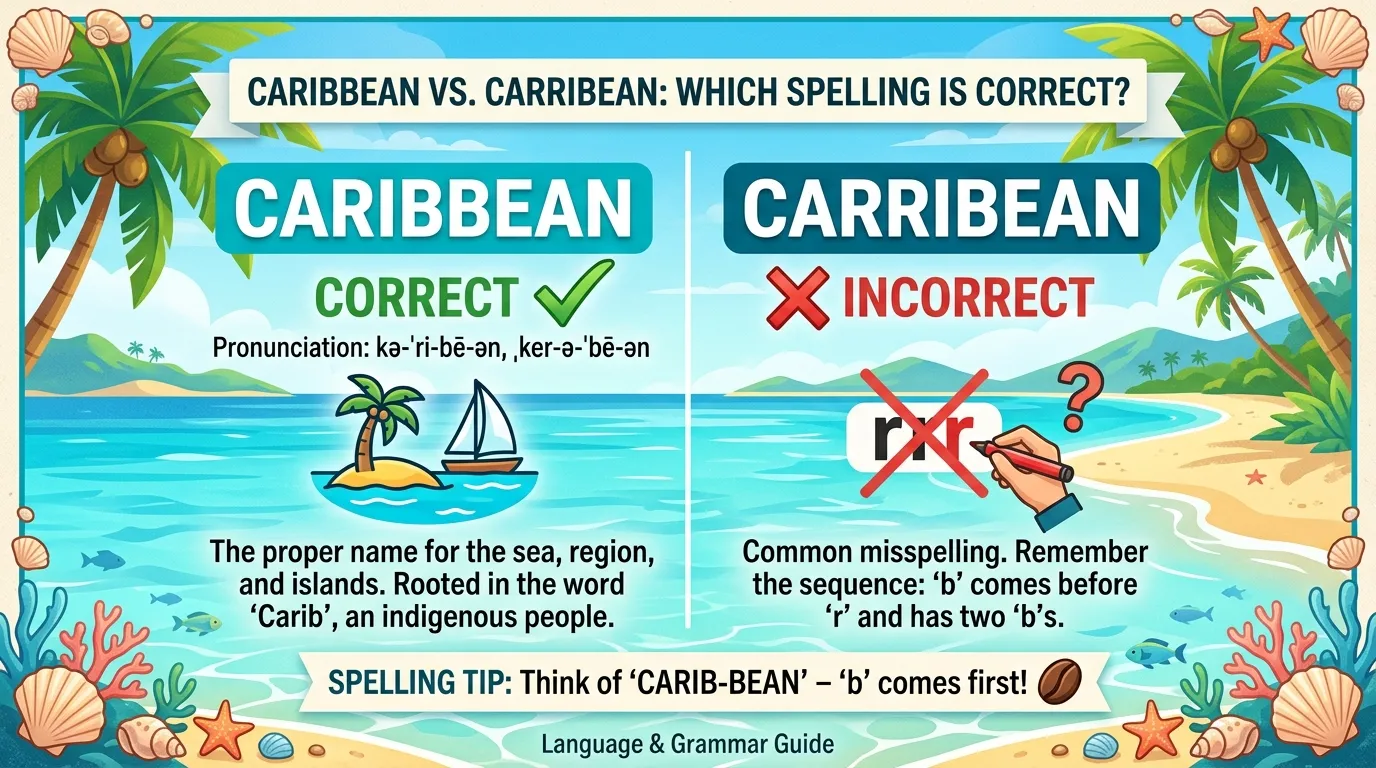
The cruise ship left Miami at dusk, and by morning it was anchored off a green island with white sand and a town of pastel houses climbing the hill behind the port. The passengers gathered on deck with their phones, typing the same message home: “We made it to the Carribean!” The message was warm. The spelling was not. The correct spelling is Caribbean — C-a-r-i-b-b-e-a-n — with one R and two B’s. Carribean, with two R’s and one B, is a misspelling. The error is a doubled letter in the wrong place, and the cruise brochure is exactly the kind of document where it cannot survive.
Caribbean is the name of a sea, a region, a culture, and a way of life, and it is misspelled more often than almost any other place name in English. The reason is a combination of pronunciation, expectation, and the way the human ear hears double consonants. The sea itself does not care. The dictionary does.
The Itinerary
Start with the itinerary, because the itinerary shows what the word covers. The Caribbean is a region of the Americas consisting of the Caribbean Sea, its islands, and the surrounding coasts. It includes more than seven thousand islands, islets, reefs, and cays, stretching in an arc from the Florida Straits in the north to the coast of Venezuela in the south. The islands include the Greater Antilles — Cuba, Jamaica, Hispaniola, Puerto Rico — and the Lesser Antilles — a chain of smaller islands from the Virgin Islands to Trinidad and Tobago — plus the Bahamas and the Turks and Caicos.
The word works as both a noun and an adjective. As a noun: “They spent two weeks exploring the Caribbean.” “The Caribbean is known for its beaches.” As an adjective: “Caribbean food,” “Caribbean music,” “Caribbean history,” “Caribbean culture,” “Caribbean islands.” The adjective is the more common job, because the word most often modifies something else — the food, the music, the weather, the cruise.
The region is also a cultural idea, not just a geographic one. Caribbean culture includes the music of reggae, calypso, soca, salsa, and reggaeton; the food of jerk chicken, rice and peas, conch fritters, and plantain; the festivals of carnival, Junkanoo, and Crop Over; and the history of Indigenous peoples, European colonisation, African diaspora, and Asian migration. The word carries all of that, and the spelling carries the word.
There is a naming note worth knowing. The Caribbean is sometimes called the West Indies, a name given by Christopher Columbus, who believed he had reached the Indies when he landed in the Bahamas. The name stuck, even though the geography was wrong. The West Indies and the Caribbean are the same region, and the two names are used interchangeably in history and in cricket — the West Indies cricket team represents the Caribbean. The spelling of Caribbean is the same in both contexts.
Why the Ear Doubles the R
Say Caribbean aloud. Most English speakers pronounce it one of two ways: kuh-RIB-ee-un, with the stress on the second syllable, or KAR-uh-BEE-un, with the stress on the first. In both pronunciations, the R sound is prominent — a rolled, buzzing consonant that the ear notices. The B sound, by contrast, is soft, a quick lip-pop that the ear rushes past.
The ear, hearing a strong R and a weak B, makes a reasonable guess: the strong sound must be the doubled one. The hand writes Carribean — two R’s, one B — and the guess feels right because the sound genuinely emphasises the R. The error is a piece of phonetic logic, and it is wrong, because the spelling does not follow the sound’s emphasis. It follows the word’s history.
There is a second force: the pattern of other place names. English has many place names with double R: Morocco, Barbados (no), Peru (no) — but the mind generalises from words like ferry, harry, marry, in which a strong R is doubled. A writer who has absorbed that pattern will double the R in Caribbean without thinking. The instinct is reasonable. It is also wrong here, because the doubled letter in Caribbean is the B, not the R.
There is a third force: speed. Caribbean is a word that appears in fast writing — travel posts, holiday messages, booking confirmations, cruise reviews typed on a phone on deck. The hand is moving fast, the word is long, and the double consonant is the first casualty. Hurry errors love double letters, because double letters are the easiest to put in the wrong place.
Carib + -ean: The People Who Named the Sea
Here is the fact that fixes the spelling for good. Caribbean is built from two parts: Carib, the name of the Indigenous people who lived in the region when Europeans arrived, and -ean, a suffix meaning “of or relating to,” the same suffix that appears in European, Mediterranean, and Chilean. The Caribbean is, literally, the sea of the Carib people.
The Carib people — who called themselves Kalinago — lived in the Lesser Antilles and parts of South America. European colonisers took their name and applied it to the whole sea and region. The name is a colonial label, and it is worth knowing that the people it names did not choose it. The Kalinago still live in the region, notably on the island of Dominica, where the Kalinago Territory preserves their community and culture. The word’s history is the history of the region: Indigenous, colonial, and still contested.
The etymology explains the doubling completely. The root is Carib — C-A-R-I-B — with one R and one B. The suffix is -ean, meaning “of or relating to.” When the suffix attaches to a root ending in a single consonant after a single vowel, the final consonant doubles: Carib + -ean = Caribbean, with the B doubled to keep the syllable boundary clear. The R stays single, because the root has a single R. The B doubles, because it is the root’s final consonant.
The pattern is the standard English doubling rule, the same rule that turns run into running and stop into stopped. The root’s final consonant doubles before a vowel suffix. Carib + -ean follows the rule exactly. The misspelling Carribean breaks the rule by doubling the wrong consonant — the R in the middle of the root, which has no reason to double.
The Sea, the Islands, and the Weather
The Caribbean Sea is the body of water at the heart of the region, and it is worth knowing because it explains why the region matters. The sea is the second-largest sea in the world, covering about 2.75 million square kilometres, bounded by the Greater and Lesser Antilles to the north and east, Central America to the west, and South America to the south. It connects to the Gulf of Mexico through the Yucatán Channel and to the Atlantic through the passages between the islands.
The sea is warm — between 24 and 29 degrees Celsius for most of the year — and the warmth drives the region’s climate, its hurricanes, and its marine life. The Caribbean is home to coral reefs, sea turtles, mangrove forests, and some of the most biodiverse waters on Earth. The reefs are also among the most threatened, by warming seas, pollution, and coastal development. The word Caribbean carries the sea, and the sea carries an ecosystem under pressure.
The islands are not one place. Jamaica is not Barbados. Cuba is not Trinidad. Haiti is not Aruba. Each island has its own history, language, music, food, and politics. English, Spanish, French, Dutch, and several Creole languages are spoken across the region. The word Caribbean covers them all, and it covers them as a region, not as a single culture. A writer who treats the Caribbean as one place will get the spelling right and the meaning wrong. The region is a collection of distinct islands, and the word is the collection’s name.
The weather is the region’s most famous export after its music. The Caribbean has a tropical climate, with a wet season and a dry season, and a hurricane season that runs from June to November. The hurricanes are named, tracked, and feared. The word hurricane itself comes from the Taíno word hurakán, the name of a storm god — another Indigenous word that English borrowed and kept. The Caribbean’s vocabulary is full of such borrowings, and the borrowings are the region’s linguistic fingerprint.
Caribbean in Culture
The word’s cultural life is worth surveying, because it shows how a place name becomes a global brand.
In music, the Caribbean gave the world reggae, born in Jamaica in the 1960s, carried by Bob Marley to global fame. It gave calypso, born in Trinidad and Tobago, carried by Harry Belafonte. It gave soca, salsa, dancehall, reggaeton, and zouk. The music is the region’s loudest export, and it is inseparable from the word. To say “Caribbean music” is to name a family of sounds that the world recognises instantly.
In food, the Caribbean gave the world jerk seasoning, rice and peas, roti, conch, plantain, callaloo, and rum. Caribbean cuisine is a fusion of African, Indigenous, European, and Asian traditions, shaped by the crops that grow in tropical soil and the peoples who were brought to the region by force and by choice. The food is the history, cooked.
In sport, the Caribbean gave the world the West Indies cricket team, which dominated world cricket in the 1970s and 1980s, and a lineage of sprinters — Usain Bolt, Shelly-Ann Fraser-Pryce, Elaine Thompson-Herah — who have made Jamaica synonymous with speed. The sport is the region’s pride, and the word Caribbean appears in every commentary.
In tourism, the Caribbean is one of the world’s most visited regions, and the word is a brand. “Caribbean cruise,” “Caribbean resort,” “Caribbean beach” — the phrases sell holidays, and the spelling sells them correctly or not. A travel brochure that writes Carribean will be noticed, and not kindly. The place name is the product, and the product’s name must be spelled right.
The Lock-In
The memory hook is the root. Caribbean is Carib + -ean. The root has one R and one B. The suffix doubles the B. The R stays single. Think of the Carib people — one R, one B — and then double the B when the suffix arrives. The doubling is the rule, and the rule picks the B.
There is a second hook, and it is built for the eye. The word Caribbean contains a double B in the middle: -bb-. The double B is the word’s visual signature, the pair of letters that no other common place name has in that position. When the word appears in your draft, look for the double B. If you see -bb-, the spelling is right. If you see -rr-, the R has been doubled by mistake, and the word is wrong.
And one final check for the keyboard: when the word appears in your draft, count the R’s and the B’s. One R, two B’s. Caribbean. The cruise ship is anchored off the island. The passengers are typing their messages home. The sea is the Caribbean, spelled with one R and two B’s, and the brochure, the message, and the postcard will all read correctly.










