The pot was large, the table was quiet, and the player in seat four had been staring at his cards for a long time. He had nothing — a seven and a two, the worst starting hand in poker. He pushed a tall stack of chips into the middle anyway, leaned back, and looked bored. The player across from him folded. Then the next one folded. Then the last one, holding a pair of kings, hesitated, studied the bored face, and folded too. Seat four turned over the seven-two and grinned. He had deceived the whole table. Later, telling the story in a message, a friend typed decieve — the I and the E swapped, the way they swap in a hundred English words. The correct spelling is deceive — d-e-c-e-i-v-e — with E before I after the C. Decieve is a misspelling. The error is a two-letter swap, and the poker story is exactly the kind of story where it appears.
Deceive is the verb for deliberately making someone believe something that is not true. It is the verb of the bluff, the con, the misleading advertisement, the false alibi. It is also a word whose spelling is governed by the most famous spelling rhyme in English — a rhyme that is right about this word and wrong about many others.
The Bluff
Start with the poker table, because the poker table is where deception is a skill. In poker, to deceive is to mislead an opponent about the strength of your hand. The bluff is the purest form: a weak hand played as though it were strong, a calm face laid over a racing heart, a large bet that says “I have the cards” when the cards say otherwise. The deception is not cheating. It is the game. Every player at the table knows that deception is part of poker, and every player is trying to detect it.
The word’s range is wider than the card table. To deceive is to cause someone to accept a false idea or belief, usually by lying, hiding information, or creating a misleading impression. “The salesman tried to deceive the customer.” “She realised he had deceived her.” “The advertisement was designed to deceive buyers.” “Do not deceive yourself about the risks.” The verb covers everything from a small misleading statement to serious dishonesty, and the scale is the same in every case: someone believes something false, and someone else arranged it.
There is a grammar point worth knowing. Deceive is a transitive verb: it takes an object. You deceive someone. “He deceived his friends.” “The company deceived its investors.” The reflexive form is common and psychologically sharp: “Do not deceive yourself.” To deceive yourself is to arrange your own false belief — to hide a truth from the one person who should know it. The phrase is the language of self-knowledge, and it appears in philosophy, in therapy, and in the quiet moments when a person admits they have been lying to themselves.
The word also has a passive life. “She was deceived by the advertisement.” “The investors were deceived.” The passive is the language of the victim’s account, the courtroom, the complaint. The active is the language of the deceiver’s confession. The two voices tell the same story from opposite sides of the table.
The Swap: Why Fingers Write Decieve
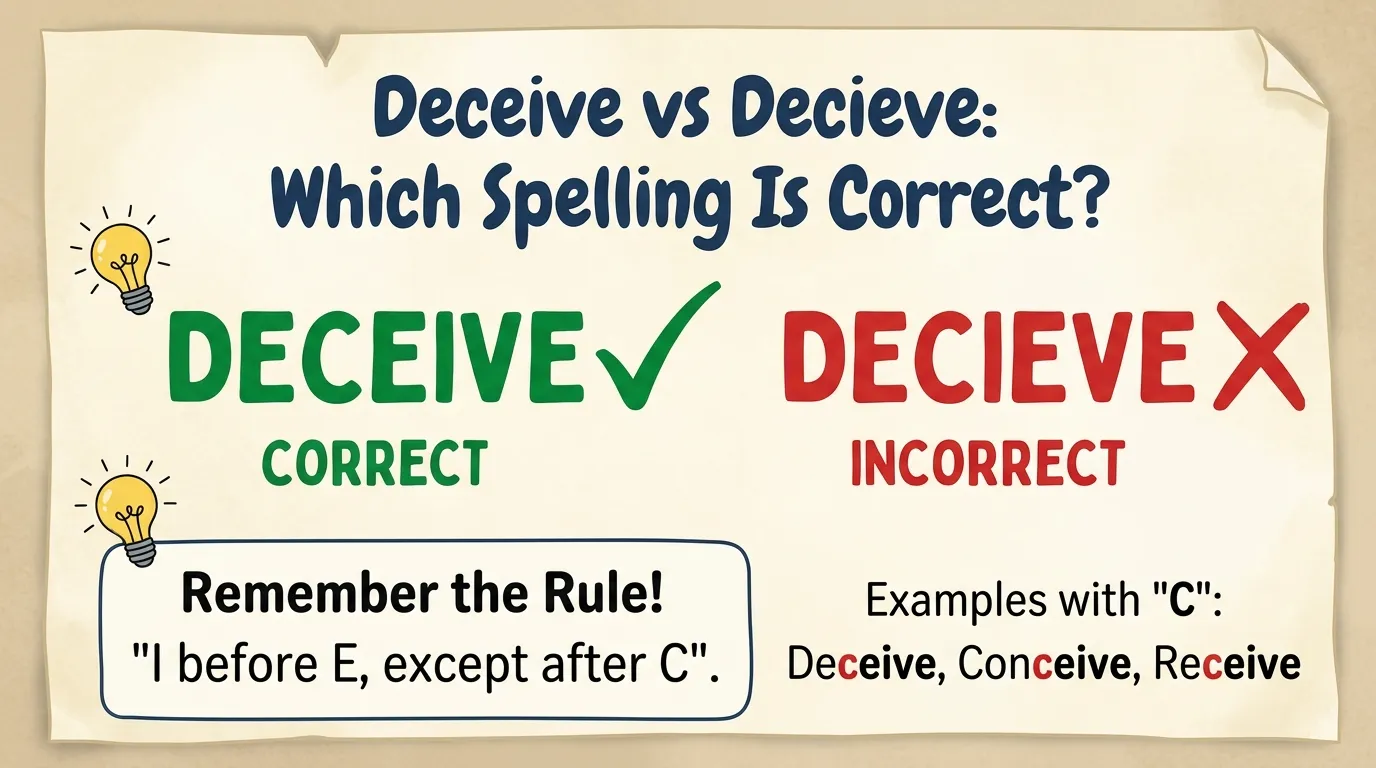
Decieve is a transposition error: the I and the E have swapped places. The correct order is E-I. The wrong order is I-E. The swap is one of the most common spelling errors in English, and it loves words in which I and E sit side by side, because the two letters are visually similar, phonetically identical in these words — both pronounced as a long ee — and governed by a rule that most people half-remember.
The half-remembered rule is the famous rhyme: “I before E, except after C, or when sounded as A, as in neighbour and weigh.” The rhyme is taught to every English schoolchild, and it is, as a description of English spelling, mostly wrong. It holds for believe, field, friend, piece, chief — I before E. It holds for receive, deceive, perceive, conceive — E before I after C. But it fails for weird, seize, leisure, protein, caffeine, height, foreign, and dozens of others. The rhyme is a guide, not a law, and a writer who treats it as a law will misspell the exceptions.
The swap is fed by a second force: the sheer frequency of the I-E order. Most I/E pairs in English are spelled I-E: believe, achieve, field, piece, thief, friend, niece. A writer who has absorbed that pattern will reach for I-E automatically, and in deceive the automatic reach is wrong. The hand writes what it has written a thousand times before. The word that breaks the pattern is the word that gets misspelled.
There is a third force: speed. Deceive is a word that appears in fast writing — messages about a poker game, emails about a misleading claim, essays about a novel’s unreliable narrator, complaints about a deceptive advertisement. The hand is moving fast, the I/E pair is a single gesture, and the fingers deliver the letters in the familiar order rather than the correct one. The swap is a hurry error wearing a pattern error’s clothing.
De- + Capere: To Take Away
Here is the fact that fixes the spelling for good. Deceive comes from the Latin decipere, built from de-, meaning “away” or “down,” and capere, meaning “to take” or “to seize.” To deceive someone is, literally, to take them away — to take their understanding away from the truth, to seize their belief and carry it off in the wrong direction. The etymology is the meaning: deception is a taking-away.
The root capere is one of the most productive in English. It gives us capture (to take), captive (one who is taken), capable (able to take hold), capacity (the ability to hold), accept (to take toward oneself), except (to take out), perceive (to take through the senses), conceive (to take together, to form an idea), receive (to take back), and deceive (to take away). The whole family is built on taking, and the family’s spellings rhyme: perceive, conceive, receive, deceive — all of them spelled with E-I after the C, all of them following the “except after C” half of the rhyme.
The family also explains why the rhyme works here. The -ceive ending is a Latin import, and Latin spelling is regular: after C, the vowel pair is E-I. The words that break the rhyme — weird, seize, leisure — come from different roots, mostly Germanic or French, and they follow different rules. The rhyme is not a law of English. It is a description of the Latin -ceive family and its cousins. Within that family, it holds perfectly.
There is a useful contrast with a word that looks like a family member and is not: achieve. Achieve is spelled with I-E, not E-I, and it comes from the French achever, to finish — a different root entirely. A writer who groups achieve with deceive will misspell one of them. The two words rhyme in sound and differ in spelling, because they came from different places. The family is the root, not the rhyme.
Deceive, Lie, Mislead, Trick: Four Dishonesties
Deceive has close neighbours, and keeping them distinct sharpens a sentence.
Lie is the bluntest neighbour. A lie is a false statement made with the intent to deceive. “He lied about his age.” The word names the act of speaking falsely. It is direct, moral, and accusatory.
Mislead is the gentlest neighbour. To mislead is to cause someone to form a wrong impression, often without an outright lie. “The advertisement misled consumers.” The word allows for the possibility that the misleading was careless rather than deliberate. A misleading statement can be an accident. A deceiving statement rarely is.
Trick is the most practical neighbour. To trick someone is to deceive them by a clever act or device. “He tricked her into signing the document.” The word implies craft — a device, a manoeuvre, a piece of stagecraft. The poker bluff is a trick. The false alibi is a lie. The misleading headline is misdirection. All three are deceptions.
Deceive sits above them: it is the general word for causing a false belief, whatever the method. When you want the general word, pick deceive. When you want the spoken word, pick lie. When you want the gentle word, pick mislead. When you want the crafty word, pick trick. The choice is a matter of register and precision, and the precision is the point.
There is also the noun family. Deceit is the act or practice of deceiving: “a web of deceit.” Deception is the same idea in a more formal register: “The deception was elaborate.” Deceptive is the adjective: “a deceptive advertisement,” “a deceptive calm.” Deceptively is the adverb, famous for its ambiguity: “deceptively simple” can mean “simple in a way that deceives” or “seemingly simple but actually complex,” and writers have argued about which for decades. All of them keep the E-I after the C, because the E-I belongs to the root.
Deception Across the Registers
The word moves through registers, and it behaves differently in each.
In law, deceive is the language of fraud: “deceived by false representations,” “intent to deceive,” “deceptive trade practices.” The legal use is precise: deception requires intent. A mistake is not deception. A lie told without intent to deceive is not deception. The law cares about the mind behind the act, and the word carries that care.
In psychology, deceive is the language of self-deception: “deceiving oneself,” “self-deception,” “the deceived mind.” Psychologists study the ways people deceive themselves — about their health, their relationships, their abilities — and the word in this sense is not moral. It is descriptive. Self-deception is a feature of the mind, not a failing of character.
In literature, deceive is the language of the unreliable narrator: the narrator who deceives the reader, the character who deceives the hero, the plot that deceives everyone. The unreliable narrator is one of fiction’s great devices, and it works because the reader, like the poker player across the table, is trying to detect the deception and failing.
In everyday speech, deceive is the language of the small betrayal: “Don’t let the calm weather deceive you.” “Appearances can deceive.” “Her smile deceived no one.” The last of these — deceived no one — is the word at its most economical: a whole story of failed deception in three words. The smile was meant to deceive. It deceived nobody. The sentence is a complete poker hand, told in miniature.
The Lock-In
The memory hook is the family. Receive, perceive, conceive, deceive. Four words, one ending, one order: C-E-I-V-E. If you can spell receive — and almost everyone can, because it is one of the commonest words in business English — you can spell deceive, because the ending is the same. The C takes E-I. The rhyme’s “except after C” half is the rule for this family, and the family obeys it perfectly.
There is a second hook, and it is built for the eye. The word deceive contains the sequence cei — C, then E, then I. The misspelling decieve contains cie — C, then I, then E. The difference is the order of two letters after the C. When the word appears in your draft, look at the letters after the C. If you see E-I, the spelling is right. If you see I-E, the letters have swapped, and the word is wrong.
And one final check for the keyboard: when the word appears in your draft, say the rhyme in your head — “I before E, except after C” — and then check that the word obeys the exception. After C comes E. Deceive. The poker player in seat four deceived the table with a seven-two and a calm face. The spelling should be as clean as the bluff. Spell it with E before I after the C, and the table will read it correctly.










