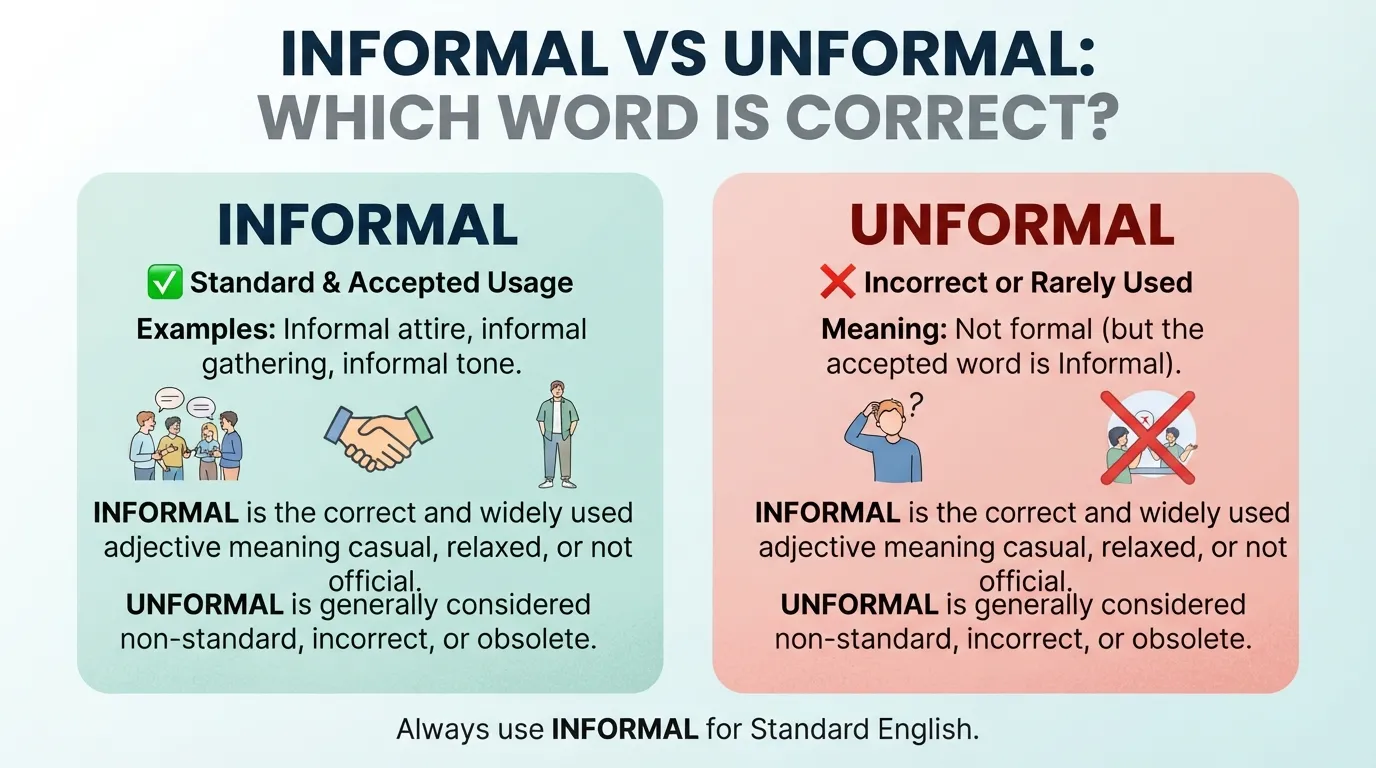
The email says, “Let us keep this meeting informal.” You nod. Relaxed, casual, no suits, no agenda — you know what informal means. Then a thought arrives, uninvited: why is it informal and not unformal? English makes opposites with un- all the time — unhappy, unfair, unkind, unable. Why does formal refuse the pattern? The answer is a small lesson in how English builds its opposites, and why the prefix you expect is not always the prefix you get.
The short answer: informal is the standard word for “not formal” in modern English. Unformal exists in dictionaries, but it is rare, old-fashioned, and sounds unnatural to modern readers. The long answer is about Latin, prefixes, and the stubborn habits of a language that borrowed its opposites from more than one source.
The Prefix Workshop: in-, un-, non-, dis-
English has at least four ways to say “not,” and each one has its territory. Understanding the territories is the key to the whole question.
In- (and its relatives im-, il-, ir-). This prefix comes from Latin, and it attaches to words that came from Latin. Formal came from Latin formalis, so its opposite takes the Latin prefix: in- + formal = informal. The same pattern gives possible → impossible, legal → illegal, regular → irregular, responsible → irresponsible, honest → dishonest (dishonest takes dis-, a Latin cousin). The prefix changes its spelling to match the first letter of the word — im- before P and B, il- before L, ir- before R — but the family is the same.
Un-. This prefix is Germanic, and it attaches to words from the Germanic stock of English. Happy → unhappy. Fair → unfair. Kind → unkind. Able → unable. Un- is the most productive opposite-maker in English — it attaches to more words than any other negative prefix — which is why it feels like the default. When a writer reaches for unformal, they are following the most common pattern in the language. They are just applying it to a word that belongs to a different family.
Non-. This prefix is the neutral, technical opposite-maker. Nonfiction, nonprofit, nonstop, noninvasive. It says “not” without emotion or judgment, and it is common in legal, medical, and technical writing. You would not say “a nonformal meeting” in everyday speech, but in a policy document, nonformal education is a recognized term for learning outside school.
Dis-. This prefix often means “opposite” or “apart.” Honest → dishonest. Agree → disagree. Approve → disapprove. It carries a slightly stronger sense of reversal than simple negation.
The rule of thumb: Latin words take Latin prefixes, Germanic words take Germanic prefixes. Formal is Latin, so it takes in-. That is the whole explanation, and it is why informal is standard and unformal is not.

Why Unformal Lost
Unformal is not a made-up word. It appears in dictionaries, and it has been used in English since at least the seventeenth century, mostly in specialized and literary contexts. But it never became the ordinary opposite of formal, because informal got there first and stayed. Language is a marketplace, and the first good product in a category usually wins.
There is a useful comparison: unorganized and disorganized. Both exist. Both are standard. But they mean slightly different things — unorganized means not organized, disorganized means messy, in disorder. English kept both because each one does a distinct job. With formal, the opposite job was already filled by informal, and unformal had no distinct job to do. It faded into the dictionary, a word that exists but is never called upon.
If you write “an unformal meeting,” most readers will understand you. But they will also feel a small bump — the sentence sounds slightly off, slightly non-native, slightly like a word assembled from parts rather than a word anyone actually uses. In writing that matters, that bump is enough reason to choose informal.
Informal Across Registers
Informal is one of the hardest-working adjectives in English, because it applies to almost every part of life. It describes language: informal speech, informal writing, the contractions and slang of everyday conversation. It describes clothing: informal dress, the outfit that is neither a suit nor pajamas. It describes gatherings: an informal meeting, an informal dinner, the kind where people relax. It describes agreements: an informal arrangement, a deal sealed with a handshake rather than a contract.
In each case, the meaning is the same: relaxed, casual, unofficial, not following strict conventions. The word is neutral — it does not praise or blame. An informal meeting is not a bad meeting. An informal email is not a rude email. The word simply says the formal rules are not in force.
The word also has a technical life in education. Informal learning is learning that happens outside classrooms — from conversation, from work, from life. Informal assessment is evaluation without tests. In these phrases, the word marks a category, not a judgment. The opposite — formal learning, formal assessment — is the structured, institutional version.

Formal, Informal, and Everything Between
Formality is not a switch. It is a spectrum, and informal is only one point on it. At the formal end: black-tie dinners, courtrooms, academic defenses, diplomatic receptions. In the middle: business casual, semi-formal events, the “smart casual” dress code that confuses everyone. At the informal end: kitchen-table conversations, text messages, sweatpants.
English has words for the points in between. Semi-formal is the dress code that means “nicer than casual, not as strict as formal.” Casual overlaps with informal but leans more toward comfort. Colloquial describes informal language specifically — the words and phrases of everyday speech. Relaxed describes the atmosphere. Each word carves the spectrum a little differently, and choosing among them is a matter of precision.
The practical rule for writers: when you mean “not formal,” write informal. When you mean something more specific — casual, colloquial, relaxed, unofficial — write that word. Informal is the general term. The others are the specific ones.
Informal English in the Classroom
Few places feel the formal-informal divide more sharply than the classroom. Students live in two languages at once: the informal English of friends, texts, and social media, and the formal English of essays, exams, and presentations. Learning to move between them — to code-switch — is one of the most important skills school teaches, and one of the least explicitly taught.
The divide shows up in small, daily decisions. An email to a professor: “Hey” or “Dear Professor”? A class discussion: “I think this is dumb” or “I disagree with this argument”? A group chat about homework: slang, emoji, fragments — all fine. An essay about the same homework: full sentences, formal vocabulary, no emoji. Each setting has its own formality setting, and students who misjudge it pay a price: an email that sounds disrespectful, an essay that sounds sloppy, a presentation that sounds unserious.
Teachers have a name for the skill: register awareness. Register is the level of formality a situation requires, and awareness of it is what lets a speaker choose the right words for the right moment. The goal is not to eliminate informal English — informal English is the language of friendship, humor, and everyday life, and it is essential. The goal is to know which register you are in, and to switch deliberately rather than accidentally.
The same skill matters at work. The email to a colleague can be informal. The email to a client usually cannot. The Slack message can be casual. The board report cannot. Professionals who master register awareness are the ones whose writing always sounds right — not because they are formal, but because they are appropriate. Informal is not a failure of formality. It is a choice, and like every choice in language, it works best when it is made on purpose.
The Lock-In
When the word appears in your draft, check the family. Is formal a Latin word? Yes — from formalis. Latin words take Latin prefixes. The Latin prefix is in-. In- + formal = informal. The un- prefix belongs to Germanic words — unhappy, unfair, unkind. It does not belong here.
And if you ever feel the pull toward unformal, remember the marketplace. Informal won the category centuries ago. It is the word in every dictionary, every style guide, every native speaker’s vocabulary. The other word is in the dictionary too — gathering dust, waiting for a job that never comes.


That is the rule, and it is worth keeping: Latin words take Latin prefixes, Germanic words take Germanic ones. Formal is Latin. Its opposite is informal. The un- prefix had its chance, and it lost — quietly, centuries ago, to a word that was already doing the job.










