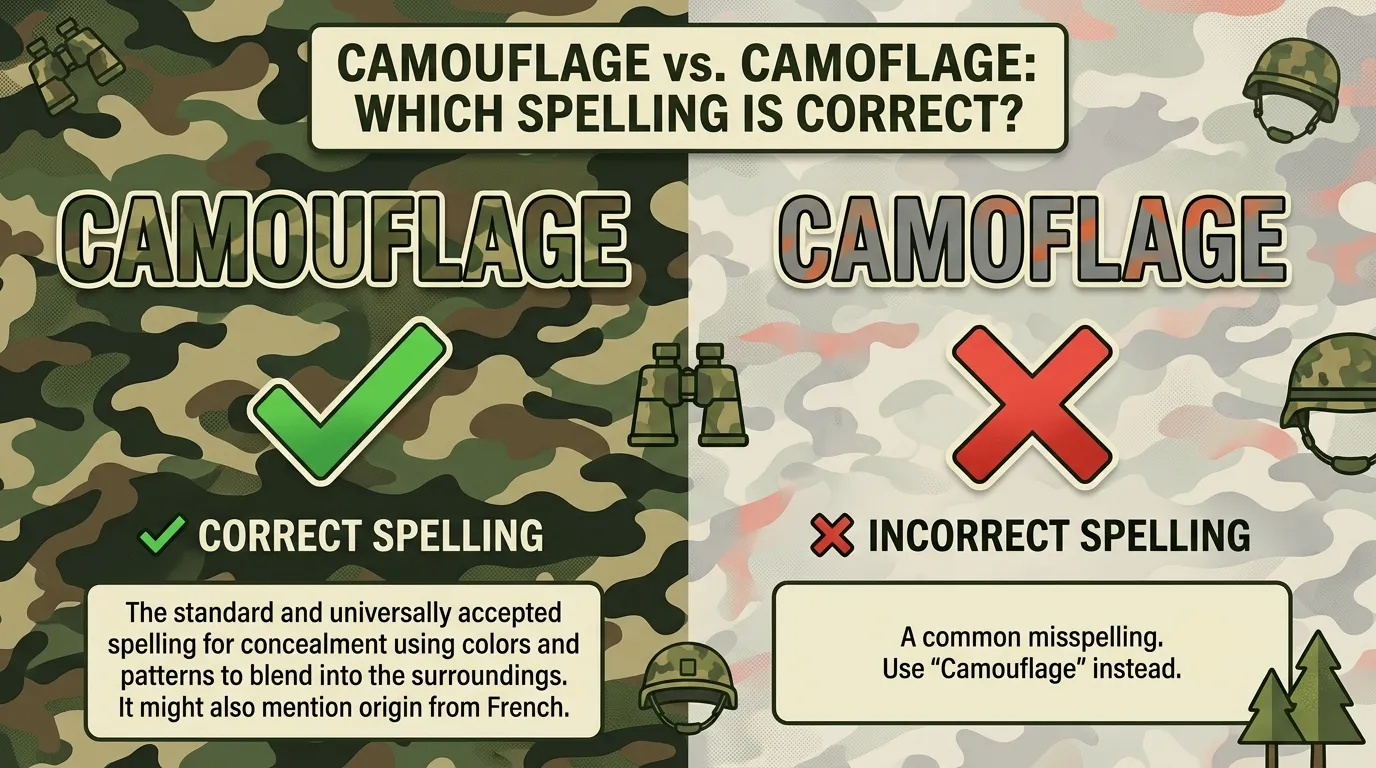
If you are wondering about camouflage vs camoflage, the answer is simple: camouflage is the correct spelling. Camoflage is a misspelling, although it is a very common one because the word is difficult to spell and its pronunciation does not clearly reveal every letter.
Camouflage can be a noun, verb, or adjective. It can describe a pattern or material used to help something blend into its surroundings, the act of hiding something, or something designed with a camouflage pattern. It can also be used figuratively when a person or action hides the truth.
In this guide, you will learn why camouflage is correct, why camoflage is wrong, how to pronounce the word, where it came from, how to use it naturally, and how to remember its unusual spelling.
Quick Answer: Camouflage vs Camoflage
| Word | Correct? | Meaning |
|---|---|---|
| camouflage | Yes | To hide or disguise something; also the material, pattern, or process used for hiding |
| camoflage | No | Common misspelling of camouflage |
The correct spelling is:
camouflage
The incorrect spelling is:
camoflage
There is no standard English word camoflage. If you are writing an essay, article, email, report, product description, school assignment, or professional document, use camouflage.
Example:
The soldiers wore camouflage uniforms.
Not:
The soldiers wore camoflage uniforms.
What Does Camouflage Mean?
Camouflage means hiding or disguising a person, animal, object, or idea so that it is difficult to recognize or notice.
The word has both literal and figurative meanings.
Camouflage as a noun
As a noun, camouflage refers to a method, appearance, material, or pattern that helps something remain hidden.
Examples:
- The leopard’s spots provide natural camouflage.
- The soldiers used camouflage to blend into the forest.
- The hunter wore camouflage clothing.
- The vehicle was painted in military camouflage.
- Snow provided camouflage for the white rabbit.
It can also describe something that hides a less obvious truth:
His friendly attitude was camouflage for his real intentions.
Camouflage as a verb
As a verb, camouflage means to hide or disguise something by making it blend with its surroundings or by making it less noticeable.
Examples:
- The soldiers camouflaged their equipment.
- The animal camouflaged itself among the leaves.
- The designer used dark colors to camouflage the stain.
- The bushes helped camouflage the building.
The verb can also be figurative:
She tried to camouflage her disappointment with a smile.
Camouflage as an adjective
Camouflage can also be used before a noun to describe something associated with camouflage.
For example:
- camouflage jacket
- camouflage pants
- camouflage pattern
- camouflage fabric
- camouflage clothing
- camouflage netting
In phrases such as camouflage jacket, the word describes the type or appearance of the jacket.
Why Is “Camouflage” Correct and “Camoflage” Wrong?
The main reason is that camouflage is a borrowed word whose spelling reflects its French history.
English contains many words whose spelling does not perfectly match their pronunciation. Camouflage is one of them.
The spelling contains:
c-a-m-o-u-f-l-a-g-e
The difficult part is the -ouflage- sequence.
People often hear the word and mentally simplify it to something like:
cam-o-flage
That can lead to the misspelling:
camoflage
However, the correct spelling includes ou after the m:
camouflage
A useful way to see the difference is:
camou + flage
rather than:
camo + flage
The letters ou are part of the standard spelling and should not be removed.
Why Do People Spell Camouflage as Camoflage?
The misspelling camoflage is understandable because English spelling and pronunciation do not always match.
There are several reasons people make this mistake.
1. The pronunciation does not clearly reveal the spelling
In American English, camouflage is commonly pronounced approximately:
KAM-uh-flahzh
The spelling contains more letters than you might expect from the spoken form.
When people hear the word, they may remember the sound rather than its written form.
2. The word contains an unusual letter combination
The sequence -ouflage- is not something English learners encounter every day.
Compare:
- camouflage
- encourage
- language
- damage
- manage
The ending -age is familiar, but the middle of camouflage is less predictable.
3. People naturally shorten the visual pattern
Because camo is widely used as a short form of camouflage, people may incorrectly assume that the full word is built from:
camo + flage
That produces camoflage.
But the correct full spelling is not based on that simplified spelling.
4. “Camo” is a real informal word
Camo is commonly used as an informal abbreviation for camouflage.
For example:
He bought a new camo jacket.
This is perfectly natural in casual English.
However, camo does not change the spelling of the full word.
Think of it this way:
camo → informal shortened form
camouflage → full standard word
Camouflage vs Camoflage: Key Differences
The difference is primarily correct spelling versus misspelling, not meaning.
| Feature | Camouflage | Camoflage |
|---|---|---|
| Standard English word | Yes | No |
| Correct spelling | Yes | No |
| Meaning | Hiding, disguise, or blending pattern | Intended to mean camouflage |
| Used in dictionaries | Yes | No as a standard spelling |
| Appropriate in formal writing | Yes | No |
| Common online typo | Sometimes | Yes |
| Informal abbreviation | Camo | No |
| Pronunciation | KAM-uh-flahzh | Usually intended as camouflage |
There is therefore no meaningful difference in definition between the two spellings.
If someone writes camoflage, they almost certainly mean camouflage.
Camouflage Pronunciation
The pronunciation of camouflage can be confusing because the spelling is unusual.
A common American pronunciation is approximately:
KAM-uh-flahzh
The final sound resembles the zh sound in words such as:
- measure
- pleasure
- vision
The final -age is not pronounced like the -age in garage or message.
Simple pronunciation guide
camouflage → KAM-uh-flahzh
The stress is generally strongest on the final part:
cam-ou-FLAGE
For English learners, it can help to remember the word as three spoken parts:
KAM – uh – FLAHZH
Do not try to pronounce every written letter individually.
Is Camouflage an American or British Word?
Camouflage is standard in both American and British English.
Unlike some words that have different spellings in the United States and the United Kingdom, camouflage does not normally change spelling between these varieties of English.
| Variety | Standard spelling |
|---|---|
| American English | camouflage |
| British English | camouflage |
| Canadian English | camouflage |
| Australian English | camouflage |
| International English | camouflage |
So there is no American-versus-British spelling issue here.
If you are writing for an American audience, use camouflage.
If you are writing for a British audience, use camouflage.
Camouflage: Dictionary-Style Definition
A concise dictionary-style definition would be:
camouflage (noun): a method, material, pattern, or appearance used to hide something by making it blend into its surroundings or by disguising it.
camouflage (verb): to hide or disguise something, especially by making it blend into its surroundings.
camouflage (adjective): having colors or patterns associated with camouflage.
Example sentences
Noun:
The bird’s feathers provide excellent camouflage.
Verb:
The army camouflaged the vehicle with branches and paint.
Adjective:
He wore a camouflage jacket.
Figurative noun:
Her laughter was camouflage for her nervousness.
Literal Meaning of Camouflage
The literal meaning involves physical concealment.
An object is camouflaged when its appearance makes it difficult to distinguish from its surroundings.
This can happen through:
- color
- shape
- texture
- pattern
- shadow
- movement
- background matching
- visual disruption
Animals provide many familiar examples.
A green insect on a green leaf may be difficult to see. A white animal in a snowy environment may blend into the background.
In military settings, camouflage can involve clothing, paint, netting, vegetation, equipment, and other methods intended to reduce visibility.
Everyday examples
The insect’s green body acts as camouflage.
The tent was designed to blend into the woodland environment.
The photographer struggled to spot the bird because of its natural camouflage.
Figurative Meaning of Camouflage
Camouflage does not always involve physical hiding.
It can also describe something that conceals a feeling, intention, problem, or truth.
Examples
His confidence was camouflage for his insecurity.
The complicated language served as camouflage for a simple idea.
Her cheerful behavior was camouflage for her disappointment.
The company’s impressive presentation was little more than camouflage for deeper problems.
In these examples, nothing is literally blending into a forest.
Instead, one thing is being used to hide another thing.
Camouflage in Military Usage
Military camouflage is one of the most familiar uses of the word.
Military camouflage is designed to make personnel, vehicles, equipment, or installations less noticeable in a particular environment.
Common examples include:
- camouflage uniforms
- camouflage netting
- camouflage paint
- camouflage fabric
- camouflage patterns
- camouflage gear
- camouflage equipment
Example
The unit used camouflage netting to make the equipment less visible.
The exact design of camouflage depends on the environment. A pattern designed for woodland may not work equally well in a desert, snowy landscape, or urban environment.
This illustrates an important point:
Camouflage is context-dependent.
Something that blends into one background may stand out strongly against another.
Camouflage in Nature
Camouflage is also an important concept in biology and ecology.
Animals can have colors, patterns, shapes, or behaviors that make them difficult to detect.
Examples include:
- insects resembling leaves or bark
- fish blending with underwater environments
- reptiles matching rocks or vegetation
- mammals whose coats resemble their habitats
- birds whose feathers reduce their visibility
Example sentences
The moth’s wing pattern provides camouflage against tree bark.
The animal remained still to improve its camouflage.
The fish’s coloring helps it blend into the reef.
Camouflage in nature is not simply about being the same color as the background. Shape, pattern, contrast, and behavior can also affect how easily an animal is detected.
Camouflage in Fashion
The word is also common in clothing and fashion.
Camo and camouflage can refer to military-inspired patterns used on everyday clothing.
Common expressions include:
- camouflage pants
- camouflage shirt
- camouflage jacket
- camouflage hoodie
- camouflage print
- camouflage pattern
- camouflage clothing
- camo shorts
- camo hat
Formal versus casual usage
Formal or neutral:
She purchased a camouflage jacket.
Casual:
She bought a new camo jacket.
Both can be natural, but camo is more informal.
“Camo” vs “Camouflage”
This is a different comparison from camouflage vs camoflage.
Camo is an accepted informal shortening of camouflage.
| Word | Status | Typical use |
|---|---|---|
| camouflage | Standard | Formal, neutral, academic, professional, everyday |
| camo | Informal | Conversation, fashion, casual writing |
| camoflage | Misspelling | Avoid |
Examples
Professional:
The product features a camouflage pattern.
Casual:
I like the camo print on these pants.
For a formal article, report, academic assignment, or business document, camouflage is usually the safer choice.
Common Collocations With Camouflage
A collocation is a group of words that commonly appear together.
Knowing common collocations can make your writing sound more natural.
Camouflage + noun
- camouflage pattern
- camouflage clothing
- camouflage uniform
- camouflage jacket
- camouflage paint
- camouflage netting
- camouflage material
- camouflage design
- camouflage technique
- camouflage system
- camouflage gear
Verbs + camouflage
- use camouflage
- wear camouflage
- apply camouflage
- provide camouflage
- create camouflage
- improve camouflage
- detect camouflage
- break camouflage
- blend into camouflage
- employ camouflage
Adjectives + camouflage
- natural camouflage
- effective camouflage
- military camouflage
- visual camouflage
- natural-looking camouflage
- protective camouflage
- temporary camouflage
Natural examples
The bird relies on natural camouflage.
The soldiers used effective camouflage.
The jacket has a traditional camouflage pattern.
The researchers studied how animals use camouflage.
Synonyms for Camouflage
The best synonym depends on whether camouflage is being used as a noun or verb.
Noun synonyms
- disguise
- concealment
- cover
- mask
- cloak
- screen
- guise
- veil
Example
The darkness provided a natural cover.
The elaborate story was a disguise.
Verb synonyms
- hide
- conceal
- disguise
- mask
- cover
- cloak
- obscure
- screen
- conceal
Example
Trees concealed the building.
The makeup masked the blemish.
The paint helped camouflage the equipment.
These words are related, but they are not always interchangeable. Camouflage often suggests hiding by blending in, disguising appearance, or reducing visibility.
Antonyms of Camouflage
There is no single perfect opposite in every context, but useful opposites include:
- reveal
- expose
- uncover
- disclose
- show
- highlight
- reveal
- display
- identify
Example
The camouflage concealed the equipment.
Opposite:
The bright lights exposed the equipment.
For figurative use:
The complicated explanation camouflaged the problem.
Opposite:
The report revealed the problem.
Related Words and Word Forms
Several words are connected to camouflage.
Camouflaged
The past-tense or past-participle form of the verb.
The vehicle was camouflaged.
Camouflaging
The present participle or gerund.
They were camouflaging the equipment.
Camouflage
The base form of the noun and verb.
The soldiers used camouflage.
They camouflage the equipment.
Camo
An informal shortened form.
He likes wearing camo.
Camouflaged
This adjective-like form is also common:
a camouflaged vehicle
a camouflaged animal
Common Phrases With Camouflage
Here are some natural expressions:
“Use camouflage”
The animal uses camouflage to avoid predators.
“Wear camouflage”
The hikers wore camouflage clothing.
“Blend into the surroundings”
The building was designed to blend into its surroundings.
“Camouflage a problem”
The new policy did little more than camouflage the underlying problem.
“Natural camouflage”
The insect’s natural camouflage makes it difficult to spot.
“Military camouflage”
The museum displayed examples of military camouflage.
Is “Camouflage” a Noun or a Verb?
It can be both.
As a noun
The rabbit uses its fur as camouflage.
Here, camouflage names the concealment.
As a verb
The rabbit’s fur helps camouflage it in the snow.
Here, camouflage describes the action of hiding.
As an adjective
He bought a camouflage jacket.
Here, camouflage describes the jacket’s pattern or style.
This flexibility is one reason the word appears in many different kinds of writing.
Common Grammar Patterns
“Camouflage something”
Use this when the subject hides an object.
The paint camouflaged the vehicle.
“Camouflage something as something”
This structure means disguising one thing to make it appear to be another.
The building was camouflaged as part of the surrounding landscape.
“Camouflage oneself”
This means hiding one’s own appearance.
The photographer tried to camouflage himself among the trees.
“Be camouflaged”
The animal was well camouflaged.
“Act as camouflage”
The leaves act as camouflage.
This is a particularly useful phrase when writing about animals or natural environments.
Common Mistakes With Camouflage
Mistake 1: Writing “camoflage”
Incorrect:
The soldier wore camoflage.
Correct:
The soldier wore camouflage.
Mistake 2: Writing “camoflauge”
Another common mistake is rearranging the letters:
Incorrect: camoflauge
Correct: camouflage
The correct order is:
camou + flage
Mistake 3: Removing the “u”
Incorrect:
camoflage
Correct:
camouflage
Remember that the ou is part of the standard spelling.
Mistake 4: Treating “camo” as the formal spelling
Incorrect idea:
Camo is the full formal spelling of camouflage.
It is not.
Camo is an informal shortened form.
Awkward vs Natural Examples
Example 1
Awkward:
The animal had a camouflage that was very good.
More natural:
The animal had effective camouflage.
Or:
The animal was well camouflaged.
Example 2
Awkward:
He used camouflage clothes.
More natural:
He wore camouflage clothing.
Or:
He wore a camouflage uniform.
Example 3
Awkward:
The camouflage was hiding the animal.
More natural:
The animal’s camouflage made it difficult to see.
Example 4
Awkward:
She camouflaged her sadness by smiling.
Natural:
She camouflaged her sadness with a smile.
The second version makes the figurative relationship clearer.
How to Remember the Spelling of Camouflage
The spelling becomes easier if you break it into parts.
Memory trick 1: Remember “camo” + “uflage”
Think:
CAMO + U + FLAGE
That extra U is important.
camouflage
not
camoflage
Memory trick 2: Remember the “OU”
The unusual middle is:
OU
So you can mentally highlight:
cam + ou + flage
Memory trick 3: Connect it with “camo”
Start with the familiar informal form:
camo
Then remember that the full word expands into:
camouflage
The short form is easier to say, but the full form has additional letters.
Memory trick 4: Think “French spelling”
Because the word entered English through French, its spelling is not as straightforward as a purely phonetic English word.
When in doubt, remember:
Camouflage keeps its unusual spelling.
Formal vs Informal Alternatives
Your choice depends on the context.
| Context | Recommended wording |
|---|---|
| Academic paper | camouflage |
| Business writing | camouflage |
| News article | camouflage |
| Technical writing | camouflage |
| School assignment | camouflage |
| Professional report | camouflage |
| Blog post | camouflage |
| Casual conversation | camouflage or camo |
| Fashion discussion | camo or camouflage |
| Social media | camo is common |
| Military discussion | camouflage |
| Scientific writing | camouflage |
If you are unsure, choose camouflage.
It is standard, clear, and appropriate in virtually every English-speaking context.
Camouflage in Academic and Scientific Writing
In academic writing, camouflage often appears in discussions of:
- biology
- zoology
- ecology
- evolution
- military history
- visual perception
- psychology
- environmental science
- computer vision
- animal behavior
For example:
The study examines how background matching improves visual camouflage.
Another example:
Researchers observed changes in camouflage patterns across different environments.
In academic writing, avoid replacing camouflage with the informal camo unless you are discussing casual language or a proper name.
Camouflage in Journalism and Business Writing
Journalists may use camouflage both literally and figuratively.
Literal
The troops used camouflage during the operation.
Figurative
The policy was criticized as camouflage for deeper economic problems.
Business writers can also use the figurative meaning:
The impressive numbers may camouflage declining customer satisfaction.
However, use the figurative sense carefully. If a simpler word such as hide or conceal communicates the idea better, it may be preferable.
Camouflage in Sports
Camouflage appears in sports and outdoor activities, particularly those involving hunting, fishing, wildlife observation, or outdoor recreation.
Examples include:
- camouflage hunting gear
- camouflage jerseys
- camouflage hats
- camouflage jackets
- camouflage equipment
Some sports teams and organizations also use camouflage-themed designs for special events or uniforms.
In casual sports writing, camo may be more common:
The team wore camo jerseys for the special event.
In formal reporting, camouflage jerseys is perfectly appropriate.
Camouflage in Technical and Digital Contexts
The concept of camouflage has expanded beyond clothing, animals, and military equipment.
Modern technical discussions can involve:
- camouflage detection
- image camouflage
- camouflaged objects
- computer vision
- object detection
- visual concealment
- pattern recognition
In computer vision, for example, researchers may study how algorithms detect objects that are visually difficult to distinguish from their backgrounds.
This gives camouflage a broader modern meaning related to visibility, detection, and visual similarity.
Is Camouflage Ever Spelled “Camoflage”?
In standard English, no.
You may encounter camoflage online, in informal posts, comments, product listings, social media, or user-generated content. Its appearance does not make it an accepted alternative spelling.
It is best treated as a spelling error.
The same principle applies in professional editing:
If you see “camoflage,” correct it to “camouflage.”
Do not treat the two forms as regional variants.
Does British English Spell It “Camoflage”?
No.
Camouflage is the standard spelling in British English as well as American English.
So if you are comparing American and British usage, this is one of the words where there is essentially no spelling difference.
Does “Camoflage” Have a Different Meaning?
No.
There is no standard separate meaning attached to camoflage.
When someone writes:
camoflage
they almost certainly intend:
camouflage
The issue is spelling, not vocabulary.
Camouflage vs Camoflage in SEO and Online Content
If you are writing web content, product descriptions, blog posts, or educational articles, always use camouflage as the standard spelling.
However, camoflage can still be relevant as a search query because people may search for the misspelling.
For an SEO-focused article, you can naturally address the query without repeatedly using the incorrect spelling.
For example:
Many people search for “camouflage vs camoflage” because the word is difficult to spell. The correct spelling is camouflage.
This satisfies the user’s search intent while maintaining correct English throughout the article.
Do not intentionally fill an article with repeated misspellings just to capture searches. Good SEO should prioritize readability and accuracy.
Quick Comparison: Camouflage, Camo, and Camoflage
| Term | Correct? | Formal? | Meaning |
|---|---|---|---|
| camouflage | Yes | Yes | Full standard word |
| camo | Yes | Usually informal | Short form of camouflage |
| camoflage | No | No | Misspelling |
| camoflauge | No | No | Misspelling |
This three-way comparison resolves most confusion.
Practical Recommendations for Writers
If you are deciding which spelling to use, follow these rules:
- Use “camouflage” in formal writing.
- Use “camouflage” in academic work.
- Use “camouflage” in professional documents.
- Use “camouflage” in journalism.
- Use “camouflage” in technical writing.
- Use “camouflage” in general-purpose articles.
- Use “camo” when an informal tone is appropriate.
- Never use “camoflage” as an accepted alternative spelling.
- Do not treat “camoflage” as an American or British variant.
- When proofreading, correct “camoflage” to “camouflage.”
Frequently Asked Questions About Camouflage vs Camoflage
1. Is it camouflage or camoflage?
Camouflage is the correct spelling. Camoflage is a misspelling.
2. What is the correct spelling of camouflage?
The correct spelling is camouflage:
C-A-M-O-U-F-L-A-G-E
The ou after the m is an important part of the spelling.
3. Is camoflage a word?
Camoflage is not a standard English spelling. It is a common misspelling of camouflage.
4. How do you pronounce camouflage?
A common American pronunciation is approximately KAM-uh-flahzh. The ending has a sound similar to the zh in measure.
5. Is camouflage an American or British spelling?
Camouflage is used in both American and British English. There is no standard American spelling camoflage and no British spelling camoflage.
6. Is “camo” the same as camouflage?
Camo is an informal shortened form of camouflage. It is common in casual speech, fashion, outdoor activities, and social media, but camouflage is the full standard word.
7. What does camouflage mean?
Camouflage means hiding or disguising something by making it difficult to see or recognize. It can refer to a physical pattern, material, method of concealment, or figurative disguise.
8. Can camouflage be a verb?
Yes. Camouflage can be a verb meaning to hide or disguise something.
The paint helped camouflage the vehicle.
9. Can camouflage be used figuratively?
Yes. It can describe something that hides a feeling, fact, problem, or intention.
His humor was camouflage for his nervousness.
10. How can I remember how to spell camouflage?
Remember that the correct word contains ou:
cam + ou + flage = camouflage
A useful shortcut is to remember that camo is only the informal short form. The full word is camouflage.
Conclusion
When comparing camouflage vs camoflage, there is one clear answer: camouflage is correct, while camoflage is a misspelling.
The word camouflage can function as a noun, verb, and adjective. Its most familiar meaning involves hiding something by helping it blend into its surroundings, whether through color, pattern, shape, clothing, paint, or another form of concealment. It can also have a figurative meaning when something hides a feeling, fact, intention, or problem.
The spelling is difficult because camouflage is a relatively unusual-looking word and its pronunciation does not make every letter obvious. The presence of the informal word camo can also encourage people to write the full word incorrectly as camoflage.
The safest rule is simple:
When you mean the full word, spell it “camouflage.”
For casual writing, camo is acceptable when the context calls for an informal tone. But camoflage should be corrected.
Whether you are writing an academic paper, business document, news article, blog post, product description, school assignment, technical report, or everyday message, camouflage is the standard spelling to use.