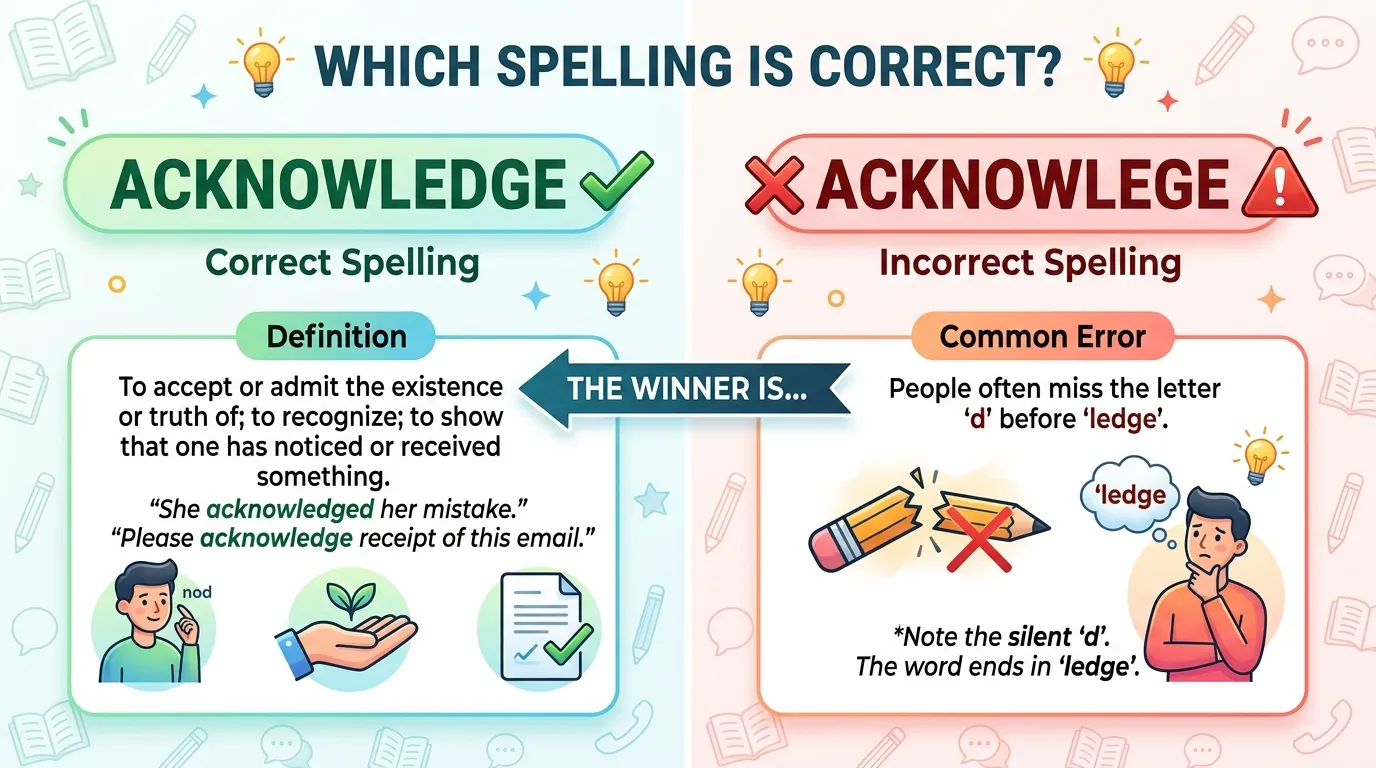
The new wing of the museum was opening on Saturday, and on Friday afternoon the director stood in the lobby with a clipboard, reading the donor wall one last time. Every name had to be spelled correctly. Every gift had to be recognised. A bronze plaque, once engraved, does not forgive a missing letter. Halfway down the list she stopped. A line in the draft programme read: “We acknowlege the generosity of the Hartley Foundation.” The sentiment was perfect. The spelling was not. The correct spelling is acknowledge — with a D tucked between the W and the L, a letter so quiet in speech that the ear forgets it entirely. Acknowlege is a misspelling. The missing D is the whole error, and the donor wall is exactly the kind of place where it matters.
Acknowledge is a long word that does a great deal of work. It admits, it recognises, it confirms, and it thanks — four jobs in one verb. It is also one of the most misspelled words in professional English, and the reason is simple: the letter that the spelling needs is a letter the mouth barely pronounces.
The Donor Wall
Start with the wall, because the wall shows all four jobs of the word in one place. A museum acknowledges its donors by putting their names on the wall. It acknowledges a gift by recording that the gift arrived. It acknowledges a debt by admitting that the new wing would not exist without the people who paid for it. And it acknowledges a contribution by saying thank you in bronze.
Each of those four jobs is a different meaning of the same verb. First, to admit that something is true: “The museum acknowledged that the old wing had become unsafe.” Second, to recognise someone or something: “The director acknowledged the volunteers by name.” Third, to confirm receipt: “Please acknowledge receipt of this letter.” Fourth, to express gratitude: “We acknowledge the generosity of our donors.”
The four jobs overlap, and the overlap is part of the word’s usefulness. When the director says “We acknowledge the Hartley Foundation,” she is admitting the gift happened, recognising the givers, confirming the record, and thanking them, all in one verb. A word that does four jobs at once earns its length. It also earns the care it takes to spell it.
The wall itself teaches something about spelling. Engraving is permanent. An email can be corrected with a follow-up. A printed programme can be reprinted. A bronze plaque cannot. The words that get carved into walls and plaques are the words that must be spelled right the first time, and acknowledge is one of the words most likely to appear on them — on donor walls, on award citations, on memorials, on the acknowledgements page of a book. It is a word with a public life, and its spelling is a public matter.
The Vanishing D
Say acknowledge aloud, the way you would say it in a meeting: ak-NOL-ij. Listen for the D. It is barely there — a flick of the tongue between the W sound and the L, swallowed by the syllable around it. In connected speech it often disappears altogether: “We acknowledge receipt” comes out sounding like “We acknowle’ receipt,” and the ear, doing its honest best, reports a word with no D in it. The hand writes down the report: acknowlege.
The disappearance is not a personal failing. It is a feature of how English pronounces consonant clusters. The -dge ending of acknowledge is pronounced ij, a single buzzing sound, and the D contributes almost nothing audible to it. The same thing happens with knowledge — pronounced NOL-ij, spelled with a D that the ear cannot find — and with edge, pledge, and judge, where the D is part of a sound that the mouth makes as one gesture. English is full of letters that the ear cannot hear and the spelling cannot do without.
There is a second force pushing the D out: speed. Acknowledge is a word that appears most often in fast, formulaic writing — email confirmations, meeting minutes, form letters, acknowledgements pages written at midnight before a deadline. The hand is moving fast, the phrase is familiar, and the D, being inaudible, is the first letter to be dropped. The misspelling is a hurry error, and hurry errors are the most common kind.
There is also a visual trap. The word is long — eleven letters — and long words invite the eye to skim. A reader scanning “acknowlege” will often read it as “acknowledge” because the overall shape is right: the same length, the same beginning, the same ending. The missing D is invisible to a skimming eye, which is why the error survives proofreading more often than it should. The word’s length is its camouflage.
Know, Knowledge, Acknowledge: The Family
Here is the fact that fixes the spelling for good. Acknowledge is built from two parts: ac-, a prefix meaning “to” or “toward,” and knowledge, the noun for what is known. To acknowledge something is, literally, to move toward knowing it — to admit it into the record of what is known. The word is a compound, and the D belongs to the second half.
The family confirms it. Know has a silent K. Knowledge has a silent K and a nearly silent D. Acknowledge has the silent K, the A, the C, and then the whole of knowledge with its D intact. Acknowledgement — the noun — keeps the D. Acknowledged — the past tense — keeps the D. Acknowledging — the present participle — keeps the D. The D runs through the whole family like a thread, because it belongs to the root.
The root goes further back. Know comes from Old English cnawan, to know or recognise, a word that carried the K and the W as audible consonants. Over centuries the K went silent and the W softened, but the spelling kept the history. Acknowledge is a word with a long memory, and the D is part of that memory. Dropping it does not simplify the word. It severs it from its family.
There is a useful contrast with a word that looks similar and behaves differently: accolade. Both words begin with ac- and end in a D sound, but accolade has no K and no W, and its D is pronounced clearly. The two words are not related. The resemblance is a coincidence, and it is worth noting because a writer who confuses them will misspell both.
Four Jobs in Real Sentences
The four meanings deserve real sentences, because the word’s range is wider than most writers realise.
To admit: “The company acknowledged the error and issued a refund.” “She acknowledged that the plan had failed.” “The report acknowledges the limitations of the study.” In this job, the word is a formal cousin of admit — cooler, less emotional, more official. A company acknowledges a mistake. A person admits one. The difference is register, and acknowledge is the register of the institution.
To recognise: “The chair acknowledged the speaker.” “He acknowledged her presence with a nod.” “The award acknowledged a lifetime of work.” In this job, the word means to show that you have noticed someone. It is the verb of the nod, the wave, the mention in the speech. A person who is acknowledged has been seen.
To confirm receipt: “Please acknowledge receipt of this email.” “We acknowledge your application.” “Kindly acknowledge this message.” This is the word’s most common job in business writing, and its most formulaic. The phrase “please acknowledge receipt” appears in millions of emails, and it is the phrase in which the misspelling appears most often — because the phrase is typed on autopilot, and autopilot drops letters.
To thank: “We would like to acknowledge our sponsors.” “The author acknowledges her editor.” “I acknowledge my parents’ support.” In this job, the word is the formal version of thank. It appears in speeches, in books, in award citations, on donor walls. It is gratitude in a suit.
Notice what all four jobs share: they are all public acts. To acknowledge something is to put it on the record. A private thought is not an acknowledgement. A spoken admission in a meeting is. A nod across a room is. A name on a wall is. The word is the verb of going on record, and going on record is exactly when spelling matters most.
The Phrases That Carry the Word
Acknowledge travels in fixed phrases, and knowing them helps a writer use the word naturally rather than forcing it.
Acknowledge receipt — confirm that something arrived. “Please acknowledge receipt of the attached contract.” The phrase is formal and slightly stiff, and it is standard in business and legal writing.
Acknowledge a mistake — admit an error. “The airline acknowledged the scheduling mistake.” The phrase is the language of the apology that does not quite say sorry: it admits the fact without performing the emotion.
Acknowledge someone’s contribution — recognise and thank. “The film acknowledges the contribution of its stunt performers.” This is the donor-wall phrase, the acknowledgements-page phrase, the credits phrase.
It must be acknowledged that… — a formal way of conceding a point. “It must be acknowledged that the evidence is incomplete.” The construction is the language of the essay and the report, a way of admitting a weakness before the reader finds it.
There is also a grammar point worth knowing. Acknowledge is followed by a noun, a that-clause, a gerund, or an as phrase: “acknowledge the problem,” “acknowledge that the problem exists,” “acknowledge making the mistake,” “acknowledge him as the leader.” All four patterns are standard. The word is grammatically flexible, which is one more reason it appears so often — it fits into almost any sentence that needs an admission.
One caution: acknowledge is not the same as admit in every context. To admit a mistake is to confess it. To acknowledge a mistake is to register it. The first is personal. The second is procedural. A writer who uses acknowledge where admit belongs will sound like a press release. A writer who uses admit where acknowledge belongs will sound like a confession. The choice is a matter of tone, and tone is the whole game in formal writing.
The Lock-In
The memory hook is the family. Know → knowledge → acknowledge. Three words, one root, and the D is in the second and third. If you can spell knowledge — and almost everyone can, because the word is drilled into every schoolchild — you can spell acknowledge, because it is ac- + knowledge with a final E.
Break the word into its visible pieces: ac + know + ledge. The middle piece is know, the word for knowing. The last piece is ledge, the shelf the D sits on. Ac-know-ledge. Say it that way — exaggerating the know and the ledge — and the D becomes audible in your head, even though it is silent in your mouth.
And one final check for the keyboard: when the word appears in your draft, look at the letters before the final -ge. If you see -lege, the D is present and the spelling is right. If you see -lege without the D — acknowlege — the D has vanished, and the word is wrong. The donor wall will not forgive a missing letter. The spell checker might catch it. The reader might not. Spell it with the D, and the wall will read correctly for as long as the bronze lasts.