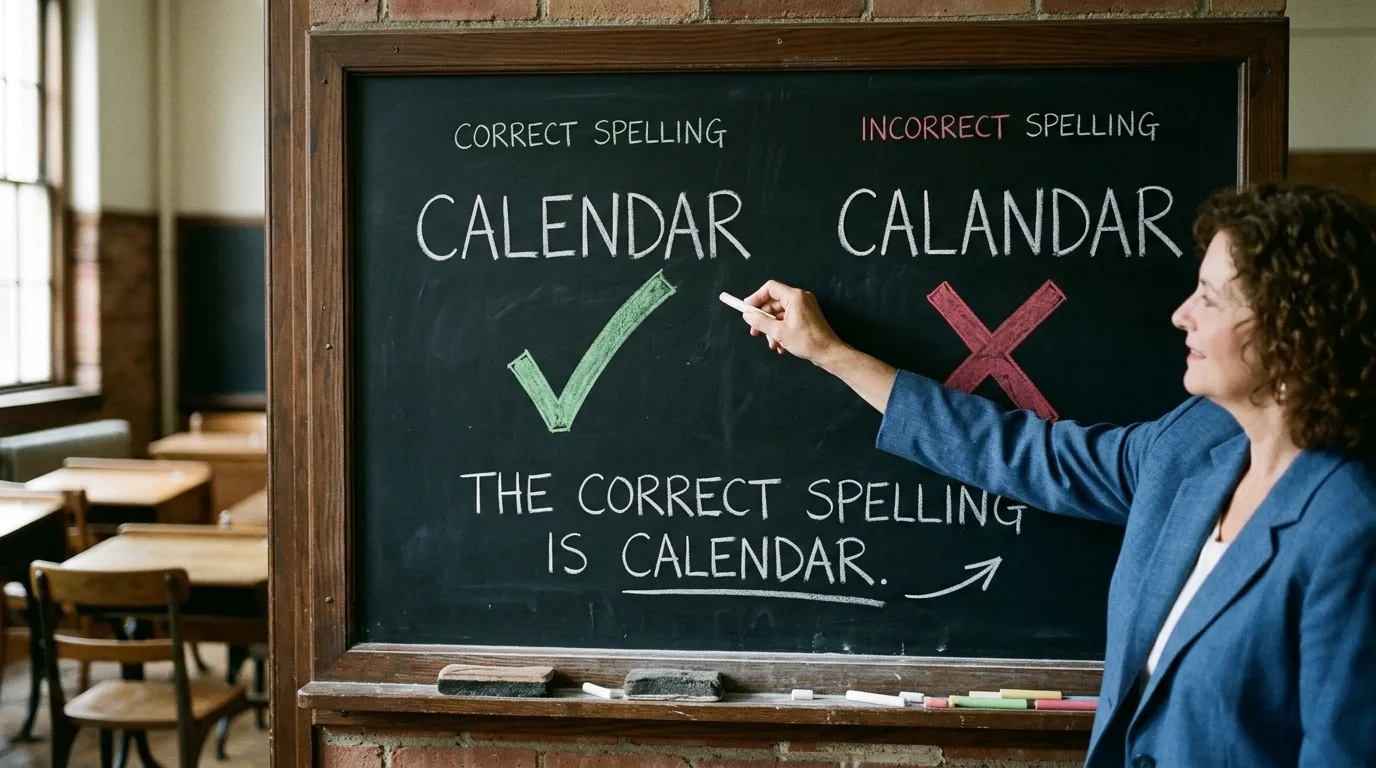
The print shop smells like ink and hot paper, and the big machine in the corner is running a job that will hang on a thousand kitchen walls: next year’s calendar. The designer is checking the proof, page by page — January, February, March — and on the cover, in big friendly letters, the word is misspelled: calandar. She catches it before the run starts, which is lucky, because a misspelled calendar is a special kind of embarrassment: a document whose entire job is to track time, with a spelling error that will stare at its owner for 365 days. The correct spelling is calendar. Calandar is a misspelling. The A in the middle is an intruder, and the reason it sneaks in is a story about an ancient Roman account book, a sound that lies, and a real word — calender — that is spelled almost the same way and means something completely different.
Calendar is a word everyone uses and almost everyone misspells at least once. It names the system for organizing days, the chart that shows them, and the schedule that fills them. The spelling is fixed, and the fix starts with understanding that the word’s middle is -en-, not -an-.
The Proof on the Press
Start with the shop, because the shop shows every use of the word in one place. The calendar on the wall is a chart of days and months. The calendar on the phone is a schedule of appointments. The calendar year is the twelve-month period from January to December. The academic calendar is the schedule of a school year. The court calendar is the schedule of a court’s cases. The liturgical calendar is the schedule of a church’s holy days. One word, many jobs, and in every job, the spelling is the same: c-a-l-e-n-d-a-r.
The word is a noun first. “Check the calendar.” “Mark it on the calendar.” “The calendar says Tuesday.” It is also a verb, less commonly: “to calendar an event” means to schedule it, to put it on the calendar. And it is an adjective in phrases like “calendar year,” “calendar month,” and “calendar day” — where it distinguishes the ordinary calendar measure from other measures, like a fiscal year or a lunar month.
There is a second noun use, broader and more institutional: the calendar as a list or register. A calendar of events is a schedule of happenings. A calendar of saints is a list of saints and their feast days. A university’s calendar is its official catalog of programs and rules. In this use, the word means “an ordered list,” and the ordering is by time.
And there is the verb phrase that every office knows: “to calendar” a meeting, a hearing, a deadline. The verb is bureaucratic, and it is useful: it means to enter something into the official schedule, where it becomes real. An event that is calendared is an event that will happen. An event that is not calendared is an event that might not.
The Roman Account Book
Here is the fact that fixes the spelling. Calendar comes from the Latin calendarium, meaning an account book — a book of debts and payments. The word is built on calendae, the calends, the first day of each month in the Roman calendar, when debts were due and accounts were settled. The calends were the deadline. The calendarium was the book that tracked them. The calendar is the descendant of a debt ledger.
The Latin root explains the spelling completely. Calendae is spelled c-a-l-e-n-d-a-e. The middle is -en-, with an E. English kept that E when it borrowed the word. Calendar is cal- + -en- + -dar. There is no A in the middle. The A in calandar is an invention of the hurried hand, with no history behind it.
The root also explains the word’s relatives. Calends — the first day of the month in the ancient Roman calendar. Calender — a machine for pressing cloth or paper smooth, and a person who operates it. Calendar — the system of days. Three words, one root, and the first two are the traps. Calender, the machine, is a real English word, spelled c-a-l-e-n-d-e-r, with an E in the middle and an E at the end. A writer who has seen calender can easily reason that calendar must share its spelling. It does — except for the last letter. Calender ends in -er. Calendar ends in -ar. The middle is -en- in both.
There is also the word’s journey through French. Old French calendier became Middle English calender, and then the spelling settled into calendar in modern English. The journey is why the word has both a -dar ending and a -der cousin. The two spellings are not interchangeable. The machine is calender. The chart of days is calendar. The difference is one letter at the end, and it is the whole difference between a factory and a kitchen wall.
The Ear’s Lie
So why does the hand write calandar? Because of the ear. Say the word aloud: KAL-un-der. The second syllable, -en-, is unstressed, and in fast speech it collapses into a neutral murmur — the schwa sound, the “uh” that lives in the middle of so many words. The ear hears “uh” and the hand, guessing, writes A — the letter that most often stands for that murmur. The guess is reasonable. It is also wrong, because the E in calendar is not pronounced as a clear E. It is a schwa, and the spelling does not record the schwa. It records the history.
There is a second force pushing toward the error: the word calendar is typed constantly, and high-frequency words are the ones most vulnerable to slips. The hand moves fast, the brain moves faster, and the fingers add a letter that the brain did not authorize. Calandar is the classic fast-typing error: a word the writer knows perfectly, misspelled by speed.
And there is a third force: the -andar pattern. English has words ending in -andar — standard is not one, but the ear hears the pattern in words like standard, calendar, and landmark, and it files calendar next to them. The filing is natural. The A is still wrong. The word’s middle is -en-, and the filing cabinet does not change it.
The fix is to slow down on exactly one letter. When the word appears in your draft, look at the middle. If you see -an-, the A is an intruder. Swap it for E. Cal-en-dar. The proof is clean again.
Calendars Around the World
The word calendar names not one system but many, and knowing them is worth a section, because the word’s history is the history of timekeeping. The Gregorian calendar is the one most of the world uses: 365 days, 12 months, a leap year every four years (with exceptions for century years). It was introduced by Pope Gregory XIII in 1582, replacing the Julian calendar, which had drifted out of sync with the seasons by ten days.
The Julian calendar, introduced by Julius Caesar in 45 BCE, was the first calendar to put the Roman year on a solar footing: 365 days, a leap day every four years. The Hebrew calendar is lunisolar, combining lunar months with solar years. The Islamic calendar is purely lunar, 354 days, drifting through the seasons. The Chinese calendar is lunisolar, with months named by the lunar cycle and years named by animals. The Mayan calendar was a complex system of interlocking cycles, including the famous 260-day sacred calendar.
Each calendar is a different answer to the same question: how do you divide the year? And each one is named with the same word, spelled the same way. The Gregorian calendar. The Julian calendar. The Hebrew calendar. The Islamic calendar. The word travels across cultures and centuries, and the spelling travels with it.
There is also the phrase calendar year versus fiscal year. A calendar year runs from January 1 to December 31. A fiscal year is any twelve-month period a business or government uses for accounting — it can start in any month. The distinction matters in finance, tax, and law, and the word calendar is doing the distinguishing. A company whose fiscal year starts in April still files its taxes on a calendar-year basis in some jurisdictions. The two years overlap, and the word calendar keeps them straight.
Calendar vs Calender vs Colander
Three words, three jobs, and keeping them distinct is the whole game. Calendar — the chart of days, c-a-l-e-n-d-a-r. Calender — the machine for pressing cloth or paper, c-a-l-e-n-d-e-r. Colander — the kitchen strainer with holes, c-o-l-a-n-d-e-r. The three words look alike, sound alike, and mean completely different things. A writer who confuses them has written a sentence about pressing cloth when they meant to schedule a meeting, or about straining pasta when they meant to check a date.
The calender machine is worth a closer look, because it is the closest trap. A calender is a set of rollers that press cloth, paper, or plastic to make it smooth and glossy. The paper in a glossy magazine has been calendered. The word is also a verb: “to calender paper” means to press it through the machine. The machine and the chart of days share the Latin root — both come from calendae, though by different routes — and the shared root is why they are spelled so similarly. The difference is the last letter: -ar for the chart, -er for the machine.
The colander is the kitchen cousin. It comes from the Latin colare, to strain, and it is spelled with an O in the first syllable: c-o-l-a-n-d-e-r. The O is the difference. A colander strains pasta. A calendar tracks days. A calender presses paper. Three tools, three spellings, and the first syllable tells you which tool you have.
The test is simple. If the word is about days, it is calendar, with an A in the first syllable and an A at the end. If it is about pressing, it is calender, with an E at the end. If it is about straining, it is colander, with an O at the start. The tools are different, and the spelling knows it.
The Print Shop Test
Back in the shop, the designer has a test. She looks at the proof the way she looks at a color swatch: letter by letter. Cal- + -en- + -dar. The middle is E. The end is A-R. The spelling is calendar.
The memory hook is the root. Calendae — the first day of the Roman month, when debts were due. The E in the middle is the E of calendae. It has been there since Rome. It is not going anywhere.
And one final check for the keyboard: when the word appears in your draft, look at the middle. If you see -an-, the A is an intruder. Swap it for E. Calendar. The proof is clean, the run starts, and the calendars will hang on a thousand walls, spelled correctly, for 365 days.










