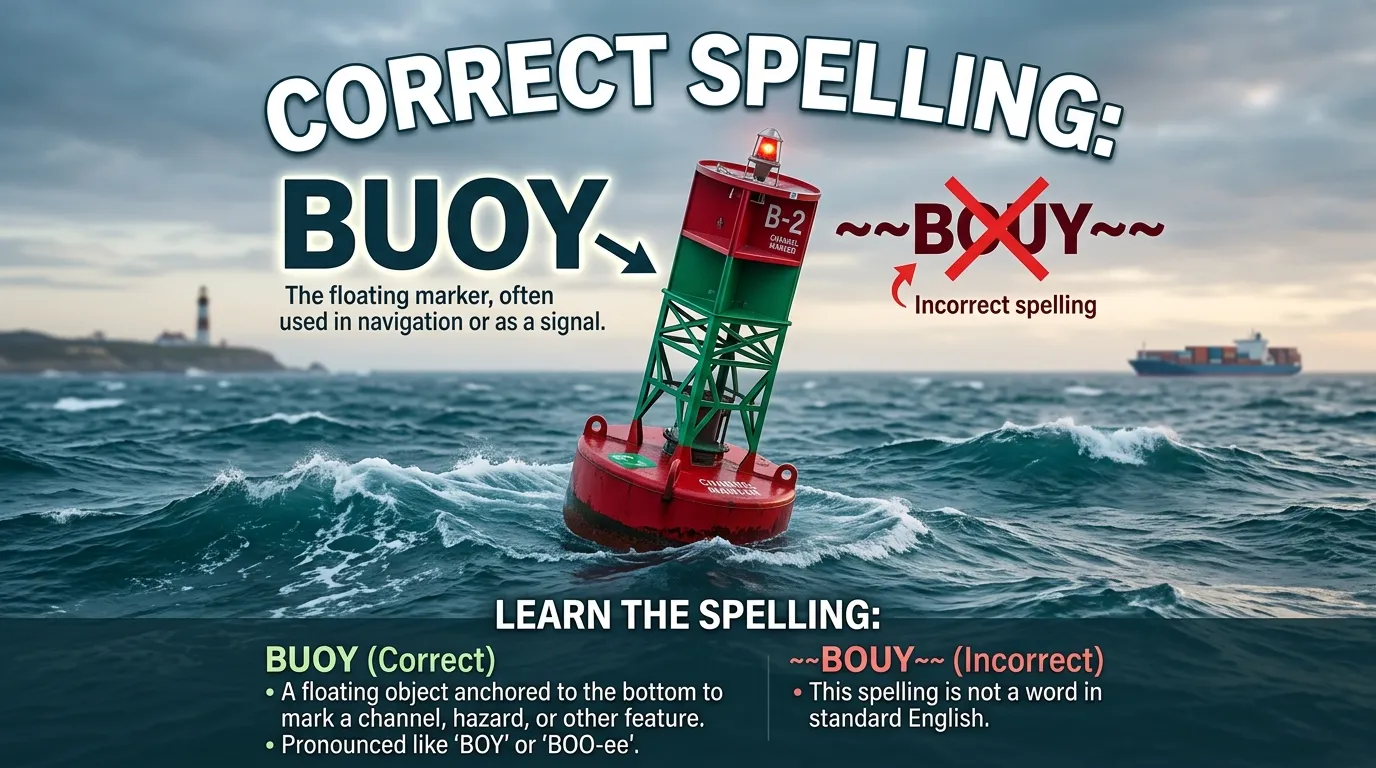
The coast guard station sits on a bluff above the harbor, and the radio crackles all day with the language of the water: channel markers, tide reports, and one word that comes up in every watch. “Buoy seven is off station.” “The life buoy is deployed.” “The crew was buoyed by the news that the missing sailor was found.” The word is buoy — a floating marker, a life ring, and a verb for lifting spirits. The misspelling is bouy, with the O and U swapped. The correct spelling is buoy: b-u-o-y. The swap is the whole error, and the reason it happens is that the word’s spelling is a small puzzle left behind by the Dutch sailors who named it.
Buoy is a word with three jobs: a noun for a floating marker, a noun for a life ring, and a verb for lifting. In all three, the spelling is the same, and the spelling is the puzzle: the U comes before the O, and the Y at the end is doing the work of a vowel.
The Morning Watch
Start with the station, because the station shows every use of the word in one shift. The buoys in the harbor are floating markers, anchored to the bottom, bobbing on the surface. They mark the channel: green buoys on one side, red buoys on the other, and a boat that stays between them stays in deep water. A buoy that drifts off station — dragged by a storm, struck by a ship — is a hazard, and the coast guard’s job is to find it and put it back.
The life buoy is a different object with the same name: a ring of cork or foam, thrown to a person in the water, to keep them afloat until rescue arrives. It is also called a life ring or a life preserver, and it hangs on the rail of every boat, every dock, every pier. The life buoy is the word’s most literal job: a thing that keeps a person from sinking.
And then there is the verb. “The crew was buoyed by the news.” “The crowd’s applause buoyed the team.” “Good earnings buoyed the stock market.” In this job, the word means to lift, to support, to keep afloat — literally or figuratively. The metaphor is the harbor: the news is the water, the crew is the boat, and the good news holds the crew up the way the water holds the boat up. The verb is the word’s most common job in writing, and it appears in news, business, and sports more often than the noun does.
There is also the phrase buoy up: “buoyed up by hope,” “buoyed up by the crowd.” The up is optional — “buoyed by hope” means the same thing — but the two-word form is common, and it emphasizes the lifting. The buoy holds you up. The phrase says so twice.
The Dutch Puzzle
Here is the fact that fixes the spelling. Buoy came into English from Dutch boei, or from Middle Dutch boye, and it kept a spelling that looks strange to English eyes: b-u-o-y. The U comes before the O. The Y at the end is a vowel, not a consonant. The word is pronounced, in American English, as “BOY” — one syllable, the U silent, the O and Y doing the work. In British English, it is often pronounced “BOO-ee” — two syllables, the U audible. The spelling is the same in both pronunciations, and the spelling is the puzzle.
So why does the hand write bouy? Because of the ear and the eye, working together against the writer. The ear hears “boy” or “boo-ee” and the hand writes bou-, with the O before the U, because ou is one of the most common vowel pairs in English: about, house, sound, found, round. The hand reaches for the familiar pattern and swaps the letters. The guess is reasonable. It is also wrong, because buoy is not an ou word. It is a uo word, and the uo is the whole puzzle.
There is also the pronunciation trap. In American English, the U is silent, and silent letters are the first things the ear forgets. A writer who hears “BOY” can easily spell it boy or bouy, because the spelling does not match the sound. The U is there, and it comes first: b-u-o-y. The spelling is a fossil of the Dutch original, and fossils do not follow the rules of the living language.
And there is a third force: the word is rare in everyday writing. Most people write buoy a few times a year, if that. Rare words are the ones most vulnerable to misspelling, because the hand has no habit to fall back on. A common word like about is spelled correctly by muscle memory. A rare word like buoy is spelled by reasoning, and the reasoning leads to bouy — the familiar ou pattern — instead of buoy, the unfamiliar uo pattern.
The fix is to memorize the puzzle, not to reason it out. Buoy is b-u-o-y. The U comes first. The O comes second. The Y is last. The order is the answer.
Buoys in the Water
The noun has a family of specific types, and knowing them is worth a section, because the harbor is full of them. A channel buoy marks the safe channel. A mooring buoy is a float a boat ties to instead of anchoring. A marker buoy marks a hazard, a wreck, or a fishing ground. A weather buoy is an instrument platform that reports wind, waves, and temperature to forecasters. A sonar buoy — a sonobuoy — listens for submarines. A bell buoy rings in the waves, warning ships in fog. A light buoy carries a lamp, flashing a code that sailors read like a language.
Each buoy has a job, and the jobs are all the same at heart: to float, to mark, to warn, to guide. The buoy is the harbor’s punctuation — the commas and periods of the water, telling sailors where to pause, where to turn, where to stop. A harbor without buoys is a sentence without punctuation: readable, but dangerous.
The verb has its own family. Buoyed by is the most common form: “buoyed by good news,” “buoyed by strong sales,” “buoyed by the crowd’s support.” Buoy up is the phrasal form: “buoyed up by hope.” Buoyancy is the noun: the quality of floating, or of recovering. Buoyant is the adjective: having the quality of floating, or of rising. Four words, one root, and the root is spelled b-u-o-y in all four.
There is also the fixed phrase buoy someone’s spirits: “The letter buoyed her spirits.” The phrase is old, and it is the verb’s most human use. The spirits are the boat. The letter is the water. The word does the lifting.
Buoy vs Float, Lift, Encourage
Buoy has close neighbors, and keeping them distinct sharpens a sentence. Float describes the state of being held up by a fluid — a boat floating, a balloon floating. Buoy, as a verb, describes the act of holding up — the water buoys the boat, the news buoys the crew. The difference is the difference between a state and an action: the boat floats, and the water buoys it.
Lift describes raising something to a higher position — a crane lifts a container, a speech lifts a crowd. Buoy describes a specific kind of lifting: the gentle, sustained support of a fluid, or the emotional equivalent. A crane lifts. Water buoys. The words overlap, but buoy carries the water with it, and the water is the point.
Encourage describes giving someone confidence or hope — a teacher encourages a student, a coach encourages a team. Buoy, in its emotional sense, describes a specific kind of encouragement: the kind that holds a person up when they are sinking. A coach encourages a team before the game. Good news buoys a team after a loss. The difference is the sinking. Buoy is for the moments when someone is going under.
There is also the word’s opposite: sink, weigh down, drag down. “The bad news sank the team.” “The debt weighed him down.” “The criticism dragged her spirits down.” The opposites name the failure that buoyancy prevents: the boat that takes on water, the spirit that goes under.
The Harbor Test
Back at the station, the radio crackles again: “Buoy seven is back on station.” The watch officer logs it, and the word is spelled correctly in the log, because the log is a legal document and the station does not tolerate misspellings in legal documents. The test is the same one that works for every uo word: memorize the order, do not reason it out.
The memory hook is the harbor. The buoy is the floating marker, and the U floats before the O, the way the buoy floats on the water. The letter order is the picture: U first, O second, Y last. Buoy. The U is the float. The O is the water. The Y is the anchor line.
And one final check for the keyboard: when the word appears in your draft, look at the first three letters. If you see bou-, the O and U are swapped. Swap them back. Buo-. U first, O second, and the buoy is back on station.