The magician holds up an empty hat, shows it to the audience — front, back, inside, outside — and then reaches in and pulls out a rabbit. A child in the front row gasps. An adult in the third row leans to her neighbor and whispers, “I don’t believe it.” She means it as a compliment. She saw the trick, she knows it is a trick, and she still cannot believe her eyes. Later, texting about the show, she types the word from her own sentence — and drops a letter. “I cant belive it.” The missing letter is an E, the second one, and its absence turns a real word into the most common way to misspell it.
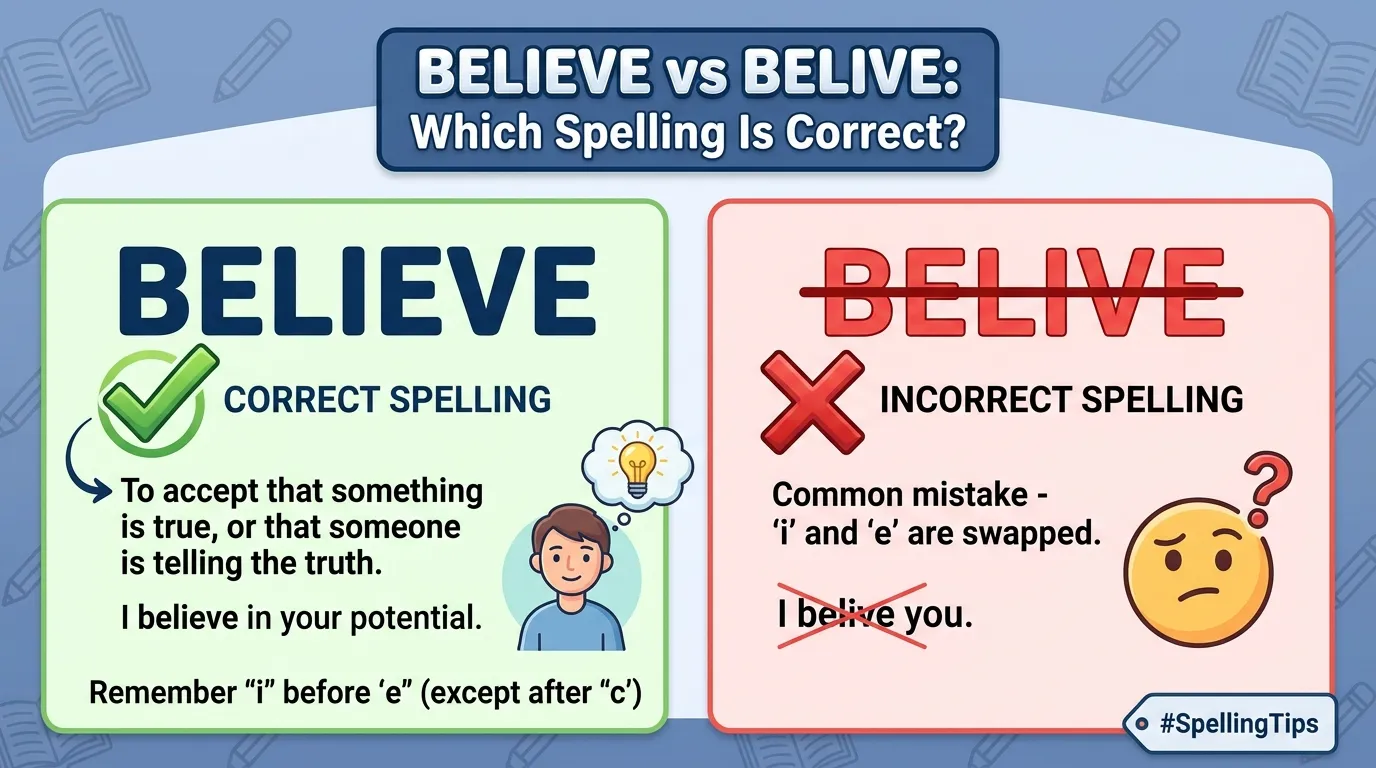
Believe is the only correct spelling in standard English. Belive is a misspelling. The error is so common that it appears in texts, emails, essays, and social media posts every day — and understanding why the E goes missing is the fastest way to keep it.
The Empty Hat
Start with what the word means. Believe is a verb meaning to accept something as true, to have confidence or trust in someone, or to have faith. “I believe you.” “We believe in honesty.” “She believes everything she reads online.” The verb covers three shades: accepting a fact (“I believe it will rain”), trusting a person (“I believe in you”), and holding a faith (“They believe in God”).
The word also has a fourth, quieter use: to suppose or think something is likely. “I believe she’s coming tomorrow.” Here the word is not claiming certainty. It is claiming a reasoned guess — the speaker thinks the thing is true but is leaving room for doubt. The shade matters, because it is the difference between “I believe” as a conviction and “I believe” as a hedge.
The pronunciation is the source of the trouble. Believe is pronounced /bɪˈliːv/ — “buh-LEEV.” The word has three E’s, and the second and third blur together in speech into a single long EE sound. The ear hears one vowel where the spelling has two letters, and the hand, writing what the ear hears, writes belive — dropping the E that the ear cannot distinguish.
Three E’s, One Lie
The spelling has a structure, and the structure is the memory hook. Believe is spelled B-E-L-I-E-V-E. Read it as three pieces: be + lie + ve. Together: be-lie-ve. The middle piece spells lie, and that is the hook generations of teachers have used: “Never believe a lie.” The word contains its own warning — the lie is right there in the middle, and the spelling keeps it there.
The hook works because it is true in both directions. The lie in the middle is a reminder that believing requires care — that not everything that asks for belief deserves it. And the spelling reminder is a practical one: if you can spell lie, you can spell the middle of believe. The E before the V and the E after it are the frame around the lie, and both of them are required.
There is a second proof in the word’s family. Belief — the noun — is spelled B-E-L-I-E-F. It keeps the same belie- opening: be + lie + f. Believable keeps it too. Unbelievable keeps it. Disbelief keeps it. Every member of the family carries the be-lie- core, and the E’s survive every prefix and suffix the word takes.
Believe In, Believe, and Make Believe
Believe takes different constructions, and each one means something different. Believe plus a statement means to accept it as true: “I believe she is right.” Believe in plus a person means to trust them: “I believe in you.” Believe in plus an idea means to hold it as a principle: “He believes in justice.” Believe in plus a supernatural claim means to hold it as a faith: “They believe in ghosts.”
The distinctions matter, because swapping the constructions changes the meaning. “I believe you” means I accept what you said. “I believe in you” means I trust your character. A parent who says “I believe you” to a child is certifying a statement. A parent who says “I believe in you” is certifying a person. The preposition in is small, and it carries the whole difference between a fact and a faith.
Then there is make believe — the phrase for pretending. “The children were playing make believe.” Here the word is doing the opposite of its ordinary job: make believe is belief that knows it is pretending. The phrase is a reminder that belief is not always about truth. Sometimes it is about play, about story, about the willing suspension of disbelief that lets an audience enjoy a magic show.
Believe in the Wild
The word appears in every register, and its spelling matters in all of them. In journalism: “Officials believe the fire started in the kitchen.” In science: “Researchers believe the vaccine is effective.” In law: “The jury believed the witness.” In everyday speech: “I can’t believe it.” In each case, the word is doing the same job — naming acceptance, trust, or faith — and the three E’s hold.
The word also appears in a set of fixed phrases. Believe it or not introduces something surprising. Believe me insists on the speaker’s honesty. Hard to believe marks skepticism. Believe your eyes certifies something seen. Seeing is believing claims that direct experience convinces. Make believe names pretense. In all of them, the spelling is the same, and the lie stays in the middle.
Belief and Knowledge: The Philosopher’s Distinction
Philosophers draw a distinction that every writer should know: belief is not knowledge. In the classic definition, knowledge is justified true belief — belief that is both supported by reasons and actually true. Belief alone is weaker. You can believe something false. You can believe something true for bad reasons. Knowledge requires all three: the belief, the truth, and the justification.
The distinction matters in writing, because the verbs carry different weights. “Scientists believe the vaccine is effective” reports a belief held on evidence. “Scientists know the vaccine is effective” claims something stronger — that the evidence settles the matter. A careful writer chooses between believe and know the way a careful scientist chooses between a hypothesis and a conclusion. The verbs are not interchangeable, and swapping them changes the claim.
There is also the famous phrase justified true belief itself, which comes from Plato’s dialogue Theaetetus and has been debated for two thousand years. The debate produced a whole field — epistemology, the study of knowledge — and the field’s central question is still the magician’s question: what does it take for a belief to be more than a trick? The answer, whatever it is, starts with spelling the word right.
Believe in Yourself: The Motivational Use
The word has one more life, and it is the one that appears on posters, in graduation speeches, and in self-help books: believe in yourself. The phrase means to trust your own abilities, to have confidence in what you can do. It is the believe in construction applied to the self — trust directed inward rather than outward.
The motivational use works because it borrows the word’s strongest sense. To believe in yourself is not merely to think you will succeed. It is to hold a conviction about your own capacity — the way you might hold a conviction about a principle or a faith. The phrase is powerful precisely because it uses the language of faith for the language of effort. The poster does not say “think you can.” It says “believe” — and the stronger verb does stronger work.
There is a caution here, too. Believe in yourself is sometimes used to paper over real obstacles — as if belief alone could substitute for preparation, resources, or luck. The phrase is at its best when it names the confidence that carries effort, not the confidence that replaces it. The magician believes in the trick because she practiced it. The belief follows the work, and the work earns the belief.
There is one more construction worth knowing: believe plus a clause introduced by that. “I believe that she is right.” The that is optional in everyday speech — “I believe she is right” — but it appears in formal writing, where it marks the boundary between the believing and the believed. The construction is the verb’s most precise form, and it is the one to use when the claim itself needs emphasis.
The Magician’s Test
Back at the magic show, the rabbit is back in the hat, the audience is applauding, and the adult in the third row is still whispering, “I don’t believe it.” When the word appears in your draft, run one check: can you see the lie in the middle? B-E-L-I-E-V-E — be, lie, ve.
And if you ever feel the pull toward belive, remember the ear’s trick. The ear hears one long EE sound and reports one letter. The spelling has two. The second E is not decoration. It is the frame around the lie, and without it the word is not the word. Believe it — with all three E’s — and the trick stays honest.