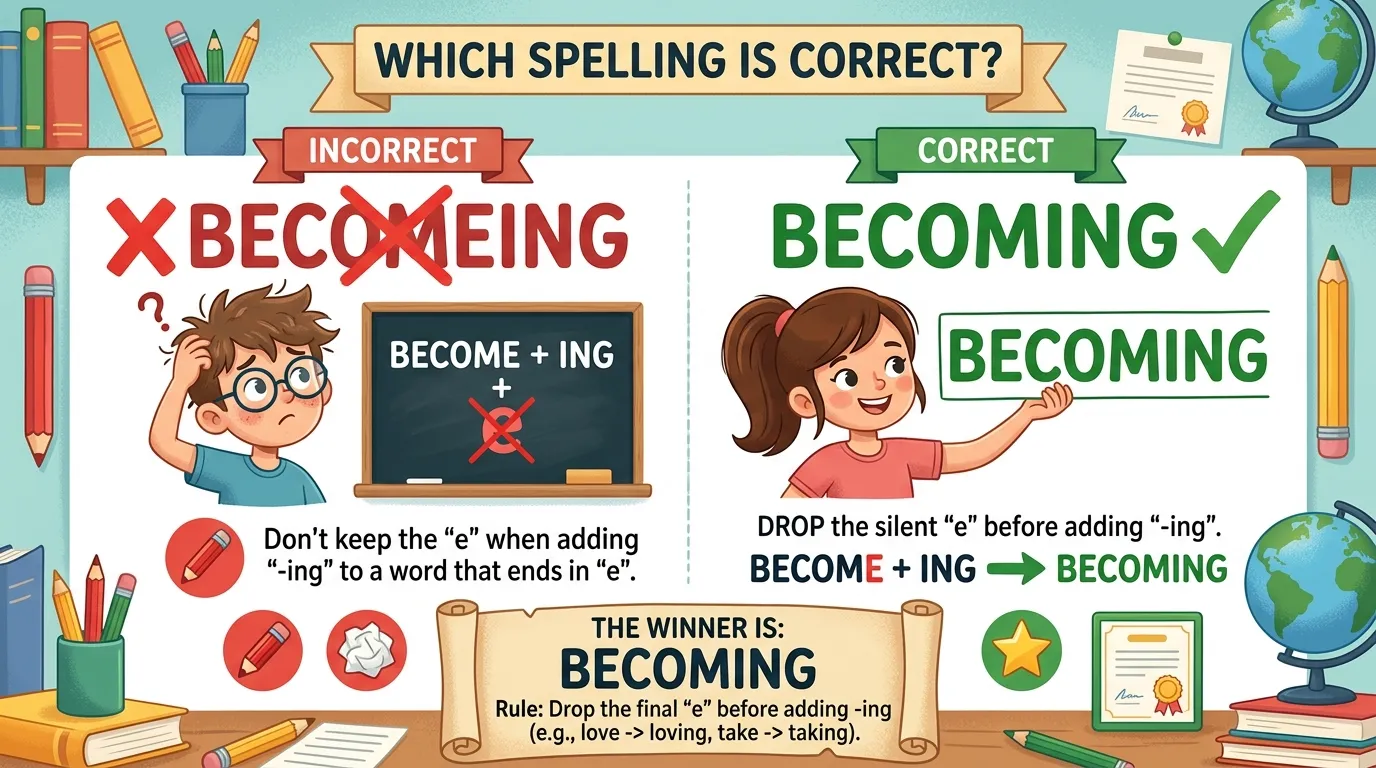
The tailor steps back from the fitting mirror and nods. The jacket fits. The client turns left, then right, and the tailor says the sentence every tailor says when the work is right: “That is very becoming on you.” The client smiles — and then, telling a friend about the fitting later, types the word from the tailor’s sentence into a message about something else entirely: “She is becomeing more confident.” The error is one letter, an E that should have left the word and did not. The correct spelling is becoming. Becomeing is a misspelling. And the two uses of the word in this story — the jacket that is becoming, and the person who is becoming — are the key to understanding why the E has to go.
Becoming is the only correct spelling. Becomeing is a misspelling. The rule behind it is one of the most reliable in English: when a verb ends in a silent E, the E drops before a suffix that begins with a vowel.
The Fitting Room
Start with the word doing its first job. Becoming is the present participle of the verb become — to grow into, to change into, to come to be. “She is becoming more confident.” “The weather is becoming warmer.” “He’s becoming a great leader.” “The situation is becoming difficult.” In each sentence, the word describes a change in progress — something that is not yet finished, but is on its way.
The word’s second job is rarer and more elegant: as an adjective, becoming means flattering, suitable, or attractive — the way the tailor used it. “A becoming dress.” “A becoming color.” “That hat is very becoming on you.” In this sense, the word describes something that suits the wearer, that makes them look their best. The two jobs share a root idea: something coming into its proper form.
The two jobs are connected by the verb’s core meaning. To become is to grow into what something is meant to be. A dress that is becoming helps the wearer become — helps them grow into their best appearance. A person who is becoming more confident is growing into their best self. The tailor’s compliment and the friend’s observation are the same word doing two jobs, and both of them spell it the same way.
The E That Leaves
The spelling rule is simple. Become ends in a silent E. When you add the suffix -ing, which begins with a vowel, the silent E drops: become minus E plus ing equals becoming. The formula is the same one that governs hundreds of English words: make + ing = making, take + ing = taking, write + ing = writing, shine + y = shiny, love + able = lovable.
The E drops because it has done its job. The silent E in become exists to make the O long — to keep become from being pronounced “beh-CUM.” Once the suffix -ing arrives, the vowel is protected by the suffix itself, and the E is no longer needed. English deletes it, the way a tailor removes the basting stitches once the seam is sewn. The stitches held the fabric while it was being fitted. The seam holds it now.
The misspelling becomeing keeps the E that the rule says to delete. The error is understandable, because the hand wants to preserve the base word whole — become + ing = becomeing — the way a tailor might hesitate to cut a thread that looks load-bearing. But the thread is not load-bearing. It is scaffolding, and the rule removes it.
The E That Stays
The rule has exceptions, and they are instructive — because becoming is not one of them. The E stays when dropping it would create confusion or an awkward spelling. Dye + ing becomes dyeing, not dying — because dying already means something else. Singe + ing becomes singeing, not singing — same reason. Eye + ing becomes eyeing, because dropping the E would leave an unpronounceable stump.
None of these exceptions apply to becoming. Dropping the E creates no confusion, no ambiguity, no awkwardness. There is no other word spelled becoming that the form could collide with. The E goes, and the word is becoming. The exceptions prove the rule by showing what the rule is protecting against — and becoming needs no protection.
There is one more case worth knowing: when the suffix begins with a consonant, the E usually stays. Become + ment would keep its E — though English does not actually form becomement; the noun for the process is becoming itself, or development. The pattern is general: vowel suffix, E drops; consonant suffix, E stays. Care + less = careless. Hope + ful = hopeful. The -ing suffix begins with a vowel, so the E drops.
Becoming in the Wild
The word appears in every register, and its spelling matters in all of them. In business: “The company is becoming a market leader.” In education: “She is becoming fluent in Spanish.” In news: “The situation is becoming critical.” In personal writing: “I am becoming the person I want to be.” In each case, the word is doing the same job — naming a change in progress — and the E is gone in all of them.
The adjective form has its own life. “A becoming dress” is the classic collocation. “Becoming modesty” is an old-fashioned phrase for modesty that suits a person. “What is becoming of him?” is a question about what is happening to someone — a slightly formal, slightly worried inquiry. “It is becoming on you” is the tailor’s compliment, formal and precise. In all of them, the spelling is the same.
The word also appears in a set of fixed phrases. Becoming increasingly clear. Becoming apparent. Becoming a reality. Becoming obsolete. Each phrase uses the participle to describe a process reaching a state, and each one drops the E.
Becoming a Butterfly: The Word in Nature
Nature gives becoming its most vivid illustration: metamorphosis. A caterpillar becomes a butterfly. A tadpole becomes a frog. A seed becomes a tree. In every case, the word describes a transformation — not a sudden switch, but a slow process with stages, each one leading to the next. The caterpillar does not wake up a butterfly. It becomes one, day by day, inside a chrysalis, in a process that takes weeks.
The biological sense is the verb’s core meaning in its purest form: to grow into what something is meant to be. A caterpillar is meant to become a butterfly the way a student is meant to become a graduate — not by accident, but by development. The process has a direction, and the word names the movement along it. That is why becoming feels so different from changing. Changing can go in any direction. Becoming goes toward something — toward the form the thing is growing into.
There is also the phrase becoming extinct — the process by which a species disappears. “The tiger is becoming extinct.” Here the word describes a process in the opposite direction: not growth toward a form, but loss of one. The verb is neutral about the direction. It names the process, and the sentence names the destination — whether that destination is a butterfly or an empty forest.
Becoming in Idioms: What Is Becoming of Us?
The verb has a set of idioms that show its range. What is becoming of him? asks what is happening to someone — a question about fate, not fashion. It is becoming clear means understanding is arriving gradually. Becoming a reality means a plan or dream is turning real. Becoming a habit means a behavior is settling into routine. In every idiom, the word is doing the same job: naming a process that is underway, a change that has started and has not yet finished.
There is also the phrase becoming a thing of the past — something disappearing from use. “Handwritten letters are becoming a thing of the past.” The phrase is gently mournful, and it shows the verb’s neutrality: becoming can describe arrival or departure, growth or loss. The verb names the movement. The sentence names the destination.
And one final note on the adjective: becoming as “flattering” has a near-synonym, flattering itself, and a near-opposite, unbecoming — behavior or clothing that does not suit a person. “Unbecoming conduct” is an old-fashioned phrase for behavior beneath someone’s dignity. The pair — becoming and unbecoming — divides the world of appearance and behavior into what suits and what does not, and both members spell the participle the same way: no E.
The Tailor’s Test
Back in the fitting room, the jacket fits, the mirror agrees, and the word is doing both of its jobs at once: the client is becoming more confident in a jacket that is becoming on her. When the word appears in your draft, run one check: did you drop the E? Become minus E plus ing equals becoming.
And if you ever feel the pull toward becomeing, remember the basting stitches. The E held the vowel long while the word stood alone. The suffix holds it now. The stitches come out, the seam holds, and the word — like the jacket — fits exactly as it should.