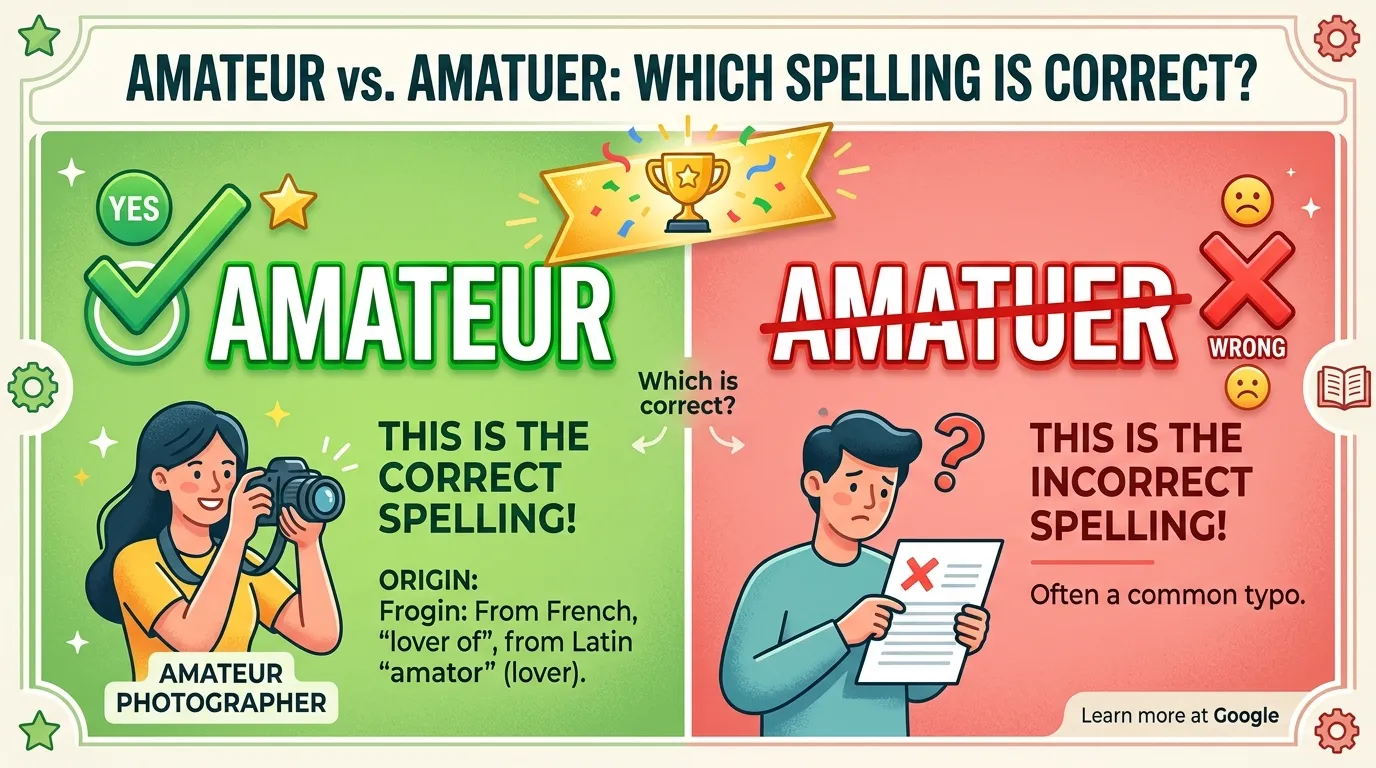
The Olympic stadium is packed for the opening ceremony, and the commentator is explaining a word that the Games were built on. “Every athlete here,” he says, “was once an amateur.” The word flashes on the screen behind him: AMATEUR. In the press box, a young reporter types it into her notes — and transposes two letters. AMATUER. The error is small, the meaning is clear, and it is wrong. The correct spelling is amateur. Amatuer is a misspelling. The two letters that swap are E and U, and they swap because the word’s ending is one of the most unusual in English.
Amateur is the correct spelling. Amatuer is a misspelling. The word appears in dictionaries, newspapers, academic writing, sports reporting, and official documents — always with the same letter order: A-M-A-T-E-U-R.
The Opening Ceremony
Start with what the word means. An amateur is a person who does something for enjoyment rather than as a profession — someone who practices a sport, art, hobby, or other activity for pleasure instead of for pay. “She entered an amateur photography contest.” “He played amateur football for years before turning professional.” As an adjective, the word describes something done by a non-professional: “an amateur video,” “amateur dramatics.”
The word’s history is the Olympic story in miniature. The ancient and modern Olympic Games were founded on amateurism — the idea that athletes should compete for love of the sport, not for money. For most of the twentieth century, the Olympics barred professionals. That rule is gone now, but the word remains, and it still carries the echo of its origin: an amateur does something because they love it.
The word also has a second, less flattering sense. In everyday speech, amateur can mean unskilled, inexperienced, or unprofessional: “an amateur job,” “amateur hour.” The judgment depends on the sentence. “An amateur photographer” is a neutral description. “An amateur mistake” is a criticism. The word names both the love and the lack of polish, and the context decides which one you hear.
The Lover in the Word
The spelling makes sense once you see where the word comes from. Amateur comes from the French amateur, which comes from the Latin amator — a lover. An amateur is, literally, a lover of the activity. The word’s ending, -eur, is the French ending that marks a person who does something: the same ending in entrepreneur, connoisseur, chauffeur, and voyeur.
The E-U order in the ending is the whole spelling puzzle. The French ending is -eur: E, then U, then R. The misspelling amatuer reverses the vowels: U, then E, then R. The reversal happens because English has many words ending in -ure — picture, nature, culture, future, structure — and the hand, reaching for the familiar pattern, writes -uer instead of -eur. The familiar pattern is wrong here, because amateur is not built on the -ure ending. It is built on the French -eur ending, and the French ending keeps its order.
There is a proof in the word’s relatives. Amateurish — the adjective for something done in an amateur way — keeps the E-U order: A-M-A-T-E-U-R-I-S-H. Amateurism — the noun for the amateur principle — keeps it too. The E-U order survives every suffix the word takes, and it is the spelling’s most reliable feature.
Amateur vs Professional vs Novice
Amateur has close neighbors, and keeping them distinct sharpens a sentence. A professional does something for pay. An amateur does it for love. A novice is a beginner — someone new to the activity, whether paid or not. A dilettante dabbles without commitment. A hobbyist pursues something as a hobby. The words describe different axes: paid versus unpaid, experienced versus new, committed versus casual.
The distinctions matter in sports, where the words carry legal weight. An amateur athlete and a professional athlete compete under different rules, in different leagues, with different eligibility. A novice athlete is simply new. A professional who calls themselves an amateur is misrepresenting their status. The words are not interchangeable, and the spelling is part of the precision: a sports report that misspells amateur undermines its own authority on the very distinction it is reporting.
There is also a tone point. Calling someone an amateur in a professional context is an insult — it says they are not good enough to be paid. Calling someone an amateur in a hobby context is a compliment — it says they do it for love. The word’s meaning flips with the setting, and the writer’s job is to know which setting the sentence is in.
Amateur in the Wild
The word appears in every register, and its spelling matters in all of them. In sports: “amateur boxing,” “amateur status,” “amateur league.” In the arts: “amateur theater,” “amateur photography,” “amateur musician.” In business: “amateur investors.” In everyday speech: “I’m just an amateur.” In each case, the word is doing the same job — naming someone who does something for love rather than pay — and the E-U order holds.
The word also appears in a set of fixed phrases. Amateur hour means a period of incompetent work. Amateur dramatics is British English for community theater. Amateur night is a talent show for non-professionals. Rank amateur is an emphatic form — someone completely unprofessional. In all of them, the spelling is the same.
Amateurism and the Olympics: A Short History
The Olympic story deserves a closer look, because it is the word’s most famous stage. When Pierre de Coubertin revived the Olympic Games in 1896, he built them on the amateur ideal: athletes should compete for honor, not for money. The rule was strict. Athletes who had ever been paid for sport were barred. The ideal was aristocratic — it assumed that athletes did not need to earn a living from their sport — and it excluded, in practice, working-class athletes who could not afford to train without pay.
The twentieth century dismantled the rule piece by piece. Tennis admitted professionals. Basketball admitted professionals. The “amateur” requirement became, in many sports, a fiction maintained by shamateurism — athletes who were paid under the table while officially classed as amateurs. By the 1990s, the Olympic movement had largely abandoned the amateur requirement, and the Games became openly professional. The word amateur survived the change, but its Olympic meaning narrowed: today, an Olympic amateur is simply an athlete who competes without professional status in a sport that still distinguishes the two.
The history matters because it shows the word’s two faces in action. The amateur ideal was noble — sport for love — and it was also exclusionary — sport for those who could afford it. The word carries both faces still. To call someone an amateur can praise their love of the game, or it can damn their lack of polish. The history is the reason the word never settled into a single tone.
The Amateur in Art and Science
Sport is not the only field where amateur does important work. In the arts, the amateur tradition is the backbone of community culture: amateur theater, amateur choirs, amateur orchestras, amateur photography clubs. These are not second-rate versions of professional art. They are a different kind of art — art made by people who do it because they love it, performed for neighbors rather than for critics, judged by enthusiasm rather than by box office.
Science has its own amateur tradition, and it is older than the professional one. Amateur astronomers have discovered comets, tracked asteroids, and monitored variable stars for centuries. Amateur naturalists built the collections that became museums. Today, citizen science — the modern name for amateur research — enlists thousands of volunteers to classify galaxies, count birds, and transcribe historical records. The amateurs in these fields are not dilettantes. They are contributors, and their work appears in peer-reviewed journals.
The pattern is the same in every field: the amateur does the work for love, and the love produces work that the professional world could not produce alone. The word’s Latin root — amator, a lover — is not a metaphor. It is the job description.
There is one more distinction worth carrying: an amateur can be world-class. The word describes motivation, not skill. An amateur astronomer who discovers a comet has done professional-quality work for love. An amateur chef who wins a cooking competition has beaten professionals at their own game. The word’s insult sense — amateur as unskilled — is a sloppy extension of its real meaning. The real meaning is about why someone does the work, not how well they do it.
The Medal Test
Back in the stadium, the commentator’s word is still on the screen: AMATEUR. When the word appears in your draft, run one check: does the ending read E-U-R? The French ending is -eur, the ending of a lover — and an amateur is, at root, a lover of the activity.
And if you ever feel the pull toward amatuer, remember the -ure trap. Picture, nature, culture — all end in -ure, and none of them is a person who does something. Amateur is a person, and persons take -eur. The E comes first, the U follows, and the lover stays in order.