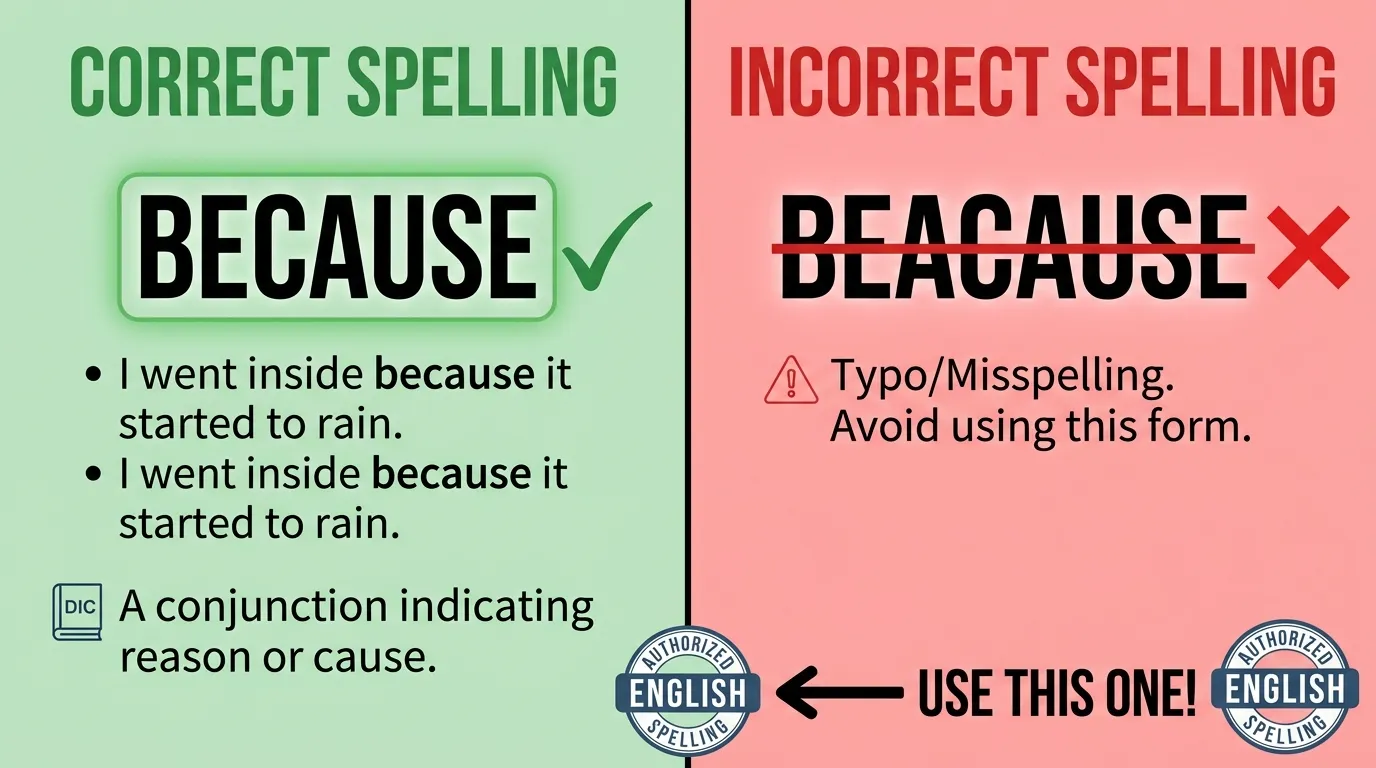
The detective’s evidence board is a tangle of photographs, receipts, and red string. Every string connects a clue to a conclusion, and every string has the same label written on it in marker: because. The suspect was at the diner because the receipt says so. The window was broken because the glass is on the inside. The alibi fails because the train was cancelled. In every sentence, because is the string — the word that ties a reason to a result. And then, on the board, one card is misspelled: beacause. The spelling is wrong. The correct spelling is because. The extra A is an intruder, and the reason it sneaks in is a story about sound, history, and a word that used to be two.
Because is one of the hardest-working words in English. It introduces reasons, explains motives, and justifies conclusions. It appears in every kind of writing, from police reports to love letters. And it is misspelled more often than almost any other short word, almost always as beacause. The error is understandable. The fix is simple once you see where the word came from.
The Evidence Board
Start with what the word does, because the job explains the spelling. Because is a subordinating conjunction: it introduces a clause that gives the reason for something. “She stayed home because she was sick.” “The flight was delayed because of the storm.” “He apologized because he meant it.” In each sentence, because connects two facts — the result and the reason — and tells the reader which is which.
The word does this job in every register. In a courtroom: “The defendant is guilty because the evidence proves it.” In a laboratory: “The solution changed color because the acid reacted with the metal.” In a kitchen: “The cake fell because the oven door was opened too soon.” In a text message: “Can’t come because I’m stuck in traffic.” The word is democratic. It works as hard in a text as it does in a verdict.
There is a second job, quieter but just as common: because as the answer to why. “Why did you leave?” “Because I had to.” “Why is the sky dark?” “Because a storm is coming.” The word is the natural partner of the question why, and the two words travel together through every conversation. When a child asks “why” for the tenth time, the parent’s answer begins with because — and often ends with “because I said so,” the most famous sentence in the language.
And there is a third job, the one that shows up in headlines and arguments: because as the hinge of an explanation. “The team lost because the goalkeeper was injured.” “Prices rose because demand outpaced supply.” The word marks the pivot from what happened to why it happened, and without it, the two halves of the sentence would sit beside each other without a connection. The string on the evidence board. The reason the board makes sense.
Two Words That Became One
Here is the fact that fixes the spelling. Because began life as two words: by + cause. In Middle English, writers wrote bi cause — “by cause of” — meaning “by reason of.” Over centuries, the two words fused into one: because. The fusion kept the spelling of both parents: be- from by, and -cause from cause.
This history explains the whole word. The be- at the start is a reduced form of by — the same be- that appears in before, behind, and below. The -cause at the end is the full word cause, spelled exactly as it is spelled on its own: c-a-u-s-e. There is no A after the be-. The A belongs inside cause, where it has always been. The misspelling beacause inserts a second A, as if the word were bea + cause. It is not. It is be + cause.
The fused-word history also explains why the word feels longer than it looks. Because carries the weight of two words — a preposition and a noun — inside a single conjunction. It is a compressed phrase, and compressed phrases keep the spelling of their parts. Before is be + fore. Because is be + cause. Once you see the seam, the spelling is obvious: spell cause correctly, put be- in front of it, and you are done.
There is a useful contrast with the word’s cousins. Become is be + come. Behave is be + have. Because follows the same pattern: be + a whole word. The be- prefix never gains an A. It is always be-, short and clean. Beacause breaks the family pattern by giving the prefix a letter it never had.
The Ear’s Trick
So why does the hand write beacause? Because of the ear. Say the word aloud: because. The first syllable, be-, is unstressed, and in fast speech it stretches. The vowel blurs. The ear hears something like “bee-uh-cause” — and the hand, trying to spell what it hears, inserts an A to represent the blur. The guess is reasonable. It is also wrong, because English spelling does not record every blur of fast speech. The word is spelled the way it is built, not the way it sounds in a hurry.
There is a second force pushing toward the error: the word cause itself. The -au- in cause is a distinctive spelling, and a writer who is thinking hard about cause can easily spill an extra A into the prefix. The brain, focused on the au in the middle, duplicates it at the front. The error is a kind of spelling echo — the A in cause bouncing forward into be-.
And there is a third force: the sheer frequency of the word. Because is typed thousands of times a day by every writer, and high-frequency words are the ones most vulnerable to slips. The hand moves fast, the brain moves faster, and the fingers add a letter that the brain did not authorize. Beacause is the classic fast-typing error: a word the writer knows perfectly, misspelled by speed.
The fix is to slow down on exactly one letter. When the word appears in your draft, look at the front. If you see bea-, the A is an intruder. Delete it. Be + cause. The evidence board is clean again.
Because Of, Because, and Just Because
The word has three common forms, and keeping them straight is worth a section, because each one is correct in its own place. Because introduces a clause: “She left because she was tired.” The clause has a subject and a verb. Because of introduces a noun phrase: “She left because of the noise.” The phrase has a noun, not a clause. The two forms are not interchangeable. “She left because of she was tired” is wrong. “She left because the noise” is wrong. Clause goes with because. Noun goes with because of.
The third form is the standalone: just because. “Just because I can.” “Just because.” This is the fragment form, the one that ends a conversation instead of explaining it. It is informal, and it is everywhere in speech. It works because the missing clause is understood: “just because [I want to]” or “just because [that’s the way it is].” The fragment is a complete thought in conversation, and a deliberate stylistic choice in writing. It is not an error — but it is not formal either. Save it for dialogue, essays with a conversational voice, and the dinner table.
There is also the family of shortened forms: cause, ’cause, cuz, cos. “I stayed ’cause I wanted to.” “Cuz I said so.” These are informal spellings of the same word, and they are all acceptable in casual writing, song lyrics, and dialogue. They are not acceptable in formal writing, where because is the only correct form. The shortened forms are costumes. Because is the suit.
One more construction worth knowing: because at the start of a sentence. “Because the train was late, she missed the meeting.” This is correct — the because-clause comes first, followed by a comma, then the main clause. The old schoolroom rule that a sentence must never begin with because was a myth, or at least a half-truth: what the rule really meant was that a sentence must never consist only of a because-clause. “Because the train was late.” — that is a fragment. “Because the train was late, she missed the meeting.” — that is a complete sentence, and a good one.
The Detective’s Test
Back to the evidence board. The detective’s test for because is the same test that works for every fused word: find the seam. Be + cause. Spell cause the way you would spell it on its own. Put be- in front. Done. The A lives inside cause, between the C and the U. It does not live in the prefix.
There is a second test, for the ear. Say the word slowly: be-cause. Two beats. The first beat is short: be. The second beat is the whole word cause. If you hear a third beat — be-a-cause — you are hearing the blur, not the word. Trust the two beats.
And a final check for the keyboard: when the word appears in your draft, count the A’s. Because has one A. Beacause has two. One A is correct. Two A’s is the intruder. The evidence board has exactly one A per string, and the case is closed.