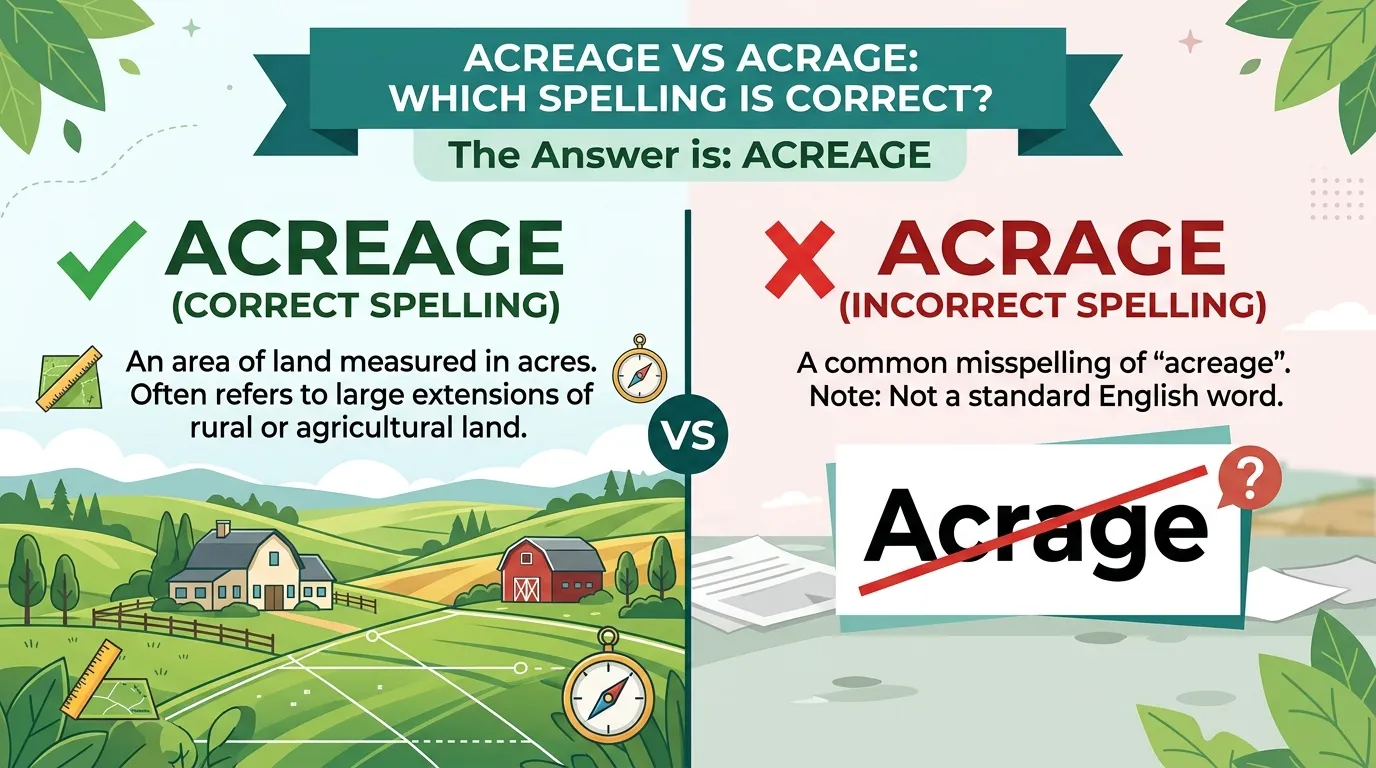
The will was read at the kitchen table, the way wills are read in farm families — with coffee going cold and three siblings doing quiet arithmetic in their heads. The farm was 120 acres. The will divided it into three parcels. And the lawyer’s letter, the one that would go to the county, described the property with a word that stopped the oldest sister mid-sentence: acreage. She had seen the word on real-estate listings for years. She had never been sure how to spell it. Was it acreage or acrage? The correct spelling is acreage. Acrage is a misspelling. The missing E is the whole story, and the story runs from an Old English field to a modern deed office.
Acreage is the word for the size of a piece of land measured in acres. It is the word on deeds, listings, surveys, and tax assessments. It is also a word that nearly everyone misspells at least once, because the E in the middle is silent, and silent letters are the first things the ear forgets.
Three Parcels, One Word
Start with the farm, because the farm shows every use of the word in one place. The whole property has an acreage of 120 acres. The north parcel — the one with the barn — has an acreage of 50 acres. The south parcel, the one by the creek, has an acreage of 40. The east parcel, the woodlot, has an acreage of 30. The word describes the area of a piece of land, expressed in acres, and it works for any size: a half-acre lot in a suburb has an acreage of half an acre, and a ranch in Montana has an acreage in the thousands.
The word shows up wherever land is bought, sold, taxed, or described. Real-estate listings lead with it: “Ten-acre parcel, level acreage, well and septic.” Tax assessments use it: “Acreage: 2.5. Land value: assessed accordingly.” Zoning hearings argue about it: “The proposed development covers an acreage of 80 acres.” News stories about wildfires report it: “The fire has burned an acreage of 15,000 acres.” In every context, the word does the same job: it turns a piece of ground into a number.
There is a second use, broader and more conversational: acreage as a general word for a large area of land, even when no one is counting. “They own a lot of acreage out in the county.” “The ranch covers serious acreage.” In this use, the word means “a large extent of land,” and the exact number does not matter. The speaker is saying: this is big. The word carries size as a feeling, not just as a figure.
And there is a third use, the figurative one, which has wandered far from the farm. “The company is gaining acreage in the market” — meaning market share. “The story is taking up a lot of acreage in the newspaper” — meaning column inches, space. The metaphor is the same in both: land as territory, and acreage as how much of it you hold. The word has traveled from the field to the boardroom, and it still carries the field with it.
The Acre in the Middle
Here is the fact that fixes the spelling. Acreage is built from two parts: acre + -age. The base word is acre, spelled a-c-r-e, with the E at the end. The suffix is -age, the same ending that appears in mileage, tonnage, footage, and storage. When the suffix attaches, the base word keeps its spelling whole: acre + age = acreage. The E stays. Nothing is deleted.
This is the opposite of what happens in many English words, and the contrast is the trap. In words like shine → shiny and make → making, the silent E drops before a vowel suffix. A writer who knows that rule can easily apply it to acreage and produce acrage — dropping the E before the A of -age. The application is logical. It is also wrong, because the drop-the-E rule has an exception, and acreage is in it.
The exception is this: when the suffix is -age and the base word ends in a silent E, the E usually stays, because dropping it would change the sound of the C or G before it. Acre + -age keeps the E, and so does mileage (mile + -age), lineage (line + -age), and tonnage is a different case — ton has no E to drop. The E in acreage is doing a job: it keeps the C soft, so the word is pronounced AY-ker-ij, not AK-rij. Delete the E, and the pronunciation collapses. The spelling keeps the sound.
The family confirms it. Mileage keeps the E of mile. Lineage keeps the E of line. Acreage keeps the E of acre. Three words, one rule, and the E survives in all three. Acrage breaks the family pattern by deleting a letter the family says to keep.
A Field’s History
The word acre is one of the oldest words in English. It comes from Old English æcer, meaning a field, and before that from a root shared with the Latin ager, meaning a field or piece of land — the same root that gives us agriculture and agrarian. An acre was originally not a precise measurement but a day’s work: the amount of land a team of oxen could plow in one day. The measure was standardized over centuries into the modern acre — 43,560 square feet — but the word kept its farming soul.
The suffix -age is younger. It came into English from French, where it formed nouns meaning “a collection” or “a measure”: mileage, tonnage, voltage, footage. When English speakers needed a word for “the area of land measured in acres,” they did what English always does: they glued the old word to the new suffix. Acre + -age = acreage. The word is a small history of the language: an Anglo-Saxon field and a French suffix, joined in one deed-office noun.
This history explains why the E matters. The E at the end of acre is not decoration. It is the last letter of an ancient word, and it has survived a thousand years of English. The misspelling acrage deletes a letter with a millennium of history behind it, all to save one keystroke. The deed office does not accept that trade.
There is also a practical reason the spelling matters more for acreage than for most words. Acreage appears on legal documents — deeds, surveys, contracts — where a misspelling can raise questions, delay a closing, or trigger a correction. A misspelled word on a deed is not a tragedy, but it is a nuisance, and nuisances in real estate cost money. The county clerk’s office does not grade spelling, but it does notice it, and a clean deed moves faster than a corrected one.
Acre, Acreage, and Area
Three words, three jobs, and keeping them distinct sharpens a sentence. An acre is a unit of measurement: 43,560 square feet. “The lot is two acres.” Acreage is the total area of a property expressed in acres: “The farm’s acreage is 120 acres.” Area is the general word for the size of a surface, in any unit: “The area of the room is 200 square feet.” Acre is the unit. Acreage is the total in that unit. Area is the general concept.
The confusion between acre and acreage is common in everyday speech. “How many acreage does the farm have?” is wrong — the question should be “What is the farm’s acreage?” or “How many acres does the farm have?” Acreage is a mass noun, like mileage or tonnage: you do not count acreages, you measure acreage. “The property has an acreage of 40 acres” is correct. “The property has 40 acreages” is not.
And the word has neighbors worth knowing. Frontage — the length of a property along a road or waterfront. Square footage — the area of a building in square feet. Hectare — the metric unit of land area, 10,000 square meters, about 2.47 acres. A listing that says “acreage: 5 acres (2.02 hectares)” is speaking two measurement languages at once, and the word acreage is doing the translating.
The Deed Office Test
Back at the kitchen table, the oldest sister has a test. She looks at the lawyer’s letter, and she looks for the E. Acre + age. The base word is whole. The E is there. The spelling is acreage.
The memory hook is the family. Mile → mileage. Line → lineage. Acre → acreage. Three base words that keep their E when -age arrives. If you can spell mileage — and almost everyone can — you can spell acreage, because it follows the same rule.
And one final check for the keyboard: when the word appears in your draft, look at the middle. If you see -cra-, the E is missing. Put it back. Acreage. The farm, the deed, and the county clerk all thank you.










