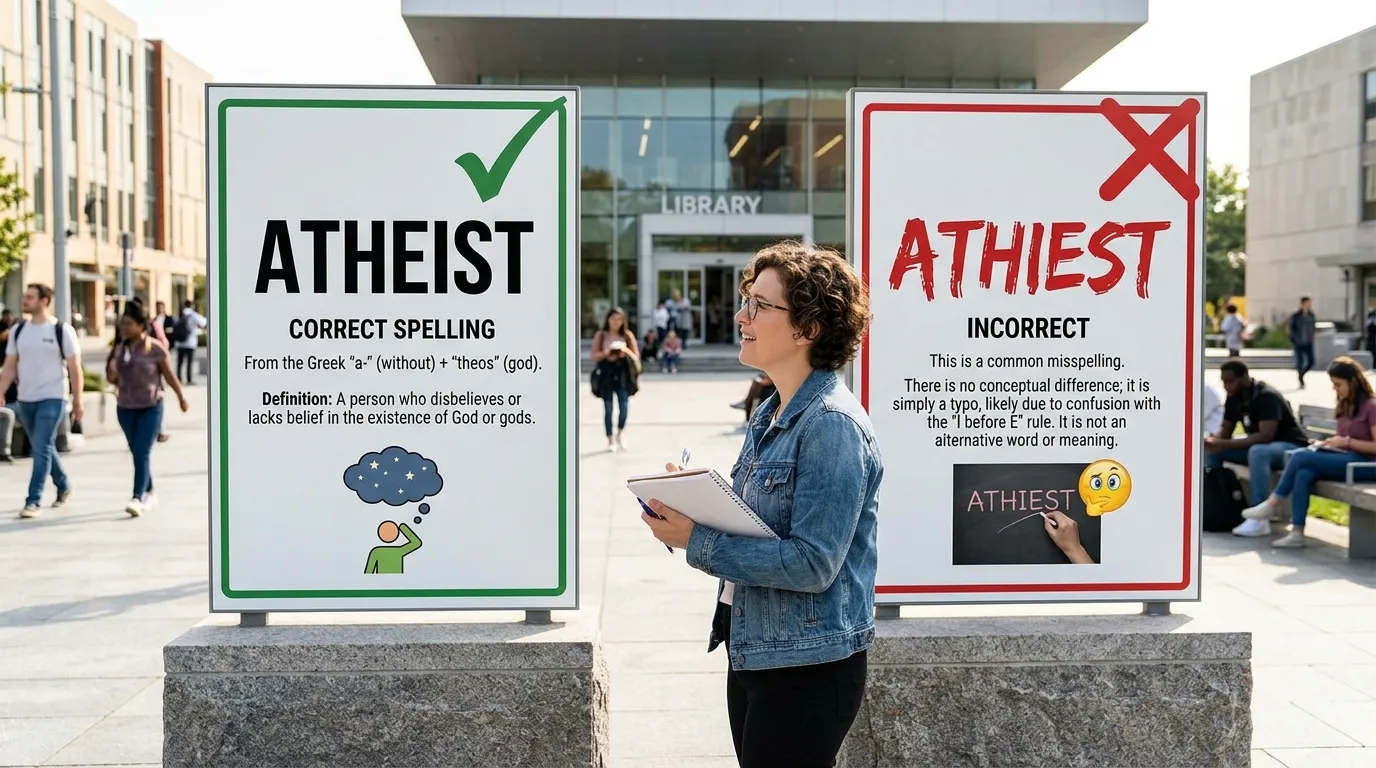
The spelling bee is down to two contestants. The pronouncer reads the word slowly, the way pronouncers do: “Atheist. A person who does not believe in the existence of God or gods. Atheist.” The first contestant steps to the microphone and spells it: A-T-H-I-E-S-T. The bell rings. Wrong. The second contestant takes a breath and spells it: A-T-H-E-I-S-T. Silence, then applause. The difference between the two spellings is two letters, swapped — the E and the I traded places — and it is one of the most common letter-order mistakes in the English language.
Atheist is the correct spelling. Athiest is a misspelling. The error is so widespread that thousands of people type athiest into search engines every month, and spell-checkers correct it every day. Understanding why the letters swap is the fastest way to stop swapping them.
The Bell
Start with the word itself. An atheist is a person who does not believe in the existence of God or gods. “Maria identifies as an atheist.” The adjective form is atheistic: “atheistic beliefs.” The abstract noun is atheism: the position that there is no God. The word is pronounced AY-thee-ist, with the stress on the first syllable and a long A sound that gives no hint of the spelling trouble to come.
Athiest, by contrast, has no accepted meaning in standard English. It is not a variant, not a regional spelling, not an archaic form. It is simply the correct letters in the wrong order. If someone writes “I am an athiest,” every reader understands what was meant — and every careful reader registers it as an error. The word does not appear in standard dictionaries, and professional writing never uses it.
The practical rule is absolute: in every context — essays, journalism, books, emails, social media — write atheist. There is no sentence in which athiest is the preferred spelling. The only question is how to remember the order, and the answer is in the word’s history.
The Greek Root: A + Theos
Atheist comes from Greek, and the Greek explains the letter order. The word is built from two pieces: the prefix a-, meaning “without” or “not,” and theos, meaning “god.” An atheist is literally a person “without god.” The E belongs to theos. The I belongs to the -ist ending, which marks a person who holds a position — the same -ist in scientist, artist, pianist, and realist.
Read the word as its parts and the order locks in: a + the + ist. The E comes before the I because the- comes before -ist. The misspelling athiest scrambles this order, putting the I of -ist before the E of the-, and the scramble is what the bell catches.
The family confirms the order. Theism is belief in a god or gods — the- plus -ism. Theist is a person who believes in a god. Theology is the study of God. Theocracy is rule by religious leaders. Every member of the family keeps the E of theos before whatever ending follows. Atheist is not an exception. It is the most regular member of the family.
Why the Letters Swap
If the order is so logical, why do so many people reverse it? Three forces push the letters around. The first is the most famous spelling rule in English, and it is the villain of this story: “I before E, except after C.” Generations of schoolchildren learned the rhyme, and it works for believe, field, piece, and chief. But the rhyme is a simplification, and it fails on atheist — because the E and the I belong to different parts of the word, and the rhyme was never meant to govern letters that straddle a boundary between a root and a suffix.
The second force is the existence of genuine I-before-E words with a similar shape. Priest is spelled I-E-S-T. Thief is I-E-F. A writer who knows priest can easily reason that atheist should follow the same pattern. It does not. Priest and atheist are different words with different histories, and their vowel orders are different because their roots are different.
The third force is speed. The E and the I in atheist sit in an unstressed syllable, and in fast speech the vowel sound blurs. The hand, typing quickly, reaches for the more familiar pattern — I before E — and produces athiest without the writer noticing. The error is a transposition, the same kind of slip that produces recieve for receive and beleive for believe. The fingers know the letters. They just put them in the wrong order.
Atheist, Agnostic, Theist
The spelling is worth getting right partly because the word sits in a family of positions that people confuse, and confusion about the spelling often travels with confusion about the meaning. A theist believes in a god or gods. An atheist does not believe in a god or gods. An agnostic holds that the existence of God is unknown or unknowable — a position about knowledge, not belief. An antitheist actively opposes belief in God. The four positions are distinct, and the words that name them are spelled distinctly.
The distinctions matter in writing about religion, philosophy, and public life, where precision is a courtesy. Calling an agnostic an atheist misdescribes their position. Calling a theist an atheist inverts it. And misspelling the word while discussing it — “the athiest position” — undermines the precision the writer is trying to achieve. The spelling is part of the argument’s credibility.
There is also a tone point worth hearing. Atheist is a neutral descriptive term, the way Christian, Muslim, and Jewish are neutral descriptive terms. It is not an insult, not a compliment, and not a political label. Writers who use it as one — in either direction — are importing a judgment the word does not carry. The word names a position. The sentence around it does the rest.
Atheist in the Wild
The word appears in every register, and its spelling matters in all of them. In academic writing: “The philosopher defended an atheist position.” In journalism: “The survey found that 7 percent of respondents identified as atheists.” In biography: “She became an outspoken atheist in her twenties.” In everyday conversation: “He’s an atheist, but he still celebrates Christmas with his family.” In each case, the word is doing the same job — naming a position — and the E-before-I order holds.
The word also appears in a set of fixed phrases. New Atheism names the movement of outspoken atheist writers in the 2000s. Atheist activism names organized advocacy. Practical atheism describes living as if there were no God, whether or not one holds the position formally. And the phrase “there are no atheists in foxholes” is a proverb — and a contested one — about fear and faith. In all of them, the spelling is the same.
The -ist Ending: A Person Who Holds a Position
The -ist ending in atheist is worth a closer look, because it is the part of the word that the misspelling scrambles. The ending -ist marks a person who holds a position, practices a discipline, or plays an instrument. A scientist practices science. A pianist plays the piano. A realist holds a realistic position. A novelist writes novels. An atheist holds the position that there is no God.
The ending is always spelled I-S-T, and it always comes last. That is why athiest fails twice: it puts the I of -ist in the wrong place, and it breaks the ending apart. The word’s structure is a sandwich — prefix, root, ending — and the misspelling shuffles the middle of the sandwich. Read the word as its three layers and the order is unavoidable: a (without) + the (god) + ist (a person). The E belongs to the middle layer. The I belongs to the last one.
The same structure appears in the word’s neighbors. Theist: the + ist. Deist: de (god, from Latin deus) + ist. Pantheist: pan (all) + the + ist. Every member keeps the E of the god-root before the I of the person-ending. Atheist is not the odd one out. It is the pattern’s most faithful example.
The Pronouncer’s Test
Back at the spelling bee, the second contestant’s winning move was not memory. It was structure. She heard the word, broke it into its parts — a, the, ist — and spelled each part in order. The test for your own writing is the same. When the word appears in your draft, break it apart: the prefix a- (without), the root the- (god), the ending -ist (a person). E before I, because the- comes before -ist.
And if you ever feel the pull toward athiest, remember the priest trap. Priest is I before E. Atheist is E before I. They are different words, and the rhyme that governs one does not govern the other. The E belongs to the god. The I belongs to the person. Keep them in order, and the bell stays silent.