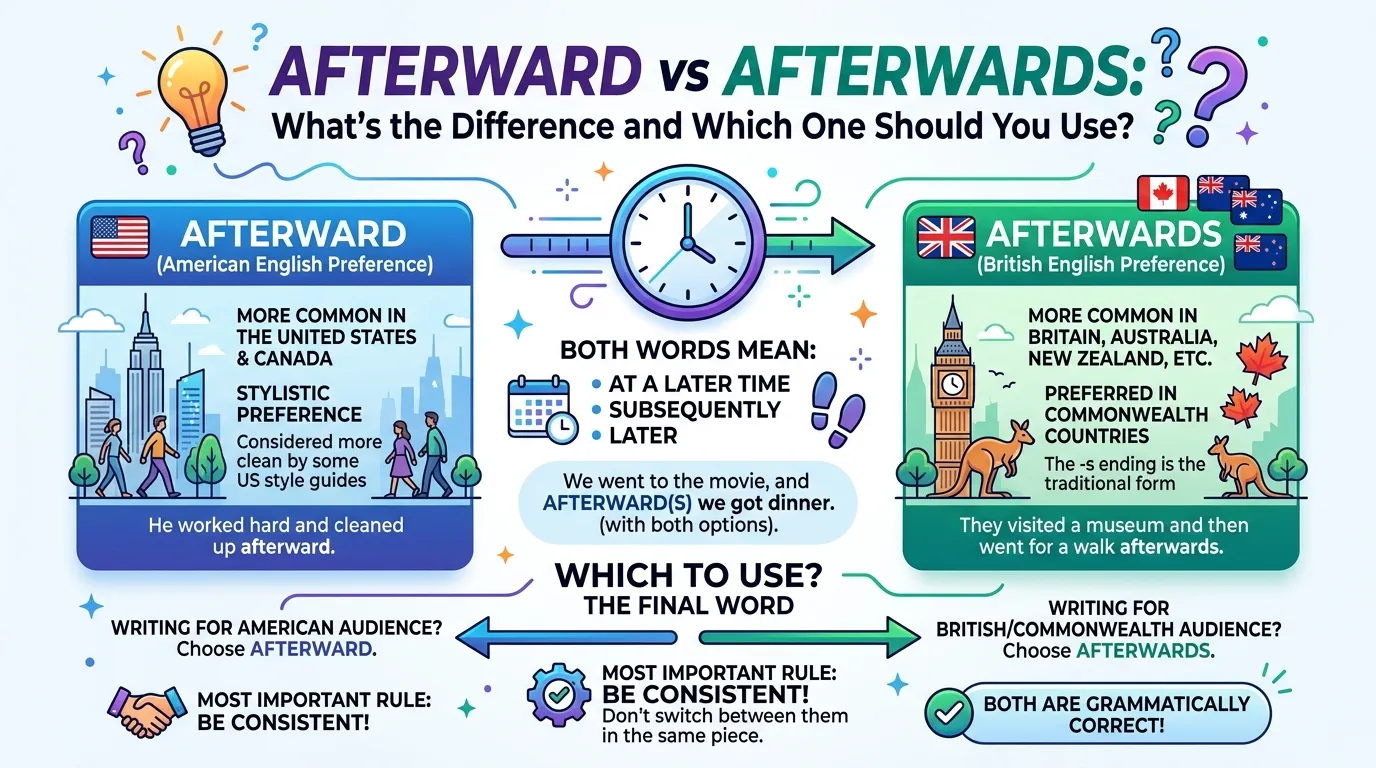
Afterward vs Afterwards: What’s the Difference and Which One Should You Use?

If you have ever wondered about afterward vs afterwards, you are not alone. Both words are correct, both function primarily as adverbs, and both mean essentially the same thing: at a later time or after something has happened.

The main difference is regional preference. In American English, afterward is generally more common. In British English and some other varieties of English, afterwards is often preferred. Neither spelling is inherently wrong, and the choice usually does not change the meaning of a sentence.

For example:

  • We went home afterward.
  • We went home afterwards.

Both sentences mean that we went home after the event or activity.

This guide explains the difference between afterward and afterwards, including their meanings, grammar, pronunciation, formality, regional usage, history, common mistakes, synonyms, collocations, and practical examples. You will also learn which form is usually best for American English, British English, academic writing, business communication, journalism, blogging, and everyday conversation.

Quick Answer: Afterward vs Afterwards

Afterward and afterwards have the same basic meaning. They are both adverbs meaning later, after that, or at a later time.

WordMeaningGrammarCommon preference
afterwardlater; after thatAdverbMore common in American English
afterwardslater; after thatAdverbMore common in British English
afterward(s)at a later timeAdverbBoth are correct

Which one should you use?

If you are writing for an American audience, choose afterward for the most natural and consistent style.

If you are writing for a British audience, afterwards is completely natural and widely used.

The important point is that afterwards is not an incorrect version of afterward, and afterward is not an incorrect version of afterwards.

What Does Afterward Mean?

Afterward means at a later time, after something has happened, or after a particular event.

It is an adverb that tells readers when something happens.

Examples of afterward

  • We had dinner and went for a walk afterward.
  • She apologized afterward.
  • I realized my mistake afterward.
  • They discussed the problem afterward.
  • He felt much better afterward.

In each example, afterward refers to a time following an earlier action or event.

Consider this sentence:

We watched the movie and talked about it afterward.

Here, afterward means after watching the movie.

The word does not need to be followed by a noun.

Compare:

  • We talked afterward.
  • We talked after the movie.

The first uses an adverb. The second uses the phrase after the movie.

What Does Afterwards Mean?

Afterwards has essentially the same meaning as afterward.

It means later, after that, or following the event just mentioned.

Examples include:

  • We went to a restaurant afterwards.
  • She called me afterwards.
  • They laughed about it afterwards.
  • I felt tired afterwards.
  • He explained what happened afterwards.

There is no meaningful difference in the basic meaning.

For example:

She went home afterward.

and

She went home afterwards.

Both mean:

She went home later, after the event being discussed.

The extra s in afterwards does not create a different meaning.

Afterward vs Afterwards: The Key Difference

The biggest distinction is regional usage, not meaning.

American English: afterward

American English generally favors afterward.

Examples:

  • We can talk about it afterward.
  • I’ll call you afterward.
  • What happened afterward?
  • She apologized afterward.
  • They left shortly afterward.

For American readers, afterward often sounds slightly more natural because it is the standard form commonly used in U.S. writing.

British English: afterwards

British English commonly uses afterwards.

Examples:

  • We can talk about it afterwards.
  • I’ll call you afterwards.
  • What happened afterwards?
  • She apologized afterwards.
  • They left shortly afterwards.

British speakers generally understand afterward perfectly well, however. It is not grammatically wrong in British English.

Likewise, American readers understand afterwards, even though afterward is often the more typical American choice.

Is Afterward or Afterwards Correct?

Both are correct.

This is one of the most important points to remember.

You do not need to treat one spelling as correct and the other as incorrect.

Correct examples

  • We went shopping afterward.
  • We went shopping afterwards.
  • I’ll explain everything afterward.
  • I’ll explain everything afterwards.
  • She felt relieved afterward.
  • She felt relieved afterwards.

The difference is mainly style and regional preference.

Why Do People Confuse Afterward and Afterwards?

The confusion usually comes from the fact that English has several pairs of words that differ by -ward and -wards.

For example:

  • toward / towards
  • backward / backwards
  • forward / forwards
  • afterward / afterwards

In many cases, both versions exist.

The spelling with -s can look like a plural form, but that is misleading. In afterwards, the s does not make the word plural.

It is part of the adverbial form.

That is why you should not think of:

  • afterward = singular
  • afterwards = plural

That distinction does not apply.

Afterward vs Afterwards Grammar

Both words normally function as adverbs.

An adverb can modify a verb, clause, or entire statement by providing information about time, manner, place, or another circumstance.

With afterward and afterwards, the main function is to indicate time.

Example

We finished the meeting and left afterward.

The word afterward tells us when we left.

Another example

She studied for three hours and rested afterwards.

The word afterwards tells us when she rested.

Neither word normally functions as a noun, adjective, or verb in standard modern English.

Where Should You Put Afterward or Afterwards?

These adverbs are flexible and can appear in several positions.

At the end of a sentence

This is extremely common.

  • We talked afterward.
  • They went home afterwards.
  • I regretted it afterward.

After the subject

This is also possible.

  • She afterward explained what happened.
  • He afterwards admitted that he was wrong.

However, this placement can sound more formal or literary.

At the beginning of a sentence

You can also place the word at the beginning when you want to emphasize the sequence.

  • Afterward, we went home.
  • Afterwards, she called her sister.

This is grammatical, but in everyday American writing, ending the sentence with afterward often sounds more natural.

Afterward vs Afterwards Pronunciation

The two words are pronounced almost identically.

Afterward

A common pronunciation is approximately:

AF-ter-werd

The final sound ends with -ward.

Afterwards

A common pronunciation is approximately:

AF-ter-werdz

The major difference is the final s sound.

So:

  • afterward → ends with a d sound
  • afterwards → ends with a dz sound

The pronunciation difference is small, and speakers of American and British English will generally understand both without difficulty.

Is Afterward More Formal Than Afterwards?

Not necessarily.

Neither word is inherently formal or informal.

The choice is primarily related to regional preference and writing style.

For example, both of these can appear in formal writing:

  • The participants completed the survey and were interviewed afterward.
  • The participants completed the survey and were interviewed afterwards.

In American English, the first may be preferred. In British English, the second may be more common.

The important factor is not formality but consistency with your chosen variety of English.

Afterward vs Afterwards in Academic Writing

Both forms are grammatically acceptable in academic writing.

However, if you are writing in American English, afterward is usually the safer default.

American academic example

The researchers collected the responses and analyzed them afterward.

For British academic writing:

The researchers collected the responses and analyzed them afterwards.

Academic writers should prioritize consistency. If your paper otherwise follows American spelling and grammar conventions, afterward fits naturally.

If your institution or publication uses British English, afterwards may be preferable.

Afterward vs Afterwards in Business Writing

In professional communication, both forms are acceptable.

For American business writing, these sentences sound natural:

  • I’ll send the report afterward.
  • We can discuss the details afterward.
  • The team will meet afterward.
  • Please complete the form and submit it afterward.

For British business writing, you may see:

  • I’ll send the report afterwards.
  • We can discuss the details afterwards.
  • The team will meet afterwards.

Practical recommendation

When writing for an international company, follow the organization’s existing style guide.

If there is no style guide:

American audience: use afterward.

British audience: use afterwards.

Mixed international audience: either is understandable, but choose one and use it consistently.

Afterward vs Afterwards in Casual Conversation

In casual speech, both are natural.

For example:

Let’s grab coffee afterward.

or:

Let’s grab coffee afterwards.

The preferred form depends largely on where the speaker is from.

American speakers are more likely to use afterward, while British speakers commonly use afterwards.

Neither sounds strange to a fluent English speaker.

Afterward vs Afterwards in Journalism

Journalistic writing can use either form.

American news writing will generally favor afterward because it follows American English conventions.

British journalism may favor afterwards.

Examples:

American style:

The player spoke to reporters afterward.

British style:

The player spoke to reporters afterwards.

Both are clear and grammatically correct.

Afterward vs Afterwards in Blogging and Online Writing

For blogs, websites, newsletters, and social content, either word works.

The best choice depends on your target audience.

If your website targets U.S. readers, afterward is usually the better default.

If your website targets readers in the United Kingdom, afterwards may feel more natural.

For global audiences, readability matters more than the extra s.

Do not repeatedly switch between the two without a reason.

For example, avoid writing:

We went home afterward. Afterwards, we watched television.

This is not grammatically wrong, but switching forms unnecessarily can make your style look inconsistent.

Choose one:

We went home afterward. Afterward, we watched television.

Or:

We went home afterwards. Afterwards, we watched television.

Afterward vs After: What Is the Difference?

These words are related but do not always work in the same grammatical way.

After can function as a preposition, conjunction, adjective, adverb, and part of various expressions.

Afterward is primarily an adverb.

Compare:

We went home after the meeting.

Here, after introduces the noun phrase the meeting.

But:

We went home afterward.

Here, afterward stands alone as an adverb.

Simple rule

Use after + noun/event when you want to name what follows.

Use afterward/afterwards when the earlier event is already understood.

Compare:

  • We talked after dinner.
  • We talked afterward.

Both are correct, but their structures are different.

Afterward vs Later

Later and afterward are close synonyms, but they are not always interchangeable.

Later means at a time after now or after another point in time.

Afterward specifically emphasizes what happens after a particular event or action.

Compare:

I’ll call you later.

This means at some future time.

But:

I’ll call you afterward.

This means after the event or activity currently being discussed.

Examples

I’ll see you later.

The reference point is broad.

I’ll see you afterward.

The reference point is a specific event or activity.

Afterward vs Then

Then can also indicate sequence, but it has a broader range of meanings.

For example:

We ate dinner, then watched a movie.

Here, then introduces the next action.

We ate dinner and watched a movie afterward.

Here, afterward refers back to the earlier event.

Both can describe sequence, but they are not always interchangeable.

Dictionary-Style Definition

Afterward

Part of speech: Adverb

Definition: At a later time; after something has happened; subsequently.

Example:

We discussed the issue afterward.

Afterwards

Part of speech: Adverb

Definition: At a later time; after that; subsequently.

Example:

We discussed the issue afterwards.

Core meaning

Both words communicate the idea:

after + a previously mentioned event

Word History and Etymology

The words afterward and afterwards developed from the same basic English idea: after combined with a directional or temporal ending related to -ward.

The suffix -ward has long been used in English to express direction or movement toward a particular point, as seen in words such as:

  • forward
  • backward
  • toward
  • afterward

Over time, afterward came to mean at a later time or following an event.

The form afterwards developed with the additional -s ending that appears in other adverbs, particularly in British English.

The two forms eventually became established as alternative adverbs with essentially the same meaning.

Synonyms for Afterward and Afterwards

Depending on context, possible synonyms include:

  • later
  • subsequently
  • thereafter
  • after that
  • following that
  • at a later time
  • in due course
  • from then on
  • later on

However, these are not perfect substitutes in every sentence.

Example

We talked afterward.

Possible alternatives:

We talked later.

We talked after that.

We talked subsequently.

The last version sounds considerably more formal.

Antonyms and Contrasting Time Expressions

There is no perfect single-word antonym for afterward, but several expressions describe an earlier time.

Examples include:

  • beforehand
  • previously
  • earlier
  • before
  • in advance
  • prior to that

Compare:

We discussed the plan beforehand.

with:

We discussed the results afterward.

These words establish opposite points in a sequence.

Common Collocations With Afterward

Some combinations occur naturally in everyday English.

Shortly afterward

Meaning: a short time later.

The meeting ended, and shortly afterward, everyone left.

Soon afterward

Meaning: soon after the earlier event.

She moved to another city soon afterward.

Immediately afterward

Meaning: directly after something.

The announcement was followed immediately afterward by a press conference.

Right afterward

Meaning: immediately or very soon after.

Call me right afterward.

Shortly afterwards

The British-preferred counterpart is commonly written:

Shortly afterwards, the team returned to the hotel.

Common Expressions With Afterward

Some useful expressions include:

  • immediately afterward
  • shortly afterward
  • soon afterward
  • right afterward
  • soon afterward
  • afterward that day
  • afterward that evening
  • the day afterward

Examples:

We met again shortly afterward.

She called me immediately afterward.

He understood the situation soon afterward.

Is “Afterward” Slang?

No.

Afterward is not slang.

It is a standard English adverb used in everyday speech and formal writing.

Likewise, afterwards is not slang.

There is no special hidden meaning associated with either spelling in standard English.

Does Afterward Have a Figurative Meaning?

Usually, afterward is literal and temporal.

It simply identifies a later point in time.

However, it can appear in figurative or emotional contexts because the events being discussed may have deeper meanings.

For example:

He thought everything would be fine afterward.

The word itself still means later. Any emotional or figurative meaning comes from the surrounding sentence, not from afterward.

Political, Sports, and Technical Usage

There is no special political, sports, or technical definition of afterward or afterwards.

The words retain their normal meaning across fields.

Political example

The candidate spoke to reporters afterward.

Sports example

The players celebrated afterward.

Technical example

The system was restarted afterward.

Medical or scientific example

The participants completed a follow-up questionnaire afterward.

The field changes the context, but not the basic meaning of the word.

Common Mistakes With Afterward and Afterwards

Mistake 1: Thinking Afterwards Is Wrong

Incorrect idea:

“Afterwards” is grammatically incorrect.

Correction:

Afterwards is completely correct.

It is especially common in British English.

Mistake 2: Thinking Afterward Is British Only

Incorrect idea:

“Afterward” is a British spelling.

Correction:

Afterward is especially common in American English.

Mistake 3: Treating the S as a Plural Marker

Incorrect:

Afterwards means more than one after.

Correction:

The s is simply part of the word afterwards.

It is not a plural ending.

Mistake 4: Using Both Forms Randomly

For example:

We went home afterward. Afterwards, we had dinner.

This is grammatically acceptable, but unnecessary switching can make your writing less consistent.

Better:

We went home afterward. Afterward, we had dinner.

Or:

We went home afterwards. Afterwards, we had dinner.

Mistake 5: Using “Afterward” When a Noun Is Needed

Consider:

We talked afterward the meeting.

This is incorrect.

Use:

We talked afterward.

Or:

We talked after the meeting.

Afterward cannot normally be placed directly before a noun like the meeting.

Awkward vs Natural Examples

Awkward

We discussed afterward the problem.

Natural

We discussed the problem afterward.

Or:

We discussed the problem afterward.

Awkward

Afterward the event, we went home.

Natural

After the event, we went home.

Or:

We went home afterward.

Awkward

I will afterward call you.

More natural

I’ll call you afterward.

The original sentences are not always strictly impossible, but the revised versions are much more natural for everyday modern English.

Formal Alternatives to Afterward

If you are writing in a highly formal context, you can sometimes replace afterward with:

  • subsequently
  • thereafter
  • following the event
  • at a later stage
  • at a later time
  • after the completion of the process

For example:

The committee reviewed the findings afterward.

More formal:

The committee subsequently reviewed the findings.

However, do not assume that longer or more formal wording is automatically better.

In many cases, afterward is clearer and more direct.

Afterward vs Thereafter

These words are related but have different stylistic qualities.

Afterward usually means later or after the event just mentioned.

Thereafter usually means from that point forward or after that time, and it has a more formal or legal tone.

Compare:

We had dinner afterward.

with:

The agreement remained in effect thereafter.

The second sentence describes what continued from a particular point onward.

Memory Trick: How to Remember Afterward vs Afterwards

Use this simple rule:

American = afterward

Think:

American English often drops the final s.

This is not an absolute rule for every English word, but it is a useful practical guideline for this pair.

For British English:

afterwards

If you are writing specifically for U.S. readers and you are unsure, afterward is a safe choice.

If you are writing specifically for British readers, afterwards is a natural choice.

Which Is Better: Afterward or Afterwards?

There is no universal winner.

The better choice depends on your audience.

Choose “afterward” when:

  • Writing in American English
  • Targeting U.S. readers
  • Following an American English style guide
  • Writing American business content
  • Writing for a U.S. academic audience
  • Creating U.S.-focused website content

Choose “afterwards” when:

  • Writing in British English
  • Targeting readers in the United Kingdom
  • Following a British English style guide
  • Writing for a British publication
  • Maintaining an established British writing style

Either is fine when:

  • Writing for a global audience
  • Speaking casually
  • Writing general English content
  • No specific regional style is required

Practical Style Recommendation

If you regularly create online content for an American audience, make afterward your default.

For example:

We’ll discuss the results afterward.

This is concise, natural, and standard for American English.

If your website is aimed at British readers:

We’ll discuss the results afterwards.

The most important rule is consistency.

You do not need to worry about readers misunderstanding either form. Instead, choose the version that fits the variety of English you are using and stick with it.

Afterward vs Afterwards: Side-by-Side Examples

ContextAmerican preferenceBritish preference
After a meetingWe talked afterward.We talked afterwards.
After dinnerWe went outside afterward.We went outside afterwards.
After a gameThey celebrated afterward.They celebrated afterwards.
After an interviewShe called me afterward.She called me afterwards.
After a classWe studied afterward.We studied afterwards.
After a tripWe rested afterward.We rested afterwards.
After an argumentThey apologized afterward.They apologized afterwards.
After a movieWe discussed it afterward.We discussed it afterwards.

The meaning remains essentially unchanged.

Everyday Examples of Afterward

Here are natural examples that fit American English:

  • I’ll see you afterward.
  • We can talk afterward.
  • What happened afterward?
  • She felt better afterward.
  • They went home afterward.
  • I apologized afterward.
  • We grabbed coffee afterward.
  • He called me shortly afterward.
  • The children went outside afterward.
  • We cleaned the kitchen afterward.
  • I’ll send you the details afterward.
  • They laughed about it afterward.

Everyday Examples of Afterwards

These examples are equally natural in British English:

  • I’ll see you afterwards.
  • We can talk afterwards.
  • What happened afterwards?
  • She felt better afterwards.
  • They went home afterwards.
  • I apologized afterwards.
  • We grabbed coffee afterwards.
  • He called me shortly afterwards.
  • The children went outside afterwards.
  • We cleaned the kitchen afterwards.
  • I’ll send you the details afterwards.
  • They laughed about it afterwards.

How to Choose the Right Word in SEO Content

For SEO writing, there is no need to force both versions repeatedly into your content.

Search engines can understand that afterward and afterwards are closely related variants.

Instead of unnatural repetition, write naturally.

For an American audience, use phrases such as:

  • afterward meaning
  • afterward definition
  • how to use afterward
  • afterward in a sentence
  • afterward vs afterwards
  • is afterward correct
  • American English afterward

For a British audience, relevant variations may include:

  • afterwards meaning
  • afterwards definition
  • how to use afterwards
  • afterwards in a sentence
  • British English afterwards
  • afterward or afterwards

The goal should be helpful coverage, not keyword repetition.

Final Recommendation for American English

If your primary audience uses American English, choose:

afterward

For example:

We went to dinner afterward.

This is the most natural default for U.S.-focused writing.

But remember that afterwards is also correct. If you encounter it in British writing, books, websites, or conversations, there is no need to “correct” it.

Frequently Asked Questions About Afterward vs Afterwards

1. Is “afterward” or “afterwards” correct?

Both are correct. They are adverbs with essentially the same meaning: later or after that. The main difference is regional preference. Afterward is more common in American English, while afterwards is especially common in British English.

2. Is afterward American or British English?

Afterward is especially common in American English. British English also uses it, but afterwards is often more common in British usage.

3. Is “afterwards” grammatically correct?

Yes. Afterwards is grammatically correct and is a standard English adverb. It is widely used, particularly in British English.

4. Does afterward mean the same as afterwards?

Yes. In ordinary usage, afterward and afterwards mean the same thing. Both generally mean at a later time, after that, or following an earlier event.

5. Which is better for American English: afterward or afterwards?

For American English, afterward is generally the preferred choice. It is concise and widely used in American speech and writing.

6. Which is more formal, afterward or afterwards?

Neither is inherently more formal. Both can be used in casual, professional, academic, and formal writing. The main difference is regional preference, not formality.

7. Can I use afterward at the beginning of a sentence?

Yes. For example:

Afterward, we went home.

It can also appear at the end:

We went home afterward.

Both structures are correct.

8. Is “afterwards” a plural word?

No. The s in afterwards does not make the word plural. Afterwards is an adverb, just like afterward.

9. Can afterward and later always replace each other?

No. They overlap in meaning but are not always interchangeable. Afterward normally refers to a time following a particular event, while later has a broader meaning and can refer to a future time without a specific preceding event.

10. Should I use afterward or afterwards in an essay?

Use the version that matches your chosen variety of English. For American English essays, afterward is a strong default. For British English essays, afterwards is often preferred. Above all, remain consistent.

Conclusion: Afterward vs Afterwards

The difference between afterward vs afterwards is much simpler than it may first appear.

Both words are correct English adverbs. Both mean later, after that, or at a time following an earlier event. The extra s in afterwards does not create a different meaning, and it does not make the word plural.

The main distinction is regional usage:

  • Afterward is generally more common in American English.
  • Afterwards is generally more common in British English.
  • Both forms are understood across major English-speaking varieties.
  • Neither form is inherently more correct.
  • Neither is slang.
  • Neither has a special political, sports, or technical meaning.
  • Both can be used in casual and formal writing.
  • Consistency matters more than choosing the “right” spelling universally.

If you are writing for an American audience, afterward is usually the best default:

We discussed the results afterward.

If you are writing for a British audience, afterwards is perfectly natural:

We discussed the results afterwards.

So, when deciding between afterward and afterwards, do not worry about correctness. Think about audience, regional English, style, and consistency. Once you know those factors, the choice becomes easy.

Leave a Comment