The auction room goes quiet as the final lot comes up: a small landscape, unsigned, but the catalog is confident about the painter. The paddle goes up at forty thousand, then fifty, then sixty. The hammer falls. The buyer leans to his neighbor and says, “I have always wanted to acquire a painting like this.” He says it correctly. If he had written it down in a hurry — a text, an email, a note in the catalog margin — he might have written aquire, dropping a letter that the ear barely hears. The missing letter is a C, and it is the entire difference between the correct spelling and the most common way to get this word wrong.
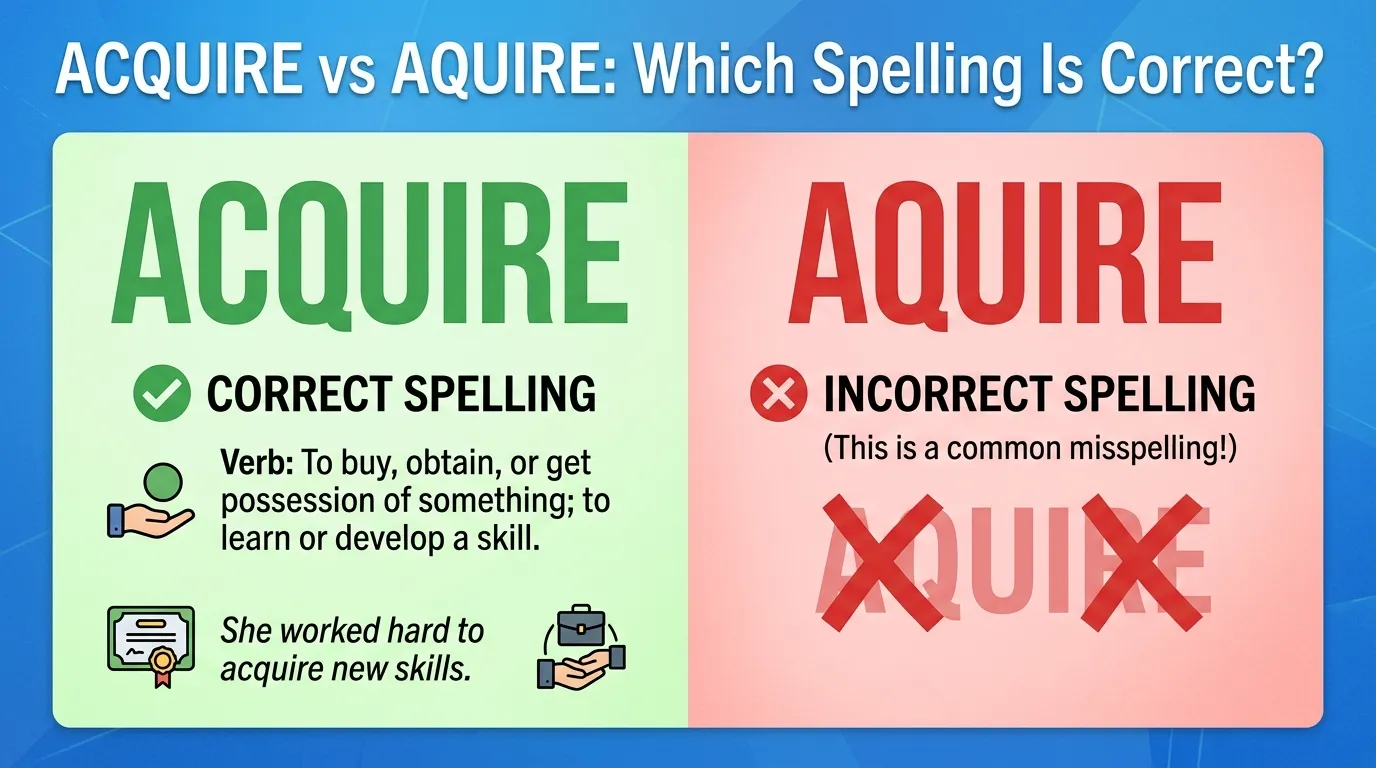
Acquire is the only correct spelling in English. Aquire is a misspelling. The error is common because the C is nearly silent in speech, but the spelling is not optional: dictionaries, style guides, and professional writing all recognize only acquire.
The Hammer Falls
Start with what the word means. Acquire is a verb meaning to get, obtain, gain, or develop something — usually gradually, deliberately, or through effort. “She hopes to acquire new skills this year.” “The company acquired a smaller competitor.” “He acquired a taste for strong coffee.” “The museum acquired the painting at auction.” In each sentence, the word describes something coming into someone’s possession or repertoire, not by accident but by a process.
The word carries a sense of intention that its synonyms do not. Get is quick and casual. Obtain is formal and procedural. Gain is about increase. Acquire is about the slow work of coming to have something — a skill learned over months, a collection built over years, a habit formed by repetition. That is why the word appears so often in résumés, business reports, and academic writing: it names the kind of getting that takes effort.
The pronunciation is the source of the trouble. Acquire is pronounced /əˈkwaɪər/ — “uh-KWIRE.” The first syllable is a soft, unstressed murmur. The C is there in the spelling, but in speech it merges into the KW sound of the Q that follows it, and the ear hears one consonant where the spelling has two. The hand, writing what the ear hears, writes aquire — and the error is born.
The Silent C: Seek, With Company
The C is not random. It is the fossil of the word’s Latin root. Acquire comes from the Latin acquirere — ad- (to, toward) + quaerere (to seek, to ask, to search for). To acquire is, literally, to seek something out and bring it toward yourself. The C belongs to the prefix ac-, the form that ad- takes before a Q. The Q belongs to quaerere. The word is two Latin pieces fused together, and the C is the seam.
The same Latin root runs through a whole family of English words, and the family proves the C is not an accident. Require — to seek again, to demand. Inquire — to seek into, to ask about. Conquer — to seek completely, to win. Quest — a seeking. Question — a seeking for an answer. Request — a seeking asked for. Every member of the family carries the Q of quaerere, and the members built on ad- carry the C that goes with it.
There is a second proof, closer to home. The noun form is acquisition — and in acquisition, the C is audible. “The acquisition of the company took six months.” Say it slowly: ak-wuh-ZISH-un. The C announces itself. The same is true of acquisitive, the adjective for someone eager to acquire things. The C that hides in acquire steps forward in its relatives, and the relatives prove it was there all along.
Acquire in Business
Business is where acquire does its heaviest work, and business writing is where the misspelling costs the most. A company acquires another company. An acquisition is the deal itself. Acquired is the past tense: “The startup was acquired last year.” Acquiring is the present participle: “We are acquiring new customers.” In all of these, the spelling is the same, and the C is non-negotiable.
The business sense has its own vocabulary. An acquirer is the company doing the buying. An acquiree is the company being bought. Acquisitive describes a company with a strategy of growth by acquisition. Acquisition cost is the price of gaining a customer. Each word in the family carries the C, and a misspelling in any of them — “aquisition cost” — reads as a lack of familiarity with the very field the writer is describing.
There is a useful distinction here, too. In business, acquire and merge are not synonyms. An acquisition is one company buying another. A merger is two companies joining as equals — at least in the press release. Writers who use the words interchangeably blur a distinction that matters to shareholders, regulators, and employees. The spelling is the small part of the precision. The word choice is the large part.
Acquire a Taste, Acquire a Habit
Beyond business, acquire has two figurative uses that every fluent writer should know. The first is acquire a taste: to come to enjoy something that was at first unfamiliar or unpleasant. “He acquired a taste for olives.” “She acquired a taste for black coffee.” The phrase captures the slow, deliberate nature of the verb — a taste is not acquired in a bite. It is acquired over weeks of trying.
The second is acquire a habit: to develop a pattern of behavior. “She acquired the habit of walking every morning.” “He acquired a reputation for punctuality.” The phrase works because habits, like tastes, are acquired gradually. And the word’s most famous collocation of all is the language-learning one: acquire a language. Linguists distinguish acquiring a language — absorbing it naturally, the way children do — from learning a language — studying it deliberately. The distinction is the verb’s core sense in miniature: acquiring is the slow, organic kind of getting.
The word also appears in a set of formal collocations: acquire knowledge, acquire experience, acquire property, acquire confidence, acquire wealth. In each case, the word is doing the same job — naming a gradual, intentional coming-to-have — and the C is doing the same quiet job in the spelling.
Acquire vs Obtain vs Gain
Acquire has close neighbors, and keeping them distinct sharpens a sentence. Obtain is the most formal of the three: it suggests a procedure, a request, a grant. “She obtained a permit.” Gain suggests increase: “He gained ten pounds.” “The team gained momentum.” Acquire suggests the slow accumulation of something valued: a skill, a collection, a reputation.
The choice among them is a matter of register and shade. “She acquired a permit” sounds slightly off — permits are obtained, not acquired, because a permit is granted by an authority, not accumulated by effort. “He obtained a taste for olives” sounds stiff — tastes are acquired, not obtained, because a taste grows gradually. The words are neighbors, not twins, and the right one depends on whether the getting was granted, increased, or grown.
One more neighbor: accrue. To accrue is to accumulate gradually, especially of money or benefits: “Interest accrues.” Accrue shares the ac- prefix and the C, but it describes growth that happens on its own, while acquire describes growth that someone pursues. Interest accrues whether you watch it or not. A skill is acquired because you practiced.
Acquired Immunity: The Word in Science
Science gives acquire one of its most precise uses: acquired immunity. In immunology, acquired immunity is the protection the body develops after exposure to a disease or a vaccine — as opposed to innate immunity, the protection you are born with. The word is exact: immunity is not granted or given. It is acquired, gradually, through exposure, the way a skill is acquired through practice.
The same precision appears in medicine’s phrase acquired condition — a condition that develops during a person’s lifetime, as opposed to a congenital one present at birth. And in psychology, acquired taste has a technical cousin: acquired behavior, behavior learned through experience rather than inherited. In every scientific use, the verb is doing the same job it does in the auction room: naming the slow, deliberate coming-to-have of something that was not there before.
There is also a warning in the scientific use. Acquired is sometimes confused with innate or inherited in casual writing about genetics and health. An acquired trait is one you develop. An inherited trait is one you are born with. Swapping the two changes the science, and in medical writing the swap can mislead a reader about cause, risk, and treatment. The spelling is the small part. The distinction is the large one.
The Seeker’s Test
Back at the auction, the buyer takes his painting home, and the word goes with him. When acquire appears in your draft, run one check: is the C there? The ear will not help — the ear hears “uh-KWIRE” and reports one consonant. The root will help: the word is ac- (toward) + quaerere (to seek), and the seeker needs both letters to do the seeking.
And if you ever feel the pull toward aquire, remember the relatives. Acquisition says the C out loud. Acquisitive says it again. The C that hides in the verb steps forward in the noun, and it was there all along — quiet in speech, essential in spelling, and the whole difference between the word and the mistake.