You arrive at the hotel, and the receptionist hands you a form: “Would you mind filling this in? It helps us improve.” At the doctor’s office, the nurse gives you another: a page of questions about your medical history. On your way out of a museum, a volunteer stops you with a tablet: “Just a few questions about your visit.” Three different places, three different forms — and one word for all of them.
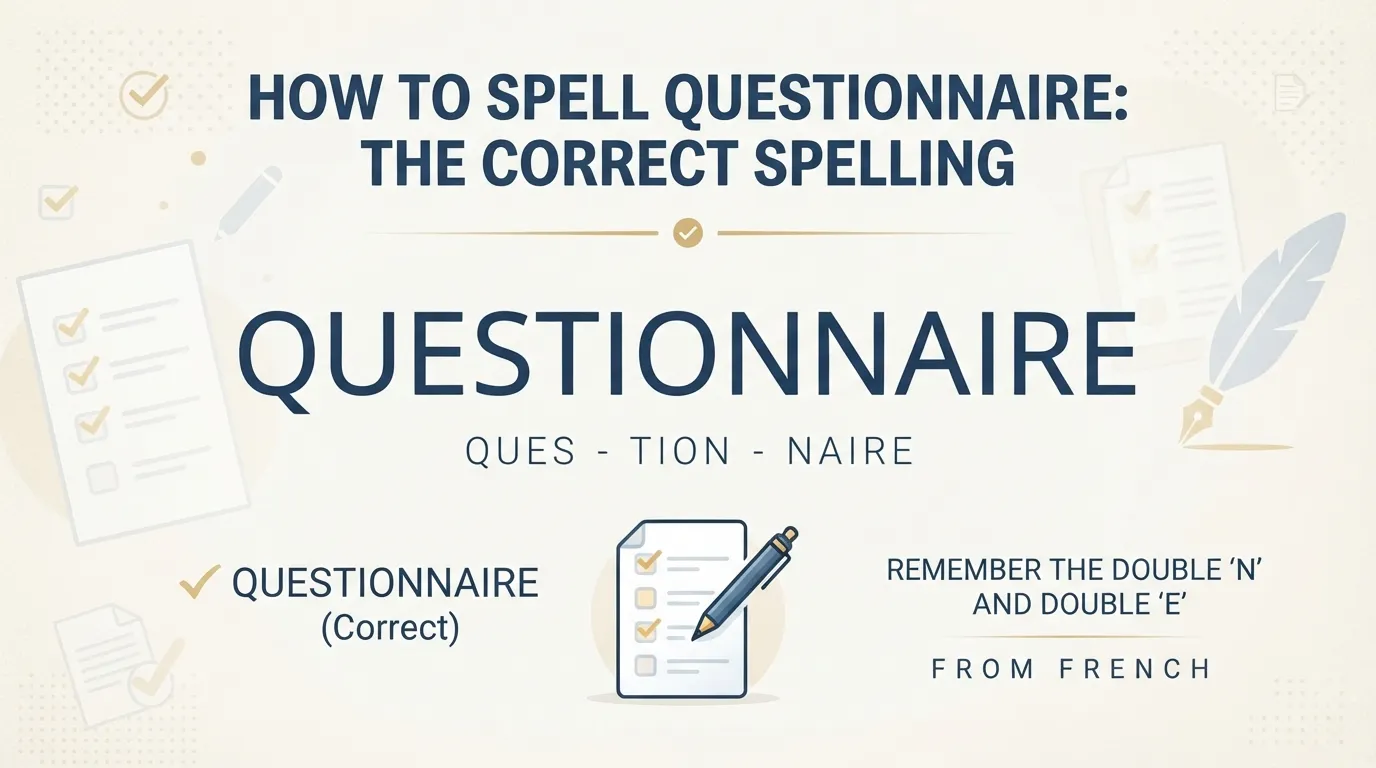
The word is questionnaire: Q-U-E-S-T-I-O-N-N-A-I-R-E. Fourteen letters, with a double N in the middle and a French-style ending. The most common mistake is writing “questionaire” with only one N, but that version is not the standard spelling in American or British English.
The Clipboard at the Door
A questionnaire is a set of written questions given to people so their answers can be collected, counted, or studied. It is used whenever someone wants to gather opinions, information, or feedback from a group. In plain terms: if a survey collects answers, the questionnaire is the actual list of questions on the page or screen.
You encounter questionnaires more often than you probably realize. A customer-satisfaction form after a hotel stay. A medical history form at a doctor’s office. A job-application assessment. A market-research poll about a new product. An academic study collecting data from students. A census form. A personality quiz used by a career counselor. In each case, the written document full of questions is the questionnaire — the same questions, given to every person, so the results can be compared.
What makes a questionnaire different from a conversation is exactly that sameness. An interviewer can improvise, follow up, and rephrase. A questionnaire cannot. The questions are fixed, printed, and identical for everyone, which is what makes the answers comparable. That fixed quality is also why the word matters: a questionnaire is a formal instrument, and formal instruments get spelled carefully.

Question + Naire
The word looks intimidating at fourteen letters, but it is really two familiar pieces joined at a seam. Split it there and the spelling becomes easy:
- QUESTION — Q-U-E-S-T-I-O-N, the ordinary word you already know how to spell.
- NAIRE — N-A-I-R-E, the same ending as “millionaire.”
QUESTION + NAIRE = questionnaire. Now look at the seam where the two pieces meet: the N at the end of “question” and the N at the start of “naire” come together to make the double N. Question + naire = questionnaire. The double N is not a decoration. It is two N’s from two different words, standing side by side where the pieces join.
That seam explains the most common error. When people say the word aloud, they hear only one N sound — “kwes-chuh-NAIR” — because doubled consonants in English are pronounced as single sounds. Writers naturally write a single N and produce questionaire. The ear hears one N; the eye must write two. The seam is the proof: both N’s survive, because both pieces keep their letters.
The ending causes the second family of errors. The “-naire” ending comes from French, and it is unusual in English, so writers improvise: questionnare (ending it like a rhyming word), questionnair (cutting off the final E, as if it were “chair”), questionnarie (swapping the I and E, the classic “-aire” vs. “-arie” mix-up). The correct ending is -NAIRE: N-A-I-R-E, pronounced like the end of “millionaire.” English has only a small family of words with this ending, and the most common models are millionaire, questionnaire, and legionnaire. If you can spell millionaire, you can spell the last five letters of questionnaire.
Questionnaire, Survey, Poll: Not the Same Thing
People use these three words as if they were interchangeable, and in casual conversation nobody minds. But they name different things, and the differences matter when you are writing precisely:
- Questionnaire — the document. The list of questions itself, on paper or on screen.
- Survey — the process. Designing the questions, distributing them, collecting the answers, and analyzing the results. A survey uses a questionnaire; the questionnaire is the survey’s tool.
- Poll — a quick vote, usually a single question or a handful, often about opinion: “Who will you vote for?” A poll can use a questionnaire, but it can also be a single question asked on the street.
So when a hotel asks you to fill in a form, the form is a questionnaire, and the hotel’s effort to learn what guests think is a survey. When a news channel asks one question of a thousand people, that is a poll. The words overlap, but they are not identical — and in research writing, using the right one signals that you know the field.
There is also the matter of who fills it in. A questionnaire is answered by a respondent — the person who responds. In research reports you will see phrases like “respondents completed the questionnaire” and “the questionnaire was administered to 500 participants.” These are the standard verbs: a questionnaire is “completed,” “filled in,” “administered,” or “distributed.” It is not “taken” the way a test is taken, though casual speech sometimes says so.

What Makes a Good One
Because questionnaires are instruments for gathering information, a badly designed one produces bad information. Researchers have learned, sometimes painfully, what makes a questionnaire work:
- Clear questions. Each question should ask one thing. “Was the food good and the service fast?” is two questions wearing one coat — a respondent who liked the food but not the service cannot answer it honestly.
- No leading questions. “Don’t you agree the new design is better?” pushes the respondent toward yes. A neutral version — “How would you rate the new design?” — lets the answer be honest.
- Closed questions for counting, open questions for stories. “Rate your stay from 1 to 5” gives numbers you can count. “What could we do better?” gives words you can learn from. Good questionnaires use both.
- A sensible order. Easy, neutral questions first; personal or sensitive questions later, after trust has been built.
- A reasonable length. A questionnaire that takes forty minutes gets abandoned halfway. The best ones respect the respondent’s time.
These details matter beyond spelling because they explain why the word carries weight. A questionnaire is not just a form; it is a research tool, and the quality of the tool determines the quality of the knowledge it produces. Governments make policy from census questionnaires. Hospitals improve care from patient questionnaires. Companies build products from customer questionnaires. The word names something that shapes decisions.
There is also a quieter use of the word: in hiring and education, questionnaires sometimes serve as assessments — personality questionnaires, learning-style questionnaires, screening questionnaires. In these cases the “questions” may be statements the respondent rates (“I enjoy working in teams”), and the answers are scored rather than counted. The document is still a questionnaire, because it is still a fixed list of written items given to many people for comparison.
The Lock-In
Here is the whole article in one image: two pieces, joined at a seam, with two N’s shaking hands where they meet. QUESTION keeps its N. NAIRE brings its own N. Together they make NN.
Write it one final time, in two pieces: QUESTION — NAIRE. Check the seam: two N’s, side by side. Check the ending: -AIRE, like millionaire. Fourteen letters, one double N, one French ending, and a word that names the form on every clipboard at every door. The hotel, the doctor, and the museum volunteer are all handing you the same thing — and now you can spell it.
Questionnaires That Made History
Some questionnaires changed the world. The most consequential is the census — a questionnaire the government sends to every household, required in the United States by the Constitution itself. Census answers decide how seats in Congress are apportioned and how billions in funding are distributed. A single misspelled word on a census form would be a minor embarrassment; a badly designed census questionnaire would be a national problem. The stakes of questionnaire design are not abstract.
Another famous one is the Proust Questionnaire, named after the French novelist Marcel Proust, who answered a version of it as a teenager. It asks questions like “What is your idea of perfect happiness?” and “What is your greatest fear?” It became a celebrity interview format — magazines still use it — because its questions reveal personality in a way that a resume never could. The questionnaire’s fame rests on a simple insight: the right questions, asked in the right order, can show who a person is.
Psychology has its own landmark questionnaires. The Kinsey Reports of 1948 and 1953 were based on thousands of face-to-face interviews structured by questionnaires about sexual behavior. They were controversial, widely debated, and enormously influential — and they demonstrated both the power and the peril of questionnaires. The answers depended on how the questions were worded, who asked them, and whether respondents felt safe answering honestly. A questionnaire is only as good as its questions, and Kinsey’s work is still cited in debates about survey design.
One of the most discussed questionnaires in modern psychology is Arthur Aron’s set of 36 questions, designed to accelerate closeness between two people. The questions progress from light (“Given the choice of anyone in the world, whom would you want as a dinner guest?”) to intimate (“What is your most terrible memory?”). Couples, friends, and even strangers have used them to build connection. The experiment worked because the questionnaire’s structure — gradual, ordered, increasingly personal — mirrors how trust actually develops.
These examples share a lesson: a questionnaire is never just a form. It is a tool for learning what people think, feel, and need — and the quality of the tool decides the quality of what you learn. The word’s spelling carries the same weight as its purpose. Fourteen letters, two N’s at the seam, an ending like millionaire — and a document that, at its best, changes what we know.











