The quality-control inspector walks the factory floor with a stamp in one hand and a clipboard in the other. Each product that passes inspection gets a green stamp: ACCEPTABLE. Each one that fails gets a red stamp: REJECT. Halfway down the line, she pauses. A new hire has been filling out the inspection forms, and one form reads “ACEPTABLE” — a single C where there should be two. The products are fine. The spelling is not. And the missing C is the entire difference between the correct English spelling and a mistake that bilingual writers make more than anyone else.
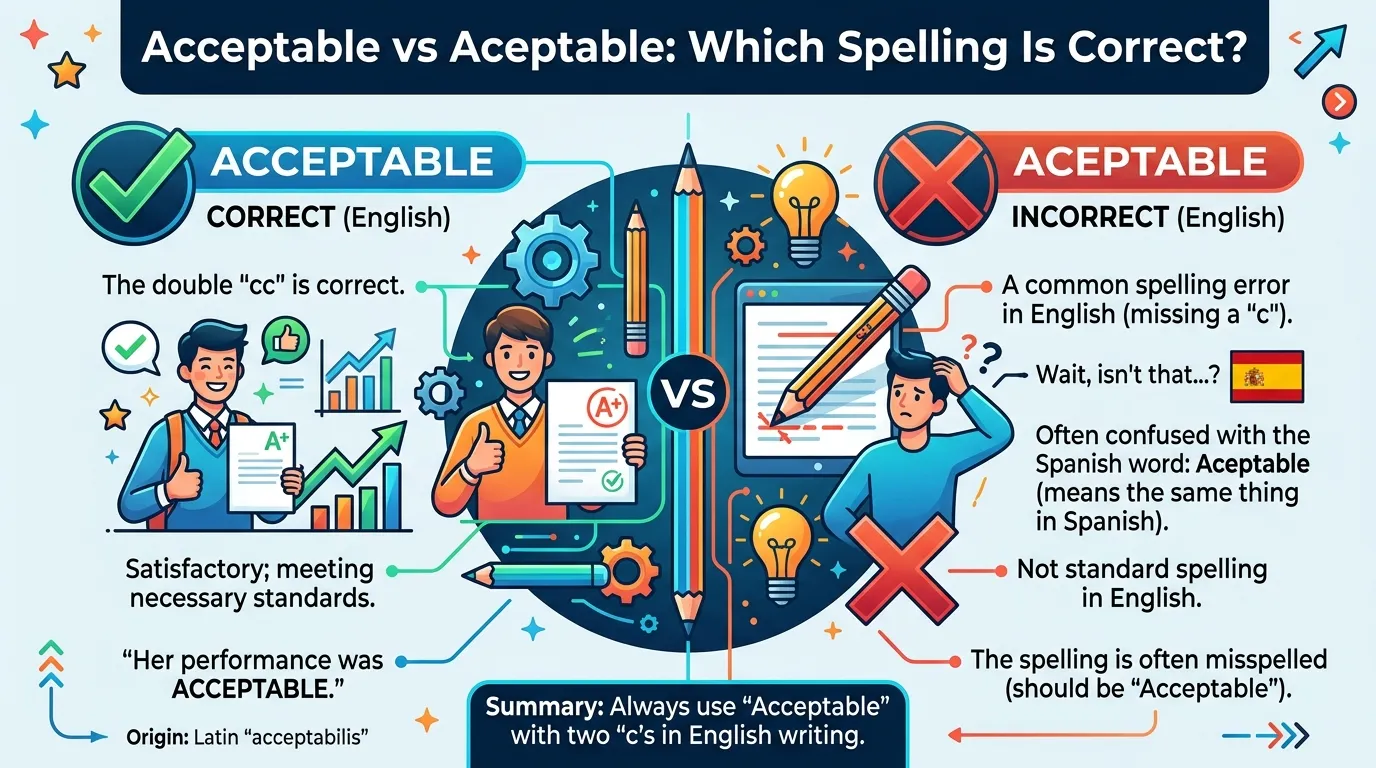
Acceptable is the only correct spelling in English. Aceptable is a misspelling in English — though it is the correct spelling in Spanish, which is exactly why the error is so common. The word comes from the verb accept, and the verb keeps both of its C’s in every form it takes.
The Green Stamp
Start with what the word means. Acceptable is an adjective meaning good enough, satisfactory, suitable, or allowed — meeting a required standard. “Your explanation is acceptable.” “Casual clothing is acceptable at this event.” “His work was acceptable, although it could improve.” “This payment method is acceptable.” In each sentence, the word draws a line: on one side, the thing passes. On the other, it does not.
The word is a judgment, and it is a deliberately modest one. To call something acceptable is not to call it excellent, outstanding, or perfect. It is to say that it meets the standard — that it will do. That modesty is the word’s power. A teacher who calls an essay “acceptable” is saying it passes without praising it. An inspector who stamps a product “acceptable” is saying it is fit for sale without claiming it is the best on the shelf.
The word also has a social sense. Acceptable behavior is behavior that a group tolerates. Socially acceptable means fitting the norms of a community. Acceptable risk means a level of danger that is judged worth taking. In all of these, the word is doing the same job — marking the boundary between what passes and what does not.
Two C’s, One Verb
The spelling rule is simple, and it lives in the parent word. Acceptable comes from the verb accept, which contains two C’s: A-C-C-E-P-T. When the verb takes the suffix -able, it keeps both letters: accept + able = acceptable. The same is true of the whole family: accepted, accepting, acceptance, acceptable, acceptability. Every member keeps the double C.
The double C has a history. Accept comes from the Latin acceptare — ad- (to, toward) + capere (to take). To accept is, literally, to take something toward yourself. The first C belongs to the prefix ac-, the form that ad- takes before a C. The second C belongs to capere. The word is two Latin pieces fused together, and the double C is the seam where they meet.
The misspelling aceptable drops the first C — the one that belongs to the prefix. The ear barely notices, because in speech the double C collapses into a single K sound: “ak-SEP-tuh-buhl.” The first C is almost silent in pronunciation. But in spelling it is essential, and it is the letter that separates the English word from its Spanish cousin.
The Spanish Cousin
Here is the fact that explains the error. In Spanish, the correct spelling is aceptable — with one C. “Tu trabajo es aceptable.” The Spanish word is spelled with a single C because Spanish spelling follows Spanish rules, and Spanish does not double the C in this word. A bilingual writer who moves between the two languages carries both spellings in their head, and the Spanish one — simpler, with one C — is the one that slips out in English writing.
The interference runs in both directions. Spanish speakers writing English produce aceptable. English speakers writing Spanish produce acceptable — with a double C that Spanish does not use. The error is not carelessness. It is the natural result of two languages that share a word and spell it differently, and it is one of the most common cross-language spelling errors in the world.
The fix is to tie the spelling to the parent verb. In English, the verb is accept — two C’s. The adjective is built on the verb, so it keeps both: acceptable. In Spanish, the verb is aceptar — one C. The adjective is built on the Spanish verb, so it keeps one: aceptable. Each language follows its own parent. The spelling follows the verb you are actually writing in.
Acceptable vs Satisfactory vs Adequate
Acceptable has close neighbors, and keeping them distinct sharpens a sentence. Satisfactory means meeting expectations — slightly more formal, slightly more positive. A “satisfactory result” is one that satisfies. An “acceptable result” is one that passes. Adequate means sufficient for the purpose — enough, but not more. “Adequate funding” is funding that covers the need. “Acceptable funding” is funding that the committee will approve.
The choice among them is a matter of shade and register. In a school report, “satisfactory” is the standard term — it appears on report cards and evaluation forms. In an inspection report, “acceptable” is the standard term — it appears on stamps and checklists. In a budget memo, “adequate” is the standard term — it appears in discussions of whether the numbers cover the need. Each word belongs to a document type, and using the wrong one is a small register error.
The word also has a negative form worth knowing: unacceptable. “Unacceptable behavior.” “Unacceptable risk.” “This is unacceptable.” The negative is formed by adding un- to the full adjective, and it keeps the double C: U-N-A-C-C-E-P-T-A-B-L-E. The double C survives every prefix and suffix the word takes, and it is the spelling’s most reliable feature.
Acceptable in the Wild
The word appears in every register, and its spelling matters in all of them. In law: “acceptable evidence.” In business: “acceptable terms.” In education: “acceptable performance.” In technology: “acceptable use policy” — the document that governs how employees may use company systems. In everyday speech: “Is this acceptable?” — the question that asks whether something passes.
The word also appears in a set of fixed phrases. Acceptable risk is the level of danger judged worth taking. Socially acceptable is behavior that fits a community’s norms. Mutually acceptable is an outcome both sides can live with — the phrase of negotiations and treaties. Generally acceptable is the hedge that says most people would agree. In all of them, the spelling is the same, and the double C holds.
Acceptable Use: The Word in Technology
Technology gave acceptable one of its most familiar modern homes: the acceptable use policy. Every company, school, and university that provides computers, networks, or accounts publishes one. The policy defines what employees or students may and may not do with the organization’s systems — which websites they may visit, what software they may install, whether personal use is permitted. The phrase is so standard that IT departments abbreviate it as AUP, and the document is often the first thing a new hire signs.
The phrase works because the word is doing its core job: drawing the line between what passes and what does not. An acceptable use is one that meets the standard. An unacceptable use is one that crosses it. The policy does not promise that acceptable uses are excellent, or wise, or productive. It promises only that they pass — that they will not get the user in trouble. The modesty of the word is the point. The policy is a floor, not a ceiling.
The same logic appears in engineering’s phrase acceptable tolerance — the range of variation that a part or process may have and still pass inspection. A bolt that is within acceptable tolerance fits. A bolt outside it does not. The word is doing the inspector’s job in a single adjective: it names the boundary, and everything on one side of it passes.
The same modest judgment appears in the phrase acceptable to, which names the person or group whose standard is being met: “The terms are acceptable to both sides.” The phrase is the language of negotiation — it says the deal passes, not that either side loves it. A mutually acceptable outcome is often the best outcome available, and the word’s modesty is what makes the agreement possible.
The Inspector’s Test
Back on the factory floor, the inspector’s fix is simple: she corrects the form, and the new hire learns the rule. The test for your own writing is just as simple. When the word appears in your draft, look at the parent: accept, two C’s. The adjective is built on the parent, so it keeps both: acceptable.
And if you ever feel the pull toward aceptable, ask which language you are writing in. Spanish — one C, aceptable. English — two C’s, acceptable. The languages share the word and split on the spelling, and the verb you are writing in decides which one you use. Stamp it green, with both C’s, and let the line keep moving.










