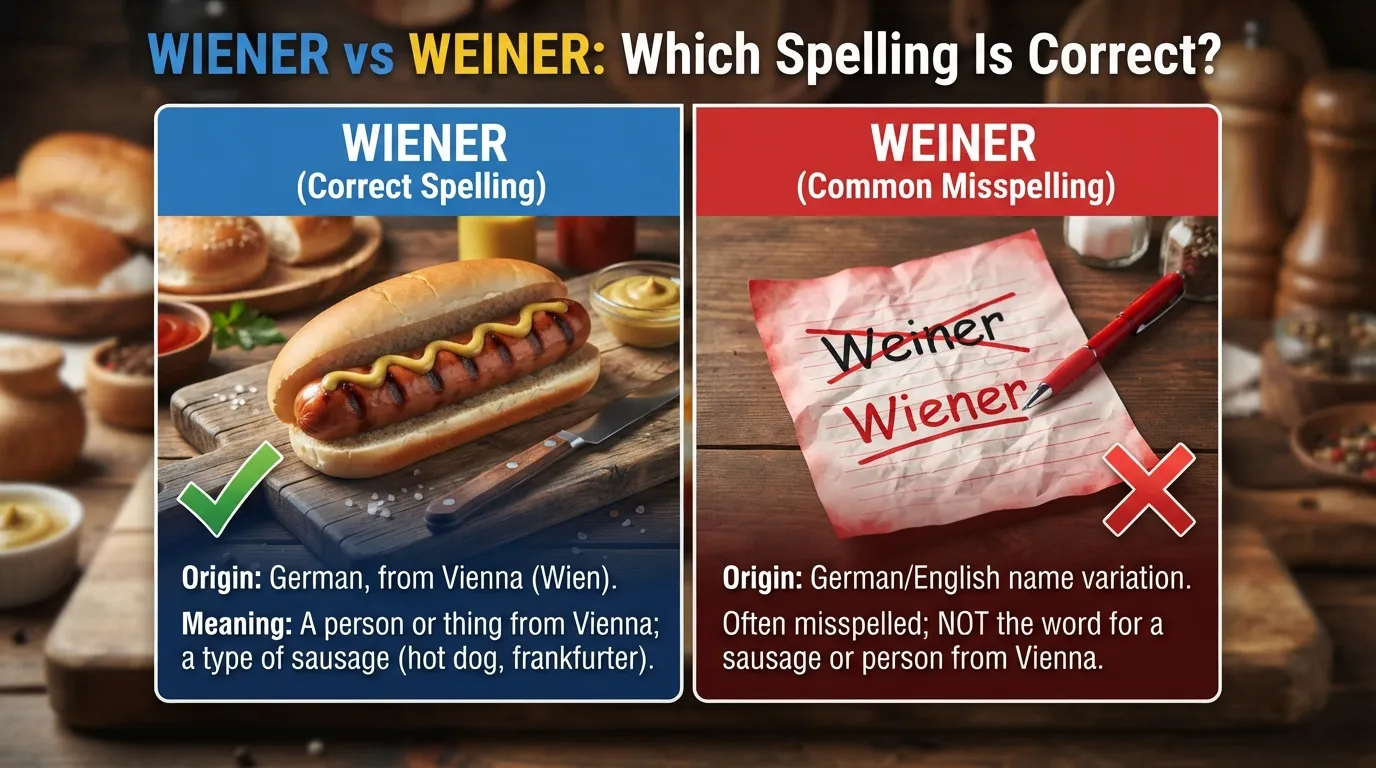
The ballpark vendor calls out his menu, and the crowd answers. Hot dogs. Sausages. Fries. A kid in the third row asks his father for a wiener, and the father orders one — and then, back at the office on Monday, the father types an email about the game and writes weiner. The hot dog does not care. The dictionary does. The correct spelling for the sausage is wiener. Weiner is most commonly a surname, and when it is used for the sausage, it is a misspelling. The difference is one letter, and it is the difference between dinner and somebody’s last name.
Wiener and weiner sound the same, look almost the same, and are not the same word. Wiener is the standard spelling for a frankfurter, a hot dog, a Vienna-style sausage — and, by extension, a dachshund. Weiner is most commonly a family name. The two words share a history, and the history explains the spelling. The story starts in Vienna.
The Ballpark Menu
Start at the ballpark, because the ballpark is where the word lives. The vendor’s menu says wiener — or, more often, hot dog, which is the American name for the same thing. The wiener on the menu is a cooked sausage, usually made of beef, pork, or a combination, served in a bun with mustard, ketchup, relish, onions, or whatever the local tradition demands. Chicago wants everything on it. New York wants mustard and sauerkraut. Detroit wants chili. The sausage is the same. The spelling is the same. Wiener.
The word also appears on grocery store packages: “wiener,” “weiners,” “cocktail wieners.” And in the phrase “wiener roast,” a gathering where wieners are cooked over a fire. And in the schoolyard joke that every generation rediscovers: the wiener dog. All of these spell the word with IE. The ballpark, the grocery store, the campfire — all of them agree.

The misspelling weiner appears because of the most famous spelling rhyme in English: “i before e, except after c.” A writer who hears the “ee” sound in wiener and remembers the rule — ei after c, as in receive and deceive — can easily conclude that the word must be weiner. The logic is tidy. The answer is wrong, because there is no C anywhere near the vowel pair in wiener. The “i before e” part of the rule applies, and the word is spelled IE.
There is a second reason the misspelling persists: the surname Weiner is common enough that writers have seen it many times, on bylines, on ballots, on class rosters. The eye remembers the EI spelling from the name and applies it to the sausage. The eye is remembering correctly — the surname really is spelled Weiner. It is just applying the memory to the wrong word.
Vienna in a Bun
The word wiener comes from Vienna. In German, Wiener means “of Vienna” — a person from Vienna, or a thing from Vienna. The sausage is called a wiener because it is a Vienna-style sausage: a Wiener Würstchen, a little Vienna sausage. German immigrants brought the sausage and the word to America in the 1800s, and the word stayed.
The German spelling explains the IE. In German, the combination ie is pronounced like a long E — the “ee” sound. Wiener in German is pronounced “VEE-ner.” English borrowed the word with its German spelling intact: W-I-E-N-E-R. The IE is not an English spelling choice. It is a German import, and it kept its passport.
The same German root gives English the word Vienna itself — the city’s name, spelled with IE in English, pronounced “vee-EN-uh.” The city and the sausage share the vowel pair. If you can spell Vienna, you can spell wiener, because the IE is the same in both. The city named the sausage, and the spelling traveled with it.
There is also a cousin worth knowing: the frankfurter, named after Frankfurt, the German city. The frankfurter and the wiener are close relatives — both German sausages, both served in buns, both called hot dogs in America. The frankfurter is named for its city with an A. The wiener is named for its city with an IE. Two cities, two sausages, two spellings, and the city names carry the vowels.
Weiner the Surname
So what is Weiner? In most contexts, it is a surname — a family name of German and Jewish origin. As a surname, it is spelled with EI, and it has nothing to do with sausages. The surname comes from a different German root: Wein, meaning wine — a person who made or sold wine — plus the -er ending that marks an occupation or origin. A Weiner is, historically, a wine person. A Wiener is, historically, a Vienna person. Two different German words, two different spellings, two different meanings.

This is why the distinction matters most when you are writing a person’s name. A person’s name is spelled the way the person spells it, and correcting it is not helpful — it is rude. If someone’s surname is Weiner, you write Weiner. If someone’s surname is Wiener — and that surname exists too — you write Wiener. The sausage rule does not apply to names. Names follow the person, not the dictionary.
The most famous bearer of the EI surname in American public life is Anthony Weiner, the former congressman. His name is spelled Weiner, and every news story about him spells it that way. The jokes wrote themselves — a politician named Weiner, caught in a scandal involving photographs — and the spelling of his name became one of the most printed EI spellings in the country. The jokes also cemented the confusion, because millions of readers saw Weiner in headlines and assumed it was the sausage spelling. It was not. It was a name.
The rule for names is simple and absolute: copy the person’s spelling. Do not “correct” a surname to match the sausage, and do not “correct” the sausage to match a surname. The two words live in different houses, and each keeps its own spelling.
The Wiener Dog
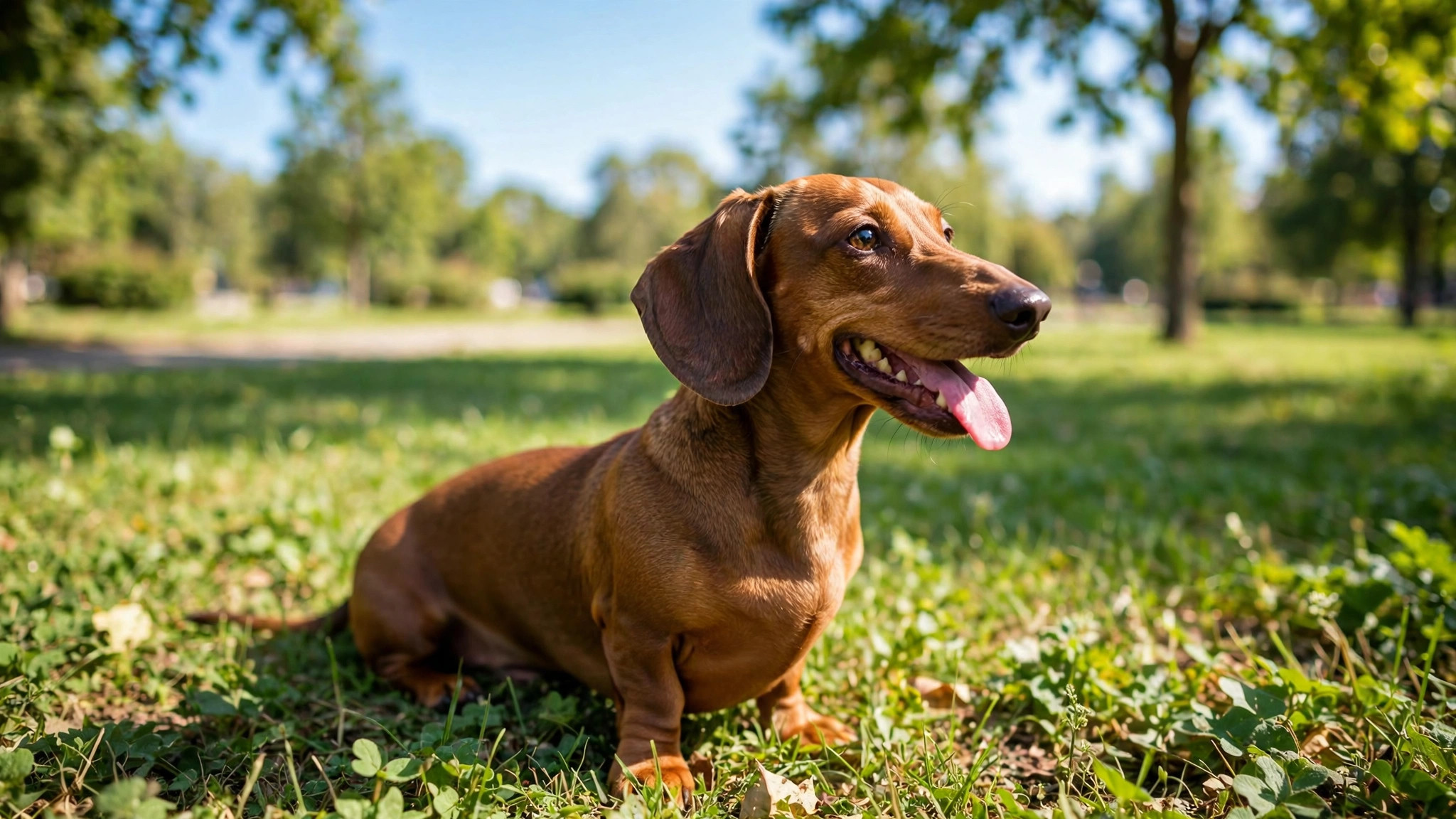
The word has one more life, and it is the most affectionate one. The wiener dog is the dachshund — the long, low German dog bred to hunt badgers. The nickname comes from the dog’s shape: long and sausage-like, like a wiener. “Wiener dog” is informal, fond, and universal. Children say it. Adults say it. Dachshund owners say it with pride.
The spelling follows the sausage: wiener dog, with IE. The dog is named after the sausage, and the sausage is named after Vienna, and the IE travels the whole chain. A “weiner dog” with EI is the same error as the sausage misspelling, wearing a leash.
The dachshund has other nicknames — doxie, sausage dog, hot dog — and all of them are informal. In formal writing, dachshund is the correct term. But in everyday speech, the wiener dog reigns, and the spelling reigns with it: IE, like Vienna, like the sausage, like the city that started it all.
There is also a slang sense to mention and then set aside. Wiener is used, informally and usually jokingly, as a slang term for a part of the male anatomy. The slang is juvenile, it is not appropriate for formal writing, and it is spelled with IE, like every other sense of the word. The spelling rule does not change with the register. IE in the ballpark, IE in the butcher shop, IE in the joke. The word is consistent, even when the conversation is not.
The Wiener on the World Stage
The wiener is not the only sausage with a city in its name, and the comparison is instructive. The frankfurter is named for Frankfurt. The bologna is named for Bologna. The hamburger is named for Hamburg. The salami family is named for Italian towns. Every one of these foods carries its birthplace in its spelling, and every one of them keeps the spelling of its birthplace.
The wiener’s international cousins show the same pattern. In Austria, the Wiener Würstchen is a small, thin sausage, served with mustard. In Germany, the Wiener is a frankfurter-style sausage, longer and milder. In America, the wiener became the hot dog, and the hot dog became a ballpark institution. Three countries, one sausage, one spelling: IE, from Vienna, all the way down.
There is also the word’s life in other languages. In Spanish, the wiener is a salchicha. In French, a saucisse de Vienne — a sausage of Vienna, with the city named outright. The French phrase is the most honest of all: it says what the English word only implies. The sausage is from Vienna. The spelling is from Vienna. The IE is Vienna’s, and it stays.
The Lock-In
The memory hook is the city. Vienna has IE. Wiener has IE. The sausage is named for the city, and the spelling is the same in both. If you can spell Vienna, you can spell wiener. The EI spelling belongs to the surname — the wine person, not the Vienna person.
And one final check for the keyboard: when the word appears in your draft, ask whether it names a sausage, a hot dog, or a dog. If it does, the spelling is wiener, IE, like Vienna. If it names a person — a byline, a ballot, a class roster — copy the person’s spelling, and if that spelling is Weiner, leave it alone. The sausage and the surname share a sound and a history, but they do not share a spelling. The ballpark knows the difference. Now you do too.